Mises Wire |
- The Role of Covid Lockdowns in 2020's Homicide Surge
- Virtual Mises University 2021
- Biden’s Rescue Plan Won't Reduce Poverty
- State Preemptions of Local Government Are a Bad Thing. Even When Ron DeSantis Does It.
- Economic Prosperity Is a Prerequisite for All Other Kinds of Prosperity
- If Deficits Don't Matter, Why Bother with Taxes?
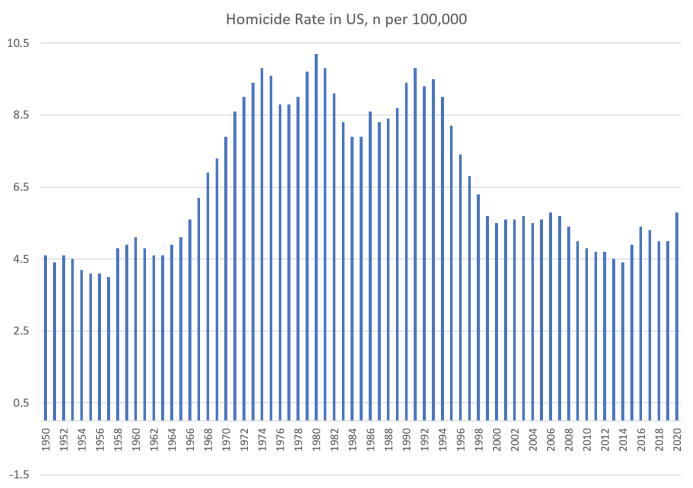
| The Role of Covid Lockdowns in 2020's Homicide Surge Posted: 25 Mar 2021 09:00 AM PDT Twenty twenty was an unpleasant year for so many reasons. It was a year of riots, unemployment, and the trend in overall rising mortality continued unabated. Homicides also increased. In fact, in preliminary homicide data, it looks like homicides increased a lot in 2020. According to the FBI's Preliminary Uniform Crime Report for the first half of 2020, "murder and nonnegligent manslaughter offenses increased 14.8%, and aggravated assault offenses were up 4.6%." If the second half of 2020 proves to be about the same as the first half, then the nationwide homicide rate for 2020 will have risen from 5 per 100,000 in 2019 to 5.8 per 100,000 in 2020. That's a big increase, and puts 2020's total at the highest rate recorded in fifteen years, matching 2006's rate of 5.8 per 100,000. Some other data, however, suggests the year-end numbers for 2020 will be even worse than that. Homicides look to be up more than 20 percent during the fall of 2020 compared to the previous year. Thus, the increase from 2019 to 2020 may prove to be one of the largest increases in homicide in more than fifty years. Source: FBI, "Crime in the US" report, 2020 preliminary report. Meanwhile, homicides in certain cities increased by far worse rates. Year-over-year increases of 30 percent or more were common in 2020, and this wasn't limited to only large cities. In data posted by researcher Jeff Asher, total year-over-year homicides through September 2020 were up in a wide range of locations: up 55 percent in Chicago, up 54 percent in Boston, up 38 percent in Denver, and up 105 percent in Omaha. What Caused the Surge?It's much easier to count homicides than to determine the events and phenomena driving trends in homicides. It's never a good idea to attribute changes in homicide totals to any single cause. Nonetheless, we can hazard some guesses. If we're going to ask ourselves what might have caused such an unusually large rise in homicide, we ought to look for unusual events. Most obvious among these, of course, are the stay-at-home orders, business closures, and lockdowns that have occurred since March of last year. These are pretty unusual things. Although it is considered somewhat heretical to point out that lockdowns can produce negative societal side effects, the connection to violent behavior is so undeniable that this is now openly admitted. For example, in a recent interview with The Atlantic, sociologist Patrick Sharkey discusses some of the likely causes of 2020's surge in violence, stating:
When asked if "idle time" caused by lockdowns was somehow connected to rising homicides, Sharkey continued:
The connection between a lack of community institutions and social dysfunction is well known by sociologists.1 Last year, when looking at the role the stay-at-home orders might have had on the summer's riots, I wrote:
As described by a Brookings Institution report, these third places include churches, parks, recreation centers, hairdressers' shops, gyms, and even fast-food restaurants. Yet, the lockdown advocates, in a matter of a few days, cut people off from their third places and insisted, in many cases, that this would be the "new normal" for a year or more. These third places cannot simply be shut down—and the public told to just forget about them indefinitely—without creating the potential for violence and other antisocial behavior.2 Few of these places exist for the explicit purpose of reducing violence, although they tend to have this effect. But during the government-mandated lockdowns, some organizations specifically devoted to violence prevention were shut down and, as noted by law professor Tracey Meares, the pandemic has prevented many antiviolence programs from operating. These programs, however, require "a great deal of a face-to-face contact, typically, among service providers and the folks who are most likely to both commit these offenses and be the victims of them," Meares says. "And it's a lot harder to do that when people can't meet in person." Of course, it's not that these people just can't meet in person, as if it were physically impossible to do so. It's that in many places they are legally prohibited from doing so. This means even the most urgent cases were neglected and put on the back burner because policymakers made a decision to ignore the realities of violent crime in order to obsess over covid risks. And this is a point that must be made repeatedly. "The pandemic" isn't what caused the widespread destruction of social institutions that are key in increasing social cohesion and preventing violence. Government edicts did this. Certainly, given fears over covid infection, it stands to reason that many people would have elected to stay home, and that important social institutions would have functioned at reduced capacity even without government mandates. However, what government mandates did was prevent people from even using their own discretion, which means even the most at-risk, isolated, and emotionally volatile people—the people who need these institutions the most—were cut off from important resources. Also important in understanding homicides is the fact covid lockdowns have increased domestic violence; as Sharkey notes, "Intimate-partner violence increased in 2020."Again, advocates for stay-at-home orders have used their bizarrely extreme preoccupation with covid deaths as an excuse to insist it is "worth it" to keep women and children locked up with their abusers. Homicides have increased as a result in many cases. The Role of Police in Lockdown EnforcementThe lockdowns aren't the only factors behind rising crime, of course. Another factor in the rising homicide rate is likely the decline of the public's trust in police institutions. The reputations of police and police organizations appear to have gone into significant decline in recent years as police encounters are increasingly being recorded and made public—thus exposing police abuse and what at least appears to be police abuse. These events have been connected to rising rates of violent crime.3 As noted by both Sharkey and by crime historian Randolph Roth, the public's trust in government institutions—which certainly includes police—can impact a community's willingness to turn to violence in personal interactions. In other words, antipolice sentiment is regarded as a likely indirect cause of growing homicide rates. This declining trust manifested itself in last summer's riots, but the origins of the riots predate both the riots and the George Floyd case. But even when we look to the role of police agencies' status within communities, we find that the stay-at-home orders and lockdowns again play a role. It is the police, after all, who have been responsible for enforcing government orders to wear masks, close businesses, and avoid gatherings. Throughout 2020, police have been a central in harassing churchgoers, beating up nonviolent citizens for not "social distancing," and arresting women for not wearing masks. Police have also arrested business owners and shut down their businesses. And then there was the case of a six-year-old girl who was taken from her mother because the mother wasn't wearing a mask when she dropped her daughter off at school. Who will be providing the regime's muscle when it comes to separating this child from her mother? Naturally, it will be the police. Although the police have continued to enjoy uncritical support from the "Back the Blue" movement, more reasonable people can only tolerate so much when it comes to police who willingly attack and arrest people for the noncrimes of using their own private property or not wearing a mask on a public sidewalk. Reversing the Damage Done in 2020It's unclear at this point if reversing policies that caused a year of community destruction can quickly undo the damage. In any case, however, the responsible thing to do is end any and all policies that keep churches, community centers, and meeting spaces closed. The police must be out of the business of roughing people up in the name of social distancing. The politicians' obsession with isolating people must end.
 This posting includes an audio/video/photo media file: Download Now |
| Posted: 25 Mar 2021 08:15 AM PDT  This posting includes an audio/video/photo media file: Download Now |
| Biden’s Rescue Plan Won't Reduce Poverty Posted: 25 Mar 2021 05:00 AM PDT "Poverty in society is overcome by productivity, and in no other way. There is no political alchemy which can transmute diminished production into increased consumption." Original Article: "Biden's Rescue Plan Won't Reduce Poverty" This Audio Mises Wire is generously sponsored by Christopher Condon. Narrated by Michael Stack.
 |
| State Preemptions of Local Government Are a Bad Thing. Even When Ron DeSantis Does It. Posted: 25 Mar 2021 05:00 AM PDT Centralizing political power in the hands of the state government only sets the stage for abuses when a new administration takes over. Original Article: "State Preemptions of Local Government Are a Bad Thing. Even When Ron DeSantis Does It. " This Audio Mises Wire is generously sponsored by Christopher Condon. Narrated by Michael Stack.
 |
| Economic Prosperity Is a Prerequisite for All Other Kinds of Prosperity Posted: 25 Mar 2021 04:00 AM PDT Recently, while reading Liberalism: In the Classical Tradition, written by Ludwig von Mises in the year 1927, I noted a striking passage, right in the beginning on page 4:
Reading this passage felt like a lesson in the very basics of psychology. This is not surprising: Mises, in addition to his contributions to the field of economics, is well remembered as someone who had a lot to say about matters across a wide a variety of related social sciences. As Jeff Deist has commented recently, given the sort of prevailing "stay in your lane" attitude many have today, who knows if Human Action would even be published in the year 2021, given how many areas the book covers. Regardless, Mises in the passage above delivered quite a prescient insight: that basic survival, along with the attainment of some level of material wealth and comfort, are necessary preconditions for an individual human being to achieve satisfaction in psychological and spiritual areas as well. Years later, we would hear Mises's views above echoed in Abraham Maslow's hierarchy of needs, which he developed in 1943 as a core concept of the "humanistic" approach to psychology. The essence of Maslow's theory is that there are various levels of internal needs that people have; these needs, for conceptual understanding, are described in a hierarchical format such that the needs at higher levels cannot be met without the needs at lower levels being met first. Safety needs cannot be met unless physiological needs are met; love and belonging needs cannot be met without safety needs first being taken care of; love and belonging is then a requirement for esteem; and finally, there is no "self-actualization" without esteem. Identifying whether Mises and Maslow ever interacted in any meaningful way, or if Mises had any influence on Maslow at all, is beyond the scope of this article. At least at a first glance, it does not look like Maslow cited Mises, praxeology, or economics in his work behind his well-known theory of humanistic psychology. Nonetheless, both Mises and Maslow illustrate the importance of economic progress. If we seek to empower human beings to pursue ends above and beyond a mere physical existence, we must also seek to raise the standard of living so that people are able to focus on noneconomic ends more freely and pursue what each individual believes to be spiritual maximization. Unfortunately—and as Mises warned in Liberalism and elsewhere—as the winds shifted away from laissez-faire and liberalism, peace, prosperity, and human flourishing suffered mightily. The tragic episodes of World War I, the Great Depression, World War II, and the Cold War are just some of the most tragic examples. In other words, as the world embraces illiberal policies—such as socialism, war, and central planning—economic well-being will suffer. These policies will thus become impoverishing in terms of both economic and noneconomic goals for every individual.  This posting includes an audio/video/photo media file: Download Now |
| If Deficits Don't Matter, Why Bother with Taxes? Posted: 25 Mar 2021 04:00 AM PDT On March 18, Joe Wiesenthal of Bloomberg Markets had MMT economist Stephanie Kelton on the show. If you're not familiar with modern monetary theory, they think governments should print more money because deficits aren't a big deal. At one point in the show, Wiesenthal asked, "If we don't need to worry about deficits, why do we have taxes?" Kelton's response was illuminating. Now, the traditional excuse for taxes is, paraphrasing Oliver Wendell Holmes, that they are the "price of civilization." Skeptics point out that, historically, societies with very low taxes were often far more civilized—think the Dutch Golden Age, Islamic Golden Age, Victorian England, the pejoratively named "Gilded Age" in American history—that thirty-year golden age when almost everything useful was invented. And, yet, throughout that period, federal receipts were one-fifth what they are today. Why so much civilization? Because much of what governments do today was done by charities or businesses competing for customer dollars instead of seizing their budget in taxes. When doctors, firefighters, and schools have to satisfy customers, things get quite civilized. Still, even if we accept a "night-watchman state" argument for, say, national defense or salaries for Supreme Court justices, it gets tricky if government can simply print up the fresh money to pay for all that civilization. Kelton's answer? Taxes would still be needed, because they make us poor. And because they can punish people she doesn't like. Specifically, Kelton likes that taxes "remove dollars from our hands, so we can't spend them," leaving more purchasing power for the government. So taxes make the people poor, and that's a selling point to her, presumably because she thinks governments are really good at lifting people out of poverty. Anybody who's spent time in America's inner cities, where government money is pretty much the only money, might disagree. Ah, but it's not just about spending our money more wisely than we ever could, Kelton adds two secondary reasons she loves taxes: to punish particular people by redistributing their money, and to punish people for doing things she doesn't like. Such as failing to buy energy-efficient appliances (no, really). In other words, social engineering with carrots for your friends, sticks for your not-so-friends. Aside from the morality of preying on our neighbors, demanding they pay an ever-growing "fair share" that invariably exceeds what, say, a journalist or professor pays, using taxes for redistribution and punishing—"nudging," in the fashionable parlance—carries enormous collateral damage. Because redistribution arranges society into hostile factions either trying to violently dispossess one another or defending against that dispossession. Moreover, redistribution isn't simply innocently shuffling the chips; it is wholesale destruction. A paper coauthored by Christina Romer, former chair of Obama's Council of Economic Advisors, found that each dollar in government spending leads to between $2 and $3 in lost economic activity. A separate study by Harvard economist Martin Feldstein came to similar deadweight estimates that "may exceed $2 per $1 of revenue." In other words, in order to move a dollar, you have to destroy at least two to three dollars. There is a similar mix of moral and practical costs to using predatory taxes for social engineering. It also breaks the social compact to live and let live, rendering our every decision subject to public vote, from what we eat, to where we vacation, to what kind of bag we use to carry our groceries. There is nothing outside the realm of the nudgers, no detail too small. Moreover, by mass imposition of what are effectively judicial fines for noncrimes, such taxes can achieve a level of control that would never be constitutional if written as law. For example, today in the United States, 90 percent of students attend public schools, despite the terrible quality of education. Why do they stay? Because each voter must pay for public schools whether or not they use them, but would have to shoulder $11,200 per child per year for opting out of the public system, while continuing to pay that $12,600 per year in taxes for the "free" public system. Especially for the working class, this penalty becomes prohibitive for all but the most committed. Pair these facts—no detail too small for the social engineers and their ability to achieve near-universal obedience via fines and subsidies—and we risk a totalitarian "permissioned" society where we are free on paper, but using that freedom comes with ruinous fines. If, indeed, the only remaining justification for taxes in an inflationary regime is to redistribute and punish—to erode social harmony in a fiscal war of all against all while impoverishing society and enabling a creeping totalitarianism—then it is much closer to the mark that modern taxes have become not the price of civilization, but the predator of civilization.  This posting includes an audio/video/photo media file: Download Now |
| You are subscribed to email updates from Mises Wire. To stop receiving these emails, you may unsubscribe now. | Email delivery powered by Google |
| Google, 1600 Amphitheatre Parkway, Mountain View, CA 94043, United States | |





No comments:
Post a Comment