Mises Wire |
- February Money-Supply Growth Hit Yet Another All-Time High.
- Shays's Rebellion: Catalyst for the Counterrevolution
- Europe's Vaccine Programs Are About As Successful As their Lockdowns
- Real Savings Are at the Heart of Lending
- Shawn Needham: How Consumers and Entrepreneurs Co-navigate Value Uncertainty in Healthcare
| February Money-Supply Growth Hit Yet Another All-Time High. Posted: 30 Mar 2021 05:00 PM PDT In February, money supply growth hit yet another all-time high. February's surge in money-supply growth makes February the eleventh month in a row of remarkably high growth, and came in the wake of unprecedented quantitative easing, central bank asset purchases, and various stimulus packages. During February 2021, year-over-year (YOY) growth in the money supply was at 39.1 percent. That's up slightly from January's rate of 38.7 percent, and up from the February 2020 rate of 7.3 percent. Historically this is a very large surge in growth, year over year. It is also quite a reversal from the trend that only just ended in August of 2019 when growth rates were nearly bottoming out around 2 percent. In August 2019, the growth rate hit a 120-month low, falling to the lowest growth rates we've seen since 2007. Historically, the growth rate has never been higher than what we've seen over the past ten months, with the 1970s being the only period that comes close. It is likely that growth will continue for the time being as it appears that now the United States is nearly a year into an extended economic crisis, with around 1 million new jobless claims each week from March until mid-September. Claims have remained above 600,000 every week since. Moreover, more than 3.8 million unemployed workers are currently collecting standard unemployment benefits, and total unemployment claims have failed to fall back to non-recessionary levels, even a year after lockdowns began. More than seven million additional unemployed are collecting "Pandemic Emergency Unemployment Compensation" as of February 27. The central bank continues to engage in a wide variety of unprecedented efforts to "stimulate" the economy and provide income to unemployed workers and to provide liquidity to financial institutions. Moreover, as government revenues have fallen, Congress has turned to unprecedented amounts of borrowing. But in order to keep interest rates low, the Fed has been buying up trillions of dollars in assets—including government debt. This has fueled new money creation.  The money supply metric used here—the "true" or Rothbard-Salerno money supply measure (TMS)—is the metric developed by Murray Rothbard and Joseph Salerno, and is designed to provide a better measure of money supply fluctuations than M2. The Mises Institute now offers regular updates on this metric and its growth. This measure of the money supply differs from M2 in that it includes Treasury deposits at the Fed (and excludes short-time deposits, traveler's checks, and retail money funds). Similar to the TMS measure, the M2 growth rate reached new historic highs in February 2021, growing 27.0 percent compared to January's growth rate of 25.9 percent. M2 grew 6.8 percent during February of last year. Money supply growth can often be a helpful measure of economic activity, and an indicator of coming recessions. During periods of economic boom, money supply tends to grow quickly as commercial banks make more loans. Recessions, on the other hand, tend to be preceded by periods of slowing rates of money supply growth. However, money supply growth tends to grow out of its low-growth trough well before the onset of recession. As recession nears, the TMS growth rate typically climbs and becomes larger than the M2 growth rate. This occurred in the early months of the 2002 and the 2009 crises. A similar pattern appeared before the 2020 recession, suggesting the US was headed for a recession even before the covid shutdowns. The question now is how long the current recession will last. The second, third, and fourth quarters of 2020 all showed negative growth in real GDP. Real GDP was down 9 percent, year over year, during the second quarter, and real GDP was down 2.4 percent, year over year, during the fourth quarter. [Read More: "The V-Shaped Recovery Never Happened" by Ryan McMaken] One significant driver in money supply growth has been growth in the Fed's balance sheet. After initial balance sheet growth in late 2019, total Fed assets surged to nearly $7.2 trillion in June and have rarely dipped below the $7 trillion mark since then. As of February, total assets have hit a new all-time high of over $7.5 trillion. These new asset purchases are propelling the Fed balance sheet far beyond anything seen during the Great Recession's stimulus packages. The Fed's assets are now up more than 600 percent from the period immediately preceding the 2008 financial crisis. While Fed asset purchases are not solely responsible for the surge in new money creation, they are certainly a sizable factor. Bank loan activity has surged as well, also driving new money creation. Total Fed assets, going back to 2007:  Also of note is the continuing surge in the Treasury's deposits at the Fed, which also partly fuels money supply growth. There is some debate over why this amount has surged so much, and why the Treasury has decided to keep such a large amount of money at the Fed. The Fed certainly has contributed to this by buying bonds on the secondary market. In any case, these deposits are counted as part of the money supply under the Rothbard-Salerno money-supply calculation. These dollars are not money according to M2, but of course these deposits should be counted as money. This is because recent stimulus packages have made it clear that the Federal government could in fact spend hundreds of billions of dollars in a short period of time through various bailouts, stimulus checks and other measures. In other words, these deposits are very liquid. Treasury may just be keeping dollars on hand for the next spending spree.   This posting includes an audio/video/photo media file: Download Now |
| Shays's Rebellion: Catalyst for the Counterrevolution Posted: 30 Mar 2021 12:00 PM PDT [Chapter 11 of Rothbard's newly edited and released Conceived in Liberty, vol. 5, The New Republic: 1784–1791.] Massachusetts suffered particularly from the economic aftermath of the Revolutionary War as its fisheries trade was cut off and its exports to the West Indies were sharply curtailed. Furthermore, the grandiose postwar funding of the wartime Massachusetts debt, which ballooned from £100,000 to £1.5 million after the war, placed a particularly heavy tax burden on its citizenry. While Congress was reevaluating its currency at a depreciation of forty to one, and other states were depreciating at higher rates, Massachusetts stubbornly and absurdly insisted on redeeming its notes at their full value when they were issued. Interest, furthermore, was paid in specie. In addition, reliance on poll and special excise taxes placed an enormously heavy burden on the poorer farmers of western Massachusetts. The courts of the western counties not only exacted high fees, but were also the hated instrument of the enforcement of the tax burden, which included imprisonment of public and private debtors as well as the selling of many debtors into servitude to pay off the debt; some were imprisoned for owing only six shillings! All the debtors' property except clothing was subject to court seizure. We have already noted the swarm of petitions and the more insurrectionary anti-tax, anti-court movement in the west before the end of the war, headed by the Reverend Samuel Ely and propelled by these distressed circumstances. The nationwide depression that struck in 1784 hit the already depressed Massachusetts particularly hard. In 1784 alone there were over 2,000 suits for recovery of taxes and other debts in Worchester County alone, and over ninety insolvent debtors were sent to jail in Worchester in the following year. Hampshire County saw its common pleas courts crowded with over 800 debt cases in 1785 alone. Lands in the western counties dropped precipitously in value, and numerous distressed citizens of Massachusetts packed up and emigrated westward. Yet western Massachusetts did not erupt immediately as might have been expected. The reason was probably that the Massachusetts General Court cut taxes in the towns enormously during 1784 and 1785, assessing only 140 towns in the prior year and none at all in the latter. The taxes were replaced by a stamp tax, which fell on the press, and transfer of documents had to be modified quickly. Furthermore, the plight of debtors was slightly eased in 1784 by increasing the maximum amount of debt suits which could be handled by local justices of the peace, who charged far lower fees than did the courts of common pleas. However, the backcountry attorneys who earned far more from the more expensive common pleas litigation insisted still on taking these small debt cases there, much to the anger of the western farmers and debtors. Many of these attorneys, furthermore, were government officials interconnected with the county judges, an interconnection that angered the citizens of the country even more. Finally, in early 1786, the masses of western Massachusetts began to erupt once again. From their state government they demanded a lowering of taxes, especially poll taxes, which now accounted for an enormous 40 percent of the state's revenue, a lowering of judicial fees and increased simplification and greater efficiency in the judicial system, and the lowering of government salaries and expenses. The protestors also opposed the acceleration of Massachusetts' assumption of public debt, the payment of 6 percent interest in specie annually, and the redemption of the notes at their full face value. In short, they objected to excessive burdens on the taxpayer for the benefit of the cliques of public creditors, mainly eastern merchant-speculators who had purchased the debt at a great discount. Western Massachusetts soberly asked for redemption of the securities at their market value and not their face value. Overall, the basic program of the people of western Massachusetts was eminently libertarian. They also asked for emission of state paper money and a law that would exempt personal property of debtors from executions. Yet, in the spring of 1786, the General Court brusquely dismissed the western pleas and piled insult upon injury by raising taxes on polls and estates. Indeed, to make up for the tax moratorium in 1785, the General Court in the following year raised the assessed tax burden on the towns to over £300,000—the highest in a five-year period. Of this amount, nearly £130,000 was for payment to public creditors on their securities, going mainly into the hands of speculators. This tax burden was even greater in real terms since prices and property values had declined in the depression, thus making given nominal taxes a heavier burden in real purchasing power and in relation to the incomes of the people. To this oppression was added an expanded work of legal fees for lawyers, judges, and court clerks—fees for less efficient judicial service in the courts. Apparently it took a lawyer to know a lawyer, for one of the leaders of the western anti-attorney campaign was the lawyer Thomas Gold, a relative of the highly conservative congressional delegate from the West, Theodore Sedgwick. Gold denounced the "Oppression, Extortion & Malpractices of the Attorneys" and introduced a bill abolishing the common pleas court in favor of justices of the peace, as well as opening up the legal profession to freedom of entry for every man. The bill was killed in the Massachusetts Senate. Thus, none of the westerners' grievances were met by the General Court in the spring of 1786; instead their demands of protest were brusquely dismissed. And not only in the West: no sooner did the legislature disperse on July 8 when the eight towns of Bristol County in southeastern Massachusetts met and called for a new constitutional convention for Massachusetts. The Bristol towns demanded the suspension of suits for debt and tax collection for nine months and an emission of paper money largely to pay the public debt. As an ultimate demand the Bristol towns asked for abolition of the Massachusetts Senate as an economical move, and significantly urged—as in the case of the battle against the Crown—that government officials be made dependent on the annual vote of their salaries by the House. In short, these liberals acted against the postwar buildup throughout Massachusetts of a state bureaucracy bent on continuing their permanent salary. Further conventions were soon held in Worchester, Berkshire, Hampshire, and Middlesex counties. The Hampshire convention began with an advanced meeting of a few towns at Pelham, which then circulated to the entire county. The convention met in Hatfield on August 22 and represented no less than fifty towns, the largest convention yet held in Hampshire County. The delegates were elected and paid by the towns and included some of the most prominent citizens of the county: e.g., the great family scion William Pynchon of Springfield, John Hastings of Hatfield, and the merchant Benjamin Ely of West Springfield. The Hatfield convention drew up a comprehensive list of twenty-five grievances that summed up the libertarian program of the Massachusetts radicals. Grievances included the exactions of state government; the stamp tax on newspapers; excessive poll, post and other taxations; high judicial and lawyers' practice fees; and "the existence of" the common pleas (civil) and general session (criminal) courts. Hampshire also followed Bristol in calling for a constitutional convention and urged reapportionment, abolition of the Senate, and making appointed government officials subject to annual vote of their salaries. The Senate was not only criticized as expensive, it had also blocked freedom of entry to the legal profession as well as instituted the tax on polls and estates. Furthermore, its membership was legally confined to the highly propertied class, and the senators were also elected by large districts, and not individual towns, which made them remote from the people. Not all from the West favored the Hatfield resolution. Hatfield itself objected to the paper-money clause. More serious were the defections of the towns of Springfield and Northampton. The conventions of Berkshire, Worchester, and Middlesex counties were also rather milder than that of Hampshire. All the county conventions, however, caused a wave of hysteria by Massachusetts conservatives who ranted about treason and even sinister British influences. The towns of Cambridge and Medford, annually rejecting an invitation to take part in the Middlesex convention, opined that annual elections of House representatives were enough of a means of exerting the public will and gaining redress of grievances. The radicals rebutted by pointing to the obstructive Senate. The city of Boston, conveniently forgetting its own "illegal" and revolutionary past, saw only subversion and British machinations in the protest movement. And the chief justice of the Massachusetts Supreme Court declared that all conventions, especially Hampshire's presumption of criticizing the Massachusetts constitution, were to be illegal and dangerous. The Hampshire convention, along with all the others, had carefully insisted that all protests be peaceful, but the protesting masses realized that only by direct action—only by taking responsibility for their own lives and fortunes—could any substantial gains be made. A few days after the Hatfield convention, an armed mob of about 1,500 assembled in Northampton and seized the county courthouse to block any sessions of the courts. The insurgents appointed a committee to "request" adjournment of the courts, to which the judges hastened to reply. The idea was to close the courts until redress of the people's grievances were achieved; the rebels surely compared the "great scarcity of cash" among the people to the handsome salaries of the appointed government officials. The leader of the successful Northampton mob was Captain Luke Day of West Springfield, a landowner who raised his own insurgents and drilled them. Assisting Day in the court seizure were Captain Joseph Hinds of Greenwich and Lieutenant Joel Billings of Amherst. The Northampton uprising set the spark for armed mobs in the other protesting counties, and courts were forcibly closed in the counties of Worchester, Middlesex, and Bristol. When Governor James Bowdoin called out the Worchester County militia against the rebels, the militia, in a classical revolutionary mood, refused to turn their guns against their friends and neighbors. A mob of rebels were thus able to close the Worchester courthouse. When the town of Concord went against the tide to vote condemnation of the Hampshire and Worcester uprisings, Job Shattuck marched into Concord with one hundred supporters and picked up another one hundred within the town. Ignoring the numerous pleas of the Middlesex convention, Shattuck and his mob seized the courthouse at Concord and closed the court of common pleas. In Bristol County the rebels were also able to overrule the militia and force the closing of the courts. On September 13 the courts of Berkshire County, scheduled to sit at Great Barrington, were seized by an armed mob of 800 men coming from twenty-three towns in the county. When the militia was called to march against the rebels, the bulk of it actually deserted to the enemy. After the judges prudently decided to close the courts, the mob forced the common pleas judges to sign a declaration that they would not open the courts until the Massachusetts constitution had been revised. The triumphant mob released all the debtors from the Great Barrington jail. One observer marveled that "not one act of private outrage was committed during the whole transaction. … Does history exhibit such another transaction as this, yet every citizen secure in his person and property?" The observer noted that the Hampshire and Worcester court closings had been similarly scrupulous and orderly. Deeply involved in the Berkshire rebellion was the formerly conservative William Whiting, a prominent physician and chief justice of the Berkshire court of common pleas. Whiting had collaborated in the insurgents' plans and had published his support for the rebellion and his condemnation of the legislature for conspiring against the liberties of the people. Whiting particularly attacked the speculators benefiting from the state's redemption of any notes at face, rather than market, value. The Berkshire closing stirred Governor Bowdoin the next day to call an emergency session of the Massachusetts General Court for September 27. But on the twenty-sixth, the Supreme Court was scheduled to sit in Springfield in Hampshire County, and there was grave danger that the grand jury might indict the Northampton rebels. To prevent any coerced closing of the courts, General William Shepard of the county militia occupied the courthouse himself with 800 men, 200 of whom consisted of "the most respectable and opulent gentlemen" of Hampshire County. The general also illegally helped his men to arms from the federal arsenal in Springfield.1 Against this formidable force marched approximately 1,100 rebels who sent a committee headed by a young former debtor from Pelham, Captain Daniel Shays, to make their demands of the Supreme Court: to dismiss the militia, to hear no suit for debt until grievances were redressed, and to take no action on grand jury indictments. The court refused the demands but found it could not round up enough people for a grand jury. Meanwhile, as the opposing forces watched each other warily, the rebels put a sprig of hemlock in their hats, while the government forces countered with slips of white paper. Finally, the court agreed to close, and General Shepard surrendered the courthouse; the rebels had won a significant victory. The Massachusetts Supreme Court was also scheduled to hold a session in Great Barrington, Berkshire County, in mid-October, but again a mob of several hundred angry men gathered to block it, and the conservative leader Theodore Sedgwick only saved himself by fleeing to Stockbridge. The Supreme Court canceled its session; the courts in five Massachusetts counties had now been forcibly closed by the armed people. One striking feature of the Shaysite rebellion was the defection of the leaders of the old Constitutionalist movement: a defection of older militants that has been a common feature of all radical revolutionary movements in history. The Reverend Thomas Allen and Berkshire sheriff Caleb Hyde, old Constitutionalist leaders, were violently opposed to the Shaysites—a movement that formed the logical continuation of the Constitutionalists, albeit more daring and revolutionary. While many were harassed debtors, the rebels, or "Regulators" as they called themselves, were by no means rabble. In addition to Chief Justice Whiting, two Berkshire justices of the peace and a Bristol justice of the peace openly supported the rebellion, as did many gentry and professional people. Many leading property owners headed the insurrection, attacking especially the idea of redeeming the public debt at face value and in specie. Leading supporters of the rebellion were former House members from Berkshire, Benjamin Ely of West Springfield and Leicester Grosvenor of Windsor. Particularly strong in the rebellion were former soldiers and officers of the Revolutionary Army—men who were understandably bitter at seeing the army notes which they had sold to eastern speculators at depreciated rates now being redeemed at full face value in interest and principal by the eastern-dominated state government. Redemption, furthermore, was paid in specie and secured by high taxation. The conservatives demagogically raised the nationalist hue and cry that the insurrection was secretly a British plot to subvert the government, but there is no evidence of British incitement, and the insurgents angrily denied the charge. Indeed, many of the western Massachusetts Tories were opposed to the rebellion. The Massachusetts General Court met on September 27, 1786, to confront the crisis. The reactionary Governor Bowdoin naturally advocated the use of force, and the conservative-run Massachusetts Senate urged the coercion and the suspension of the basic individual right of habeas corpus. However, the less conservative Massachusetts House decided first to hear the numerous grievances of the rebels. But angered by a letter of defiance from the insurgents, the House agreed to suspend habeas corpus; moreover, the General Court passed repressive anti-riot acts and gave the governor and council the right to imprison without bail anyone they chose to hold inimical to the safety of the state. Furthermore, the Supreme Court was given the power to try the supposedly dangerous folk in any county it wished, rather than before a jury of their peers in their home districts. To balance this repression, the General Court decided to make a few halting concessions to the protestors. Specifically, it permitted the payment of taxes in commodities as well as specie, permitted for eight months the payment of debts in appraised real estate instead of specie, exempted clothing and needed instruments from execution, and made all suits for debt (except real estate) arguable before justices of the peace. Furthermore, the legislature sweetened the pill of repression further by granting an indemnity to all rebels who had ceased their activity and taken an oath of allegiance before January 1, 1787, and it prudently postponed the reopening of the Hampshire and Berkshire courts. By November 18 the General Court adjourned, confident that its blend of big stick and small, but widely trumpeted, carrot would quell the insurrection. And it is true that a disorganized Hampshire convention, held untimely in November during the legislative session, secured little support. The General Court, however, had not postponed the reopening of the courts in the counties of Bristol, Middlesex, and Worcester. On November 21 the armed rebel forces of Shays, Day, and Thomas Grover, 200 strong, seized possession of the Worcester courthouse and forced the judges to withdraw. Job Shattuck and Oliver Parker of the gentry of Groton organized a concerted county-wide attack on the Middlesex courthouse. But the Worcester rebels failed to arrive, and the Bristol movement reneged at the last moment and surrendered to the allegedly good deals of the General Court. Betrayed, the Shattuck forces fought bitterly but were finally defeated, and Shattuck, Parker and several other revolutionary leaders from Groton and Shirley were imprisoned under the new repressive legislation. From that point on the insurrectionary movement was confined to the western counties of Worchester, Hampshire, and Berkshire. The Worcester courts were again closed on December 5 as the rebels marched against the courthouse. There had never been an overall organization to the Regulator rebellion, but now in December the insurgents began to organize more formally on military lines. The Hampshire insurgents formed a "Committee of Seventeen" as captains and six organized county regiments. Chairman of the committee was John Powers of Shutesbury. It is clear that the name Shays' Rebellion is a misnomer because Shays was never any more than one of the leading military captains of the insurrection. In fact, there is evidence that Shays was one of the most reluctant of the rebel leadership. At the end of December, 300 organized rebels headed by Shays, Day, and Grover marched into Springfield and easily forced the closing of the new session of the Hampshire court. Thus, by the end of 1786, it was clear to the conservative rulers of Massachusetts that the Regulator rebellion in the West could not be crushed by the county militias. Actually, they could have simply allowed the western courts to remain closed, as had held true during and after the Revolutionary War. But the forces of conservatism could not leave the people of the interior alone, and instead they felt the rebellion to be a threat to their mystical sovereign power. Hence, Massachusetts prepared to escalate the violence and proposed to raise an army against its own citizens, and it appealed to Congress for aid. Congress was indeed worried at this libertarian upsurge, for those oppressed by taxes and imprisonment to pay for the public debt began to be inspired by the Massachusetts example. As early as July 1786, conventions were held in New Hampshire to protest taxes needed to pay the public debt. In September, a mob demanding paper-money relief for debt suits and court fees laid siege to the New Hampshire legislature at Exeter and threatened the lives of the recalcitrant legislators. The New Hampshire rebels, too, were wildly attacked as levelers of property and condemned as opponents of "law and government." And former rebels from Massachusetts were soon causing trouble in Litchfield County, Connecticut. In the South, too, radical uprisings were erupting. As early as 1785 South Carolina insurgents were stirred by heavy taxes to pay public debts at face value and had closed many courts in the state; in Maryland, mobs closed many courts and rioted during 1786 and 1787. The new revolution was clearly spreading. Congress was also worried about the federal arsenal, an enclave of federal power in Springfield. The arch-reactionary Secretary of War, General Henry Knox, had investigated the scene in the autumn of 1786 and now warned hysterically of the danger of social revolution, while Congressman Henry Lee of Virginia ranted of the "dreadful work" that was leading inexorably to "anarchy." Congress unanimously decided on October 20, 1786, to raise a special body of continental troops to crush Shays' Rebellion and called upon New England to raise the men. However, it secretly and fraudulently concealed its purposes by pretending that the troops were for crushing the Northwest Indians. Congress, however, kept from its eagerly sought taxing power, had to raise the money for the troops by borrowing and requisition, and neither source could raise the funds in time. Knox managed to send troops to Springfield by February 1787, but by that time the insurrection was nearly over. The Massachusetts General Court had even less money to organize a state army of counterrevolution; but a hundred odd "public spirited" wealthy men contributed over £5,000 to finance the huge 4,400 man army formed out of the militia of five counties. The new army was put under the command of General Benjamin Lincoln. Triumphant within their home territory, the rebels could not be expected to vanquish such a formidable force gathered from outside counties. Marching westward, Lincoln's army permitted the Worcester courts to open on January 23, and the insurgents retreated westward to Palmer in Hampshire County. The desperate rebels seized supplies from conservative opponents, burned their buildings, and looked longingly at the federal arsenal in Springfield, manned by 1,100 militia under General Shepard. Moving on Springfield were Luke Day in West Springfield with 400 men, Eli Parsons of Adams with 400 Berkshire Regulators, stationed to the north at Chicopee, and Daniel Shays with 1,200 men east of Springfield at Wilbraham. Meanwhile, under the pressure of Lincoln's advancing army, the insurgents had radically scaled down their demands to complete indemnity, the release of Shattuck and the other Middlesex prisoners, and a provision of the settlement of grievances at the next legislative session. Shays now organized a joint Shays-Day attack on Springfield and moved himself to the attack on January 25. However, Day could not join Shays until the twenty-sixth, and the government forces intercepted Day's message to Shays to that effect. As Shays besieged the fort, one volley into the ranks unaccountably scattered the rebels, who retreated to Ludlow without firing a single shot. This ignominious defeat caused dozens to desert the rebel ranks. Marching northward, Shays joined Parsons and retreated further to South Hadley, while Day's forces were dispersed by the combined governmental forces of Lincoln and Shepard. Confronting each other at Hadley, Shays and a committee of rebel officers headed by Francis Stone asked the General Court for a general pardon as the terms for laying down their arms—a petition backed by ten Massachusetts towns. Thwarted by the legislature, Shays retreated northeastward to Petersham. In a forced march at night through a snowstorm, General Lincoln reached Petersham, and the rebels surrendered en masse. The main leaders, however, did not surrender and fled to surrounding states. In the meanwhile the Berkshire rebels became restive, resisted attempted arrest, and tried to open a second front against Lincoln. However, the county militia under General Patterson defeated the Berkshire rebels in a series of skirmishes, and Lincoln's arrival in Pittsfield on February 10 spurred a rash of surrenders under Lincoln's terms of pardoning all arrested men who would take an oath of allegiance. The determined hardcore of Berkshire, however, escaped westward to New York from where they were led by Captain Perez Hamlin to conduct guerrilla raids against Massachusetts. By the end of February 1787, the Massachusetts Regulator rebellion had been crushed; Massachusetts asked the neighboring states to cooperate in stamping out the remaining guerrilla forces. Only Connecticut responded readily, while in independent Vermont the people welcomed the fleeing rebels with Shays himself at their head. In fact, Vermont itself had its own Regulator rebellion at the same time as in Massachusetts, and was directed similarly against the courts. On October 31, 1786, thirty armed Regulators of eastside Vermont led by Robert Morrison, a blacksmith, and Benjamin Stebbins, a farmer, had marched to Windsor to close the courts. The stern line of the sheriff and state's attorney, however, was able to disperse the rioters, and Morrison and others were arrested; after this the sheriff fell upon a group of rebel followers who were planning to rescue their colleagues and arrested them as well. Still, the remaining band of eastside Regulators were considering another rescue attempt but were dissuaded by a force of 600 militia assembling at Windsor. The westside Regulator rebellion in Vermont was more short-lived; a mob attempt to break up the Rutland County court led by Assemblyman Jonathan Fassett was foiled by the militia. The militia surrounded the rebels, who quickly surrendered. Fassett was fined and unanimously expelled permanently from his seat in the Vermont Assembly. Hence, when Shays' Rebellion reached its climax in January 1787, the Vermont rebellion had already fizzled out and could not be revived. The people of Vermont, however, were still sympathetic, and Governor Thomas Chittenden delayed moving against the Shaysites. Soon, however, Chittenden did move. First, he warned the Vermonters not to aid the Massachusetts rebels, and then he proceeded to raise troops to round them up. The Massachusetts General Court, meeting after the crisis in mid-February 1787, quickly proceeded to a nakedly vindictive attack on the former rebels with the Disqualifying Act; no amnesties were allowed to any former rebel that was an important officer, to citizens of other states, to any former member of the legislature, to anyone ever a delegate to any state or county convention, or to anyone holding a civil or military office. Even the supposedly "amnestied" rank and file of the Regulators were forbidden to vote, hold office, serve on a jury, teach school, operate an inn, or sell liquor for three full years. This bitterly harsh reprisal defeated its own purpose because even conservatives and moderates, such as George Washington and General Lincoln, attacked the punishment as overly severe. Lincoln declared in a cold and calculated analysis that to deprive the rebels of their full rights would rejuvenate the movement. Full amnesty, on the other hand, would "be the only way … to make them good members of society and to reconcile them to that government under which we wish them to live."2 A commission of three, including General Lincoln, extended pardons to nearly 800 Shaysite sympathizers. But fourteen of them, of whom five were from Hampshire and six from Berkshire, were indicted for "treason" to Massachusetts, convicted, and sentenced to death by the Supreme Court. Many others were fined and imprisoned. By the late 1780s, the old Massachusetts Left had become so conservatized that Sam Adams' reaction to the rebels was as bigoted and uncomprehending as any conservative's. Like the city of Boston, Adams simply painted the Regulators as disorderly guerrillas and attacked them as greedy men and subversive British agents. In fact, it was precisely the ex-radical Adams who, as an appointee of the vigilant Governor Bowdoin on the Massachusetts Council, pushed through the Senate the suspension of habeas corpus and led in urging the maximum force against the Regulator movement. It was also Adams who led the fight for a maximum policy of revenge and the execution of the Shaysite leaders. At this point, however, buoyed by his great popularity and the harsh repression of the Shaysites, the moderate John Hancock swept back into the governor's seat and crushed Bowdoin in the 1787 elections. Hancock also brought with him a liberal General Court. The turnover was enormous: nearly three-fourths of the House representatives were new, as well as over half of the Senate. The new legislature promptly repealed the harsh Disqualifying Act, and Governor Hancock pardoned with full amnesty for anyone who would take an oath of allegiance to the state. Only nine leaders were exempted from the amnesty, but soon all of them under the death penalty were pardoned by Hancock. Day was captured by New Hampshire in January 1788 and was pardoned. The following month, Shays and Parsons recanted their evils, promised good behavior, and soon received pardons, with the provision that neither could ever hold civil or military office in Massachusetts. The newly liberal legislature passed reforms to address some of the grievances of the interior: the tender law was extended, clothing and various goods were exempted from execution, the imprisonment for debt was virtually abolished for debtors who could not pay for their room and board, and poll and state taxes were dramatically lowered. Moreover, court fees were sharply reduced, and Hancock voluntarily lowered his salary by nearly one-third. However, the General Court refused to issue future paper money, scale down the debt, refine the appropriation of excise revenues, or crack down on the practices of the legal profession. Nevertheless, in the final result, after peaceful protest had failed, the Regulator rebels, by taking to arms and engaging in illegal acts, were able to push through substantial liberal reforms. Thus, direct armed insurgency came to provide the necessary impetus to enact liberal parliamentary reforms.3 The reform policies and their drastic lowering of direct taxes weakened the grandiose Massachusetts debt-funding program. As a result, the public creditors in Massachusetts came to support a strong central government with taxing power to assume their claims as they were now doubtful of Massachusetts ever being able to pay its debts. The propertied men of Massachusetts shifted en masse into the nationalist camp, and Shays' Rebellion conservatized many of the state's leaders who now felt that the state government and the Confederation were too weak to prevent such tax uprisings from occurring. Shays' Rebellion served as a spur to nationalist sentiment in other states by providing fuel for demagogic attacks about dangers of weak government under the Confederation. General Knox lost no opportunity in whipping up a scare campaign about the rebellion and damning the system of "vile state governments" as "sources of pollution" and were therefore directly responsible. George Washington was apparently frightened enough by the Shays episode to return to politics to push the nationalist cause; the young Connecticut-born lecturer and textbook writer Noah Webster denounced the rebellious state, urged national government, and even called for a "limited monarchy" to block the "ignorance and passions of the multitude." Above all, perhaps, Alexander Hamilton raised the charge of anti-Shayism hysteria. Brusquely dismissing the real and intense grievances of the people of western Massachusetts, Hamilton thought that the intention of the rebels was to abolish all debts, abrogate contracts, and generally to establish some vague kind of subversive and egalitarian government. Only a strong national government, opined Hamilton, could save America from the army of future and greater Shayses and their "spirit of licentiousness." And, in a sense, the liberal reformist Regulators who followed after the rebellion were, to Hamilton, as dangerous and subversive as the insurrection itself. George Washington and James Madison also dismissed Shaysite grievances and wanted to confiscate the arms of the rebels. Both Madison and Washington believed the rebellion was designed to abolish all debts and redistribute property. Outside the ardent nationalist camp, opposition to the Shaysites was far more sober and subdued. Benjamin Franklin refused to get excited about the rebellion. More interesting was the reaction of Thomas Jefferson, minister to France. Until now a political moderate, Jefferson was still opposed to any modification of the debt process or to popular acts against the courts. But, it was remarkable that while all the other major leaders of America were being pushed rightward by the Shaysite turmoil, Thomas Jefferson, in contrast, moved sharply leftward. Jefferson began to realize that repression was far worse than rebellion and that in the non-governmental body of the people was to be found far more wisdom and justice than in the government. Rebellion is a voluntary education, he began to conclude, and he also reflected on the whole of government: "were it left to me to decide whether we should have a government without newspapers or newspapers without a government, I should not hesitate a moment to prefer the latter." Here was a decidedly anarchistic statement, and this sentiment was refined by a critically important letter that he wrote at the time to his old friend James Madison, who was worried about the Shaysite troubles in Massachusetts. There were three types of societies, wrote Jefferson: "1. Without government, as among our Indians. 2. Under governments wherein the will of every one has a just influence, as is the case in England to a slight degree, and in our states, in a great one. 3. Under governments of force: as is the case in all other monarchies and in most of the other republics." Jefferson went on to declare that the first anarchistic form was probably the best, "but I believe it to be inconsistent with any degree of population." Next best was democracy, under which "the mass of mankind … enjoys a precious degree of liberty & happiness." True, democracy may be turbulent, as presumably in the Shay episode, "But weigh this against the oppression of monarchy, and it becomes nothing. … [and] even this evil is productive of good. It prevents the degeneracy of government and nourishes a general attention to the public affairs. … It is a medicine necessary for the sound health of government."4  This posting includes an audio/video/photo media file: Download Now |
| Europe's Vaccine Programs Are About As Successful As their Lockdowns Posted: 30 Mar 2021 09:45 AM PDT For many months, the governments of European Union have made it clear they view the distribution and administration of a covid-19 vaccines as a public policy priority. Whatever one may think of the vaccines, the fact remains Europe's regimes think they're fantastic and want as many jabs in arms taking place as soon as possible. By their own standards, however, these governments' efforts at maximizing use of the regime aren't going very well. Indeed, the EU's rollout of the vaccine is now routinely called "disastrous." Total vaccine doses administered in the EU remain well behind those of Israel, the US, the UK, and even Chile. Meanwhile, member countries are arguing over controls on export vaccines, and other members are complaining they're not getting enough doses At the heart of the controversy is the fact that the European Union overall has administered only 15 doses per 100 people. In the UK, on the other hand, the total is 50 doses per 100 people. In the United States, it's 43 per 100. And the situation is not exactly improving, as "E.U. countries are still lagging, administering vaccines less than half as rapidly as" state governments in the United States. Moreover, this has been the case for months. In spite of claims that the Trump administration was an obstacle to vaccine distribution, the US was already well ahead of the EU by early January. On January 13, for example, the US had administered more than 3 doses per 100 people, while the EU had administered less than 1. A Failed PlanWhy the large differences in total doses? Much of it is due to the fact the European Union member states allowed Brussels to coordinate and plan the EU's vaccine effort. This means an added layer of government planning and multiple rounds of negotiation with vaccine providers, made worse by endless handwringing over whether or not vaccines would be distributed in an egalitarian fashion. It is evident that EU politicians badly want to to maximize the number of Europeans who have received vaccine doses. Yet the result of their big plan has been a vaccine rollout that is slow, haphazard, and is now being met with calls to restrict exports so that the EU can hoard any doses that can be found within its borders. Increasingly in the EU, everything has to be pre-planned by the Brussels regime, and everything must be vetted to make sure it checks all the boxes in terms of what helps increase the Brussels regime's political strength. For example, as Wolfgang Münchau points out, the vaccine distribution program was first and foremost a political program of the EU's central bureaucracy:
The end plan was for the EU to obtain the vaccine doses and then distribute based on population. But several EU member states allege that isn't happening. Moreover, at least four EU member countries have now done an end-run around the Brussels government and signed up to obtain vaccine doses from Russia as the EU plan falters due to doubts over the AstraZeneca vaccine's safety. Austria is also reportedly in talks with Russia. It looks like using vaccine policy to ensure harmony and unity among all EU members hasn't been a stunning success. Indeed, the experience is mostly a helpful reminder that regimes are political institutions that primarily concern themselves with political problems. Although the Brussels regime may have declared that vaccine procurement was a priority, the real priority is Brussels's political class. Nor can this be blamed on "vaccine hesitancy" in Europe. Survey data suggests not only that Americans are less interested in the vaccine that Europeans, but that American resistance is actually growing in recent months. The opposite is happening in Europe. Back to LockdownsNow, with European opposition to lockdowns and business closures always having been weak and inconsistent, Europe's regimes are using the anemic vaccine program as an excuse to to keep talking about yet another round of lockdowns. This is the case in Ireland, France, Germany, Italy, and Poland. Apparently, France and Italy are willing to double down on a strategy that has clearly done little or nothing to improve outcomes. Although "public health" experts have long claimed countries with lockdowns would deliver far better outcomes than countries without lockdowns, the actual outcomes paint a far different picture. The countries with some of the strictest lockdown measures—i.e., Spain, Italy, and the UK—have outcomes comparable with, or worse than, Sweden—which never had anything more than very weak mandatory lockdown measures. Covid outcomes are also mostly unimpressive when compared to the US which has always had extremely haphazard lockdown measures. (In the US, the states with the strictest lockdowns also tend to have the worst outcomes.) Moreover, in spite of the fact that these same experts claimed a failure to lockdown would bring even greater economic devastation in the medium term, this has never happened. Rather, as expected, the US with its relatively open economy is recovering more quickly than Europe from 2020's lockdown-induced economic destruction.  This posting includes an audio/video/photo media file: Download Now |
| Real Savings Are at the Heart of Lending Posted: 30 Mar 2021 09:00 AM PDT After climbing to 12.2 percent in April last year, the yearly growth rate of combined commercial bank real estate and consumer and business loans plunged to –2.6 percent in early March. 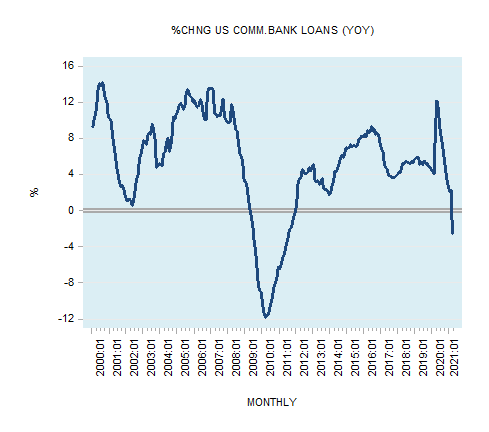 For most commentators an important factor in setting economic prosperity in motion is bank lending. Hence, this sharp decline in the yearly growth rate in bank loans raises the likelihood that US economic activity is under strong downward pressure. Consequently, most commentators are of the view that central authorities must provide the necessary support to strengthen bank-lending growth. However, is it true that bank lending is an important factor in economic prosperity? For instance, farmer Joe, who produced two kilograms of potatoes. For his own consumption, he requires one kilogram, and the rest he decides to lend for one year to farmer Bob. The unconsumed one kg of potatoes that he agrees to lend is his real savings. This example is necessary in order to illustrate that for lending to take place there must be real savings first. Lending must be fully backed by real savings. By lending one kilogram of potatoes to Bob, Joe agrees to give up ownership over these potatoes for one year. In return, Bob provides Joe with a written promise that after one year he will repay 1.1 kilograms of potatoes. The 0.1 kilogram constitutes interest. What we have here is an exchange of one kilogram of present potatoes for 1.1 kilograms of potatoes in a year's time. Both Joe and Bob have entered this transaction voluntarily, because they both have reached the conclusion that it would serve their objectives. The introduction of money does not alter the essence of what lending is all about. Instead of lending one kilogram of potatoes, Joe will first exchange his kilogram of potatoes for money, let us say for $10. Joe may now decide to lend his money to another farmer, John, for one year at the going interest rate of 10 percent. Observe that the introduction of money did not change the fact that real savings precede the act of lending. Furthermore, it is not the act of lending as such that strengthens economic growth but real savings that support the borrower while he is busy upgrading his infrastructure. With the help of an enhanced infrastructure, the borrower of real savings can boost the production of his product. Also, note that when a saver lends money, what he in fact lends to a borrower are final consumer goods that he did not consume. Banks as IntermediariesNow, instead of Joe directly lending his $10 to John, he can do it via an institution called a bank. The bank here fulfills the role of intermediary. For the services of mediating the transaction, the bank charges a service fee. The bank also fulfills another important role by providing a money storage facility. (Observe that individuals can exercise their demand for money by either holding the money or by placing the money with the bank storage facilities, known as demand deposits). Banks facilitate the flow of real savings by introducing the "suppliers" of real savings to the "demanders." In this sense, by fulfilling the role of intermediary, banks are an important factor in the process of real wealth formation. (Banks can also engage in direct lending by employing equity funds or borrowed funds). For instance, farmer Joe sells his saved kilogram of potatoes for $10. He then deposits this $10 with Bank A. Note that the $10 are fully backed by the saved kilogram of potatoes. Also, observe that Joe is exercising his demand for money by holding it in the demand deposits of Bank A. (Joe could have also exercised his demand for money by holding the money at home in a jar, or keeping it under the mattress). Now, if Joe decides to lend part of his deposited money—let us say $5—to John via the mediation of Bank A, his $5 will be transferred to John's demand deposit from his demand deposit. Note that by being a mediator Bank A provides an important service to Joe the lender by introducing him to John the borrower. The Essence of Credit out of "Thin Air"Whenever a bank takes a portion of deposited money without the permission of the owner of the deposit and lends it out, this sets in motion serious trouble. Let us say that Bank A lends $5 to Bob by taking $5 out of Joe's demand deposit. By lending the $5 to Bob, Bank A opens a demand deposit to Bob to the tune of $5. Note that Joe has never agreed to lend his money. Remember that Joe has an unlimited claim over his $5. Also, note that no additional real savings back the loaned $5. Once Bob the borrower of the $5 uses the borrowed money, he in fact engages in an exchange of nothing for something, the reason being that the $5 is not backed by any real savings—it is empty money. What we have here is $15 of demand deposits that are only backed up by $10 proper. Also, note that an increase in demand deposits because of the loan to Bob results in the money supply increasing by $5. When loaned money is fully backed by savings, on the day of the loan's maturity it is returned to the original lender. Bob—the borrower of $5—will pay back on the maturity date the borrowed sum and interest to the bank. The bank in turn will pass to Joe the lender his $5 plus interest, adjusted for bank fees. To put it briefly, the money makes a full circle and goes back to the original lender. Note, again, that the bank here is just a mediator; it is not a lender, so the borrowed money is returned to the original lender, which is in our case Joe. In contrast, when credit originates out of "thin air" and is returned on the maturity date to the bank, this leads to a withdrawal of money from the economy, i.e., a decline in the money stock, the reason being that in this case we never had a saver/lender, since this credit emerged out of "thin air." Using our example of Bank A making a loan of $5 to Bob, we must realize that the bank took the $5 out of Joe's demand deposit without Joe's consent to this. Joe never agreed to lend the $5 to Bob, since he continues to exercise unlimited claim over his deposited $10. (Remember that Joe saved the one kilogram of potatoes, which he in turn exchanged for the $10, and in turn deposited with Bank A). Note that if Joe were to agree to lend his $5 to Bob, then all that we would have here is a transfer of $5 from Joe to Bob. In that case, the $5 in loaned money to Bob would be fully backed by real savings. (Again, the $5 are part of Joe's $10 deposit, which originated in his saved kilogram of potatoes). Now, when Bob repays the $5, the money leaves the economy, since the bank is not required to transfer it to the original lender. There is no original lender here—the bank has created the $5 loan out of nothing. Again, when the bank generates a new deposit for $5 which is not backed by real savings—we do not have here any original lender/saver. Credit out of "Thin Air" Sets the Platform for Nonproductive ActivitiesObserve again that this extra $5 of new money sets in motion an exchange of nothing for something. This provides a platform for various nonproductive activities that prior to the generation of credit out of "thin air" would not have emerged. As long as banks continue to expand the credit out of "thin air," various nonproductive activities continue to expand. Once, however, the continuous generation of credit out of "thin air" lifts the pace of real-wealth consumption above the pace of real-wealth production, the positive flow of real savings is arrested and a decline in the pool of real savings is set in motion. Consequently, the performance of various activities starts to deteriorate and banks' bad loans start to increase. In response to this, banks curtail their lending activities, and this in turn sets in motion a decline in the money stock. (Remember, the money stock declines once loans generated out of "thin air" are repaid and not renewed). The fall in the money stock begins to undermine various nonproductive bubble activities, i.e., an economic recession emerges. (Note that nonproductive activities cannot stand on their own feet. They require the assistance of the credit out of "thin air." The credit out of "thin air" diverts to them real wealth from real-wealth producers). According to a popular view held by many commentators, the economic depression of the 1930s occurred because of a sharp fall in the money supply. This way of thinking originates from the Chicago school, championed by Professor Milton Friedman. The economic depression was not caused by the collapse in the money stock as such, but in response to the shrinking pool of real savings on account of the prior easy monetary policy. The shrinking pool of real savings leads to a decline in the money stock. Consequently, even if the central bank were to be successful in preventing the fall of the money stock, this cannot prevent a depression if the pool of real savings is declining. Summary and ConclusionWithout real savings the act of lending cannot take place. The role of banks in lending is to mediate between lenders, i.e., savers, and borrowers. Another important role that banks fulfill is to provide money storage facilities known as demand deposits. Trouble, however, emerges once banks start to engage in lending unbacked by real savings; this gives rise to the expansion of credit out of "thin air." This in turn sets in motion the menace of the boom-bust cycle. Again, contrary to popular thinking, it is not possible to increase credit without a prior increase in real savings. Any attempt to do so results in the expansion of credit out of "thin air."  This posting includes an audio/video/photo media file: Download Now |
| Shawn Needham: How Consumers and Entrepreneurs Co-navigate Value Uncertainty in Healthcare Posted: 30 Mar 2021 06:30 AM PDT Austrian economics provides new insights into value: what it is, how it is created, and who creates it. The insights are summed up by Professors Per Bylund and Mark Packard in our E4B podcast episode #108 (see Mises.org/E4B_108). One of the most vivid images they paint is the picture of entrepreneurship as "the two-sided navigation of radical value uncertainty, both by producers and consumers, in that never-ending quest towards higher value states". The market for healthcare provides us with a pertinent example of co-navigation of radical value uncertainty. For consumers, there is no certainty available — they can't know which doctors or providers will give them the best experience, they don't know the right means to choose to attain their end (health), and they can't use the usual market price signals in the search for value since the price of healthcare is not visible to them. The don't purchase the product, they purchase insurance, a different financial product than the healthcare experience they really need. Thus, the healthcare market is a natural medium for the co-navigation of value uncertainty that Professors Bylund and Packard described. In E4B podcast episode #111, Shawn Needham, a healthcare entrepreneur dedicated to helping the consumer in their navigation task, lays out 6 principles for entrepreneurs. Key Takeaways & Actionable Insights1. Help consumers to be proactive about their own health.The healthcare system wants consumers who are sick. Chronic sickness is their most profitable line. A good way to help consumers is via what Shawn calls Pro-Health: encouraging the consumer mindset and commitment to actively make good health and lifestyle choices in diet, exercise, quality sleep and stress reduction. Entrepreneurs can share valuable knowledge and tools to help good decision-making, and to facilitate health creation by consumers. 2. Enable consumer sovereignty via cash, pay-out-of-pocket options.It's hard to discern the operation of consumer sovereignty in healthcare systems. End-users can become locked-in to a limited set of choices. Entrepreneurs can help by developing more choices, so that expressed consumer dissatisfactions can be actualized as new options. Examples that are already in motion include Direct Primary Care (DPC), an arrangement whereby doctors charge a set monthly fee for access to primary care, and consumers pay cash in return for an improved experience, including more time with the doctor, easier scheduling and lower cost prescriptions. DPC doctors are healthcare entrepreneurs who are enabling consumer sovereignty, having alertly discerned the signals of consumer dissatisfaction. 3. Entrepreneurial empowerment in employer health financing options.Employers offer ways for employees to finance traditional healthcare insurance, usually via benefits programs. In episode #109, Professor Desmond Ng described the Austrian-inspired movement among employers to empower their employees to be more creative and entrepreneurial and less centrally-directed: he called the movement Entrepreneurial Empowerment. Entrepreneurial empowerment can be granted to employees to unleash their creativity in searching for financing options for their healthcare. The use of Health Savings Plans provides consumers with an alternative approach to meeting healthcare expenses through dedicated savings. There may be other ways to re-direct the funds devoted to funding healthcare insurance through centrally-directed employer programs, such as freeing employees to opt out of company-paid insurance premiums, and to take the same amount as a deposit into a 401K, leaving the employee with a freer choice in healthcare financing. 4. When the consumer pays the bill, the benefits of free markets can emerge.Another pay-out-of-pocket option development is Cash Fee For Service, which is a straightforward payment whenever a specific service is required. We've highlighted Surgery Center Of Oklahoma as a pioneering example. When the consumer pays the bill, lower prices tend to result because of competitive free market processes, and the quality of care tends to increase for the same reasons. In his book, Shawn Needham cites cosmetic surgery and lasik eye surgery as two examples of free market forces at work to generate higher quality and lower costs. 5. Entrepreneurial initiative combined with consumer search for betterment can create new solutions.Shawn identifies medical cost sharing programs as an innovation emerging from the consumer-entrepreneur co-navigation of value uncertainty in healthcare. In medical cost sharing, a voluntary community pools funds so that any unexpected major medical cost can be shared across the community. The firm that co-ordinates the community typically also offers services such as bill negotiation, concierge medical services, health coaching, and discounts on health-promoting resources. There's a greater degree of consumer sovereignty than is typical in healthcare arrangements, such as a freer choice of which doctors and labs to use. Similarly, doctors who participate in these programs are freer to set their own rates and to compete for patient trust in lasting relationships. The healthcare market is a process.The healthcare market may appear to be an inflexible structure, built over many years to impede organizational innovation. But viewed in an Austrian way, as a process governed by consumer sovereignty and responsive entrepreneurial creativity, it is possible to discern emerging trends in favor of greater consumer choice, market flexibility, and the inevitable role of the price mechanism to disperse blockages and lower barriers to better consumer experiences. Additional Resources"Navigating Healthcare Uncertainty" (PDF): Mises.org/E4B_111_PDF Sickened: How The Government Ruined Healthcare And How To Fix It by Shawn Needham: Mises.org/E4B_111_Book Check out one example of medical cost sharing: Mises.org/E4B_111_Example Read about Direct Primary Care: Mises.org/E4B_111_DPCare  |
| You are subscribed to email updates from Mises Wire. To stop receiving these emails, you may unsubscribe now. | Email delivery powered by Google |
| Google, 1600 Amphitheatre Parkway, Mountain View, CA 94043, United States | |




No comments:
Post a Comment