Each May and June, Motorists Should be on the Alert for Turtles Crossing the Road 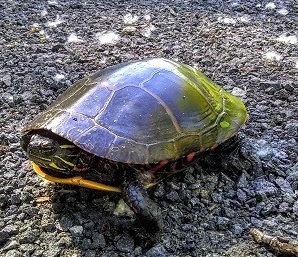 Our native turtles are on the move in May and June seeking sandy areas or loose soil to lay their eggs. In New York, thousands of turtles are killed each year when they are struck by vehicles as they migrate to their nesting areas. Our native turtles are on the move in May and June seeking sandy areas or loose soil to lay their eggs. In New York, thousands of turtles are killed each year when they are struck by vehicles as they migrate to their nesting areas.
What you can to do help: - If you see a turtle on the road, please give turtles "a brake". Slow down to avoid hitting it with your car.
- If you can safely stop your vehicle, please consider moving it to the shoulder on the side of the road in the direction it was facing.
- Picking the turtle up by its tail may frighten or injure it. Most turtles can be picked up by the sides of the shell.
- Use caution when moving snapping turtles; either pick her up at the rear of the shell near the tail using two hands, or slide a car mat under the turtle to drag her across the road.
- Please do not take turtles home. All native turtles are protected by law and cannot be kept without a permit. All 11 species of land turtles that are native to New York are declining. Even losing one mature female can have a negative impact on a local population.
Update on Northern Zone Fisher Population Study DEC staff, in partnership with researchers from SUNY ESF, are conducting a study to better  understand fisher population dynamics and survival across the Northern Zone. With the help of trappers, we have live-captured over 120 fisher since the project began in 2017. Adult females are fitted with GPS collars to locate and monitor dens and reproduction. When a den is located, DEC staff monitor the area with trail cameras to better understand kit production and survival. We are currently monitoring over 60 collared fisher, including several adult females with kits. Ultimately, these data will help us better understand the population dynamics of fisher in the Northern Zone, and will be used to inform season setting and ensure sustainable harvest opportunities for this important furbearer resource. understand fisher population dynamics and survival across the Northern Zone. With the help of trappers, we have live-captured over 120 fisher since the project began in 2017. Adult females are fitted with GPS collars to locate and monitor dens and reproduction. When a den is located, DEC staff monitor the area with trail cameras to better understand kit production and survival. We are currently monitoring over 60 collared fisher, including several adult females with kits. Ultimately, these data will help us better understand the population dynamics of fisher in the Northern Zone, and will be used to inform season setting and ensure sustainable harvest opportunities for this important furbearer resource.
R.E.P.E.L. Nuisance Wildlife Spring time can coincide with an increase in conflicts between people and wildlife. Woodchucks in the garden, squirrels or other critters in the attic, and skunks under the shed are but a few of the problems people may encounter. The best way to reduce common wildlife issues is by eliminating access to food, water, and shelter. Tips to help you REPEL or prevent and control problems with wild animals: - R emove food sources – do not feed wildlife, remove all feeders and suet in the spring and summer, secure or remove garbage immediately and wait until the day of trash pick-up to bring outside, and feed pets indoors.
- E liminate cover and shelter close to homes and buildings - get rid of piles of brush, logs, and junk, and stash firewood away from your house or other buildings; mow tall grass near houses or other buildings.
- P ut up barriers - use chimney covers and soffit vents, fence in areas such as gardens and underneath decks, and seal entry holes that lead into the house.
- E xcite or agitate - use visual repellents such as scarecrows or lights, create noise by yelling or using noisemakers (be sure to check noise ordinances in your area).
- L egally remove or "take" - contact a licensed Nuisance Wildlife Control Operator (NWCO) to remove problem wildlife from your property or remove or "take" nuisance animals on your own in accordance to New York State laws and regulations. Visit our website for more information on what species may legally be taken and under what conditions you may do so.
|


No comments:
Post a Comment