| The World Health Assembly can't force China to permit a credible investigation into whether the coronavirus emerged from a Wuhan lab. But member nations could flip China's own script that it fully complied with the probe. "If you have enough international agreement that we want a proper, credible investigation…and China says no to that, then you've completely changed the narrative," said Filippa Lentzos, a senior lecturer in science and international security at King's College London. The United States is trying to change the narrative at the annual assembly this week.U.S. and Chinese officials brought clashing messages to yesterday's meeting of the World Health Assembly, which is the World Health Organization's decision-making body. 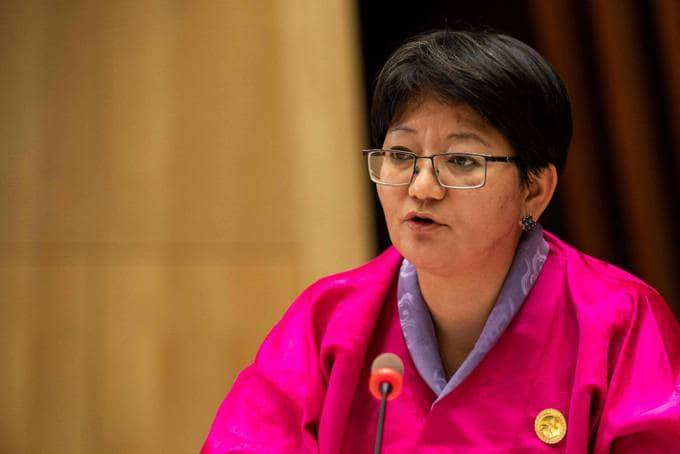 Dechen Wangmo, Bhutan minister for health and president of the 74th World Health Assembly, delivering a speech in Geneva on Monday. (Christopher Black/ AFP) | Beijing insisted it considers the investigation in its own country into the virus's origin to be complete, the Wall Street Journal reported. But Washington called for a new round of studies to be conducted with independent experts — something the Biden administration has pushing for the past month. It has been asking China to allow experts "unfettered access" to data and unlimited interviews after the country heavily restricted WHO investigators earlier this year. The WHO's subsequent report dismissed claims the virus had escaped from the Wuhan Institute of Virology, prompting immediate pushback that it wasn't credible because of China's refusal to be transparent. - In prerecorded remarks, Health and Human Services Secretary Xavier Becerra told the meeting that international experts should be given "the independence to fully assess the source of the virus and the early days of the outbreak."
- "We need to get to the bottom of this and we need a completely transparent process from China," said Andy Slavitt, senior adviser to the White House coronavirus task force. "We need the WHO to assist in that matter. We don't feel like we have that now."
- White House press secretary Jen Psaki told reporters yesterday that "the president believes there needs to be an independent investigation, one that's run by the international community."
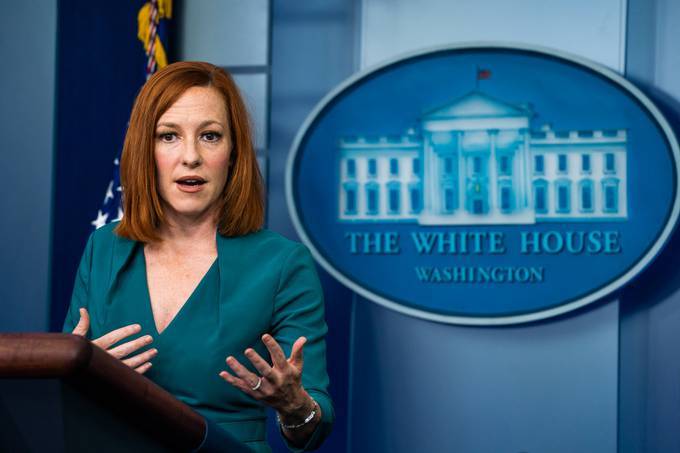 White House press secretary Jen Psaki. (Demetrius Freeman/The Washington Post) | | Hoover Institute fellow Lanhee Chen: | 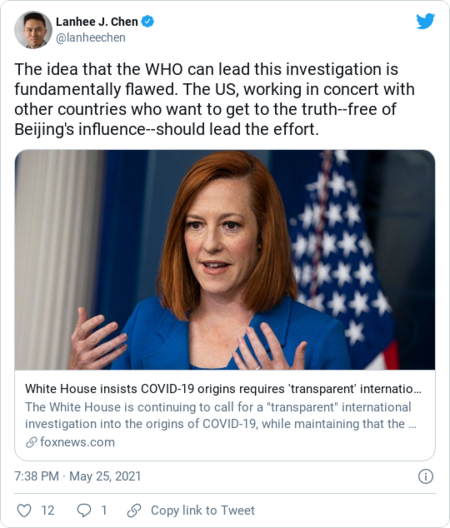 | | | Yet there are no known plans at the assembly to pass a resolution on the matter; WHO officials told the Wall Street Journal that there's "little sign that governments could agree on a path forward." And there's little hope China would comply with the requests, even if the assembly turned up the pressure. "China will never agree to that, of course," Lentzos said, adding that she doubts "a smoking gun" will ever be found. Even so, the new attention on the lab leak hypothesis is prompting introspection among scientists and the media.We still don't know whether the virus emerged "zoonotically" from animals, or whether it was the result of a lab experiment gone awry. "Scientists' default assumption has been that this was a naturally occurring event since hundreds of zoonotic viruses jump from animals to humans and cause all manner of diseases," Yasmeen Abutaleb, Shane Harris and Ben Guarino write. "Many scientists who study zoonotic diseases say that's still the more likely scenario. But in part because they have not yet identified the animal that may have spread the virus to humans, the Wuhan lab theory has gained more credibility." Sen. Tom Cotton (R-Ark.) was widely ridiculed when he first advanced the notion that the virus may have escaped from a lab, rather than jumping from animals to humans at a Wuhan seafood market. Numerous experts dismissed the possibility the virus could be man-made, according to reporting by my colleague Paulina Firozi in February 2020. "There's absolutely nothing in the genome sequence of this virus that indicates the virus was engineered," Richard Ebright, a professor of chemical biology at Rutgers University, said at the time. "The possibility this was a deliberately released bioweapon can be firmly excluded." | Claims from former president Donald Trump that the virus came from a lab also contributed to the skepticism, FiveThirtyEight founder Nate Silver argues: | 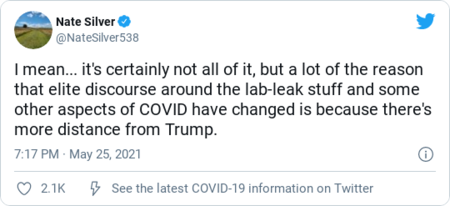 | | | | Vox writer Matt Yglesias slammed the media for how it dismissed the hypothesis: | 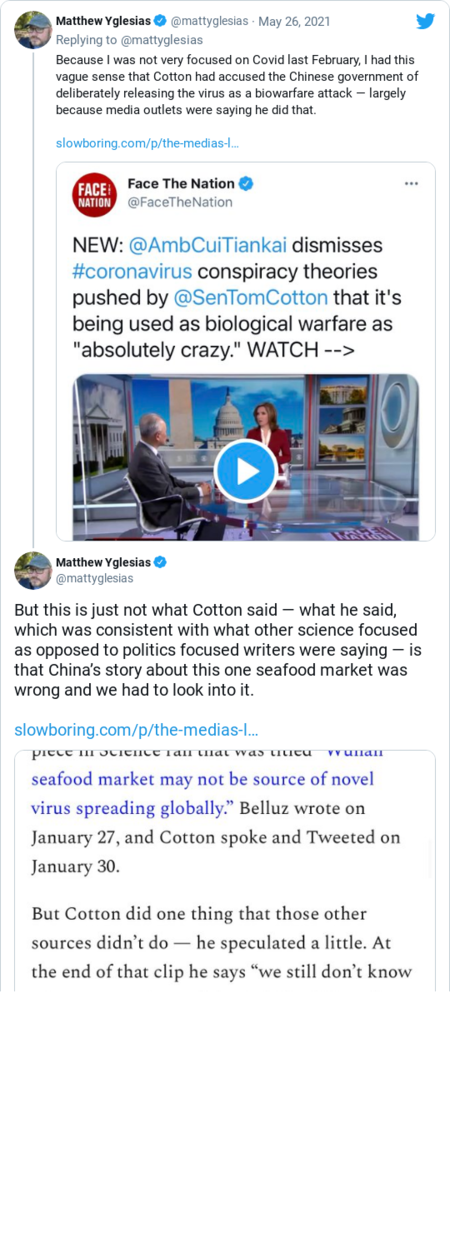 | | | Important information was available from the start, but generally ignored, The Post's fact-checker Glenn Kessler writes. "But in other cases, some experts fought against the conventional wisdom and began to build a credible case, rooted in science, that started to change people's minds," he writes. "This has led to renewed calls for a real investigation into the lab's activities before the coronavirus emerged." Glenn has a timeline tracking what we knew, when. Here are a few early-on examples of evidence suggesting the lab-leak hypothesis should have been at least considered. Jan. 26: A study by Chinese researchers published in the Lancet of the first 41 hospitalized patients in Wuhan who had confirmed infections found that 13 of the 41 cases, including the first documented case, had no link to the seafood marketplace that originally was considered the origin of the outbreak. Feb. 6: Botao Xiao, a molecular biomechanics researcher at South China University of Technology, posts a paper stating that "the killer coronavirus probably originated from a laboratory in Wuhan." He pointed to the previous safety mishaps and the kind of research undertaken at the lab. He withdrew the paper a few weeks later after Chinese authorities insisted no accident had taken place. March 27: A Defense Intelligence Agency assessment on the origin of the coronavirus is updated to include the possibility that the new coronavirus emerged "accidentally" because of "unsafe laboratory practices." April 14: Josh Rogin, writing in The Post, reveals that in 2018, State Department officials visited the WIV and "sent two official warnings back to Washington about inadequate safety at the lab, which was conducting risky studies on coronaviruses from bats. The cables have fueled discussions inside the U.S. government about whether this or another Wuhan lab was the source of the virus — even though conclusive proof has yet to emerge." | 


 Email
Email 




No comments:
Post a Comment