Mises Wire |
- Medical Staffing and the Revolutionary Innovations We Need
- Can Economics Save Medicine?
- Explaining Malinvestment and Overinvestment
- Missouri Tells the Feds: We Won't Enforce Your Gun Laws
- Transitory Inflation or Stagflation?
- Central Banks See No Way out of the Low Interest Rate Trap
| Medical Staffing and the Revolutionary Innovations We Need Posted: 21 Jun 2021 01:30 PM PDT A new world of medical entrepreneurship is growing. Concierge and cash-only practices, walk-in cash clinics, medical tourism, and cost-sharing plans are just a few of the ways free-market approaches are changing the landscape. Our expert speakers will discuss several of these developments, and more. Recorded in Salem, New Hampshire, on June 17, 2021.  |
| Posted: 21 Jun 2021 01:15 PM PDT A new world of medical entrepreneurship is growing. Concierge and cash-only practices, walk-in cash clinics, medical tourism, and cost-sharing plans are just a few of the ways free-market approaches are changing the landscape. Our expert speakers will discuss several of these developments, and more. Recorded in Salem, New Hampshire, on June 17, 2021.  |
| Explaining Malinvestment and Overinvestment Posted: 21 Jun 2021 12:00 PM PDT Mainstream macroeconomists may—and do—disagree with such an assessment, but Austrian macroeconomists rightly consider the Misesian/Hayekian1 theory of the business cycle to be one of the signal achievements of the entire Austrian School of thought. This Austrian business cycle theory (ABCT) offers a unique perspective on the destructive array of private sector incentives created by central bank manipulations of the supplies of money and credit ABCT is essentially a theory of unsustainable economic expansions, that is, macroeconomic expansions that must unavoidably be followed at some point by macroeconomic contractions. At the center of this scenario is the phenomenon of malinvestment. Thus, in order to explain ABCT one must be able to convey in what malinvestment consists. In the past, Austrians have usually done this either entirely by means of verbal explication or with the assistance of certain unconventional constructions such as Hayekian triangles.2 These figures relate the stages of production to the magnitude of ultimate output and thus can reveal the effects of a change in market interest rates on the structure of production. However, to grasp the significance of such triangles one must also comprehend certain distinctively Austrian ideas such as"roundabout production" and the average production period. Students of economics who are not already familiar with the Austrian School are thus not likely to find Hayekian triangles to be very enlightening. Something more familiar to such students might prove more helpful. Pursuing that line of thought, the present paper will offer an interpretation of malinvestment in more conventional terms, using such frameworks as the familiar capital asset pricing model (CAPM) seen so often in finance classes. In addition, the everyday observation about the disproportionate effects of interest rate changes on the present values of assets with different maturities will be shown to be congruent with Hayekian triangles, thus removing the latter from the realm of the exotic. Finally, the important role of the "subsistence fund" in understanding malinvestment will be illustrated. First of all, however, the basics of ABCT will be briefly reviewed ABCT in a NutshellThe distinctive Austrian approach to business cycles is bundled within the two "universals" of macroeconomics, time and money3 (Garrison 2001, pp. 47–52). Production in a modern economy is a roundabout process. It takes time and is measured in monetary units. The intertemporal dimension of the structure of production is, and I believe quite rightly, untiringly emphasized by Austrians. They always distinguish higher-order capital goods, which function at or near the beginning of the temporal string, from lower-order consumer goods, which are the culmination of the process. The complicated and somewhat fragile production structure requires that complementary inputs be available not only in the right magnitudes but also at the right moments in time. If they are not, then projects that appeared profitable are soon revealed to be unprofitable. In other words, what appeared to be capital creation is seen in fact to be capital consumption. ABCT focuses on the "medium run," because that is where problems arise. In the short run, the capital structure cannot be changed significantly, and in the long run all errors have been rectified. It is in the medium run that there is time enough for capital projects to be initiated and the direction of production to change, but insufficient time for any possible malinvestments to be corrected—at least not without serious repercussions. This inability to smoothly liquidate or redirect projects stems largely from the heterogeneity of most capital goods. What is the source of the widespread "cluster of entrepreneurial errors" (Rothbard 1970, p. 746; 1975, pp. 18–21) that typifies the boom-bust sequence? It is that market rates of interest are driven below the "natural rate" as result of credit expansion by the central bank. Market rates are the result of the supply of and demand for credit (or loanable funds), while the natural rate is an expression of individuals' time preferences, that is, their preferred rate of substitution between present goods and future goods. Such declines in market rates make it appear as if consumers have chosen to save (delay consumption) at a higher rate than before, when in fact they have not done so. Furthermore, the increased credit available at relatively low interest rates must appear as an increase in funding for businesses. Otherwise, no cycle will appear (Rothbard 1978, pp. 152–53). The low rate of interest and abundant credit induce businesspeople to lengthen the production process.4 This occurs because the net present value of longer-term projects rises relative to that of shorter-term projects (see figure 1). Entrepreneurial demand for capital goods thus increases, and producer goods' prices rise relative to consumer goods' prices. The result is a production structure that is unsustainable. Consumers will eventually reassert their unchanged time preferences via strong demand for consumer goods, and the prices of consumer goods begin to rise relative to those for capital goods. The resources needed to complete the projects will not be forthcoming, so many such projects cannot be completed at all, or can be completed but at a loss. The economy is being pulled in two directions. Entrepreneurs want more capital goods (and the complements to those capital goods), at the same time that consumers want more consumer goods. The needed correction comes in the form of a recession, during which many projects are liquidated and unemployment rises. Macroeconomic equilibrium can only be re-established when and if the central bank ceases to expand the supply of credit, thus allowing market rates of interest to once again be consistent with time preferences. Figure 1
The Subsistence FundRegardless of which aspect of the credit expansion one highlights, whether it is the pattern of market interest rates that first encourages, then discourages, greater roundaboutness, the zero-sum struggle for available resources between lower-order goods and higher-order goods, the overinvestment which prolongs the contractionary, corrective phase of the cycle, the scarcity of resources that serve as complements to the lengthened capital structure, or the "forced savings" imposed on consumers by entrepreneurial malinvestment, one theme (implicitly) runs through the entire exposition of the Austrian theory of unsustainable business cycles: the subsistence fund. It is, in fact, a concept that links all aspects of the theory. Moreover, since it focuses on the actions of the capitalist/entrepreneur as the key appraising agent, it pinpoints a crucial element of ABCT, i.e., the proposition that unsustainable expansions only occur if and when it is businesspeople to whom the artificial increase in credit is made available. [T]he Austrian theory of the trade cycle reveals that only the inflationary bank credit expansion that enters the market through new business loans (or through purchase of business bonds) generates the overinvestment in higher-order capital goods that leads to the boom-bust cycle. Inflationary bank credit that enters the market through financing government deficits does not generate the business cycle; for, instead of causing overinvestment in higher-order capital goods, it simply reallocates resources from the private to the public sector, and also tends to drive up prices. Thus, Mises distinguished between "simple inflation," in which the banks create more deposits through purchase of government bonds, and genuine "credit expansion," which enters the business loan market and generates the business cycle. . . . Mises did not deal with the relatively new post-World War II phenomenon of large-scale bank loans to consumers, but these too cannot be said to generate a business cycle . . . because they will not result in "over" investment, which must be liquidated in a recession. Not enough investments will be made, but at least there will be no flood of investments which will later have to be liquidated. Hence, the effects of diverting consumption [/] investment proportions away from consumer time preferences will be asymmetrical, with the overinvestment-business cycle effects only resulting from inflationary bank loans to business. (Rothbard 1978, pp. 152–53) By what standard is a credit expansion deemed to be cycle-generating? First of all, it must be an "artificial" expansion, that is, not the result of a decline in the rate of time preference. This is the necessary but not sufficient condition. A further stipulation is needed: the gap between credit and saving must be experienced by businesses, not consumers. Entrepreneurs must have access to credit in excess of the saving that is available to them. That is the fundamental message which Rothbard conveys quite emphatically in the citation above. Some Austrians may speak and write about a contrast between generic "saving" and the supply of fiduciary credit, but that is insufficiently precise. As Rothbard recognized so clearly, the only discrepancy that really matters insofar as business cycles are concerned is that between the magnitude of saving at the disposal of entrepreneurs and the magnitude of credit at the disposal of entrepreneurs. The former sets the limit on a sustainable lengthening of the capital structure, and the latter identifies the maximum initial investment in capital projects (see figure 2). Figure 2
It is not saving per se that is the benchmark, but the magnitude of the subsistence fund. What, exactly, is this subsistence fund? Saving and Productive ExpenditureThe labor expended by employees of business firms is not, contrary to widespread assumption, the primary or original source of income. One of the serious flaws of classical economics was just that erroneous assumption.5 Reflect on a pre-capitalist, primitive world in which there are no businesses, but of course there does exist both labor and land. When goods are produced, what should the income receipts be called? They cannot be wages, because there are no employers to pay wages. They are, unavoidably, profits. In such a world, laborers sell goods but not their own labor. "Smith and Marx are wrong. Wages are not the primary form of income in production. Profits are" (Reisman 1996, p. 479). What occurs as capitalists appear? The proportion of total income that is profit (100 percent in the primitive state) declines as those capitalists provide funds to their employees (wages) in advance of the sale of the finished goods.6 This transfers most of the risk from the workers to the capitalists, but it also allows the capitalists to benefit from the increased productivity of the more roundabout production processes. What then is the source of wages? It is capitalists and their decision to save a portion of their earned income. Placed in the hands of businesspeople, this saving becomes productive expenditure which is used to acquire the factors of production. The greater the amount saved, the more that is available to be spent for labor and other inputs. The wages fund, or subsistence fund,7 is that part of the monetary income of capitalists which is saved and invested in productive projects. Equivalently, it is that portion of the funds which capitalists make available to entrepreneurs that is then used to purchase inputs.8 It overlaps, but is not identical to, the concept of saving. Some economists will reject the concept of the subsistence fund on the grounds that firm revenues depend on sales to consumers and therefore, in effect, consumers provide the funds that businesses need to hire labor and other inputs. Such a train of thought may seem reasonable, but it flies in the face of another classical insight. John Stuart Mill realized that there was a "fundamental theorem" regarding capital which was often misunderstood even in his day. It appears to be almost wholly forgotten today. What supports and employs productive labour, is the capital expended in setting it to work, and not the demand of purchasers for the produce of the labour when completed. Demand for commodities is not demand for labour. The demand for commodities determines in what particular branch of production the labour and capital shall be employed; it determines the direction of the labour; but not the more or less of the labour itself, or of the maintenance or payment of the labour. These depend on the amount of the capital, or other funds directly devoted to the sustenance and remuneration of labour. (Mill 1987, p. 79; emphasis in original) One might think of the above in the following terms. From a macroeconomic perspective, the level of saving determines the level of potential total demand for, and thus the potential total employment of, inputs. It sets an upper limit on sustainable production. From a microeconomic perspective, consumer demand for final goods determines the relative demand for inputs, and thus the pattern of employment of those inputs in the production of particular goods and services. At one level, capitalists and entrepreneurs steer the economy. At a different level, consumers (indirectly) steer the economy. Classical economists emphasized the first; while Austrians emphasize the second. One should note carefully that it is not saving per se that is crucial, but the productive expenditures of entrepreneurs, which are made out of the totality of funding available to those entrepreneurs. In a properly functioning, free-market economy, that pool of funds will consist only of real saving, and no unsustainable macroeconomic expansions will result.9 Austrians are accustomed to thinking in terms of the relative prices of all things including those of inputs, the imputation of values for higher-order, capital goods from the demand for lower-order, consumer goods, and the allocation of inputs based on their discounted marginal value products.10 Do Austrians need to abandon that approach? Not at all. Allocations of inputs between industries and firms are driven by the discounted marginal productivity of those inputs; while relative prices drive specific output choices. However, consideration of the subsistence fund yields some insights that may be more difficult to achieve if one avoids the use of the concept. First of all, in a central banking system with fiat currency, the link between real saving and the supply of loanable funds is very loose. Therefore, the link between real saving (by both consumers and businesspeople) and the pool of funds available for business investment is equally loose. In such a system, businesses that invest in new projects may not, in fact, be engaging in truly productive expenditures. This will not be evident ex ante, but it will become painfully clear ex post when the investments have to be liquidated. What appeared to be capital creation reveals itself to be capital consumption. Also, one might recall the two dimensions of erroneous investment that characterize a typical, credit-driven business cycle: malinvestment and overinvestment. Austrians have explained the former very well.11 Malinvestment occurs due to misleading relative price signals, and it necessitates a corrective contraction. But what of the overinvestment? That is, why must the contraction persist for a substantial time and, thus, bring about considerable suffering? The answer to that question may become less opaque if one applies the concept of the subsistence fund. Briefly stated, the overinvestment occurs because entrepreneurs are led to believe that the subsistence fund is larger than it actually is. The pivotal role played by the concept of the subsistence fund is addressed directly, although from a slightly different angle, by George Reisman, a Misesian who sees much in classical economics that he thinks should be of interest to Austrians: The wages-fund doctrine held that at any given time there is a determinate total expenditure of funds for the payment of wages in the economic system, and that the wages of the employees of business firms are paid by businessmen and capitalists, out of capital, which is the result of saving; not by consumers in the purchase of consumers' goods. . . . [T]he abandonment of the wages-fund doctrine and with it, classical economics' perspective on saving and capital, made possible the acceptance of Keynesianism and the policy of inflation, deficits, and ever expanding government spending. (Reisman 1996, p. 474) The usefulness of the subsistence fund concept also extends to the issue of complementarity. In ABCT the credit expansion that initiates the cyclical sequence leads to a capital structure that cannot be maintained, because [I]t is relative scarcity of complementary factors which here causes excess capacity and upsets plans. . . . [C]omplementarity is of the essence of all plans, and withdrawal of a factor, or its failure to turn up at the appointed time, will equally endanger the success of the production plans. (Lachmann 1978, p. 107) Imagine that the absent factor is labor of a particular kind. If it is unavailable, why is it unavailable? Does it not exist? Surely it does exist, for otherwise no one would plan a project that required its participation. Then why is it not forthcoming in the context of a roundabout production process that entrepreneurs have made lengthier? A lengthier production structure means that the labor must be applied in an earlier stage of the process, farther removed from the final goods. In other words, the time interval between application of the labor and sale of the final product has expanded. This requires, in real terms, that the workers have available a greater stock of consumer goods by means of which they can sustain themselves over this longer time period. Without such goods, no labor will be made available for these lengthier projects, or the labor may be available but only for a period shorter than the duration of the project. In a crucial sense, consumer goods are used to "purchase" the needed factors of production (Strigl 2000, p. 11). And, ceteris paribus, such an enlarged stock of consumer goods can only exist if time preferences have fallen, proportionately less is consumed by capitalists, and those capitalists have thus provided businesspeople with a larger subsistence fund. Furthermore, multi-period projects are viable only if the required conditions are replicated intertemporally. "Production can only be maintained if each attained subsistence fund is used to support another roundabout method of production" (Strigl 2000, p. 12). A subsistence fund that is adequate only for one time period will lead, in subsequent periods, to capital consumption as the production process is forced to become more "momentary" and less roundabout. The tension between capital goods expansion and an undiminished demand for consumer goods helps to highlight the value of the subsistence fund in explaining another key issue in ABCT, that is, why overinvestment occurs as well as malinvestment. Some critics, such as John Hicks, have asserted that while an increased money stock and cheap credit can indeed induce an artificial boom that exhibits a capital-goods bias, the excess money balances in consumers' hands should quickly correct the restructuring of production or even prevent its appearance in the first place. As Garrison notes, "[w]ithout the over-investment, the malinvestment would be as short-lived as Hicks's critical remarks suggest" (Garrison 2001, p. 81). Time is the issue at hand. Entrepreneurs have overinvested in long-term projects, overinvested, that is, in higher-order goods far removed from the final goods. The mix of goods is unsustainable, and so too is the level of production (Garrison 2001, p. 74). To the extent that those higher-order goods are durable and specific, the process of correcting the imbalance will require a significant period of time. The economy "crashes" because unjustified investments in the early stages of production have been undertaken. The economy recovers slowly, and no doubt painfully, from the contraction because the overinvestment in the early stages of production is sure to involve at least some goods that are durable as well as being firm- or even project-specific. Liquidation of such goods, and the firms or projects employing them, will be a difficult and time-consuming process. Re-establishing a sustainable level and mix of goods will take time. Quick and painless adjustments are out of the question. (Sechrest 2001, p. 68) This becomes clear when considering the subsistence fund in real terms. Once the boom is seen to be unsustainable, cannot entrepreneurs simply sell the overproduced capital goods? Quite possibly, but this will not help to correct the underlying problem. First of all, the prices they will get are sure to be below the present values they originally thought the capital goods to have. Once the contraction begins, demand for capital goods will decline and market interest rates will rise. Both events will drive down their prices. Furthermore, even if entrepreneurs somehow did retrieve the full original value of their investments, all that will have happened is that the economy will have experienced a redistribution of liquidity. What is needed is a greater quantity of real, completed consumer goods. And capital goods cannot immediately be converted into final consumer goods. Changes in the structure of production cannot easily be reversed. There is a significant degree of "path-dependence" involved with the capital restructuring that occurs in the medium run. The economy cannot simply "erase" the errors and start over. Ultimately the only solution is to have a subsistence fund sufficient to meet consumers' needs. But if that were the case all along, then no boom-bust cycle would have occurred in the first place. In Diagrammatic TermsHow can the components of this ABCT scenario be illustrated? Moreover, how can they be illustrated in terms more-or-less familiar to the typical economics student? In order to respond, one will first need to revisit figures 1 and 2, which show the effects of interest rates on (a) projects' net present value (NPV) and (b) business investment decisions. Then, to reveal the excessive risk-taking inherent in malinvestment, one can examine figure 3, a modified version of the capital asset pricing model. Figure 3
In figure 1, the net present value of a project's stream of discounted cash flows (the vertical axis) is affected by (a) the time needed to complete the project (the horizontal axis) and (b) market rates of interest. This is notably similar to the dimensions of the Hayekian triangle. In such triangles, "[t]he horizontal leg of the triangle represents production time. The vertical leg measures the value of the consumable output of the production process" (Garrison 2001, p. 46). In figure 1 the market interest rate declines, which increases the NPV of all capital projects. However, such increases in NPV accelerate as the time period of the project lengthens. Longer term projects rise in value by a greater percentage than do shorter term projects, for the same initial decline in interest rates. Therefore, as long as businesspeople think that the required complementary inputs will be available, there is always an incentive to undertake longer term projects in an environment of falling interest rates. And, if businesspeople think that the falling rates are a reflection of falling time preferences, they will indeed believe that those complementary inputs will be available when needed. In figure 2, businesspeople act on the incentives created in figure 1. The market rate of interest (im), initially equal to the natural rate (in), declines to im*. Businesspeople opt for proportionately more higher-order (capital) goods and proportionately fewer lower-order (consumer) goods. This is made possible by the expansion of credit. Yet time preferences have not fallen, so there is no greater subsistence fund than there was before the credit expansion. The gap between the new level of investment expenditures and the subsistence fund is thus unsustainable. Figure 3 applies a modified version of the capital asset pricing model to ABCT. Here the required rate of return (the vertical axis) should be thought of as the internal rate of return (IRR) on specific capital projects. Risk, on the horizontal axis, is not the systematic risk of an asset, measured by the asset's β, but the total risk, measured by the variance of the returns to the project (σ2). As the central bank expands the supplies of money and credit, market interest rates fall, so the rate at which cash flows are discounted declines, driving up net present values. But the forecasted cash flows themselves will also rise, since, in an inflationary environment, output prices usually rise faster than do input prices. From both directions, NPVs increase, with the longer term projects exhibiting the greater percentage increases. This makes it appear as if, for the same level of risk exposure, businesses can now enjoy a higher rate of return. The capital market line (CML) seems to rotate upward from CML (actual) to CML (perceived), and businesspeople move toward what they think will be a higher level of utility (U1 to U2). However, in fact this moves businesses into the realm of exceedingly risky—indeed, ultimately unsustainable—capital investments. SummaryProfit, the return to the entrepreneur, is the original form of income, not wages. Wage incomes only come into being when and if capitalists set aside a part of their income instead of consuming it all. Out of these savings comes productive expenditure (or in real terms the subsistence fund), including the demand for labor, because consumers' demand for final goods is not the source of demand for originary factors of production. The subsistence fund is the source of demand for originary factors and sets the limit on sustainable expansions by identifying the proper intertemporal allocation of resources. Both malinvestment and overinvestment appear whenever credit expansions are initiated by a central bank, because in such circumstances the subsistence fund will be inadequate to sustain the new, artificially lengthened production process. An excess of money and credit creates the problem. The solution takes time, because real capital goods cannot be transformed into real consumer goods overnight. Monetary changes can be effected rather quickly, but once undertaken, their impacts on real goods cannot easily or quickly be reversed. To view these issues through the lens of the subsistence fund can be very helpful. To do so certainly reminds one that it is capitalist/entrepreneurs who lie at the center of the process, most critically with regard to a distinction emphasized by Rothbard. That is, it is not the gap between saving and credit per se that matters, but the gap between saving in the hands of businesspeople (the subsistence fund) and credit in the hands of businesspeople. The subsistence fund has really always been an implicit part of ABCT. The verbal and diagrammatic analysis found in the present paper has attempted to make it an explicit part of ABCT. Moreover, in order to more readily convey these essentials of Austrian macro thought to mainstream students of economics, certain rather conventional constructions have been employed. It is hoped that pedagogical considerations, important though they may be, have not detracted from the more important, theoretical objective.
 |
| Missouri Tells the Feds: We Won't Enforce Your Gun Laws Posted: 21 Jun 2021 09:45 AM PDT On June 12, Missouri governor Mike Parson signed HB 85, the "Second Amendment Preservation Act" recently approved by the state's legislature. The new law is designed to prevent state and local law enforcement from enforcing federal laws regulating private ownership of firearms. The act
Moreover, the act opens up law enforcement officials and other state personnel to legal penalties if they do enforce federal firearms laws and
Basically, the law attempts to do two different things. The first is to declare certain federal laws invalid within the state. The second is to state that police are prohibited from providing "material aid and support" to federal officials seeking to prosecute Missouri residents under federal gun laws. The first aspect of the legislation is on shaky ground. The second aspect, however, has the potential to have a real effect on the enforcement of federal gun laws in the state. States Can't Invalidate Federal Laws, But They Don't Have to Help Enforce ThemNaturally, gun control advocates and opponents of decentralization have condemned the bill, mostly on grounds of the legal doctrines and federal preemption and federal supremacy. But this only applies to the part of the bill claiming to invalidate federal law. National Public Radio, for instance quotes law professor Stephen Vladeck, who states: "If I am a resident of Missouri, I am no less subject to federal gun laws today than [before the law was passed]." This is true enough in the strict legal sense. Federal gun laws have not actually been repealed in Missouri, and the federal government can still draw upon its own resources to attempt to enforce these laws within the state. On the other hand, by directing state officials to not enforce federal laws in the state, the new act makes it more difficult to enforce federal law and deprives the federal government of resources it has long assumed it could call upon whenever it wanted. After all, the federal government has long regarded state and local police as "valuable partners" who act as informants and who provide personnel, firepower, jails, and other amenities that make it easier for federal officials to arrest and prosecute locals. If the new Missouri legislation truly leads to a situation in which federal officials can't count on any state or local manpower, this will mean a de facto decline in the ability of federal officials to enforce federal law in the state. This is not unprecedented. During the 1850s, for example, state governments passed laws prohibiting state officials from assisting federal agents who sought to enforce the federal fugitive slave acts. The Lessons We Learned from State Marijuana LegalizationBut there is a much more recent example that we can look to to better understand Missouri's new law. We have seen this tactic at work already in the realm of federal marijuana laws. For example, when Colorado voters approved Amendment 64, which legalized recreational marijuana in the state, the result, in practice, was something similar to what Missouri is attempting. Amendment 64 declared marijuana to be legal in the state under a broad variety of circumstances, and the text of the amendment simply stated that marijuana would be legal for people in Colorado over twenty-one years of age. This invalidated state and local laws outlawing marijuana. Of course, marijuana continued to be illegal under federal law, and federal officials were free to enter the state and prosecute business owners and individuals who owned, bought, and sold marijuana. And yet this rarely happened. There were some efforts—and numerous threats—by federal officials to "crack down" on locals in Colorado, but these efforts proved to be anemic. It should be noted that the Colorado amendment (and enacting legislation) was in fact much more mild than the Missouri legislation. The amendment did not explicitly prohibit state officials from cooperating with federal officials. But the result in practice was similar. State and local law enforcement backed off substantially from all enforcement efforts, and federal law came to be seen as an alien force working contrary to the interests of policymakers of both parties. Colorado members of Congress (from both parties) introduced and supported legislation seeking to limiting federal enforcement of marijuana laws in Colorado or in states that had legalized the use and possession of marijuana. Moreover, when it was thought that the Trump administration might finally "crack down" on Coloradans using marijuana, state legislators did introduce legislation specifically prohibiting state officials from cooperating with federal officials in "Arresting a Colorado citizen or person lawfully present in Colorado for committing an act in Colorado that is a Colorado constitutional right." (This legislation passed the House but failed in the Senate). Today, federal marijuana prohibitions and enforcement in Colorado have been significantly limited and scaled back. Public Opinion MattersPart of the reason marijuana legalization at the state level has worked so well in pushing back against federal law is that public opinion is on the side of legalization. As more and more states moved to legalize marijuana, it became clear that the public in general and many members of Congress had little interest in really pressing the issue. That is, cracking down on marijuana users apparently just didn't have much of a national support base. Congress and the White House have been unwilling to legalize marijuana, but they have also apparently also been unwilling to push the issue. State-level moves to legalize marijuana have not made federal law "invalid" in any de jure sense. But they have gone a long way toward doing so in practice. Can Opponents of Federal Gun Laws Copy the Colorado Strategy?Can Missouri succeed in the way efforts to legalize marijuana have succeeded through state legalization? This will depend on both public opinion and the willingness of other state governments to join in. Other states must take similar steps just as other states joined Colorado. As Alaska, California, Washington, Massachusetts, and other states joined Colorado in legalizing marijuana, this made it all the more clear to federal law enforcement agencies that they shouldn't expect a groundswell of support should they decide to show the state governments who's boss. Only after several states—ideally including politically powerful states like Florida and Texas—start to line up on the side of state autonomy in gun legislation will we know if there is enough political will to cripple federal enforcement as has happened with marijuana. In other words, states' efforts to end federal enforcement within their borders are as much a political effort as they are a legal one. Legal scholars can talk about the supremacy clause and federal preemption until they're blue in the face, but it's political trends and public opinion that will ultimately decide the outcome. Because public opinion in so many states has been trending in the direction of marijuana legalization, neither the federal courts nor the White House have been willing to press the issue of forcing federal "supremacy." Another lesson of the Colorado marijuana strategy is this: meaningful reform began at the state level and indirectly forced the hand of federal officials. It was only after states began saying, "We're not going to do what the federal government wants," that Congress and federal agencies began to lose their nerve to force these federal regulations on states. In other words, the political strategy of effectively ignoring and essentially nullifying federal marijuana laws has clearly been effective. Whether or not opponents of federal gun laws can find similar success with this strategy remains to be seen.  This posting includes an audio/video/photo media file: Download Now |
| Transitory Inflation or Stagflation? Posted: 21 Jun 2021 09:00 AM PDT Bloomberg uses the price of a certain bike, the Santa Cruz Hightower C R, to make the case that price inflation is upon us. This bike will set you back $4,749, a 10 percent leap from the first of the year. By the way, I have three bikes for sale on OfferUp, each priced at less than 10 percent of the fancy Hightower. No one even wants to negotiate. I'm not so sure there has been an outbreak in bike riding, despite Justin Blum's assertion that "Americans went on a bike-buying binge at the start of the Covid-19 lockdown, to get exercise, avoid public transportation or entertain kids stuck at home." Here in Las Vegas, currently 105 degrees as I write, I don't see too many bikers. Supply chain breaks and increased demand are not inflation. A more clear-eyed view is from Peter Boockver, who wisely looks at price inflation, first in services, and then in goods. In an interview with Real Vision's Ed Harrison, Boockvar said, "When it comes to services, take out energy, so call it core services, over the last 20 years, it's averaged an annual gain of 2.7%." He cites increases in rents, medical costs, insurance, and education as the culprits. As for goods, over the past 20 years, the average inflation rate is zero. "Exactly zero," Boockvar emphasizes. "In order for the aggregate inflation story to be so called transitory, you're going to have to assume that the rise in goods prices are going to go back to its 20-year trend of zero." Transitory or Not?Transitory is Jerome Powell's description for the current rise in prices. Look out, Hightower buyers. If Chairman Powell is right, you'll be stuck like I am with my trio of Treks. Boockvar argues that transportation price increases, whether it be fuel or due to a lack of drivers, are going to push up the price of everything. Even the BDI Baltic Exchange Dry Index, after more than a decade in the doldrums, is starting to show life. "Now, you have this rush of demand for dry bulk capacity and you've had 13 years of lack of building of new ships," he told Harrison. One would think sawmills would be hiring full tilt with the increase in lumber products. Not so. According to Boockvar, "sawmill operators have seen this boom in business, and they're not rushing to add capacity because they know that chances are lumber prices recede and they don't want to be stopped with all this excess capacity." Addressing whether the sugar high of Biden's fiscal largess will wear off, Boockvar argues "that 2022 is a very important election year and the Democrats are going to do everything they can to keep control of Congress for Joe Biden. Therefore, if there's any sign of any fiscal cliff type situation, you can be sure that there will be more fiscal spending in 2022, so they don't lose at least one part of Congress in November of next year. This fiscal spending tsunami, in my opinion, will continue through next year." The chief investment officer at Bleakley Advisory Group and editor of the Boock Report said the red-hot housing market is a stagflation story. "Because then people are stuck in their homes, they're not moving into a new one. If they're not moving into a new one, they're not working on that new house, they're not buying new furniture, and they're not doing things that would be economically stimulative. It is your perfect stagflationary type micro situation." He puts the blame on the Federal Reserve for revving up housing prices as they did over a decade ago. The CIO said, "you'd think that maybe the Fed would have learned their lesson, but now they're presiding over and while obviously the dynamics are different in terms of how easy credit was then relative to now, … on a price increase basis and what it's doing to that first time buyer, it's complete madness and the Fed is just presiding over all over again. The same people on the Fed were on the Fed, it's amazing." Perhaps it's not amazing, but par for the course. "The Fed's track record is out-and-out abysmal," Jesse Eisinger wrote on ProPublica in 2013. Narayana Kocherlakota wrote in Bloomberg of "the ongoing collapse of [the Fed's] institutional credibility." Martin Bodenstein, James Hebden, and Ricardo Nunes wrote in the Federal Reserve publication the Federal Reserve Board, "We determine optimal policy in a New Keynesian model when the central bank has imperfect credibility and cannot set the nominal interest rate below zero." Chairman Powell can shout from atop his ivory tower that inflation identifies as transitory, but stagflation is where we're headed.  This posting includes an audio/video/photo media file: Download Now |
| Central Banks See No Way out of the Low Interest Rate Trap Posted: 21 Jun 2021 04:00 AM PDT Since the 1980s, slower economic growth in the industrial countries has been accompanied by declining interest rates. They have even turned negative in more recent years. At the same time, investment, productivity, and real GDP growth all have slowed. Recession caused by lockdowns of the economy to fight the corona pandemic in 2020/21 has accelerated the demise of interest. Even as the world economy recovers, central bankers around the world have signaled that interest rates will be kept low for a long time to come. What is going on here? Various economists have provided different theoretical and empirical explanations for the global decline of interest rates. The Keynesian perspective in the tradition of Alvin Hansen and Larry Summers has attributed secularly declining nominal and real interest rates—and thus declines of the "natural rate"—to a global savings glut driven by aging societies, a declining demand for fixed capital investment, and a declining marginal efficiency of fixed capital.1 From this perspective, monetary policy has simply adjusted to these changes and lowered nominal and real interest rates. The corona crisis has only reinforced what has been going on for a long time before. Owing to the lockdowns, household and company incomes fell off a cliff, so the neutral rate has dropped even more, probably deeply into negative territory.2 In sum, central banks simply take account of exogenous forces, such as secular stagnation and the corona crisis, by aligning policy and market interest rates with a natural rate of zero or less. By contrast, from the point of view of Austrian economic theory developed by Ludwig von Mises and F.A. Hayek, the deep plunge of interest rates has been policy driven.3 While central banks have aimed at stabilizing economic activity with strong interest rate cuts during crises, they have hesitated to lift interest rates during the recoveries following.4 From an Austrian perspective, negative interest rates are not possible under free market conditions. Human beings strive to achieve their goals earlier rather than later (i.e., have a positive time preference by nature), and they will take detours only when they are compensated for this (through interest in the case of saving). The question of who is right in this debate is not only of academic interest, for if the "Keynesians" are right, a return to "normal" interest rates should be possible when circumstances change accordingly. Central banks would simply follow an increase in the "natural rate," possibly resulting from the policies adopted to counter the pandemic. But if the Austrians are right, central banks face a dilemma: if they tighten monetary policy, they risk triggering another credit crisis, and if they leave monetary policy extremely easy, they risk debasing their money through an uncontrolled rise of inflation. Here we argue that the Keynesian view is flawed, both from a theoretical and an empirical perspective. Since it is the dominant view, this does not bode well for the future. Figure 1: US Credit Impulse and Private Demand  Source: Macrobond. Credit impulse is calculated as the change in credit flows relative to GDP.5Let's start with a look at the Keynesian model. As it does not include a banking sector, it cannot explain money creation by banks and falls into the trap of assuming that savings are always equal to investments. Exogenous increases in money supply lower the interest rate and shift the LM (liquidity preference–money supply) curve along the IS (investment-savings) curve to achieve a higher level of production. Money drains operate in the opposite direction. But in our existing credit money system new investments are funded not only with existing money savings but also with money created by banks for the investors through credit extension. As an intermediator in the money market and lender of last resort to banks, the central bank steers the money market rate and thereby indirectly (normally) the credit rates. In our time of quantitative easing, the central bank exerts also a direct influence on longer-term credit rates. Thus, as money and credit are created by banks and the process is managed by central banks, interest rates are (ever more closely) tied to the monetary policy of the central banks. Figure 2: Old-Age Dependency and Household Savings Rate in OECD Countries, 1995–2018 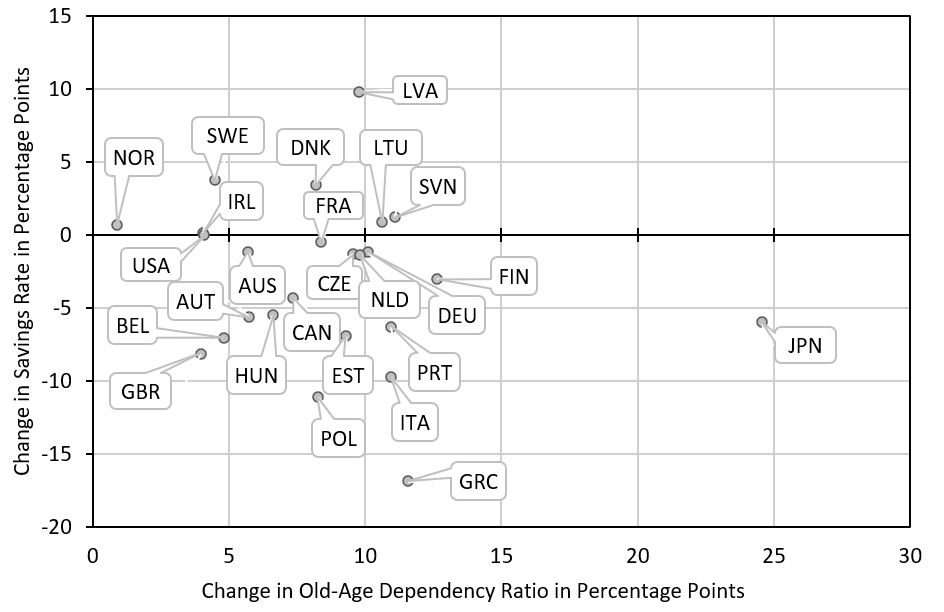 Source: Organisation for Economic Co-operation and Development (OECD). Household savings rates in percent of GDP.And here comes Hayek into play. If the central bank knew at what interest rate existing money savings would be equal to the demand for funds by investors, all would be fine. But the central bank cannot know this rate. Nevertheless, it presumes to know. In vain attempts to set the market rate at the level of the unknown natural rate, the central bank follows an error-correction process, with rates either too low or too high. The result of this is a credit boom-bust cycle, shown for the US in figure 1, which is accompanied by fluctuation in real private demand. But even if the Keynesian model is incomplete and therefore misleading, could the Keynesians nevertheless be supported by empirical facts? The answer is no. We could not find support to the view that ageing societies save more.6 In fact, as figure 2 shows, changes in the old-age dependency ratio in Organisation for Economic Co-operation and Development (OECD) countries are not linked to systematic changes in household savings rates. If at all, households tend to save less when populations age. Moreover, we also fail to find a systematic decline in the marginal productivity of capital, as suggested by the secular stagnation theory (see figure 3). Figure 3: Marginal Productivity of Capital of US, Japan, and Germany  Source: AMECO. Marginal productivity of capital defined as the absolute change of real output compared to the previous year divided by real investment of the current year.This evidence strongly supports the view that economic agents have adapted to the low-rate environment created by the central banks (and not the central banks to an environment of "naturally" low rates). One consequence of this is that inefficient firms are kept alive artificially. Based on firm-level data from fourteen advanced economies, Ryan Banerjee and Boris Hofmann find a rise in the share of zombie firms, defined as unprofitable firms with low stock market valuations, from 4 percent in the late 1980s to 15 percent in 2017.7 This implies that central banks have contributed to the low-growth environment by impeding productivity gains. Moreover, in attempts to reanimate growth, government debt has increased to levels last seen in times of major wars (see figure 4). As a result of the adaptation of economic agents, an exit from the low-rate environment most likely would be accompanied by major financial and economic disruptions. The last time a major central bank knowingly took the risk of disruption for the sake of ending a low-rate policy occurred in Japan in the late 1980s. Since then, no central banker has wanted to repeat this unhappy experience. Figure 4: Public Debt Ratios Source: OECD Economic Outlook.This leaves us with a quite skeptical outlook for the credit money system. Inflation is likely to get out of control and money will probably need to be reanchored one way or another. Central bank digital money could help to achieve this and preempt a monetary crash.8 But central bankers are probably too risk averse to try experimental therapy even in the face of death.
 This posting includes an audio/video/photo media file: Download Now |


| You are subscribed to email updates from Mises Wire. To stop receiving these emails, you may unsubscribe now. | Email delivery powered by Google |
| Google, 1600 Amphitheatre Parkway, Mountain View, CA 94043, United States | |




No comments:
Post a Comment