 |  | | Washington, Fast. | | Presented by ExxonMobil | | | | | | | Good Wednesday morning. HBD 🎂 to Power Up fans & readers real and imagined: Fran McDormand, Bernie Schneider and Nintendo 64. This is the Power Up newsletter – thanks for waking up with us. | | | At the White House DEBATE ESCALATES OVER CONTROL OF BIDEN'S NEW HEALTH AGENCY: There's at least one proposal leftover from the Trump administration that President Biden is set on reviving: the creation of the Advance Research Projects Agency for Health (ARPA-H). In the administration's debut budget proposal, the National Institutes of Health received $6.5 billion to launch the new agency modeled after the military's Defense Advanced Research Projects Agency (DARPA). ARPA-H would accelerate the development of medical treatments for Alzheimer's disease, cancer, cardiovascular disease, and more. But there's a battle brewing over where exactly the agency should be housed — and how it should be structured to have the most impact. 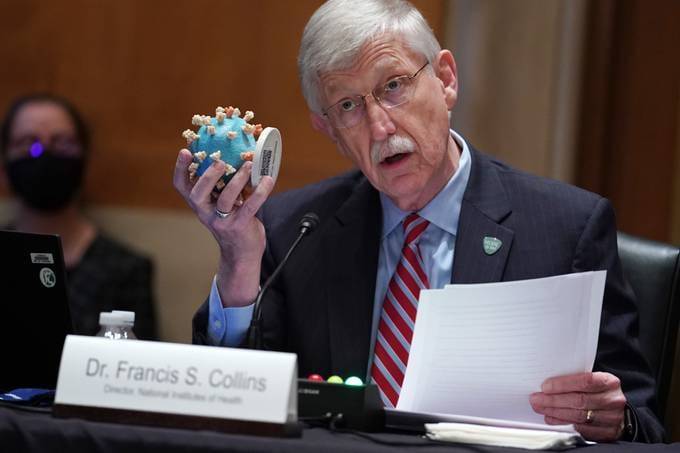 National Institutes of Health Director Francis Collins testifies before a Senate Appropriations Subcommittee looking into the budget estimates for NIH. (Photo by Sarah Silbiger-Pool/Getty Images) | Medical experts and some lawmakers believe that for the agency to successfully innovate, it should be a stand-alone entity within the Department of Health and Human Services, and free of what many experts view as NIH's bureaucratic and time-consuming approach to innovation and research. The White House and NIH Director Francis Collins, however, are making a full-court press to house the entity inside NIH. Collins and Eric Lander, Biden's new director of the White House Office of Science and Technology Policy, published an abstract in Science Magazine yesterday outlining how a "DARPA-like culture at NIH can drive biomedical and health advances." - "I think it would be a big mistake to put this outside of NIH," Collins told us in an interview. "You'd immediately create all manner of administrative duplications. "There would be potentially a sense of competition about who is doing which part of which project [and it would] lose the synergy with [an] already deep bench of scientific capabilities in NIH."
- "This project is the president's project," Lander also told us. "He's been interested in this since the campaign and he has a deep understanding of the biomedical ecosystem... This isn't really my choice or Francis Collins's choice. This is the president's choice."
- Read our full piece here.
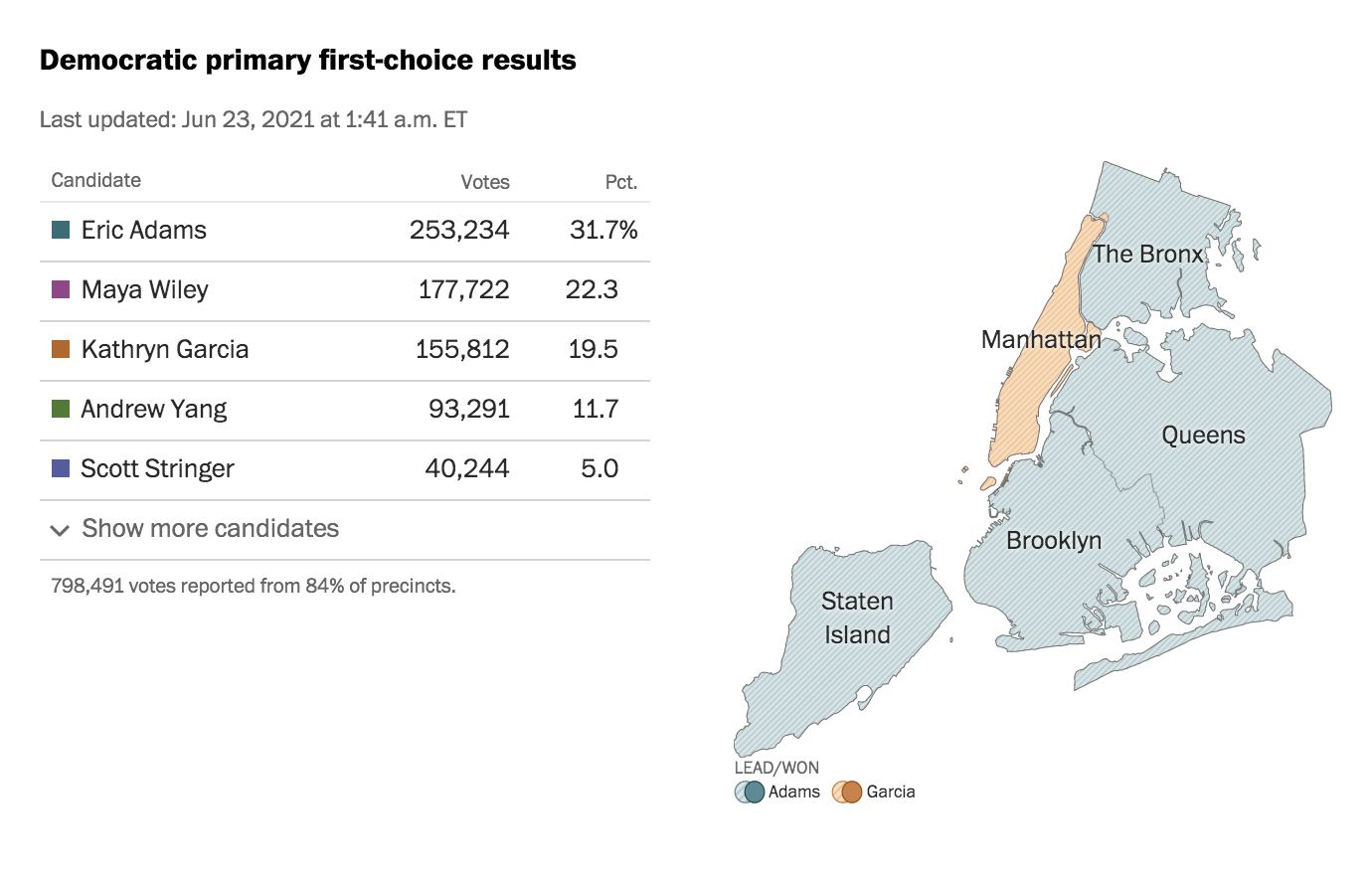
| | | The campaign 🗳️NYC PRIMARY UPDATES: "New York's Democratic primary for mayor was left unsettled on Tuesday night, with Brooklyn Borough President Eric Adams, a former police captain, appearing to have the advantage in the city's first ranked-choice election," our colleagues David Weigel and Jada Yuan report. - "Adams, 60, who would be just the second Black mayor of New York, emerged from a field that spent the last six months debating the city's rising crime and the difficulty of building back after the pandemic. Final results are not expected until July 12."
- "Two other candidates trailed Adams in first-choice votes but hoped to prevail in the final allocation of ballots: civil rights attorney Maya Wiley and former city sanitation commissioner Kathryn Garcia."
- "In a distant fourth was 2020 presidential candidate Andrew Yang. He conceded the race on Tuesday night, saying he had no path to victory."
| From a NY1 reporter: | 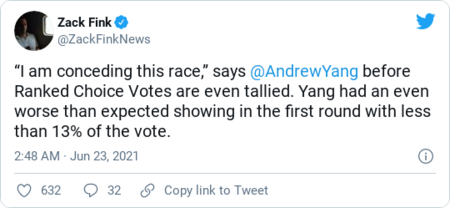 | | | Reminder: We may not have an official winner for weeks. "The earliest the final, official outcome will be clear — when the BOE counts every vote and certifies the results — is the week of July 12," The City's Josefa Velasquez and Samantha Maldonado report. "The initial outcome capped an intensely acrimonious campaign defined by debates over public safety and the economy, political experience and personal ethics, as the candidates presented sharply divergent visions for how they would lead New York into its post-pandemic future," the New York Times' Katie Glueck writes. - "But if the race was defined in part by clashes over policy and vision, it also had all the hallmarks of a bare-knuckled brawl."
- "Adams faced intense criticism from opponents over transparency and ethics, tied to reports concerning his tax and real estate holding disclosures and fundraising practices."
- "And Yang stumbled amid growing scrutiny of his knowledge of municipal government as rivals sharply questioned his capacity to lead."
| | | On the Hill THE GREAT CONGRESSIONAL GRIDLOCK OF 2021: "Republicans on Tuesday blocked the most ambitious voting rights legislation to come before Congress in a generation, dealing a blow to Democrats' attempts to counter a wave of state-level ballot restrictions and supercharging a campaign to end the legislative filibuster," the Times's Nicholas Fandos reports. - "There's no legislative path left to pass such a bill — or even the less ambitious bill Democrats already tried to pass in the previous Congress, the John Lewis Voting Rights Act," our colleague Peter W. Stevenson writes.
- And it's not just voting. Democrats are caught in a legislative bind. "On voting rights, on infrastructure and on their other big legislative priorities — including climate change and immigration — Democrats are pushed up against the limits of their razor-thin Senate majority."
So what can Democrats do? "The Republican blockade in the Senate left Democrats without a clear path forward, and without a means to beat back the restrictive voting laws racing through Republican-led states," Fandos writes. - "For now, it will largely be left to the Justice Department to decide whether to challenge any of the state laws in court — a time-consuming process with limited chances of success — and to a coalition of outside groups to help voters navigate the shifting rules."
But in terms of voting, all is not lost. "More than half of U.S. states have lowered some barriers to voting since the 2020 election, making permanent practices that helped produce record voter turnout during the coronavirus pandemic — a striking countertrend to the passage of new restrictions in key Republican-controlled states this year," our colleague Elise Viebeck reports. - "The newly enacted laws in states from Vermont to California expand access to the voting process on a number of fronts, such as offering more early and mail voting options, protecting mail ballots from being improperly rejected and making it easier to register to vote."
- "The push to make voting easier around the country comes even as Republicans have moved to restrict voting in GOP-controlled states such as Georgia, Florida and Iowa. Some states have passed laws that make some elements of voting easier and others harder, leading to mixed effects."
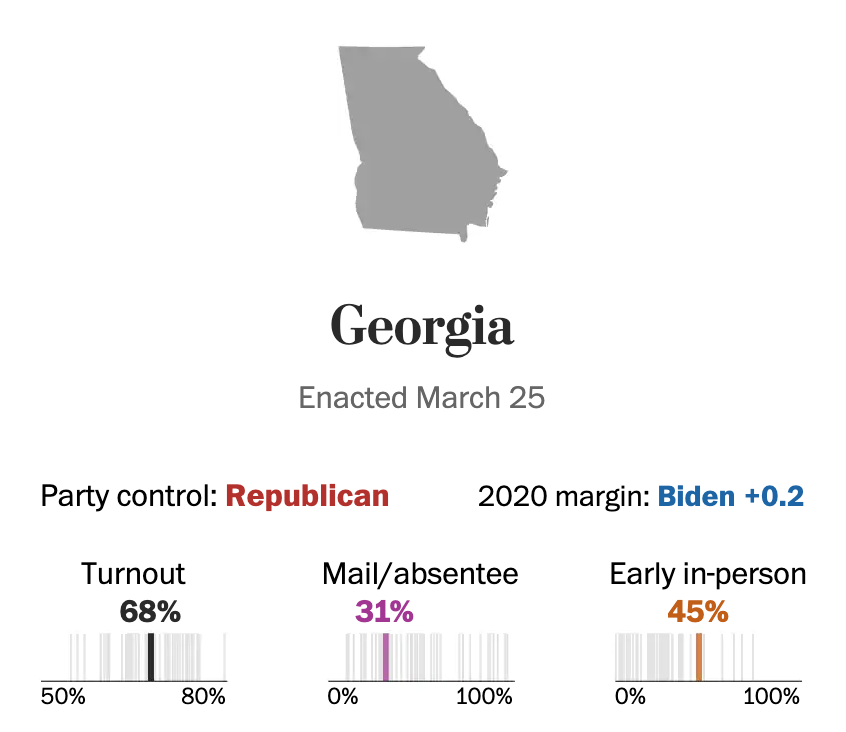 Combining elements from more than a dozen other bills, Georgia's new voting law signed by Gov. Brian Kemp (R) on March 25 imposes a number of restrictions on voting in the state, earning it comparisons to the Jim Crow laws. (Source: The Washington Post) | | | | At the Pentagon NO MORE CHAIN OF COMMAND: "Defense Secretary Lloyd Austin said Tuesday that he will work with Congress to remove sexual assault prosecutions from the military justice system, marking a dramatic about-face for the Pentagon, which for years has not meaningfully confronted an epidemic believed to affect thousands of personnel every year," our colleagues Dan Lamothe and Alex Horton report. - "The acknowledgment came one day after Austin received recommendations and a comprehensive report from an independent commission that reviewed the issue."
- "Austin said that he will present to President Biden within days recommendations for change, which will require amendments to the Uniform Code of Military Justice. The commission's work 'provides us real opportunities to finally end the scourge of sexual assault and sexual harassment in the military,' the defense secretary said."
- "Austin said in his statement that solving the sexual assault problem requires not only greater accountability, but also changes in the Defense Department's approach to prevention and victim's services, and to the climate in some units."
Discord among the chiefs: "The Pentagon's shift comes as lawmakers consider the Military Justice Improvement and Increasing Prevention Act, legislation proposed by Sen. Kirsten Gillibrand (D.-N.Y.) that would remove control of sexual assault cases from commanders's purview, and a day before bipartisan legislation aimed at similar changes is due to be introduced in the House." - But members of the Joint Chiefs of Staff have expressed concerns with the legislation. They argue that "taking all serious crimes out of the chain of command would undermine military leadership and potentially lead to unintended results, including a possible erosion of prevention efforts," per the Wall Street Journal's Nancy A. Youssef and Lindsay Wise.
Meanwhile, our colleague Missy Ryan tells us about the military's top man. - "Days after cameras captured him walking alongside Trump across a square near the White House that had been violently cleared of protesters, Army Gen. Mark A. Milley, chairman of the Joint Chiefs of Staff, sat in his office across the Potomac assessing the fallout."
- "People whom Milley respected had issued scathing condemnations of his role in the president's June 2020 photo op, saying it represented a military endorsement of Trump's suppression of peaceful protests, and a chorus of commentators called for the general to resign."
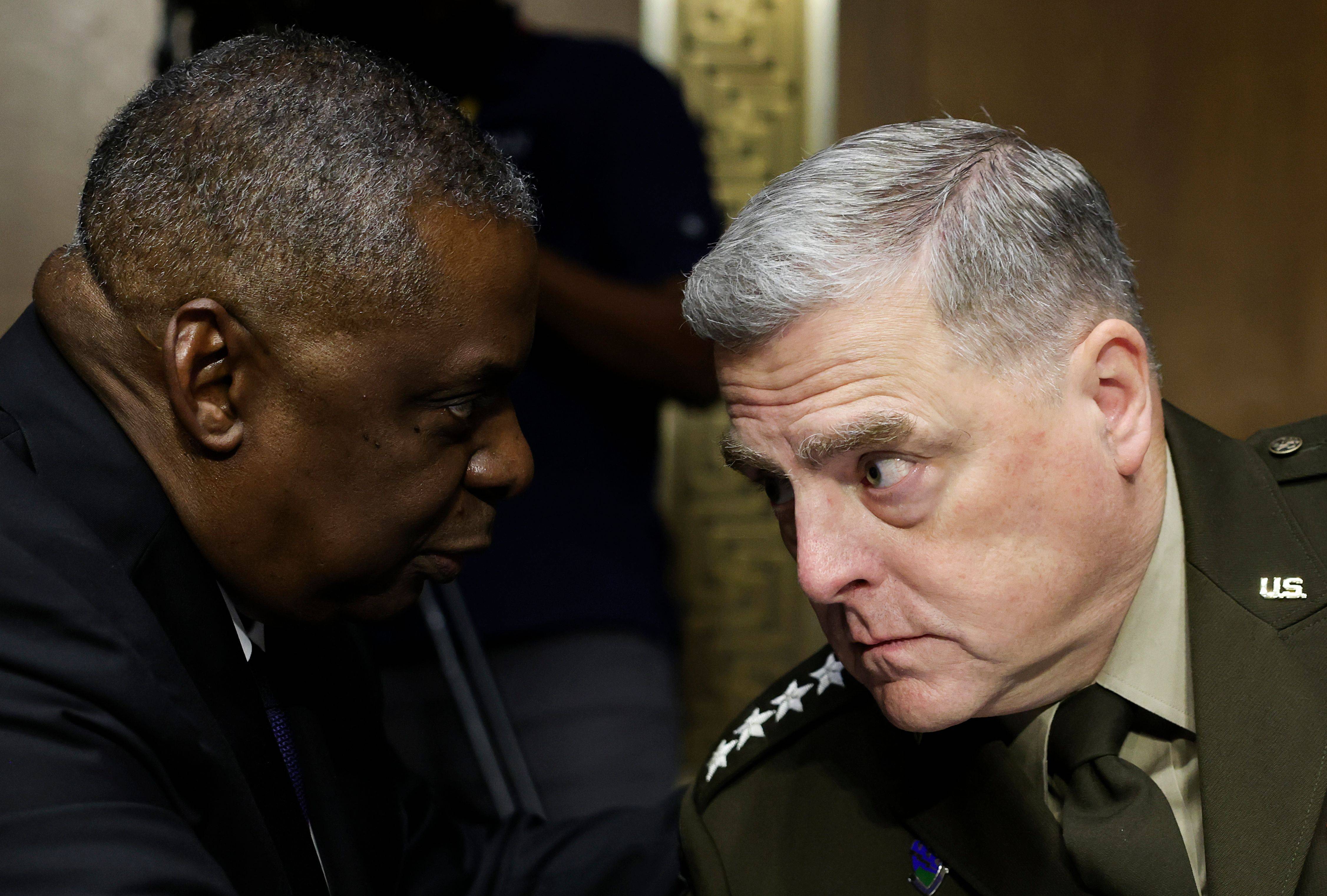 U.S. Defense Secretary Lloyd Austin talks with Joint Chiefs of Staff Chair Gen. Mark Milley during a Senate Appropriations Committee hearing on June 17. (Evelyn Hockstein/Pool/EPA-EFE/Shutterstock) | - "Milley tried to explain that the episode had caught him off guard, that he hadn't known Trump's intentions when they walked into an area where just minutes earlier authorities had used tear gas to disperse protesters. Milley also knew that to the cold gaze of history, it might not matter."
- "The whole thing was f---ed up," Milley, loquacious and often vulgar, told others after the fact.
| | | Global power 🚨: "Four Saudis who participated in the 2018 killing of Post journalist Jamal Khashoggi received paramilitary training in the United States the previous year under a contract approved by the State Department," the New York Times's Mark Mazzetti, Julian E. Barnes and Michael LaForgia report. - "The instruction occurred as the secret unit responsible for Khashoggi's killing was beginning an extensive campaign of kidnapping, detention and torture of Saudi citizens ordered by Crown Prince Mohammed bin Salman, Saudi Arabia's de facto ruler, to crush dissent inside the kingdom."
- "The training was provided by the Arkansas-based security company Tier 1 Group, which is owned by the private equity firm Cerberus Capital Management."
 An image of Jamal Khashoggi was projected onto the front of the Newseum in Washington on October 1, 2019. (Michael S. Williamson/The Washington Post) | | | | Viral | 🤨 |  | | | | | | | | | | | |


 Email
Email 





No comments:
Post a Comment