| When it comes to cyber diplomacy, America is back. That's one of the key messages President Biden is sending as he this week jets across Europe in a series of top-level diplomatic meetings. Those sessions have yielded a host of joint actions with allies condemning Russia's aggression in cyberspace and its tolerance for ransomware hackers who operate in its territory. The United States and its NATO allies also endorsed a new cyber defense policy and pledged that their commitment to joint defense extends to hacking as well. Today the president will meet with European Union leaders where a key topic will be combating Chinese dominance in next-generation technology that U.S. officials say could vastly increase the risks of Beijing spying or digital sabotage. Such cyber diplomacy wasn't absent during the Trump administration, but it was muddled by the chaos that regularly engulfed the administration. Efforts were also frequently undermined by then-President Donald Trump, who was hesitant to get tough with Russia and often undercut his own administration's efforts to rein in China's emerging tech dominance. 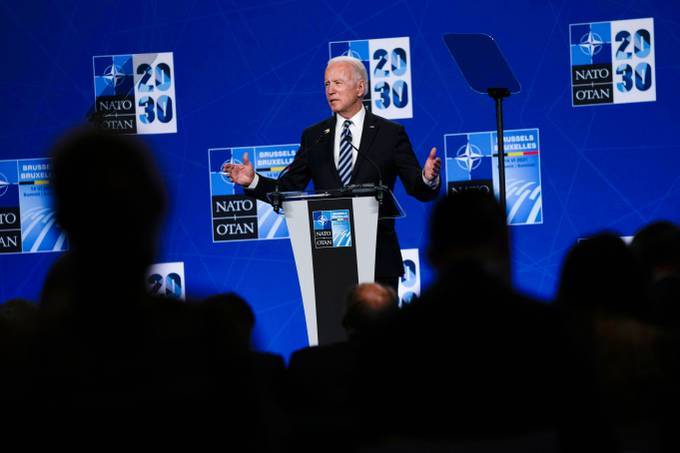 President Biden speaks during a media conference at a NATO summit in Brussels. (Francisco Seco/Pool/EPA-EFE/Shutterstock) | "This last week has demonstrated a very high-level leadership with the president himself talking about these issues. That will make a difference," Chris Painter, the State Department's top cyber official during the Obama administration, told me. On Wednesday, Biden will go toe-to-toe with Vladimir Putin in Switzerland, where he has promised to challenge the Russian president on espionage and criminal hacking and to set firm lines for when the United States will retaliate. "I'm going to make clear to President Putin that there are areas we can cooperate if he chooses," Biden said. "And if he chooses not to cooperate and acts in a way that he has in the past relative to cybersecurity and some other activities, then we will respond. We will respond in kind." The intense focus on cyber diplomacy is no guarantee of progress with Russia. U.S. officials have warned against expecting any big breakthroughs in the Biden-Putin summit. They're focusing instead on rallying allies to collectively respond to Russian cyber aggression. But it could begin a long-term process of changing Russia's behavior — especially if Biden follows up his warnings with concrete punishments for Russian hacking. "Will it make a difference in shaping Putin's behavior in the short term? That's going to be hard. I'm not highly optimistic there's going to be any epiphany coming out of the Biden-Putin meeting," Painter told me. He added: "But there won't be the failure of the president coming out saying, 'We agreed to have an impenetrable cybersecurity unit.' We know what the low bar is." That's a reference to Trump's comments upon exiting his first meeting with Putin in 2017, which were widely pilloried even by Trump allies including Sen. Lindsey O. Graham (R-S.C.).  Leaders of the Group of 7 pose for a photo overlooking the beach at the Carbis Bay Hotel in Carbis Bay, St. Ives, Cornwall, England. (Patrick Semansky/Pool/AP) | There's also a slight chance Biden and Putin could reach an agreement to limit ransomware gangs operating on Russian territory. Those gangs have wreaked havoc in the United States and Europe recently, including an attack on Colonial Pipeline that strangled gas supplies in the southeastern United States before the company paid a $4.4 million ransom to unlock its computers. "The ransomware criminals operating within Russia's borders are given a free hand, and are known to have received protection from the security services, but their activities relate only tangentially to Putin's core domestic and national security objectives," Dmitri Alperovitch, chairman of the Silverado Policy Accelerator, and Matthew Rojansky, director of the Wilson Center's Kennan Institute, wrote in a Post op-ed. "This makes stopping them exactly the sort of narrow, achievable objective Biden should pursue with Putin." There's also a possibility, Biden can successfully rally NATO allies to be more competitive with China when it comes to next-generation technology. The allies stated in their closing communique that "China's stated ambitions and assertive behavior present systemic challenges to the rules-based international order," as Michael Birnbaum, Anne Gearan and Ashley Parker report. Biden warned, "We're in a contest — not with China per se — but a contest with autocrats, autocratic governments around the world, as to whether or not democracies can compete with them in the rapidly changing 21st century." The Trump administration convinced numerous allies in Europe and elsewhere to reject the Chinese tech firm Huawei from building their 5G telecommunications systems over spying concerns. But the former president repeatedly muddled that effort and undermined his administration's national security argument by linking it with the broader U.S.-China trade dispute. | Share The Cybersecurity 202 |  |  |  | | | 


 Email
Email 




No comments:
Post a Comment