| First off, don't panic. Disruptions of major websites this morning are due to an error at the cloud computing service firm Fastly and a fix is coming soon. Details from the Financial Times's Matt Taylor: | 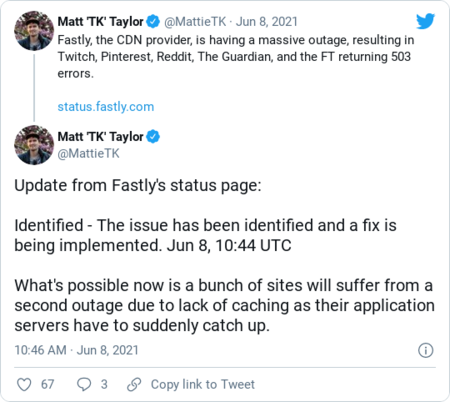 Now, on to the news. | The Justice Department's seizure of more than $2 million from the Colonial Pipeline ransomware hackers represents one of the most substantial blows against organized cybercrime to date. Although previous law enforcement operations have made it tougher for cybercriminals to conduct business, they've rarely created a situation in which those crimes aren't highly lucrative. The Justice Department action effectively erased the profit that the hackers made off a $4.4 million ransom the pipeline company paid in bitcoin to unlock its computer systems, Ellen Nakashima reports. The difference between the $4.4 million ransom and the $2.3 million seized is essentially due to the drop in the price of bitcoin and the ransomware version of processing fees. The department didn't reveal all the operation's details but said it used a method it could replicate again to obtain a key to the hackers' bitcoin wallet and take out the money. "The extortionists will never see this money," said Stephanie Hinds, acting U.S. attorney for the Northern District of California. "This case demonstrates our resolve to develop methods to prevent evildoers from converting new methods of payment into tools and extortion for undeserved profits." 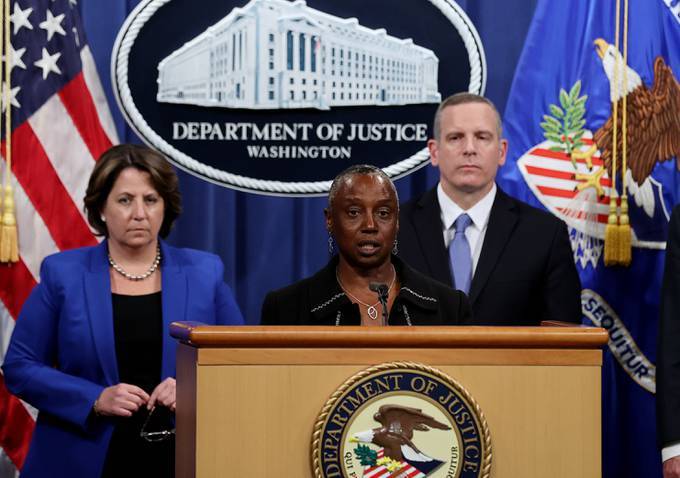 Acting U.S. attorney for the Northern District of California Stephanie Hinds speaks about the Colonial Pipeline ransomware attack. (Jonathan Ernst/Pool/EPA-EFE/Shutterstock) | The move comes as U.S. government officials are struggling to seize the offense against a surge of ransomware attacks that increasingly threaten U.S. economic and national security. In addition to the pipeline hack, a ransomware attack against JBS threatened U.S. meat supplies and a cavalcade of lesser attacks have temporarily closed schools, hospitals and local governments. Attacks against such vital institutions can often be more lucrative for ransomware hackers because those organizations can ill afford to stay offline and may be more likely to pay ransoms to unlock their computer systems and data. The Colonial ransom seizure alone won't be enough to ward hackers off such targets, but it could be a start. "No one seizure, no matter how big and flashy, is going to cast much doubt on the economics of the [ransomware] business model," Bobby Chesney, a former Justice Department official who directs the Center for International and Security Law at the University of Texas at Austin, told me. "But every journey starts with a first step and this is a pretty good step." If the Justice Department can repeatedly claw back ransoms in such high-profile cases, that could — at the very least — convince some ransomware gangs to focus on victims that won't draw as much attention from law enforcement and the public. "If it becomes sufficiently questionable whether you'll be able to monetize these efforts, that takes away a lot of the incentivizes," Chesney said. "The big question is how replicable is this." Seizing money can only be part of the solution. U.S. government officials also are pushing allies to force more transparency from cryptocurrency exchanges about who their customers are so they can identify ransomware payments. And they're pressing companies to improve their cybersecurity protections to stop hackers from seizing their computers in the first place. In the case of pipelines, officials are even preparing to mandate certain minimum protections. The seizure could take some heat off Colonial. The pipeline company has faced harsh criticism for its decision to meet the hackers' ransom demand — including from many lawmakers. House Oversight and Reform Committee Chairwoman Carolyn Maloney (D-N.Y.) called the payment a "dangerous precedent that will put an even bigger target on the back of critical infrastructure going forward." Colonial CEO Joseph Blount acknowledged that making the payment was "a controversial decision" in a Wall Street Journal interview, but said "it was the right thing to do for the country." Blount is scheduled to testify before the Senate Homeland Security Committee this morning and before the House Homeland Security Committee tomorrow. He praised the FBI after the seizure. "As our investigation into this event continues, Colonial will continue its transparency in sharing intelligence and learnings with the FBI and other federal agencies," he said. "Our goal is to help our peers in the critical infrastructure space strengthen their cyber defenses and to collaborate across industry so that we can thwart these types of attacks before they happen." Lawmakers also were quick to praise the Justice Department. House Intelligence Chairman Adam Schiff (D-Calif.) called the operation "a significant success, sending a message to these criminal actors that we can and will impose consequences on them — despite their efforts to remain untraceable and anonymous." Rep. Jim Langevin (D-R.I.), co-founder of the Congressional Cybersecurity Caucus: | Share The Cybersecurity 202 |  |  |  | | | 


 Email
Email 






No comments:
Post a Comment