| The siren song of Silicon Valley has hooked another Washington policymaker — and her hiring offers new clues about Google's health care ambitions. Amy Abernethy is the latest official to trade government acronyms for employment at Alphabet, the umbrella company for Google's ventures, as the tech giant tries to break through in the $3 trillion health sector. Abernethy – who recently stepped down as the Food and Drug Administration's second-in-command – will be announced today as president of clinical research platforms at Verily, the Google spinoff focused on health care innovation, the Health 202 scoops. It's the company's latest move to muscle up in health care.The hire was pitched as an effort to improve the speed and value of clinical trials by drawing on Abernethy's FDA expertise. Verily currently runs Project Baseline, a data-collection initiative to map human health and boost clinical studies. Abernethy told me that as an FDA leader, she felt the nation's clinical research infrastructure needed to be "more efficient, more patient-centric, and able to accommodate a larger number of medical products." "That's actually one of the main reasons I left FDA, to work on that problem," she added. It's also a notable get: the Biden administration vetted Abernethy to fill its still-open FDA commissioner job, and she ran many aspects of the agency's day-to-day operations and also oversaw its IT efforts before stepping down on April 23. "Amy coming on board is really a testament to how seriously we think that we can contribute to the evolution of clinical research," said Jessica Mega, Verily's co-founder and its chief medical and scientific officer.  (AP Photo/Jens Meyer, File) | Google-world's interest in health care is no secret. Alphabet founders Sergey Brin and Larry Page have long told allies that the sector is a potential business opportunity, ripe for reform — a persistent belief that's launched some intriguing ventures but has yet to pay significant dividends. (More on that below.) And to better navigate the heavily regulated sector, they've scooped up former officials like Robert Califf, who led FDA under Obama and now serves as a Google Health and Verily adviser; Karen DeSalvo, who served as the Obama administration's top health IT official and is now chief health officer at Google Health; and Vindell Washington, who was DeSalvo's successor and now runs Onduo, a virtual care company in Verily's portfolio. Andy Slavitt, the former Medicare chief and current senior adviser for the Biden administration's coronavirus response, also served on Verily's advisory board. 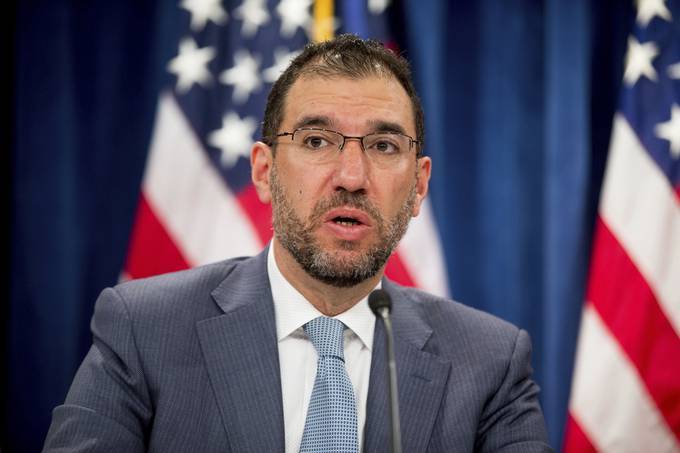 Andy Slavitt, former acting administrator of Centers for Medicare and Medicaid, speaks at a news conference at the Treasury Department in 2016. (AP Photo/Andrew Harnik, file) | The Google-affiliated companies have undertaken multiple approaches to health care, leaning on their data-driven initiatives and deep pockets. For instance, Google's cloud computing division struck a deal last month with national hospital chain HCA Healthcare Inc. to develop algorithms intended to boost care and efficiency, the Wall Street Journal's Melanie Evans reported. Google Health last month also announced an artificial intelligence-powered tool intended to help diagnose dermatological conditions. And the company's broader health efforts gained new momentum during the pandemic, as Google tracked coronavirus spread, built alliances with public health organizations and even released a memorable commercial about why people should get vaccinated. But much of Alphabet's health care work is now centered on Verily.Verily grew out of the moonshot factory then-known as "Google X," became a standalone company in 2015 and has pursued industry partnerships with companies like Johnson & Johnson and developed devices like a miniaturized glucose monitor. In a detailed profile for the San Francisco Business Times last week, reporter Ron Leuty described Verily as a "virtual hydra of health care," cataloguing the company's efforts to treat diverse conditions like opioid addiction and sleep apnea, launch insurance subsidiary Coefficient and even serve as a landlord for emerging businesses, backed by billions of dollars in funding. Coronavirus also teed up Verily for yet another investment: It's helping fund a startup led by Charity Dean, a former California public health official who was lionized by author Michael Lewis in his new book on the pandemic. 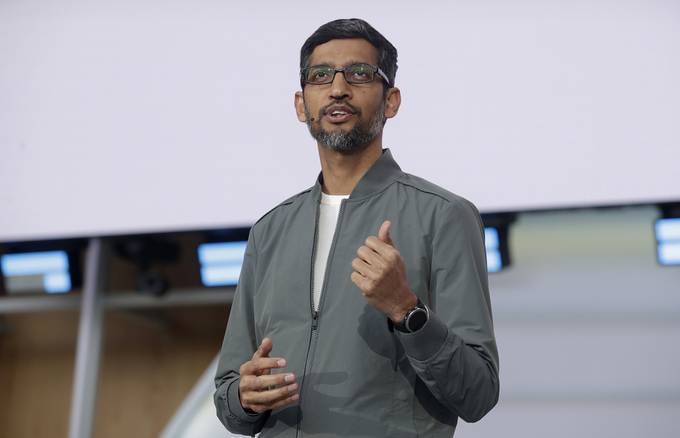 Google CEO Sundar Pichai speaks at the Google I/O conference in Mountain View, Calif. in 2019. (AP Photo/Jeff Chiu, File) | Verily's sprawling approach has raised eyebrows across health care.Outside executives and investors have grumbled that the high-profile company lacks focus and has a skimpy track record of producing hits. But few want to go on record criticizing Verily, given their own entanglements or the fear of crossing Google-world. Google's health efforts also were thrust into the national spotlight in March 2020 when then-President Trump announced in the Rose Garden that the company was developing a coronavirus website that would "determine whether a test is warranted and to facilitate testing at a nearby convenient location." But the episode turned into a public relations mess. Google distanced itself from Trump's pledge, with CEO Sundar Pichai vowing support but clarifying that the company's efforts were significantly more limited and centered on Verily. Trump dismissively dropped Google's statement on the floor during a press briefing. Still, the attention contributed to Verily winning contracts with California to perform coronavirus testing, a former official said. Meanwhile, would-be Silicon Valley reformers invite necessary scrutiny; health care is littered with a veritable graveyard of tech giants that promised to transform the industry only to peter out. (To say nothing of the spectre of a certain company known for its bad blood.) Verily isn't Theranos — far from it — but its executives on Wednesday side-stepped repeated questions about specific revenue targets and product goals, opting instead to focus on more far-reaching aspirations. "Health care and life science is complicated, and we're creating a movement," said Mega, Verily's co-founder. "To really succeed, we're going to have to improve the generation of evidence, which is what [Project] Baseline is all about. And we're going to have to develop better systems to apply the evidence so that people get better outcomes at a lower cost," Califf told The Post. "Ultimately, five years from now, you can judge us as to whether these have come together, and it's something that changes the way health care is delivered and also improves the health of people." | 


 Email
Email 




No comments:
Post a Comment