| Sen. Elizabeth Warren is calling on a federal watchdog to investigate Google for alleged abusive behavior in advertising, potentially adding to the tech giant's regulatory woes. The Massachusetts Democrat, however, isn't turning to the Justice Department, which already brought a historic antitrust case against the search giant. She wants the Commodity Futures Trading Commission to take on the case, arguing that the largely unregulated world of online advertising could fall under the jurisdiction of the country's top derivative markets cop. 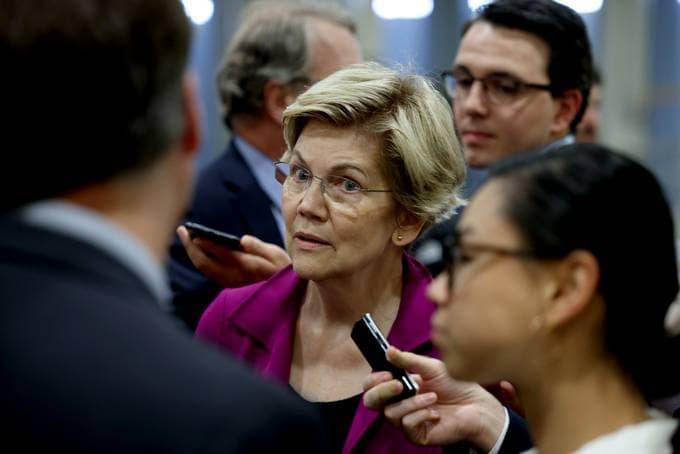 Sen. Elizabeth Warren (D-Mass.) speaks to reporters in the Senate subway. (Photo by Anna Moneymaker/Getty Images) | Warren specifically wants the regulator to drill into "Project Bernanke," a secret program that allegedly gave the company's own ad-buying system an edge over competitors by leveraging data from past bids. The program wasn't disclosed to publishers, and its existence first became public in court documents filed in a Texas antitrust lawsuit, as the Wall Street Journal reported in April. Texas alleged that the company's use of bidding information effectively amounted to insider trading in digital advertising, according to the Journal. "Given the power of a company like Google to unilaterally manipulate the online advertising market, it is critical that the CFTC ensures these new digital commodities are traded fairly and without harmful manipulation," Warren wrote in a letter addressed to CFTC acting chairman Rostin Behnam shared with The Technology 202. The letter reflects the broad political pressure on regulators to take on Silicon Valley. Amid concerns the Justice Department and Federal Trade Commission lack adequate resources to take on the tech industry, Warren is setting her sights on the ways that other government watchdogs could play a role in checking the industry's power. Her letter comes amid growing pressure for the nation's top financial and commodities cops to step up to new challenges of the digital age. Warren argues that online advertising could be considered a commodity, and therefore within the jurisdiction of the agency. She says that the CFTC has evolved to investigate other new commodities, such as cryptocurrencies, and now should do the same with advertising. Warren is homing in on ad exchanges. They've been compared to stock market exchanges, and facilitate the buying and selling of ads and determine prices based on real-time bidding. "The problem is that for more than a decade, Google has controlled the dominant ad exchange, the dominant ad-buying tools, and the dominant ad-selling tools," she wrote. "The situation has been ripe for manipulation, and there is now strong evidence that Google has taken advantage of its position." Warren says this would not conflict with the other ongoing challenges to Google's power. In addition to the Justice Department suit, the company is the target of state attorneys general and European regulators. Google has defended its practices in court. The company defended its use of the data in court records, calling it "comparable to data maintained by other buying tools," the Journal reported. Peter Schottenfels, a Google spokesman, said that Warren's letter is based on a "mischaracterization" of Google's ad system in the Texas case. The company claims it made these changes to "optimize advertiser bids." "Like many other businesses in this highly competitive field, we constantly work to improve our products and compete more effectively," he said in a statement. "That's the kind of behavior that increases competition and makes ads more effective for businesses large and small." Warren has long advocated greater accountability for the tech industry. She's known for her outside-the-box ideas about how to rein in the industry's power. In the 2020 Democratic presidential primary, she prominently called for the breakup of Apple, Amazon, Facebook and Google. The senator's threat was largely seen as a turning point in the relationship between Silicon Valley and the Democratic Party. And her ideas have now gone mainstream in Congress, as lawmakers advanced bills last week to dismantle Google and other tech giants' power. (Amazon CEO Jeff Bezos owns The Washington Post.) Warren today sent a letter to the new FTC chair, Lina Khan, calling for a "broad" and "meticulous" review of Amazon's acquisition of Metro-Goldwyn-Mayer Studios. She urged Khan to use the FTC's "broad authority" to probe the "possible anticompetitive effects this deal will have on streaming services and entertainment products in addition to the broader impacts that this transaction may have on workers, small businesses, and competition overall." | 


 Email
Email 








No comments:
Post a Comment