| In this edition: New York City votes, social conservatives bring more Latinos for the party, and Donald Trump returns to New Jersey's airwaves (thanks to Democrats). We just spent three months determining that Joe Manchin will vote for cloture on a bill he used to co-sponsor, and this is The Trailer. 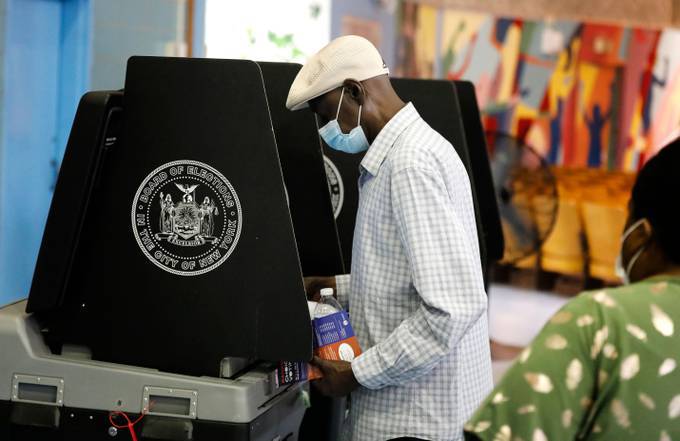 A man votes at Public School 81 in the Bedford-Stuyvesant neighborhood of Brooklyn on Tuesday. (Peter Foley/EPA-EFE/Shutterstock) | New York City's Democratic primary ended ugly, with accusations of "voter suppression" and race-baiting, fliers with fake endorsements, and a canvasser for one leading candidate recovering from stab wounds. The whole race was shaped by rising crime, and by media coverage of anti-Asian attacks and street violence. Andrew Yang, who had a following from his presidential bid but no experience in elected office, led in polls for months and grabbed most of the attention online. Gaffes about legal codes and city bureaucracies didn't change that, and at the start of May, the media covering Yang asked if they had been underrating his "breezy" appeal. That was not how Yang ended the campaign — trailing in polls, accusing Brooklyn Borough President Eric Adams of corruption and breaking a liberal taboo by saying that violent mentally ill New Yorkers were being treated too leniently. In debates and interviews, Yang was genuinely rattled by attacks on Asian Americans committed by mentally ill people, and he did not back down after rivals called his response offensive. "We all see these mentally ill people on our streets and subways, and you know who else sees them? Tourists," Yang told conservative radio host John Catsimatidis on Monday. "Then they don't come back, and they tell their friends, 'Don't go to New York City.' " No longer the favorite, Yang is one of three candidates closely training Adams in polls; the others are former city sanitation commissioner Kathryn Garcia and civil rights attorney Maya Wiley. Only Wiley has run as an ideological liberal, in line with the city's young, rising left. But liberal ideas have surfaced: All four have promised to expand affordable housing, with Wiley and Yang proposing that vacant offices and hotels could be rezoned. All four have pledged to rebuild equitably after the coronavirus, with Adams promising to be a "blue-collar mayor." Wiley proposed shifting $1 billion from the NYPD's budget and putting money into trauma-informed care for kids in school. Adams and Yang, meanwhile, talked about revisiting a law that allows police officers to be prosecuted for executing chokeholds, and took pains to praise the NYPD. "I don't hate police departments," Adams told the New York Times. "I hate abusive policing, and that's what people mix up." Adams benefited from a strong base of Black voters, and from Yang taking fire for most of the campaign. Both candidates benefited from super PACs, lavishly funded by donors such as New York Mets owner Steven A. Cohen and hedge fund manager Kenneth Griffin. Garcia and Wiley raised less, though an infusion from the city's public financing system kept them competitive, with Garcia buying up digital ad time. We'll know a lot tonight, as the city counts first-choice ballots cast from the early voting period through Election Day. (Polls close at 9 p.m. Eastern). We won't get the totals for every ballot until July 12. Here are a few things to watch at the top of the ballot and all the way down. How big is the electorate? Turnout in New York primaries peaked 32 years ago, when Manhattan Borough President David Dinkins ousted Mayor Ed Koch, with nearly 1.1 million ballots cast. Fewer than 700,000 turned out in 2013, a late-breaking race that ended when Bill de Blasio surged ahead with Black voters. Since then, Democrats have updated the state and city's archaic voting rules, pushing the primary up — it had been in September — creating a week of early voting and offering ways for absentee voters to correct their ballots if a problem keeps them out of the count. By Sunday evening, when the early voting period closed, nearly 192,000 New Yorkers had cast ballots in person. The majority of those votes came from Manhattan and Brooklyn, a typical pattern in modern Democratic primaries. Nearly 210,000 more voters had requested absentee ballots, with fewer than half returning them by Monday. It's not clear what that means for overall turnout, though multiple campaigns expect eventual turnout between 800,000 and 900,000, between a quarter and one-third of all eligible Democrats. Democrats were surprised in this month's Virginia primaries, when thin early voting was followed by robust Election Day voting. Voting changes have made it slightly easier to show up, more money is being spent to bring out voters and the race is genuinely competitive, unlike the de Blasio rout that 2009 turned into. Yang's campaign, which doesn't dispute that he has fallen from his spring peak, is betting on high turnout from voters who usually skip municipal primaries. Where does Adams win? Pollsters and rival campaign strategists expect Adams to lead in the first count of ballots. They also believe that the further the leading candidate is from a majority, the more likely it is that another candidate could surpass them. If Adams reaches 35 percent of the vote, and if no rival is within 10 points of him, the second-, third-, fourth-, and fifth-choice votes for other candidates probably will be too divided to overcome Adams. What would a big Adams advantage look like? Nathaniel Rakish's guide to the city's "five political boroughs" is a big help here. Adams's overwhelming support from Black voters, especially those over 40, should show up in the Bronx, which usually lags behind the city's other big liberal boroughs in turnout. Adams should dominate the Black-majority neighborhoods of Brooklyn, but Rep. Hakeem Jeffries (D-N.Y.), who represents a swath of them, has endorsed Wiley. That part of the city has been open to backing a left-wing Black candidate in the past, but not when a more moderate Black candidate has been on the ballot. The White liberal neighborhoods of Manhattan and Brooklyn are not natural Adams territory, but we'll know tonight just how divided those voters were on more liberal alternatives. What backfired at the end? Adams, who navigated some of the race's strangest controversies, rarely lost his cool. In debates, he complimented candidates for trying their best "feisty" attacks; he seemed to relish in attacking Andrew Yang. But in the final weekend, when Yang formed a ranked-choice alliance with Garcia, Adams blew up, dispatching surrogates to accuse the duo of racism and of trying to keep a working- class Black man out of City Hall. That was too much even for Adams's rivals. "I will never play the race card lightly unless I see racism," Wiley told reporters, "and I'm not calling this racism." Adams's goal was for Black voters to get fired up about his campaign. Garcia's goal was to get the second-preference votes of Yang voters who have not warmed to any other candidate, especially Asian American voters at the edge of Queens. Yang's advantage here is less obvious, but Adams gave him an opening, talking so dismissively about his rival that Yang, for the final time, could say that Asian voters were being disrespected. "I've been Asian all my life," he quipped to reporters, asked about the insistence of the Adams campaign that the deal with Garcia was a coup for White voters. (Garcia, whose ex-husband is Puerto Rican, is White.) There are signs that the deal helped Yang and Garcia, and some signs that it backfired. Public Advocate Jumaane Williams went out of his way to say he would not rank Garcia after her deal, so opposed was he to Yang. Karl McKoy, 60, a landscaper from England by way of Jamaica, ranked Adams first and Wiley second, but decided to leave both Yang and Garcia off his ballot after learning about their deal. "It just seemed like a strategic playing of the system," he said. "I really didn't like that move." Where do voters for straggling candidates go? Wiley's last-minute surge came at the expense of two candidates beset by very different problems: long-ago sexual misconduct allegations against city Comptroller Scott Stringer, and the spectacular staff revolt of the Dianne Morales campaign. The latter was a clearer boost to Wiley, as some left-wing voters were parking their first-choice preference with Morales, abandoning her once she looked too incompetent to compete. Stringer, who has denied the allegations, had hoped to unite left-wing voters and good-government liberals and has only belatedly sunk in the polls. But he spent more time attacking Yang and Adams than he did trying to win back votes from Wiley. "I actually don't think you're an empty vessel," Stringer told Yang in one debate, referring to a damaging article about how Yang consultants viewed him. "I think you're a Republican." We'll know tonight whether voters broke away from fading candidates — add former Citi executive Ray McGuire and former HUD secretary Shaun Donovan to that list. We'll know less whether voters took advantage of the ranked-choice system to cast sympathy or conscience votes for the lower-tier candidates, leaving the mystery of their next choices unsolved until July. What was the AOC effect? Rep. Alexandria Ocasio-Cortez was one of the primary's most sought-after endorsers, elevating comptroller candidate Brad Lander's profile — she stars in one of his ads — and leading the migration of Morales voters over to Wiley. Wiley's gains also came at the expense of Stringer; the comptroller's campaign hoped for an Ocasio-Cortez endorsement, but wrote it off after the allegations. (On Election Day, the congresswoman revealed that she had ranked Stringer second.) Derrick Jackson, 45, and Marc Hurlbert, 51, a couple who voted in Jackson Heights on Sunday, had decided on Wiley as they walked toward the polls, moved in part by the good word of their member of Congress: Ocasio-Cortez. "She and Elizabeth Warren are backing her and that's all I needed," Jackson said. "We need to be more progressive. I'm sick of straddling the fence and, you know, baby steps, baby steps. You have need someone who's actually going to go in and make a change." Ocasio-Cortez is the best known of many New York liberal politicians who have climbed into office by defeating a local machine. Six city council candidates are, like Ocasio-Cortez, backed by Democratic Socialists of America; the race to watch is in the 35th Council District, where DSA-backed Michael Hollingsworth is facing Krystal Hudson, a Jeffries-backed candidate, on a crowded ballot. Does the left split the vote? For the left, a good election night — or, let's be honest, election month — would be victories for Wiley and Lander, victories for the DSA's city council candidates, and a victory for India Walton in Buffalo's mayoral primary. (Albany, Rochester and Syracuse are also holding mayoral primaries today, along with the small Long Island city of Glen Cove.) Depending on whom you ask, it would also mean a victory for attorney Tahanie Aboushi in the race for Manhattan district attorney\ or, alternately, a win for former prosecutor Alvin Bragg. That race has split the mainstream left, with the Working Families Party backing Aboushi and other left-wing and liberal advocates backing Bragg. And because this is a county race, where ranked-choice voting won't be used and a plurality would win, backers of both worry about Tali Farhadian Weinstein breaking through. A veteran of the Obama administration's Justice Department, she has made reformers nervous and made opponents furious, spending $8.3 million of her family's money on a campaign that, among other things, accused Bragg and another candidate of favoring the rights of "domestic abusers," and dismissed attacks on her self-financing as "misogyny." Polling has been sparse, but a survey from the left-wing Data for Progress put Bragg nearly 10 points ahead of Farhadian Weinstein, boosted by his New York Times endorsement. Does anybody protest the results? We could get a hint of that tonight, too, but the question might linger for days. Three years ago, a Republican who got the most first-choice votes in a Maine congressional race sued after second-choice votes put now-Rep. Jared Golden (D-Maine) ahead. The case got nowhere, but the tenor of Adams's remarks this weekend has fueled speculation that he would seek legal remedy if he comes out ahead tonight, as multiple campaigns expect, but loses as the count continues, as multiple campaigns hope. Jada Yuan contributed reporting from New York. | 


 Email
Email 


No comments:
Post a Comment