The expanded child tax credit is working. Let's make it permanent. 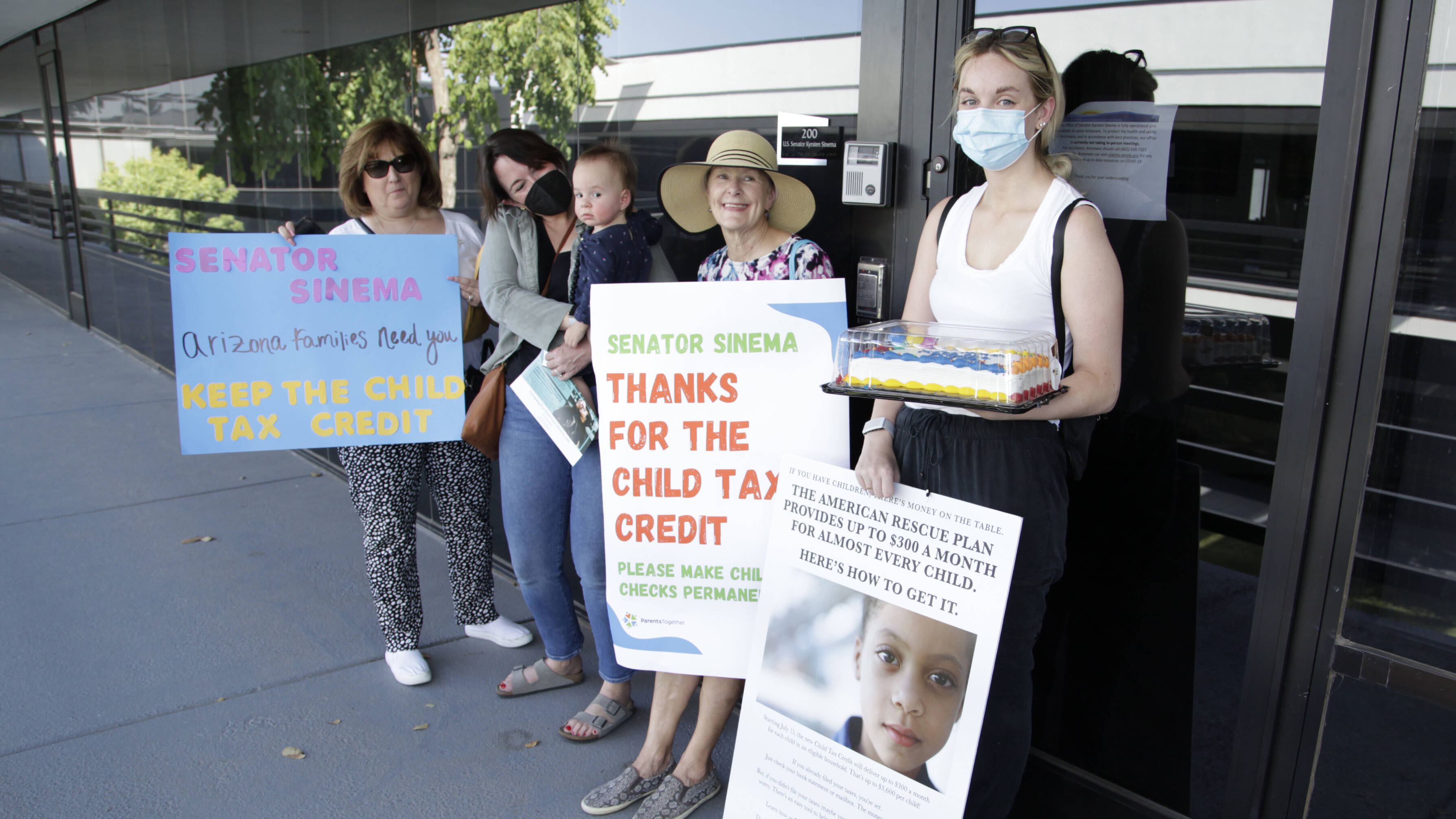 Demonstrators outside the Phoenix office of Sen. Kyrsten Sinema (D-Ariz.) this month. | There are just three child tax credit payments left to distribute this year, but there is already growing evidence that the plan to help lift families out of poverty is working. Families are building up much-needed emergency funds, digging out of debt and setting aside money for college. This makes a strong case for Congress to prioritize making the payments permanent. The American Rescue Plan expanded the child tax credit for the 2021 tax year to a total of $3,600 for children 5 and younger and $3,000 for those 6 through 17. Starting in July, parents of children 5 and under began receiving up to $300 a month per child. For parents of children ages 6 through 17, the monthly electronic deposit or check could be up to $250 per child. The credit itself isn't new. It was created in 1997 and has always been meant to help struggling families. What's different for 2021 is a significant increase from the pre-pandemic maximum of $2,000 per child under 17. Temporarily, for one year, the IRS is distributing an advance payment on a monthly basis instead of households having to wait to claim the credit when they file their tax return. With just half of the payments distributed so far, we know that the money is helping millions of families. Even after just one payment, the child poverty rate fell to 11.9 percent in July, down from 15.8 percent in June, according to a briefing paper from the Center on Poverty and Social Policy at Columbia University. In addition to lifting families just above the poverty level, the payments could also give people a chance to get a better financial footing for the future, according to a new study by the Social Policy Institute at Washington University in St. Louis. (You can find the entire report, "Employment, Financial and Well-being Effects of the 2021 Expanded Child Tax Credit," at the institute's website, at wapo.st/childtaxcredit.) "We know that families with emergency savings have lower rates of hardship, lower housing volatility, higher food security, all of which are important for children's development over the long term and their economic success," said Stephen Roll, assistant professor of research at the Social Policy Institute and one of the co-authors of the study. If the expanded child tax credit isn't extended, qualified families will go back to claiming the credit when they file their federal tax returns. However, while they wait for that yearly influx of cash — and at a lower amount under the regular rules — they often take on expensive debt to make ends meet. "When faced with a financial emergency or when income falls short of usual expenses, households typically turn to credit," the Social Policy Institute study points out. "For households with subprime credit scores, credit options may be limited to high-cost options such as payday loans." Payday loans are marketed to people with cash-flow problems. Lenders advertise these relatively small-dollar loans as a saving grace for people living paycheck to paycheck. Short on cash, they borrow using their next paycheck as collateral. However, here's what happens to a lot of folks. By the next payday, many borrowers can't pay off the loan, which then leads them into a cycle of debt. The fees, when annualized, can equate to a triple-digit interest rate. If families had a reliable stream of cash in the form of advance child tax credit payments, they might avoid getting into such expensive debt. The goal should be to "lessen families' risk for material hardship," according to the Social Policy Institute study. "… This is important because hardship is associated with a host of adverse outcomes related to other policy objectives, such as the increased risk for child maltreatment, child behavior problems, and intimate partner violence." A blog post from the Brookings Institution, based on the Social Policy Institute study, also argues the enlarged payments, delivered on a monthly basis, could have an even greater impact on pushing families up the economic ladder. When asked how they would use the child tax credit payments, 75 percent of parents reported they would put the money in an emergency fund. Let's stop right here. Living paycheck to paycheck creates an extreme amount of financial stress for families, frequently resulting in never being able to get ahead. Being able to weather a financial setback such as a major — or even minor — car repair can be the difference between someone keeping a job or being out of work. Families also indicated they would use the child tax credit payments to move to a better place or make home improvements. Others said they would get a tutor for their child or start a college fund. And for those who may complain about the cost of expanding the child tax credit, think about this, said Roll, who was also a co-author on the Brookings Institution blog post. Recent research from the Center on Poverty and Social Policy found that for every dollar we invest in the child tax credit, society gets $8 back in terms of higher future wages for the children being helped. "It's one of these areas where investing in children in this way is almost always going to pay dividends down the road," Roll said. Short-term child tax credit payments put food on families' tables. But the goal shouldn't stop at the bare necessities. As Roll points out, having some slack in their budgets gives families some financial freedom to think long-term. Allowing families to build an emergency fund, avoid an eviction, improve their living conditions and send their children to college with less debt are all worthy outcomes of the expanded child tax credit. Extend this benefit beyond this year and we have the potential to address a lot of other problems that keep so many families living paycheck to paycheck. Lift them up, and we all benefit. Reader Question of the Week If you have a personal finance or retirement question, send it to colorofmoney@washpost.com. In the subject line, put "Question of the Week." Please note that questions may be edited for clarity. Q: We are in our late sixties and would like to retire soon. The news about this possible government shutdown is very scary, and the thought of losing a significant part of our retirement fund is unimaginable. Should we pull money out from riskier investments such as stocks, and move it to bonds? A: As you get closer to retiring, it's natural to be nervous about how your investments will perform given any market turbulence brought on by current events. This week it's all about the possible government shutdown. At the same time, the Treasury Department is warning the government could default on its obligations if the debt ceiling isn't lifted. (Like many consumers, the federal government doesn't take in enough money to cover its expenses). To catch you up, here's the latest FAQ: What to know about a potential government shutdown Yellen tells Congress that U.S. will run out of debt-ceiling flexibility on Oct. 18 The debt-ceiling fight, explained The debt-ceiling debate is out of control. Here's how to stop the madness. Certainly, it's possible that the stock market could see steep drops if there's a shutdown while the country is still in recovery mode from the pandemic. But a graver situation would follow if the federal government defaults on its debts. That is likely to send the stock market into a tailspin. "Shutting the government down would not be an immediate hit to the economy, but a default would be a catastrophic blow to the nascent economic recovery from the COVID-19 pandemic," according to a report by Moody's Analytics. Read: U.S. default this fall would cost 6 million jobs, wipe out $15 trillion in wealth, study says The debt-ceiling fight carries a heavy financial price — even if we don't default On Tuesday, in part because of the budget and debt ceiling standoff, the Dow Jones industrial was down 1.6 percent. The S&P 500 dropped by 2 percent, and the tech-heavy Nasdaq fell by 2.8 percent. Read: Dow slides more than 500 points as Treasury yields hit three-month high At this point, it's unclear if you should be seriously worried. However, moving all your retirement investment funds to safer ground could be a mistake. Let's say stocks nosedive because of a shutdown. The government will eventually open back up again and then stocks could soar. You might miss the upswing. Most experts agree you need a master investment plan to avoid panic moves like what you're contemplating. If you're close to retirement or retired, you should have already rebalanced to a risk level you can tolerate. Your plan should also include enough emergency cash to weather a significant market downturn. Having this money available and not at risk will give your investment portfolio time to rebound if the stock market declines. If you haven't yet read the following columns, here's what experts recommend when the stock market is facing a tough time. In the long run, slow and steady stock-buying easily beats trying to time market dips, experts say Investing in 2020 was a scary, bumpy ride. Here's what to expect in 2021. The stock market is going bonkers. Here's what investors should know. A Wharton professor puts stock market plunges in perspective In Retirement News Part of planning for retirement and then living on the money you've saved or invested is keeping up with the issues that you need to know. In this section, I feature blogs, news stories, new research, surveys, and government policy changes that could affect your retirement. If you see a news story or issue you think would help folks, let me know and I'll check it out and share it with newsletter subscribers. Today, I'd like to continue the discussion about how hitting the debt ceiling, or the possibility that a government shutdown could impact the stock market. For this, you could let history be your guide. I read an interesting article on Investopedia.com on this topic. Referring to a report by the Schwab Center for Financial Research, the financial education website pointed out that, "shutdowns historically have had little impact on overall market performance." But after "a bitter fight over the debt ceiling in 2011, the S&P index dropped 6.7 percent the following trading day," Investopedia pointed out. Things did get bad in 2011: S&P downgrades U.S. credit rating for first time Standard & Poor's downgraded the U.S. credit rating for the first time because of "political brinkmanship" over the debt ceiling debate at that time. "The statutory debt ceiling and the threat of default have become political bargaining chips in the debate over fiscal policy," the 2011 report said. Yet, the market recovered and soared, including recently despite a global pandemic: Wall Street powers through the first half of 2021 with U.S. stocks at record highs Read: The stock market hit a double, but almost nobody noticed Retirement Rants and Raves This is your space to rant or rave about anything related to retirement. Send your comments to colorofmoney@washpost.com. Please include your name, city, and state. In the subject line put "Retirement Rants and Raves." Responses may be edited for clarity. Still Time to Share Your Story of Becoming an IRA, 401(k) or TSP Millionaire A growing number of workers have reached the millionaire's club – at least before taxes. If you've joined this club, I would like to hear from you for a future project. I'm hoping to show workers starting out how it's possible to become a millionaire in their workplace retirement plan. If you're responded already, I'll be contacting you soon. If you haven't responded and would like to share your story, email me at colorofmoney@washpost.com. In the subject line put "IRA, 401k or TSP millionaire." | 



 Email
Email 


No comments:
Post a Comment