| We're reading the tea leaves here, but it looks like the United States could be in for a sea change on abortion rights. Based on today's arguments before the Supreme Court about Mississippi's 15-week abortion ban, a majority of justices on the conservative-leaning court appear open to trimming or eliminating the existing right to an abortion during the first half of pregnancy. The justices probably won't rule until next summer. There is no federal law protecting abortion rights, but the 1973 Roe v. Wade ruling and another 1992 ruling affirmed that women can legally get an abortion until about 24 weeks. Here are three takeaways from one of the biggest days on the Supreme Court in years; I write about this in more depth here. 1. Four justices seem ready to overturn abortion protections 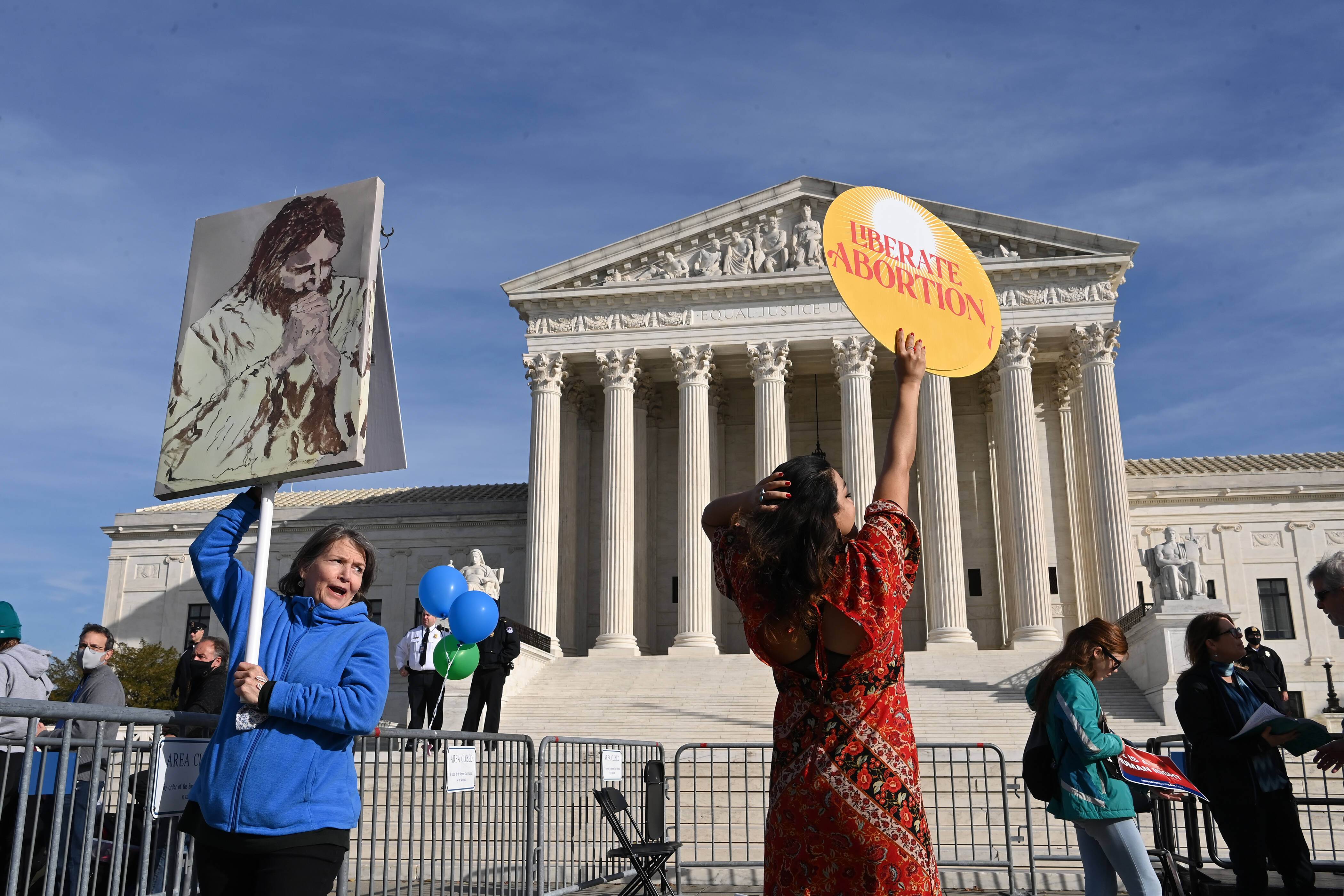 Protesters for and against abortion rights in front of the Supreme Court. (Matt McClain/The Washington Post) | That would be Justices Clarence Thomas, Samuel Alito and two nominated by former president Donald Trump: Amy Coney Barrett and Brett M. Kavanaugh. "Why should this court be the arbiter rather than Congress, the state legislatures, state supreme courts, the people being able to resolve this," Kavanaugh asked, suggesting he's in favor of letting states regulate abortion as they please. The court only needs five votes to overturn long-standing abortion protections; it looks like they're pretty close to having that. 2. The court could decide on a middle ground to allow abortion bans earlier in pregnancies Anything short of the court striking down Mississippi's ban in full would be a loss for abortion-rights supporters. Two of the GOP-appointed justices seemed open to letting Roe v. Wade stand, thus protecting a woman's right to abortion, but allowing states to ban abortion earlier — perhaps months before the current standard of viability (when a fetus can live outside the womb). "Why would 15 weeks be an appropriate line?" asked Chief Justice John G. Roberts Jr., in a telling question. A Trump appointee, Neil M. Gorsuch, asked similar questions. But Justice Elena Kagan, appointed by a Democratic president, argued that for 50 years, the right to abortion before viability has been "part of the fabric of women's existence in this country." If the justices allow some or all of the 15-week Mississippi law to stand, strict abortion bans could become reality in as much of half of the country. About a dozen states have trigger laws that would ban abortion immediately if Roe v. Wade were knocked down; more would greatly restrict it. 3. Republicans seem poised to achieve a sought-after political goal The battle over abortion is one of the oldest and hottest fights in modern politics. Conservatives are this close to winning it. And that's in large part because of their gamble in supporting Trump. He was not, shall we say, the typical buttoned-up candidate that evangelical Christians tend to support. But he promised to be the most antiabortion president in history, and he delivered by taking advantage of three openings on the Supreme Court to appoint justices who seem willing to uproot long-standing abortion protections. But did these Republicans go too far in pushing — and now maybe getting — abortion outlawed in a significant portion of the nation? Polls show nearly six in 10 Americans are just fine with Roe v. Wade. Conservatives getting what they want could actually rally the left to vote in next year's midterm elections, where Republicans are rightly optimistic about their chances to take back Congress. "For decades, the GOP has pushed this goal, but it was mostly a hypothetical — something few believed would actually come to fruition," writes The Post's Aaron Blake. Trump tested positive for coronavirus and went about his regular duties 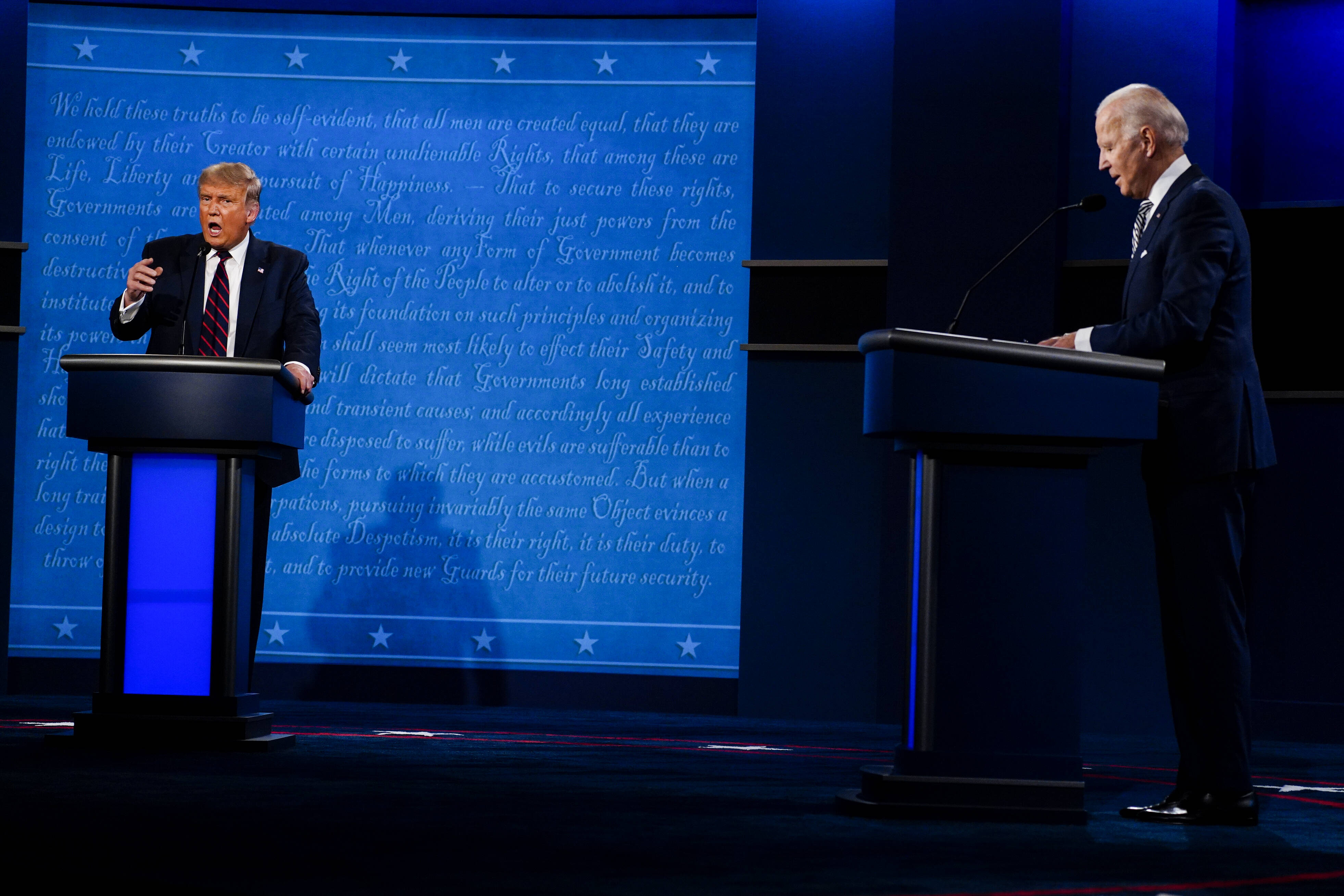 Trump may have known he had tested positive for coronavirus at this debate. (Melina Mara/The Washington Post) | That's what Trump's former chief of staff, Mark Meadows, says. Meadows wrote a book about his time in the administration, which The Guardian got an early copy of today. As president, Trump was tested daily, or more. Meadows writes that Trump tested positive after a potential superspreader event nominating Justice Amy Coney Barrett in September. But then he got another negative test and took that as liberty to go about his regular life. In the meantime, Trump went to: - A presidential debate with Biden.
- A meeting with Gold Star families.
- Fundraisers and rallies, all largely maskless.
- Briefings with reporters, where at least one thinks Trump probably gave covid to him.
In fact, Trump left in his trail a number of coronavirus infections from events he attended during this time. It wasn't until nearly a week later he announced he had tested positive, which was shortly before he flew in a helicopter to Walter Reed National Military Medical Center. If his symptoms had been less serious, would the president have tried to hide his coronavirus infection completely? Finally on this, The Post's Felicia Sonmez reports: "Asked Wednesday whether the former president put him at risk, Biden said, 'I don't think about the former president.'" | 




 Email
Email 


No comments:
Post a Comment