| Happy Monday, and welcome to another collaboration with The Early 202's Theodoric Meyer. Today: The federal government is struggling with when to bring employees back to the office and inside the Postal Service's effort to ship 500 million coronavirus tests. But first: | Public health experts suggest rethinking how much covid-19 death we're okay with | 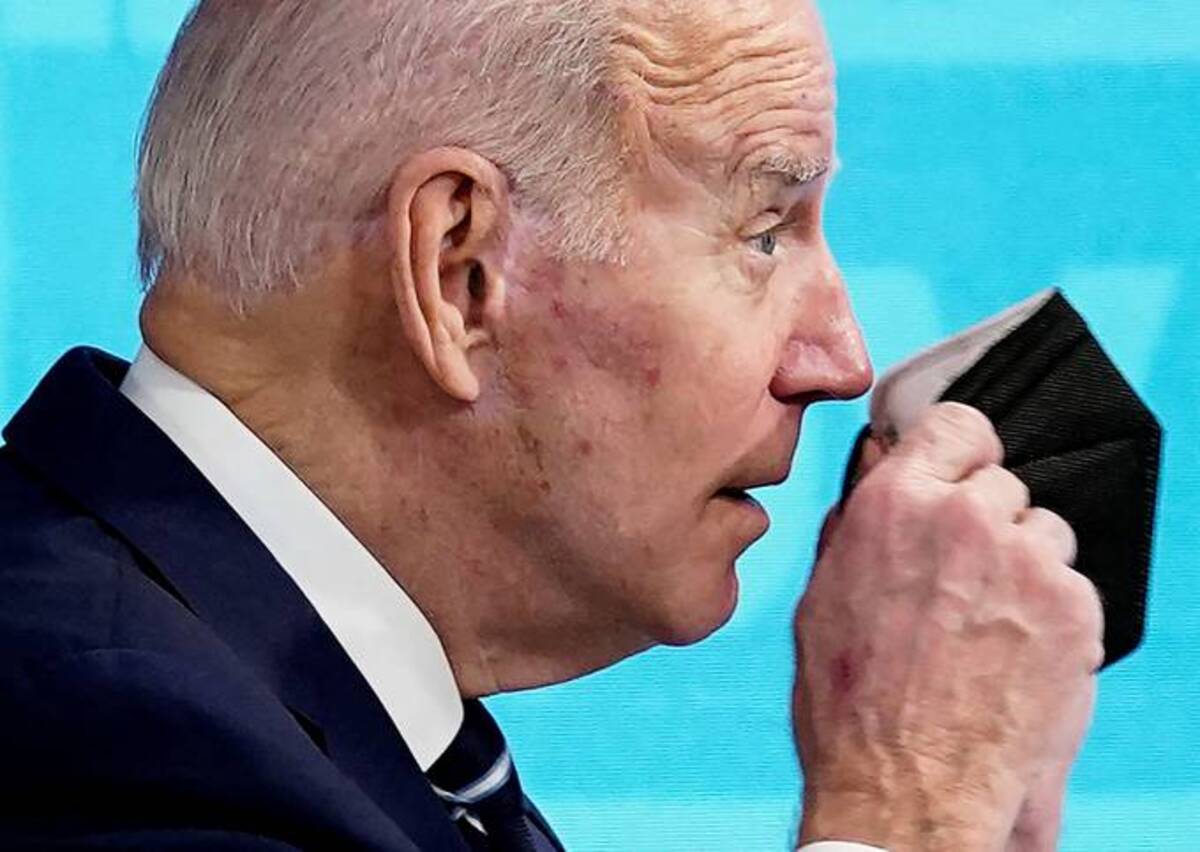 Some feel the Biden administration is struggling in its pandemic approach. REUTERS/Kevin Lamarque | | | Best practices: President Biden said last week he'd resolved to seek more advice from outside experts in the second year of his presidency — "more input, more information, more constructive criticism about what I should and shouldn't be doing." So Theodoric Meyer, one of our Early 202 reporters, and I surveyed more than a dozen outside experts — including epidemiologists, public health officials and think-tank types — to ask what more the Biden administration could do to meet perhaps its greatest challenge: curbing the seemingly neverending pandemic. Here are four of their suggestions: 1. Stop making decisions based on covid-19 numbers alone: It's hard to come up with a number of covid deaths that the country might accept in the long run. But several epidemiologists who advised Biden's transition team suggest one place to start: looking at the toll of similar illnesses before the pandemic. "In recent years, the U.S. has accepted as many as 35,000 hospitalizations and 3,000 deaths per week from influenza and respiratory syncytial virus (RSV) alone," Céline Gounder, Rick Bright and Ezekiel Emanuel wrote in a Stat op-ed last week. | - "We use that as a starting point for discussion because that is a level of hospitalization and death that society was willing to bear where we did not close schools, we did not have lockdowns, we did not mask," Gounder said in an interview. "We didn't do anything special, we just went about our lives."
| | The problems with tracking influenza, RSV, covid and other viral respiratory infections as a whole is a lack of data, Emanuel said. | - "We need to move toward it," Emanuel told us. "We can't quite do it now because we don't do a great job of tracking all infections and having the right databases in place."
| | What the administration says: Asked whether the Centers for Disease Control and Prevention might adopt such an approach, Director Rochelle Walensky said it's already collecting data on influenza, RSV and other viral respiratory infections. In an interview last week, Anthony Fauci, Biden's chief medical adviser, said covid-19 deaths and hospitalizations were still too high to start contemplating living with the virus. | - "Living with the virus when the virus is at a very, very low level … is okay," he told us. "That's something that we could accept, that we could move on with our lives. But to say that we want to live with the virus the way it currently is now, where it's averaging 156,000 hospitalizations and 1,900 deaths — that's not an acceptable level."
| | 2. Mandate vaccination for domestic air travel: The Supreme Court earlier this month struck down the Biden administration's vaccination-or-testing requirement for large employers, but the administration may have another option for inducing reluctant Americans to get vaccinated. Require Americans be vaccinated to fly. | - "Having vaccine — or at minimum vaccine-and-testing — mandates for domestic travel as well as international would help both with minimizing the spread of the disease, maximizing safety of airline travel, helping to protect our TSA workers, our flight attendants and our pilots," Megan Ranney, the academic dean of Brown University's School of Public Health, told us.
| | But support for the idea is not universal. | - "If the government imposes it, it will probably likely be mired in court, it will not actually result in more vaccinations and it will probably create much more backlash," Amesh Adalja, a senior scholar at Johns Hopkins University's Center for Health Security, told us.
| | What the administration says: Fauci has said a vaccination mandate for domestic flights is "something that seriously should be considered" but declined to discuss the matter in our interview. Asked about the idea, White House press secretary Jen Psaki told reporters earlier this month that "masking is very effective, according to our health experts, in protecting people on flights." 3. Put in place new rules to protect health-care workers: That's one potential virus-fighting weapon experts pointed us to. David Michaels, who led the Occupational Safety and Health Administration (OSHA) during the Obama administration and now teaches at George Washington University, said Biden's top priority on this front should be putting out a permanent standard to protect health-care workers. | - "Many hospitals still cling to the idea that the coronavirus as well as influenza are spread by droplets, which means that many workers, especially ones who don't directly provide care, are not given N95s [even] if they're in the vicinity of hospital patients," Michaels, a Biden transition adviser, said — which a permanent standard may help clarify.
- The agency issued a temporary standard last year but allowed part of it to lapse in December, as our colleague Dan Diamond wrote, "saying it wasn't ready to issue permanent protections by a December deadline, even though it believed 'the danger faced by health-care workers continues to be of the highest concern.'"
| | What the administration says: OSHA wrote in a court filing Friday in response to a suit filed by the National Nurses Union and other labor organizations that it would "re-prioritize its resources to focus on finalizing a permanent" standard. | - "The Agency currently anticipates that it will be able to complete this rulemaking within six to nine months," the agency wrote.
| | 4. Step up aid to other countries: The Biden administration has touted its efforts to send hundreds of millions of vaccine doses to countries that need them. But some global health experts say it's not nearly enough. "The verbal commitment is there," said Eric Goosby, a University of California at San Francisco, professor who advised Biden's transition team on the pandemic. "It's larger than any commitment made by any other country, but it is grossly inadequate." What the administration says: Asked about Goosby's call for the administration make better use of its infrastructure set up to combat HIV abroad in support of covid vaccination efforts, a White House official pointed to the $250 million for such programs that was included last year in Biden's covid relief bill. The money has paid for tens of millions of covid tests, and the administration has used "surveillance capabilities built for HIV detection to identify covid-19 hot spots and quickly allocate appropriate health-care resources," according to the official. Read the report in The Early 202. | | |  | Readers help us | | | Private insurers are now required to cover coronavirus tests. We want to hear from you how it's going. Has the process been easy or cumbersome? Have you had to pay up front for the tests or did you get them for free without paying first? How long is it taking to get reimbursed? Tell us all at rachel.roubein@washpost.com. | | |  | Coronavirus | | Inside the federal government's return-to-office struggle |  A security member walks outside the Department of Housing and Urban Development. (Matt McClain/The Washington Post) | | | Muddled plans: It's been two months since the Biden administration's deadline for federal workers to get vaccinated. But the government's plan to bring employees back to the office remains confusing, our colleagues Lisa Rein, Ian Duncan and Alex Horton report. | - ICYMI: On Friday, a Trump-appointed federal judge blocked the administration's vaccine mandate for federal workers and contractors.
- But even before, many agencies hadn't yet mapped out when and how to bring employees back, our colleagues note.
| | About half the workforce is still working from home as the pandemic enters Year 3, and the omicron surge prompted some agencies to scrap their return-to-office plans slated to kick in after the new year. While the vast majority of the civil workforce is vaccinated, officials haven't yet figured out how to deal with those who aren't. | When the Postal Service transforms into a relief agency | | The U.S. Postal Service is launching a high-stakes mission to deliver 500 million at-home coronavirus tests to Americans across the country. It's a role unprecedented in the agency's nearly 250-year history and comes as covid-19 infections have peaked within its own ranks, The Post's Jacob Bogage writes. | - Last week, Americans began ordering the free tests, which are scheduled to begin shipping by the end of the month.
- How the Postal Service is handling the effort: It's extended the contracts of 8,000 seasonal employees and converted over 40 facilities into fulfillment centers.
- Behind-the-numbers: The Postal Service plans to ship 2 million packages, each containing four test kits, every day.
| | "Success, though, is far from assured, postal officials privately concede," Jacob writes. Experts are keeping their eye on whether there are any test-kit processing snags, IT failures or delivery issues. | Another coronavirus treatment option | | Federal regulators approved the use of the antiviral drug remdesivir for coronavirus outpatients who are at high risk of being hospitalized. That gives doctors struggling with shortages of effective drugs another way of caring for infected patients, our colleague Laurie McGinley reported Friday night. Previously, the use of the intravenous treatment was limited to patients in the hospital. Now, the Food and Drug Administration says it can be administered to outpatients with mild-to-moderate illness — an expansion that includes both adults and younger children. | | The Food and Drug Administration's announcement: | 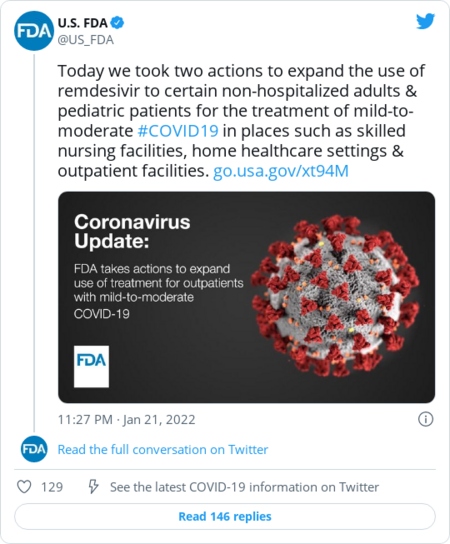 | | | | | |  | In other health news | | - The omicron variant was likely in the country over a week before its first case was identified, per a new CDC study analyzing wastewater samples.
- Tech darlings, like Netflix and Peloton, are now facing pressure after their popularity skyrocketed when people first started working from home, The Post's Aaron Gregg reports.
- When could this surge peak? Fauci was cautiously optimistic a peak for most states could come by mid-February, per comments on ABC's "This Week."
| | |  | Daybook | | | The House and the Senate are out this week. Monday through Saturday: The World Health Organization's executive board is meeting. Wednesday: The FDA has a virtual town hall on questions related to the development and validation of coronavirus tests. | | |  | Health reads | | By Michael D. Shear, Sheryl Gay Stolberg, Sharon LaFraniere and Noah Weiland l The New York Times ● Read more » | | | | By Brittany Shammas and Hannah Knowles l The Washington Post ● Read more » | | | | | |  | Sugar rush | | | Thanks for reading! See y'all tomorrow. | |






No comments:
Post a Comment