Mises Wire |
- Your History Teacher Lied About the "Era of Good Feelings"
- San Jose's Gun Tax Has Nothing to Do with Reducing Crime
- We Are All Canadian Truckers Now!
- Conscription as an Omen
- The Fed Is Trapped: It Has No Room to Taper or Raise Rates
- Bart Vanderhaegen on Flow: Transcending Organizational Barriers to Progress
- The Unseen Consequences of the Interstate Highway System
- Rising Rents and Cheap Money Flowing—So Apartment Prices Are Soaring
- Quantitative Tightening Won’t Stop Price Inflation
| Your History Teacher Lied About the "Era of Good Feelings" Posted: 02 Feb 2022 07:30 AM PST Virginia's stranglehold over American politics continues with President James Monroe. While high school textbooks refer to this period of one-party rule as the "Era of Good Feelings," the reality is the Second Bank of the United States offers some of the most vulgar examples of corruption the American people have seen. In this episode, Patrick Newman and Tho Bishop discuss the Panic of 1819 and the impact it had on political alliances for decades to come. Recommended ReadingThe Panic of 1819: Reactions and Policies by Murray Rothbard — Mises.org/LP7_A A Short History of Paper Money and Banking in the United States by William Gouge — Mises.org/LP7_B "The Scandal of Smith and Buchanan: The Skeletons in the McCulloch vs. Maryland Closet" by David Bogen (PDF) — Mises.org/LP7_C Cronyism: Liberty versus Power in Early America, 1607–1849 by Patrick Newman — Mises.org/LP_Crony To subscribe to the Liberty vs. Power Podcast on your favorite platform, visit Mises.org/LvP. |
| San Jose's Gun Tax Has Nothing to Do with Reducing Crime Posted: 02 Feb 2022 04:00 AM PST CNN touts San Jose as being "poised to take a step closer to first-in-the-nation gun ownership requirements." At first, I had thought that the poorly worded headline must be mistaken, as there are cities, such as Kennesaw, GA, that have required residents own guns. In San Jose's case, "gun ownership requirements" means paying an annual tax and being required to purchase insurance to exercise the right (privilege?) to own a firearm. CNN also published an opinion piece by San Jose mayor Sam Liccardo defending the recently passed legislation, saying "gun owners should cover the costs of gun violence." Why should individuals who played no role in the crimes of others be held responsible? I don't know the answer, but it seems that holding criminals responsible for their own misdeeds is becoming increasingly unpopular in California governance. Liccardo emphasizes the costs to taxpayers of gun violence, citing a report by the National Institute for Criminal Justice Reform. What stands out to me from the report is that it seems that it is only entities dependent on taxpayer money that unabashedly publicize how crazily inefficient they are in order to argue for more resources. Estimates in the report are typically on the high end; e.g., even though the median time served for murder in the US was 13.4 years in 2016, the National Institute for Criminal Justice Reform's estimated cost for incarcerating a shooting suspect in California is based on twenty-five years of imprisonment, costing $81,203 per year. Other expenses include police response to a homicide—not including investigation, which is another $12,200—costing $4,480 and $2,500 to clean up the crime scene. And, for some reason, "gunshot surgery" on a dead victim costs $45,200. Liccardo expects anyone who goes plinking with a .22 rifle to help pay for that. In defense of requiring gun owners to purchase insurance, Liccardo claims that it "incentivizes safe gun ownership, where risk-adjusted premiums might encourage owners to take gun-safety courses, use gun safes or install child-safety locks." He compares it to auto insurance: "In the context of auto safety, insurers rewarding good driving or the use of airbags have reduced per-mile auto fatalities by 80% in five decades, saving 3.5 million lives." As is often the case when looking at claims made by civilian disarmament advocates, they cite advocacy organizations that make it an involved process for the reader to determine the source and plausibility of those claims. Liccardo, in stating that incentives by insurance companies have reduced auto fatalities, links to a page run by the Educational Fund to Stop Gun Violence, which links to an article by progressive outlet The Nation, which cites a report by Ralph Nader's Center for Auto Safety. By going down this rabbit hole, one sees that Liccardo is making things up. The author of the Center for Auto Safety report does not even mention insurance as a reason for why traffic fatalities went down. Liccardo's comparison is based entirely on misdirection and obfuscation. In trying to implement both annual taxes and insurance requirements, Liccardo is throwing things at the wall to see what sticks, as the memo on the proposed legislation fully anticipates legal challenges on multiple fronts. Liccardo seems to be running a play out of the Obamacare playbook (or, really, a play based on Justice John Roberts's sophistic opinion that declared Obamacare's individual mandate a tax, which should have invalidated it, since taxing bills are to originate in the House). The Obama administration's argument was not that the penalty for violating the individual mandate is a tax, but that the federal government may force individuals to purchase insurance based on the Commerce Clause. In this case, Liccardo is covering both bases: the legislation has both an annual fee for gun owners (a tax) and a mandate to purchase insurance. Thus, if only one burden on gun owners is overturned, the other remains. Another legal challenge the bill's proponents expect to face is "the constitutionality of permanent seizure of the firearm as a consequence of noncompliance." Liccardo is surprisingly candid that the goal is disarmament:
Of course, the penalty for failure to provide proof of insurance for one's car is not impoundment (let alone permanent impoundment). We again see the intellectual dishonesty in comparing the legislation to regulation of automobiles. Also dishonest is the common practice of citing particular mass shootings as the impetus for further restrictions on gun ownership without asking, let alone answering, the question of how such restrictions would have done anything about the mentioned shooting. In his opinion piece, Liccardo begins by mentioning the May 26, 2021, San Jose shooting that resulted in nine deaths, as well as the suicide of the shooter. Although he does not claim that the measure would have prevented this event, it is an awkward incident to mention if he is making a case about the fiscal impact of gun violence since the vast majority of the estimated cost per shooting is incarceration, which does not apply in this case. Clearly, the intended effect of mentioning this shooting is emotional manipulation, not to provide a useful illustration. The emphasis on how much money the state spends in response to shootings is interesting in light of a relevant case decided by the Illinois Supreme Court in October 2021. The court decided that Cook County's special taxes on retail sales of firearms and ammunition violated the Illinois Constitution's uniformity clause because "the relationship between the tax classification and the use of the tax proceeds is not sufficiently tied to the stated objective of ameliorating" the costs of gun violence. The court decided that such a connection is necessary if Cook County is going to put a special tax on a fundamental right. However, the California Constitution does not recognize an individual's right to bear arms, nor does it have a similar uniformity clause from what I can tell, so San Jose's tax is unlikely to face a similar legal challenge, at least at the state level. Regardless of any laughable claims about reducing the burden on taxpayers, proponents know they will face legal challenges and that the taxpayer will have to pay for them. They know that the measure will do nothing about gun violence, as that is not the point. The point is to put extra burdens on gun owners and increase the powers of the state to disarm the public. This posting includes an audio/video/photo media file: Download Now |
| We Are All Canadian Truckers Now! Posted: 01 Feb 2022 12:00 PM PST We all remember where we were when the Berlin Wall came down. While it may have seemed that communist rule would go on forever, when the people decided that they had enough suddenly the wall fell. Just like that. Thus it is after two years of Covid authoritarianism that in Canada the largest truck convoy in history has smashed through the Berlin Wall of tyranny. I have watched as the Canada I once respected as a haven for antiwar Americans in the 1960s turned into one of the most repressive countries on earth. I wondered how a freedom-loving people could allow themselves to be abused by these mini-Stalins without a peep. But then Canada stood up and showed the rest of the world that freedom can triumph over tyranny if the people demand it. As I say, no army can stop an idea whose time has come. Canadian prime minister Justin Trudeau had been basking in his ability to terrorize the population in the name of fighting a virus. He was so confident in his seemingly unlimited power that he felt he could ridicule any Canadian with different views. The prime minister said in a recent interview that unvaccinated Canadians were "extremists," "misogynists," and "racists." When the Canadian truckers stood up to his tyranny and began their historic convoy to Ottawa, he thought he could continue ridiculing people. The truckers and their supporters were just a "small fringe minority" who hold "unacceptable views," he confidently claimed. For Trudeau, love of liberty is just an "unacceptable view." Less than a week later, as tens of thousands of trucks began entering the capital with millions of supporters behind them, the "brave" Canadian prime minister had fled the city and shuffled off to an undisclosed location. As Elon Musk Tweeted, "It would appear that the so-called 'fringe minority' is actually the government." The Canadian mainstream media is obviously just as obedient to the regime as ours. They ignored the Freedom Convoy for as long as possible. There was almost no reporting. Then, when it became impossible to ignore, they began to attack and ridicule instead of trying to report it accurately. It was disgusting and almost comical to see a "reporter" from the Canadian Broadcasting Corporation suggest that the Canadian Freedom Convoy was cooked up by Putin and the Russians! Thousands of trucks have arrived in Ottawa. They demand an end to covid tyranny. They are backed by millions of citizens, who braved the Canadian winter at night to cheer the truckers on. This protest is so important because it's not limited to Canada. The truckers are being supported worldwide, and a similar convoy is being planned from California to Washington, DC. In a US where grocery store shelves are increasingly bare, the truckers have more leverage than the powers-that-be would like to admit. If I were prime minister of totalitarian Australia or New Zealand – or most anywhere in Europe – I would be getting pretty nervous right now. Just as the Covid tyranny descended across the globe in a seemingly coordinated fashion, now that the Berlin Wall of the tyrants has been breached, it's just a matter of time before the shockwaves are felt far and wide. We owe a debt of gratitude to the Canadian truck drivers. Let's all do whatever we can to help the freedom movement continue to gather steam! This posting includes an audio/video/photo media file: Download Now |
| Posted: 01 Feb 2022 12:00 PM PST There is one step now proposed, supported by government propaganda, which seems to me to strike at the very basis of freedom. It is the proposal that we establish compulsory military training in time of peace. The power to take a boy from his home and subject him to complete government discipline is the most serious limitation on freedom that can be imagined. Many who have accepted the idea favor a similar government-controlled training for all girls. There is no doubt that the government, and particularly the War and Navy departments, are straining every nerve to secure the enactment of this legislation. Secret meetings are being held in the Pentagon Building and elsewhere. Recently the chief executive officers of some forty or more women's organizations were invited there, and it is said they were addressed by the Secretary of War, the Secretary of the Navy, the Under Secretary of State, General Marshall, Admiral King, and other high-ranking officers. The ladies were requested not to disclose the substance of the speeches made or identify the War Department or its officials with the sponsorship of the plan … Government propaganda is bad enough when it is open, but it is inexcusable when secret. We may expect a flood of open propaganda after the ground has been prepared, and everyone who is opposed to the plan will be pictured as for war and for unpreparedness. We have fought this war to preserve our institutions, not to change them. We have fought it to permit us to work out our problems here at home on a peaceful foundation, not on a foundation dominated by military preparations for another war. The question of the best form of military organization should not be an emotional problem. It should be dealt with by argument and not by propaganda. But the methods being used threaten the freedom of this country, for if they are successful they can be used to fasten upon us every kind of regulation, price control for business, wage control for labor, production control for farmers…. Military conscription is essentially totalitarian. It has been established for the most part in totalitarian countries and their dictators led by Napoleon and Bismarck. It has heretofore been established by aggressor countries. It is said it would ensure peace by emphasizing the tremendous military potential of this country. Surely we have emphasized that enough in this war. No one can doubt it. On the contrary, if we establish conscription every other nation in the world will feel obliged to do the same. It would set up militarism on a high pedestal throughout the world as the goal of all the world. Militarism has always led to war and not peace. Conscription was no insurance of victory in France, in Germany, or in Italy. The countries with military conscription found that it was only an incident and not the determining factor in defense or in victory. Military training by conscription means the complete regimentation of the individual at his most formative period for a period of twelve months. If we admit that in peacetime we can deprive a man of all liberty and voice and freedom of action, if we can take him from his family and his home, then we can do the same with labor, we can order the farmer to produce and we can take over any business. If we can draft men, it is difficult to find an argument against drafting capital. Those who enthusiastically orate of returning to free enterprise and at the same time advocate peacetime conscription are blind to the implications of this policy. They are utterly inconsistent in their position. Because of its psychological effect on every citizen, because it is the most extreme form of compulsion, military conscription will be more the test of our whole philosophy than any other policy. Some say it is unconstitutional. It makes very little difference whether it actually violates the terms of the Constitution. It is against the fundamental policy of America and the American Nation. If adopted, it will color our whole future. We shall have fought to abolish totalitarianism in the world, only to set it up in the United States. From a speech delivered by Senator Taft at the Gettysburg National Cemetery 1946. |
| The Fed Is Trapped: It Has No Room to Taper or Raise Rates Posted: 01 Feb 2022 09:00 AM PST Last November, the Federal Reserve System announced tapering (a gradual reduction of the central bank's monthly asset purchases to the point of ending the asset purchase program, which means that the Fed would stop increasing its balance sheet). In December, it announced another decrease in monthly asset purchases. And in the last Federal Open Market Committee meeting, held on December 14–15 and published in January, the committee participants spoke not only of finishing the tapering, but also of a faster rate hiking. In addition, participants spoke of reducing the Fed's balance sheet (selling the assets it holds, shrinking its balance sheet and the monetary base, M0) while it is hiking rates or after. This is the process called quantitative tightening, which is the opposite of quantitative easing, an expansion of the Fed's balance sheet through asset purchases (expanding the monetary base). Prior to the tapering announcement in November, the Fed was purchasing about $120 billion in assets a month ($80 billion in government bonds and $40 billion in mortgage-backed securities). That is, the Fed's balance sheet was expanding by about $120 billion each month (meaning that M0 was increasing at a similar pace): Chart 1: Fed Balance Sheet (Green) and M0 (Red), 2020–22  Source: FRED; author's own elaboration.And because the Fed has been buying a lot of government bonds (to cover much of the federal budget deficit; see chart 2), the money it has created has been spent by the government and has gone directly into the economy, increasing M1 and M2, as can be seen in chart 3. Consequently, the Consumer Price Index (CPI) soared in 2021 (reaching 7 percent in December, the highest level since 1982), as seen in chart 4. Note that this is the official CPI and that the government changed its methodology in the 1990s (if you want to know the details, listen to this episode of The Peter Schiff Show, starting at 10:04). According to Shadow Government Statistics, if calculated with the 1980s methodology, the CPI is slightly above 15 percent. Chart 2: US Budget Deficit, 2012–21  Source: FRED; author's own elaboration.Chart 3: M1 (Black) and M2 (Yellow), 2008–21  Source: FRED; author's own elaboration.Chart 4: CPI, 1980–2021  Source: Trading Economics; author's own elaboration.The Core CPI (which excludes food and energy prices), reached an annual rate of 5.5 percent in December (the highest rate since 1991): Chart 5: Core CPI, 1980–2021 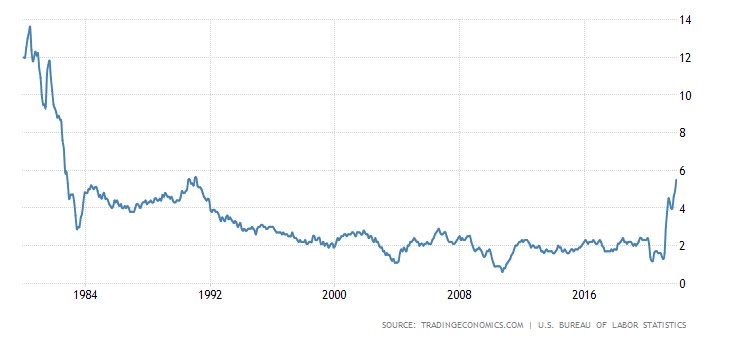 Source: Trading Economics; author's own elaboration.The Flexible Price Consumer Price Index, which measures the prices of CPI items that are much more flexible to economic conditions, reached 17.9 percent in December, the highest level in the entire historical series of this index, which began in 1967: Chart 6: Flexible Price Consumer Price Index, 1967–2021  Source: FRED; author's own elaboration. Note: Flexible Price Consumer Price Index in orange and the Flexible Price Consumer Price Index excluding food and energy in red.However, in December and in January the Fed did not taper that much. Between December 1 and December 29, the Fed's balance sheet expanded by $107 billion. As of this writing, the latest data available is for January 19 (the Fed's balance sheet data is updated every Wednesday), and between December 29 and January 19, the Fed's balance sheet expanded by $110.4 billion! And we still have one Wednesday until the end of January. The Fed doesn't have much room to raise rates. The interest rate on reserve balances, which is the rate that the Fed uses to influence the federal funds rate, is at 0.15 percent. In July 2021, the interest rate on reserve balances replaced the interest rate on excess reserves (the interest that banks received from the Fed on excess reserves they held with the Fed and which was the rate that the Fed used, since 2008, to influence the federal funds rate) and the interest rate on required reserves (the interest rate on reserves that banks are required to hold with the Fed). For details on how the Fed began to use the interest rate on excess reserves to influence the federal funds rate in 2008, read pages 61–68 of my article at Procesos de mercado. Note that the federal funds rate has been almost on the same level as the interest rate on excess reserves (and now as the interest rate on reserve balances): Chart 7: Federal Funds Rate (Red), Interest Rate on Excess Reserves (Green), and Interest Rate on Reserve Balances (Orange), 2019–22  Source: FRED; author's own elaboration.The highest level the federal funds rate reached in the last cycle of interest rate hike (2015–18) was 2.4 percent. In December 2018 there was significant turbulence in the US stock market, and in September 2019 there was a crisis in the repurchase market and the Fed started to inject liquidity into this market (doing QE and expanding its balance sheet). The Fed had started raising rates in December 2015 (but started lowering them again in the first half of 2019) and started shrinking its balance sheet in late 2017 (but in September 2019 was expanding it again). So, the Fed was not able to shrink its balance sheet and raise rates previously. Therefore, most likely, the US economy would not support rate hikes right now. The Fed stopped raising rates to avoid a significant stock market drop in late 2018, when the interest rate had reached only 2 percent. At that time, the US federal debt stood at "only" $22 trillion; today, it stands at almost $30 trillion. Therefore, it is likely that the maximum level that the federal funds rate can reach without complications in the financial market and in the economy is already lower than 2.4 percent. The Fed has even less room to raise interest rates right now. In addition, commercial banks are registering unrealized losses again. An increase (decrease) in the value of the assets that a bank has on its balance sheet represents an unrealized gain (loss) which would occur if the assets were sold. One of the measures the Fed often takes to convert unrealized losses into unrealized gains is to lower the federal funds rate. Note (in chart 8) that when the Fed raised the federal funds rate (green line, right axis), the banks started to register unrealized losses (purple line, left axis, below zero). To prevent this, the Fed started to lower the federal funds rate. Also note that recessions (represented by the grey bars) have occurred most times after unrealized losses have been registered. That does not mean that there will be a recession right now, as there are other factors to consider. But it shows how fragile the system is, considering that the Fed is barely tapering (let alone raising rates or shrinking its balance sheet) and the banks are already facing unrealized losses. Chart 8: Banks' Unrealized Gains/Losses and Federal Funds Rate, 1998–2022 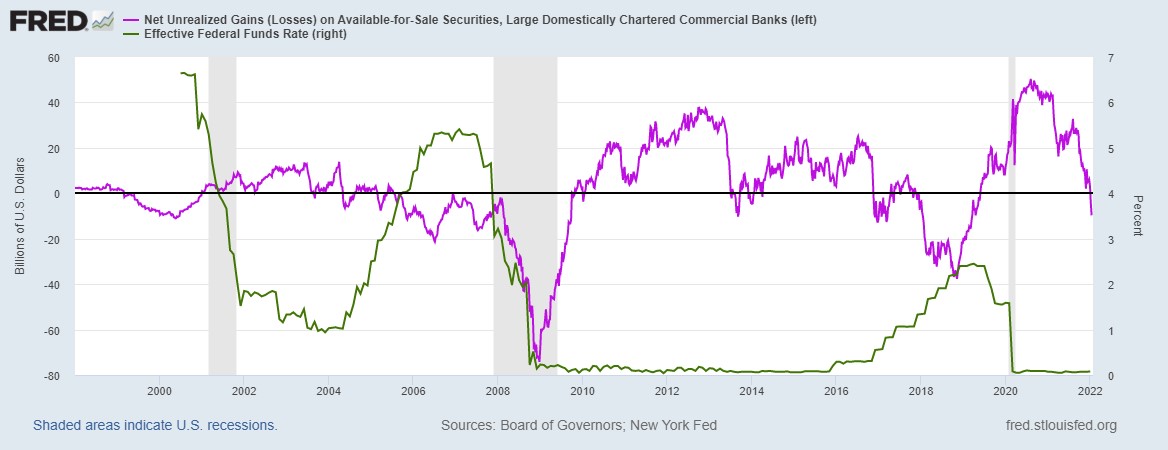 Source: FRED; author's own elaboration. Note: Banks' unrealized gains/loss are the purple line read against the left axis, and the federal funds rate is the green line read against the right axis.ConclusionThe Fed is trapped in its own web. It does not have much room to raise rates without major complications in the financial market and in the economy. Even if it finally delivers on tapering and starts raising rates, it won't get any further than it did back in the last rate hike (2015–18) and balance sheet shrinking (2017–19) cycles. This posting includes an audio/video/photo media file: Download Now |
| Bart Vanderhaegen on Flow: Transcending Organizational Barriers to Progress Posted: 01 Feb 2022 08:30 AM PST We all seek progress: at the individual level, the team level, and the company level. Flow is the term for the experience that we feel when we are making progress on challenging activities through our own actions. Flow is high productivity and high achievement. It is the sensation you have when making progress is "winning" over being distracted or frustrated. Organizational structure is often a barrier to flow. Bart Vanderhaegen tells Economics For Business how to transcend the barrier. Key Takeaways and Actionable InsightsLearning and change are good for people and organizations, but very hard to implement.Management books, management gurus and consultants are all for change to established ways of doing things. But the business landscape is littered with failed change and transformation projects. It's not people who resist change, it's processes and established practices and organizational structure. In many ways, structure is the biggest barrier to change, and the enemy of learning. Even when change projects re-make a business's structure, it's still there, just in a different configuration. What if it were possible to transcend structure? The secret lies in motivation.Austrian economics reveals the secret of motivation: every individual seeks better circumstances for themselves, trading one set of conditions that's unsatisfactory for another set that they prefer. That's an intrinsic motivation — it comes from inside the individual. Most business systems rely on extrinsic motivations, what Bart Vanderhaegen calls carrot and stick. The firm metes out rewards in the form of awards and bonuses and promotions for behavior it wants to encourage, and withholds them when there is unapproved behavior. The firm takes a positivist or behaviorist view of the world: people can be "nudged" into approved behavior patterns. Rewards have many flaws. They rely on predictions — setting future targets — that can never be reliable. These predictions are often fixed, unresponsive to changes in the environment, and usually set without much discussion with the individual who is to be motivated by the target. If the target is met or not, the individual finds it hard to know exactly how their actions contributed to the result. There is a third kind of motivation: FLOW.It is possible to harness a third kind of motivation that is neither carrot nor stick, and relies on neither reward nor punishment. It can provide autonomy and freedom to individuals to pursue what they find valuable. They can see their own activity as a contribution to a greater end or purpose for themselves. This kind of motivation comes from FLOW. FLOW is your absorption into an activity performed well. It's the enjoyment of performing an activity to the extent that you are actually experiencing that you are good at it, while you ae doing it. The activity itself creates the motivation for it. FLOW easily wins the internal competition between getting distracted or diverted versus making progress on the activity. We are progress-seeking creatures, and FLOW gives us the greatest sense of progress. FLOW is practical, and can be harnessed, practiced, and linked to work and organization.There are three conditions for being in FLOW, or getting back to FLOW when you fall out of it. 1) A clear and specific goal for the activity. This is not to be confused with aspirational goals like a corporate vision, or target goals like the year-end sales volume target. This goal is at the level of action. For the specific activity, what represents completion? In what time specific frame? What problem will have been solved when the action is complete? 2) Capture immediate feedback from the activity. The activity tells you if you are making progress. Measurement is in the activity itself — there is no outside judge. If you're not making progress, the activity can steer you back to it. Bart Vanderhaegen uses a tennis analogy: if your shots are going in, you're making progress; if not, you can adjust your action. 3) The activity must have a challenging but solvable level of difficulty. To make progress requires taking on challenges that can elevate our skills. FLOW requires overcoming difficulties (an insight that is contrary to the old adage of "keep it simple"). For those who are quantitatively minded, Mihaly Csikszentmihalyi, the founder of FLOW studies, measured the appropriate degree of difficulty as 10-12% harder than one's current ability — a kind of Goldilocks number of not too hard and not too easy. This has profound implications for organizations engaged in motivation. They must present ever-increasing levels of difficulty to their employees and teams, as they learn to perform better and better in the flow of taking on challenging tasks. 4) Organizational structure is a barrier to FLOW and to its power to solve complex business problems. FLOW can solve complex problems. When the overarching problem to solve is how to deliver customer value — which is a problem that cuts across all elements of corporate structure — a FLOWing team can succeed, because value is a clear goal, and learning by taking on difficult challenges provides a pathway to the goal. The customer doesn't care how the firm is structured. Internal structures of departments and functions and conflicting goals and rules can present a major barrier to FLOW and to customer value generation. A problem-solving team representing many departments and focused on the goal of customer value can transcend the barrier, and transcend corporate structure. Therefore, Bart Vanderhaegen recommends not to spend time and effort creating a new structure when the current one is problematic. Create FLOW over structure. 5) How to put FLOW into action. Like everything that has value, FLOW is a subjective experience. But there are some application actions that can help to generate team FLOW.
Through criticism and testing, teams will be able to FLOW to new levels of comfort in solving the most difficult of problems. They become more and more capable. And the problem-solving network is scalable: it can become bigger and bigger and solve harder and harder problems. Additional Resources"The Value-Creating FLOW Process for Business Problem-Solving" (PDF): Mises.org/E4B_155_PDF Bart Vanderhaegen's TED Talk: Mises.org/E4B_155_Video The Pactify Podcast: Anchor.fm/Pactify FLOW: The Psychology of Optimal Experience by Mihalyi Csikszentmihalyi: Mises.org/E4B_155_Book1 Creativity: Flow and the Psychology of Discovery and Invention by Mihalyi Csikszentmihalyi: Mises.org/E4B_155_Book2 |
| The Unseen Consequences of the Interstate Highway System Posted: 01 Feb 2022 05:00 AM PST Today, it's easy for socialists to point to the Interstate Highway System and exclaim, "Look at what we socialists did to facilitate transportation." They're careful to always ignore the unseen downside. Original Article: "The Unseen Consequences of the Interstate Highway System" This Audio Mises Wire is generously sponsored by Christopher Condon. Narrated by Michael Stack. |
| Rising Rents and Cheap Money Flowing—So Apartment Prices Are Soaring Posted: 01 Feb 2022 04:00 AM PST Fannie Mae announced last week that it provided nearly $70 billion in multifamily financing last year. The government lender crowed about $9.6 billion of the total being for affordable housing projects and $13.5 billion financing projects deemed "green and sustainable" units. This helped Fannie "grow its Multifamily Green MBS (mortgage backed securities) issuance to more than $100 billion last year," according to the press release. Fannie Mae apartment loan pricing and terms are attractive: the five-year fixed rate starts at 2.74 percent to the thirty-year fixed starting at 3.81 percent. Thirty-year amortizations are available and in some cases interest-only loans can be negotiated, as well as nonrecourse loans. The larger point is that with the Consumer Price Index at 7 percent in December, the real interest rate on these Fannie Mae loans is negative.  According to Multi-Housing News, "On an annual basis through December, rents increased by double-digit percentages in 26 of the top 30 metros, six of which posted gains of 20 percent or more: Phoenix (25.3 percent), Tampa (24.6 percent), Miami (23.5 percent), Orlando (22.7 percent), Las Vegas (22.2 percent) and Austin (20.9 percent)." So with rents rising and cheap money flowing, the prices of apartment projects are soaring. The latest Las Vegas multifamily announced sale is Ideal Capital Group's purchase of the 287-unit Jade project near the Rio hotel and casino for $124.5 million. That is a whopping $433,798 per unit. The covid shutdown in 2020 slowed project sales as many renters lost their jobs. But "Las Vegas' rental market has since heated up with fast-rising rents and shrunken availability, in part as people sought more space amid widespread work-from-home arrangements, and investor sales have rebounded," reports Eli Segall for the Las Vegas Review-Journal. Jade went for double 2021's average sales price per unit, $215,151. Average apartment sales per unit have risen over 460 percent, from $38,219 in 2011 to last year's price. Wolf Richter writes on his site, wolfstreet.com, that working people are harmed by inflation because their wages never catch up, while people with assets, inflated in value by low interest rates, reap the benefit. He writes, "[T]he wealth of the wealthiest 1% of households spiked, creating the biggest and worst wealth disparity ever to the bottom 50% and even to the bottom 99%, based on the Fed's own wealth distribution data."  Over lunch recently I expressed my astonishment over the $400,000-per-unit sales to a developer (and apartment project owner) I used to bank. He told me units would be selling for $500,000 by the end of this year. I said rents would have to jump even more or capitalization rates would have to go to virtually nil for that to happen. He said emphatically, "Rents are going up." People moving in from California believe rents in Vegas are cheap. Not for long. This posting includes an audio/video/photo media file: Download Now |
| Quantitative Tightening Won’t Stop Price Inflation Posted: 01 Feb 2022 03:00 AM PST Markets reacted badly last week to Federal Reserve chairman Jerome Powell's statements outlining the Fed's initial forecast for the coming year. With inflation clearly no longer being "transitory," with the Consumer Price Index accelerating to 7 percent in December, Powell has turned increasingly hawkish. Apart from seeming to confirm a series of rate hikes for 2022, markets were also shaken by Powell's confirmation that the Fed would begin reversing its bond-buying program in March. The opposite of quantitative easing (QE), quantitative tightening (QT) will see the Fed begin reducing its now more than eight-trillion-dollar balance sheet. The reason for the move, as San Francisco Fed boss Mary Daly put it, is to give the Fed more ability to fight inflation without resorting to multiple 2022 rate hikes. With experts increasingly dubious of the US economy's ability to grow in a higher-interest-rate environment, beginning QT in March would seem, on the surface, an obvious thing to do, the reasoning being that as QE seems to help hold down the yields of long-term bonds, doing the opposite should cause them to rise. This is true only in theory, however, and several considerations cast doubt on the enterprise. First, the history of QE, and thereby also of QT, is quite short. Apart from brief Japanese experimentation in the early 2000s, much of the evidence of their real impacts comes from the period 2008–19. During that time, there was no obvious correlation in the US between inflation and Fed balance sheet activities. If anything, inflation rose commensurately with QT. And, further, the period suggests that premiums on long-term bonds reflected inflation forecasts, not central bank balance sheet activities. Second, Bernanke's initial moves to reverse QE were memorably beaten back by the so-called taper tantrum, and the process then proceeded glacially. Today, the Fed's balance sheet is significantly larger than in 2013, and this presents a dilemma. On the one hand, were the pace as slow as it was under Bernanke's leadership, the sheer size of the Fed's balance sheet means the process would take a decade, thereby compromising the Fed's ability to respond to the next inevitable crisis. On the other hand, moving fast risks popping what looks like a "bubble in everything." With the S&P trading at a whopping thirty-six times its forward earnings, higher than at its 1929 peak, and home prices according to the Case-Shiller index nearly 67 percent higher than their 2006 record, the possibility of a crash landing can't be ruled out and will want to be avoided by policy makers. Lastly, while it isn't clear the Fed reversing its bond-buying program will do anything to bring down inflation, QT might again coincide with rising inflation if future expectations of inflation continue to be high and yields compressed, as The Economist points out that. Therefore, while QT will doubtlessly roil financial and equity markets—US firms being highly reliant on easy credit in the debt markets to finance their operations and leveraged positions—it seems highly unlikely on its own to dampen inflation. In short, the Fed remains trapped. While it may want to chicken out of rate hikes in 2022, the fact is inflation isn't going anywhere—barring the onset of recession. From its vast increase in the money supply to supply chain disruptions, commodity and labor shortages, elevated shipping and insurance costs, and geopolitical hazards, the Fed will have to raise rates or risk completely losing control of what is already a deteriorating situation. This posting includes an audio/video/photo media file: Download Now |
| You are subscribed to email updates from Mises Wire. To stop receiving these emails, you may unsubscribe now. | Email delivery powered by Google |
| Google, 1600 Amphitheatre Parkway, Mountain View, CA 94043, United States | |








No comments:
Post a Comment