| |  | On the Hill | | Zelensky expected to detail the aid he wants to combat the Russian invasion | 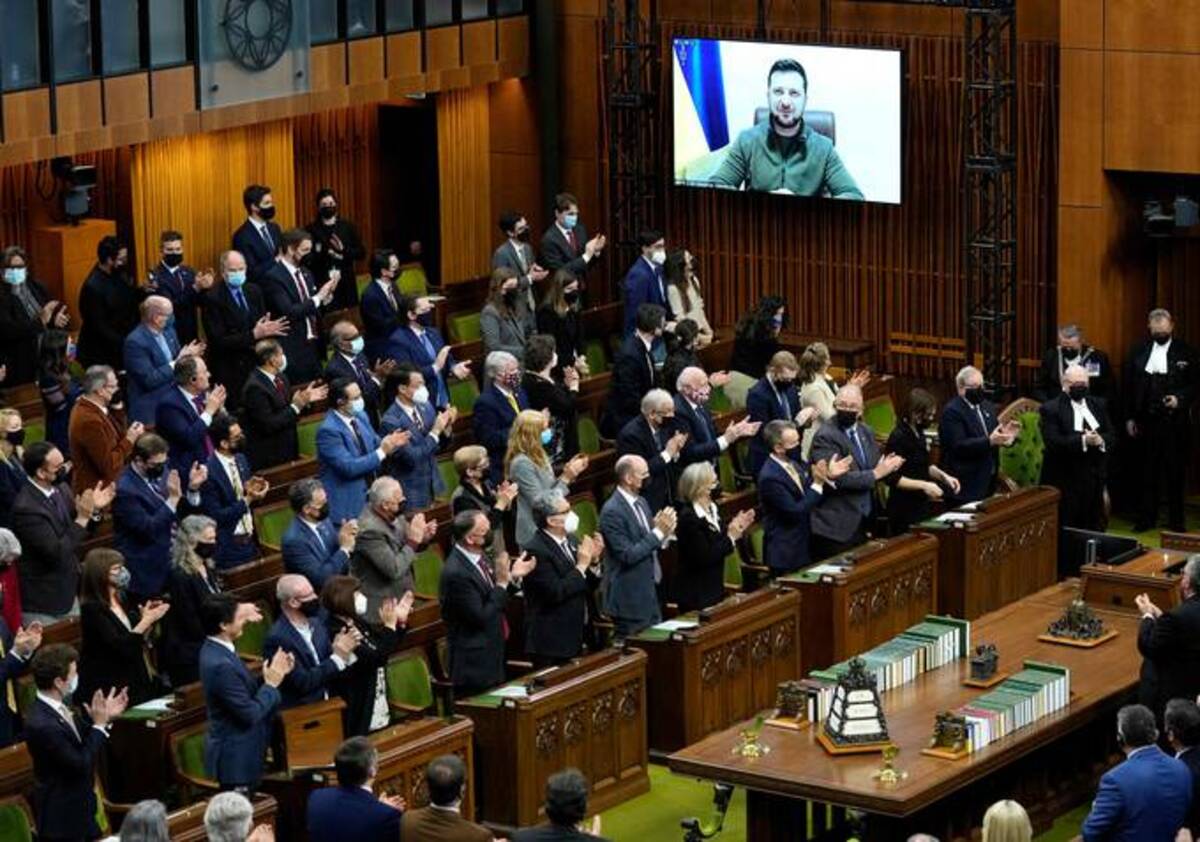 Ukrainian President Volodymyr Zelensky virtually addresses the Canadian Parliament in Ottawa on Tuesday. (Photo by JUSTIN TANG/POOL/AFP via Getty Images) | | | Zelensky's big speech is also a test for Biden: Ukrainian President Volodymyr Zelensky has lobbied President Biden unsuccessfully to impose a no-fly zone over Ukraine, warning that it risks sparking "World War III." Biden's reluctance to take steps that could escalate the conflict "will face its biggest and most emotional test" this morning, when Zelensky addresses Congress, our colleagues Ashley Parker, Mike DeBonis and Shane Harris report. | - "Zelensky's speech to U.S. lawmakers is expected to be equal parts beseeching and defiant, asking the Biden administration — as he has other Western allies — to 'please close the sky' above Ukraine. The speech is also likely to provide an opening for Republicans, who have already begun criticizing Biden for being too cautious and weak in his handling of Russia's aggression."
| | Biden's reluctance to facilitate the transfer of Soviet-era MiG fighter jets from Poland has become a flash point in recent discussions about how to help Ukraine. Republicans have urged Biden to strike a deal to supply F-16s to Poland, allowing Poland to provide MiGs — on which Ukrainian pilots are trained — to Ukraine. The administration has countered that "the limited tactical benefit of providing jets is far outweighed by the strategic risk of escalating Western involvement in the war," as Ashley, Mike and Shane write. "Senate Minority Leader Mitch McConnell (R-Ky.) kept up his drumbeat against what he called the administration's 'hesitancy and weakness' in a speech Tuesday." | | "My guess is that everything he's going to request is something we ought to be doing," McConnell told reporters later, referring to Zelensky's address. "And so my individual response to that would be 'yes.' Unfortunately, the administration keeps on dragging its heels. Even when they do the right thing, they do it too late." | | "Ukrainian officials plan to present the United States with a list of military equipment they need, including armed drones and mobile air-defense systems," when Zelensky speaks today, two European diplomats briefed on the request told the New York Times' Julian Barnes. Some of the asks, "like antiaircraft Stinger missiles and antitank Javelin missiles, have already been provided by the United States," Barnes writes. "But other matériel, like armed drones and communication jamming equipment, would be new." | - "Ukraine wants bigger mobile air-defense systems that can hit aircraft flying at higher altitudes than Stingers can reach. Highflying Russian bombers launched the missile attack that killed more than 35 people at a Ukrainian military training center on Sunday."
- "The Ukrainians are also seeking long-range, anti-ship missiles, improved satellite navigation technology, tactical military radios, communications jamming equipment and other electronic warfare equipment. They are also looking for controllers for drones."
| | Biden "is expected to announce a total of more than $1 billion in new military assistance to Ukraine's government as early as Wednesday, according to U.S. officials," the Wall Street Journal's Gordon Lubold, Vivian Salama and Nancy Youssef report. The package "is expected to include more of the same kinds of military equipment the U.S. says the Ukrainians need the most: antiarmor and antiair systems, including portable air defenses such as Javelins and Stingers. The money would come from the roughly $13.6 billion allotted for Ukraine in the omnibus budget bill Mr. Biden signed Tuesday." | | | | On the Hill | | Congressional committee seeks information about Trump's record keeping |  Workers load boxes into a truck inside the Eisenhower Executive Office Building on the White House complex on Jan 14, 2021. (Photo by Jabin Botsford/The Washington Post) | | | About those boxes: A congressional oversight committee requested additional documents and information from the National Archives and Records Administration (NARA) by March 10 and March 17 related to Donald Trump's removal of classified documents and presidential records from the White House, as the panel seeks to better understand whether the former president abused record-keeping laws. | | Among the information the House Oversight Committee requested by March 10 is a detailed description of the boxes of records recovered last year from Trump's Mar-a-Lago resort in Palm Beach, Fla., along with an index of the classified material they contained. It's unclear what information NARA has handed over so far and when they might fulfill the Oversight Committee's request. "We continue to be in communication with the National Archives regarding our requests and their timeline and process for production," a committee spokesman told The Early regarding the process. On the other side of Congress on Tuesday, the issue of presidential records was the topic du jour during a hearing held by the Senate Homeland Security and Governmental Affairs Committee. Experts told lawmakers that federal record-keeping protocol is in dire need of a facelift after Trump was found to have ripped up and mishandled presidential documents, as first reported by The Washington Post last month. "Whether administrations avoided creating records of meetings, used personal emails and devices, disappearing message apps, or attempted to obscure their decision-making processes, these failures to appropriately handle presidential and federal records have limited transparency for the American people, and risked letting critical moments in our nation's history slip through the cracks," Sen. Gary Peters (D-Mich.), the chairman of the committee, said in his opening remarks. The hearing featured discussion regarding several key reforms to the Presidential Records Act (PRA) and Federal Records Act (FRA), including a potential prohibition on the use of apps that auto delete messages by federal employees; stronger enforcement mechanisms for both the PRA and FRA; and new technology and resources for NARA to keep up with an influx of electronic records. "Why did Congress enact such a toothless law?" Anne Weismann, outside counsel for two government watchdog groups, testified to lawmakers. "It assumed presidents would voluntarily comply, both because they would surely recognize the rule of law that is so fundamental to our democracy and because they would want to preserve their place in history through a full historical record." | - "We can't understand how to chart a course forward if we don't know what happened in the past," Weismann later added. "Information is the cornerstone of our democracy so it's critical that this committee act to take steps to ensure records are preserved."
| | Jason Baron, an information studies professor at the University of Maryland, and Jonathan Turley, chair of public interest law at George Washington University, both recommended that the Capstone approach — a systemic method for agencies to stay compliant with creating and managing email records — be required by law. Baron also proposed incorporating machine learning tools to enhance and expedite the search for responsive records. | | |  | In the agencies | | Federal reserve expected to raise interest rates this week |  Federal Reserve Chairman Jerome Powell testifies during a Senate Banking Committee hearing on March 3. (Tom Williams/Pool via Reuters) | | | Happening today: The Federal Reserve "faces the monumental challenge of starting to undo its massive economic help at a time when conditions are far from ideal," CNBC's Jeff Cox reports. | - "When Federal Reserve officials raise interest rates [today], they will do so amid an unfortunate economic reality: Many of the inflationary pressures they had long assumed would dissipate have instead lingered, and some are getting worse," the New York Times's Ana Swanson and Jeanna Smialek write.
- "Supply chains that showed signs of improvement in January and February are being thrown further into disarray by the Russian invasion of Ukraine and sweeping lockdowns in China, developments that promise to lengthen delivery times and add to prices."
- Still, the session "will set the tone for the central bank's reaction to a war-driven energy shock that is colliding with an end-of-pandemic economic reopening and strong consumer demand," Reuters's Howard Schneider writes.
| | |  | At the White House | | Second gentleman Doug Emhoff tests positive for coronavirus |  Second gentleman Doug Emhoff listens as he meets with women entrepreneurs for a panel discussion while visiting Mi Casa Resource Center in Denver, on March 11. (Jason Connolly/Pool via AP) | | | 😷: "Second gentleman Doug Emhoff tested positive for the coronavirus Tuesday, the White House announced, becoming the first member of the first or second family in the Biden administration to publicly announce a diagnosis," our colleague Tyler Pager reports. | - "Vice President Harris tested negative on Tuesday, but she skipped a White House event Tuesday evening on Equal Pay Day to celebrate Women's History Month 'out of an abundance of caution,' a spokesperson for Harris said. The spokesperson said Harris would continue to test."
- "A White House official said Biden was not considered a close contact with Emhoff. Biden tested negative for the virus over the weekend and will continue his regular testing regimen the official said."
- "Harris was with Emhoff on Tuesday morning and spent much of the day with Biden. She attended the president's daily briefing in the Oval Office in the morning and then joined Biden as he signed the budget bill."
| | |  | The Media | | | |  | Viral | | | Hello, sunshine, my old friend: "The Senate voted Tuesday to end the biannual practice of 'spring forward' and 'fall back' under a bill that would make daylight saving time permanent — a move that reflects the increasingly popular view that the twice-yearly disruption hurts sleep and poses health and safety risks," our colleague Dan Diamond reports. | - Be careful what you wish for? "As most of us bemoan our messed-up sleep schedules on the first Monday after losing an hour, it's worth a little history lesson: We've tried this before, and it didn't go over well," our colleague Aaron Blake writes. "Whatever momentary mental anguish you're experiencing right now, there are huge trade-offs that many or most Americans have previously decided aren't worth the switch."
| | | AM/PM | | Looking for more analysis in the afternoon? | | | | Weekday newsletter, PM |  | | | | | | |


No comments:
Post a Comment