In This Issue:  - Identifying and Reducing Flood Risk
- Deadline Approaching to Apply for Water Quality Grants
- NYS Water Infrastructure Improvement Act and Intermunicipal Water Infrastructure Grants
- Hudson Estuary Trees for Tribs
- Harmful Algal Bloom (HAB) Notifications
Identifying and Reducing Flood Risk Flooding remains the country's number one disaster and can potentially affect everyone and every property. A new FEMA webpage provides a comprehensive guide about how to protect yourself and your property from flooding. The webpage includes free resources to learn about the flood risk in your community and ways to reduce that risk. Resources linked on the webpage include the Flood Map Service Center, National Risk Index for Natural Hazards and the Flood Risk and Endangered Species Habitat Mapping Tool.
Deadline Approaching to Apply for Water Quality Grants This is a reminder that the annual Consolidated Funding Application (CFA) will remain open until 4:00 p.m. on Friday, July 29, 2022 for two Division of Water grant opportunities and other water-related grants. - Water Quality Improvement Projects (WQIP): WQIP funds implementation projects to improve water quality or protect a drinking water source. Eligible project types include wastewater treatment improvement, non-agricultural nonpoint source abatement and control, land acquisition for source water protection, salt storage, aquatic connectivity restoration, and marine habitat restoration. For full program details and requirements, including maximum award amounts, required match, and project type descriptions, view DEC's WQIP webpage.
- Non-Agricultural Nonpoint Source Planning and MS4 Mapping Grant (NPG): NPG funds production of planning reports for nonpoint source water quality improvement projects and mapping of Municipal Separate Storm Sewer Systems (MS4). For full program details and requirements, including maximum award amounts, required match, and eligible grant categories, view DEC's NPG webpage.
Other water-related grant opportunities available through the CFA include:
NYS Water Infrastructure Improvement Act and Intermunicipal Water Infrastructure Grants The New York State Environmental Facilities Corporation (EFC) has announced the availability of $225 million in grant funding through the New York State Water Infrastructure Improvement Act (WIIA) and New York State Intermunicipal Water Infrastructure Grants (IMG) Program. This funding is for municipalities with infrastructure projects that protect or improve public health and/or water quality. Eligible critical water infrastructure projects include those that combat emerging contaminants such as PFOA, PFOS and 1,4 dioxane with system upgrades and innovative pilot technologies, along with those that address combined and/or sanitary sewer overflow impacts from sustained rain events. Applications must be submitted using the Application Submission Form that can be found on EFC's WIIA webpage or IMG webpage by 5:00 p.m., Friday, September 9, 2022. NYS EFC will host webinars to present the WIIA and IMG programs on July 21, 2022, at 11:00 a.m. and August 16, 2022, at 2:00 p.m. Go to EFC's WIIA and IMG webpages to register.
Hudson Estuary Trees for Tribs 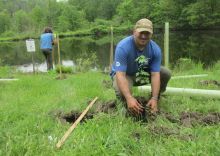
Apply now to the Hudson Estuary Trees for Tribs Program for free native trees and shrubs to help reduce erosion and improve habitat along tributary streams in the Hudson River Estuary watershed. If your project is selected, you must recruit volunteers for planting and maintain the site after the planting is complete. Staff in the Hudson River Estuary Program can help you with a planting plan and work with your volunteers. The application deadline is August 1 for a planting in fall, but applicants are strongly encouraged to apply before the deadline. Large sites will be given preference. Visit DEC's website for more information or to download an application.
Harmful Algal Bloom (HAB) Notifications 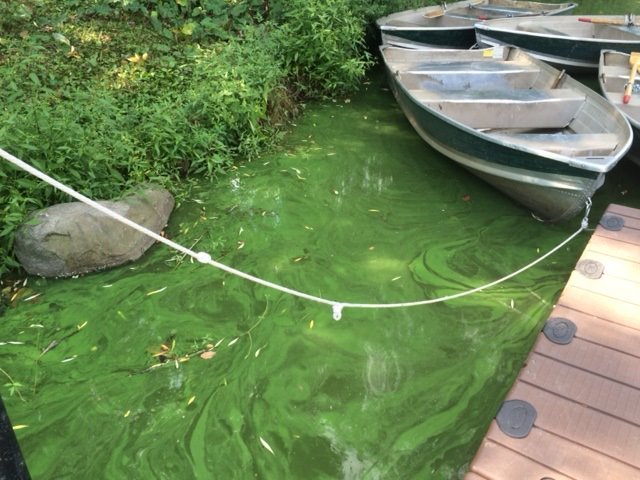
Visit NYHABS, DEC's harmful algal bloom notification map to view locations of freshwater HABs in New York State that were reported in the past two weeks. Click on a dot for more information, including the date it was reported, the waterbody name, and pictures. Click on the arrow at the bottom of the screen to view a list of reported HABs. Instructions on how to use NYHABS are on DEC's HABs notification webpage. Know it: HABs vary in appearance from scattered green dots in the water, to long, linear green streaks, pea soup, or spilled green paint, to blue-green or white coloration. Avoid it: People, pets, and livestock should avoid contact with floating mats, scums, and discolored water. Report it: Report a suspected HAB using the NYHABS online reporting form. Report health concerns related to HABs to the Department of Health at harmfulalgae@health.ny.gov, or contact your local health department. |


No comments:
Post a Comment