| Last fall, it wasn't exactly clear why former Donald Trump political adviser Stephen K. Bannon was refusing to cooperate with the Jan. 6 congressional committee. Members wanted to talk to him about what connection, if any, he had in planning the insurrection. Instead of talking to the committee about what he knows, he refused and is now facing jail time. It's rare for the government to prosecute these kinds of cases, but next week Bannon is set to be the first person in decades to go to trial for not complying with a congressional subpoena. And that's when he suddenly did the about-face and told the committee he'd testify. Why? We can only speculate, but here are some plausible reasons he suddenly wants to talk. 1. Bannon may be getting nervous about his trial: I've talked to legal experts who said he has very little in the way of defense. He claimed he was protected by executive privilege, but he was a private citizen at the time of the attack. The punishment for ignoring a congressional subpoena is a fine or up to a year in jail. Bannon may figure that by being willing to testify, he can avoid prosecution. That's not likely, though. The committee doesn't know if it will take Bannon up on his offer to testify, and the Justice Department seems pretty set on continuing its trial. Bannon's "sudden wish to testify," prosecutors wrote in a recent court filing, "is not a genuine effort to meet his obligations but a last-ditch attempt to avoid accountability." 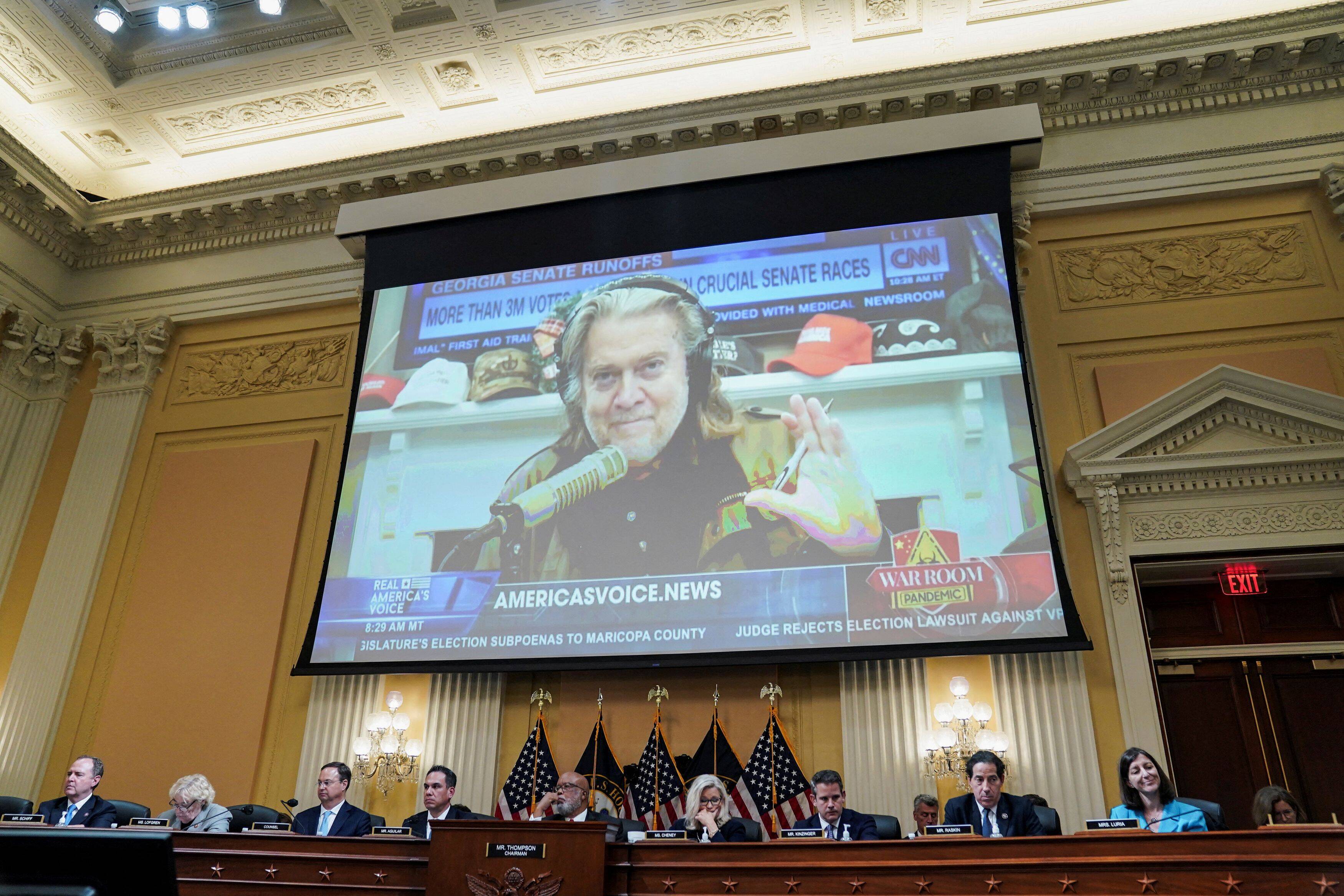 The House select committee airs a video of Steve Bannon. (Sarah Silbiger/Reuters) | 2. Trump wants his voice heard in the Jan. 6 hearings: The Jan. 6 committee has talked to plenty of people in Trump's orbit, but, as my colleagues pointed out, it has yet to feature live witnesses sympathetic to Trump's point of view. Trump has been frustrated by that. After Trump lost, Bannon was one of the most hardline drivers of false election fraud claims. If he managed to testify live, which is far from a sure thing, he could fight back against the committee's damaging narrative that Trump willingly fomented a violent insurrection to stay in power. What would a public health emergency do for abortion rights? President Biden said this weekend he's considering declaring one. But there's a debate among Democrats around whether that's a good idea. What declaring such an emergency means: It could help government agencies put together resources to help women seeking abortions, especially when paired with other authorities they have during emergencies and disasters, said Marya Torrez, senior policy director at Planned Parenthood Federation of America. For example, the Biden administration today announced it was reiterating that federal law protects doctors when providing life-or-death abortion services in emergency situations. More announcements like that could come under a public health emergency. More than anything, it would serve as a signal that Biden gets how important of an issue this is for advocates. Public health emergencies are usually declared around major events, such as the coronavirus pandemic. But some in the White House worry this would look overtly political by declaring a Supreme Court decision as an emergency, my colleagues reported, especially when it wouldn't do much to expand abortion rights. And it could backfire since it's possible to imagine a future Republican president trying to declare a public health emergency to curb abortion rights. Reader questions: Will Republicans end the filibuster? Q: Since a future Republican Senate majority could abolish the filibuster to enact what they want, why are some Democrats so afraid to do it? A: We can't predict what Republicans will do if or when they get in power in the Senate, but Senate Minority Leader Mitch McConnell (R-Ky.) has been explicit about how he feels about ending the filibuster. He doesn't want to do it. During the Democrats' failed push to end the filibuster for voting rights legislation at the beginning of the year, McConnell said abolishing the filibuster would "shatter the soul of the Senate for short-term power." This spring, McConnell vowed that the Republican Party wouldn't nix the filibuster to push a nationwide abortion ban through: "No carve out of the filibuster. Period." But political situations can change. It's possible that in a few years, there's a Republican president and a Republican Congress, and all that stands in the way of a national abortion ban or another long-sought conservative goal is ending the filibuster. Would McConnell be as supportive of keeping the filibuster then? Also, set aside what Republicans would do. Democrats don't have the votes among their own party to end the filibuster. Q: If Congress codified abortion rights, wouldn't the Supreme Court just strike the law down as unconstitutional? A: No. In fact, that's what the conservative justices argued the country should do if it wants to protect abortion rights nationally. There is no federal law on how far into a pregnancy a woman can have an abortion, and conservative justices argued that when the Supreme Court in the 1970s protected abortion as a constitutional right, it overstepped Congress's role in the matter. While the justices who struck down Roe v. Wade likely personally oppose abortion, they took pains to say they were reacting to that legal decision and not to an ideological point of view. "It is time to heed the Constitution and return the issue of abortion to the people's elected representatives," their opinion reads. Ask me a question any time. | 



 Email
Email


No comments:
Post a Comment