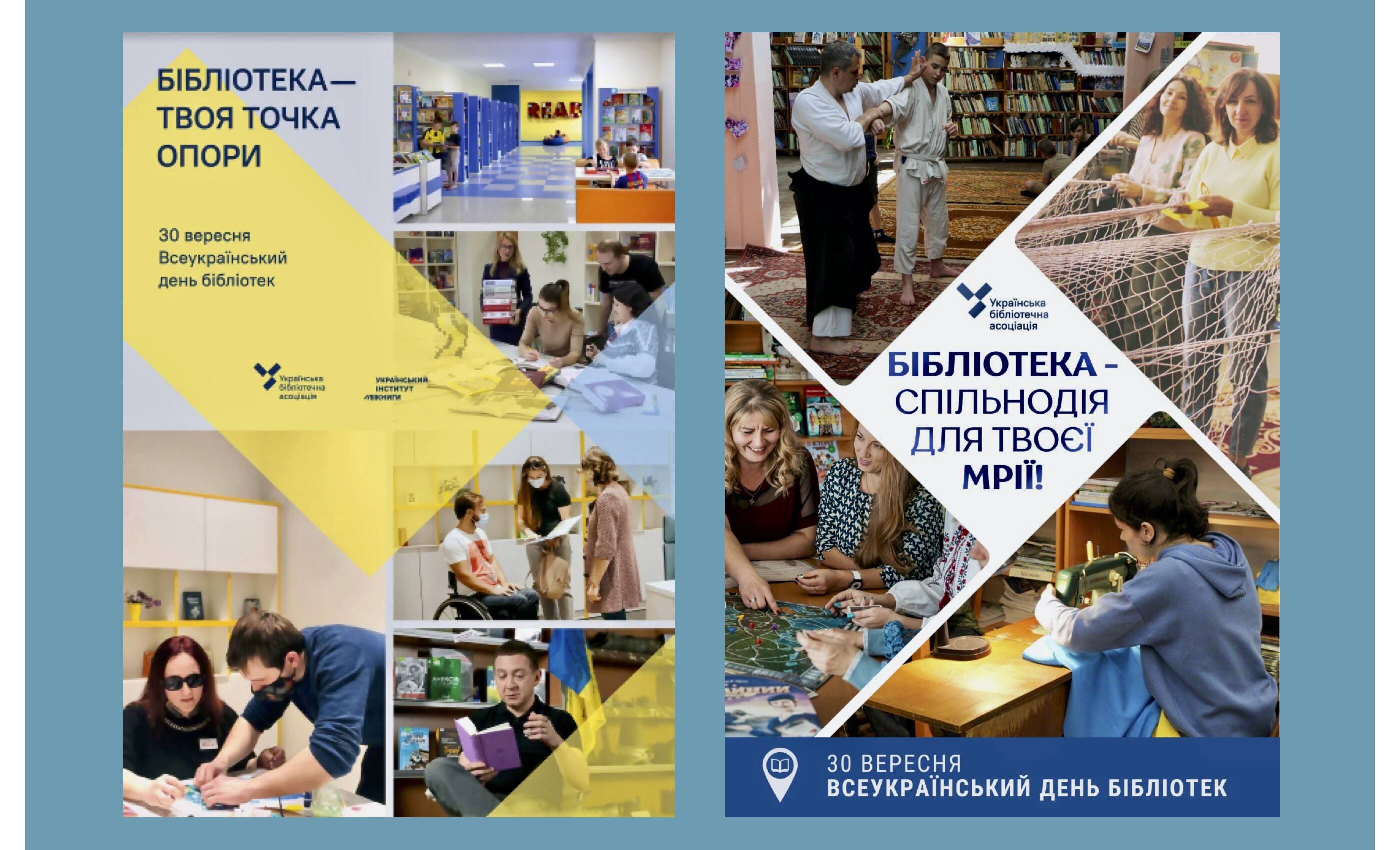
 Posters for All-Ukrainian Library Day 2021 (left) and 2022 (right). "Notice the difference," says Ukrainian Library Association executive director Yaroslava Soshynska – from chatting and quietly reading books last year to practicing self-defense and sewing medical gowns today. (Courtesy of ULA) | Today in Moscow, Vladimir Putin is pretending he can annex four chunks of his western neighbor, but nothing can deflate the spirit of All-Ukrainian Library Day. The national holiday on Sept. 30 started in 1998 as a way to celebrate librarians and the crucial role libraries play in expanding access to cultural and intellectual resources. The indomitable Ukrainian Library Association is determined to keep this annual tradition alive, even while bombs are falling. "In 2022, All-Ukrainian Library Day has a bitter aftertaste because we celebrate it in conditions of a large-scale, brutal and genocidal war," ULA executive director Yaroslava Soshynska tells me via email. "But these terrible losses have only strengthened our nation, the desire to be free and to choose our own path independently and democratically." If anything, Russia's barbaric assault on the country has radically expanded the role of Ukraine's libraries. "Today the libraries not only serve users, conduct cultural and educational events, and provide their communities with reliable information, but have also turned into volunteer centers for assistance to the Armed Forces of Ukraine and internally displaced persons," Soshynska writes. "Ukrainian librarians weave camouflage nets, sew elements of military equipment, linens and medical gowns for hospitals, knit socks, collect books for the soldiers, cook food for them, organize charity collections of funds, food and medicine." And by providing shelter from rocket attacks, "libraries literally save lives." | By 1776, various colonial powers claimed nearly all of the continent. But Indigenous peoples still controlled it. This sweeping narrative shatters many basic assumptions. | | | | | This year's motto for All-Ukrainian Library Day is "Library – the joint action for your dream." "We librarians, together with our users in each Ukrainian library, have our own small front," Soshynska writes, "on which we acquire our big dream – our Victory – with all our bravery and love of freedom." 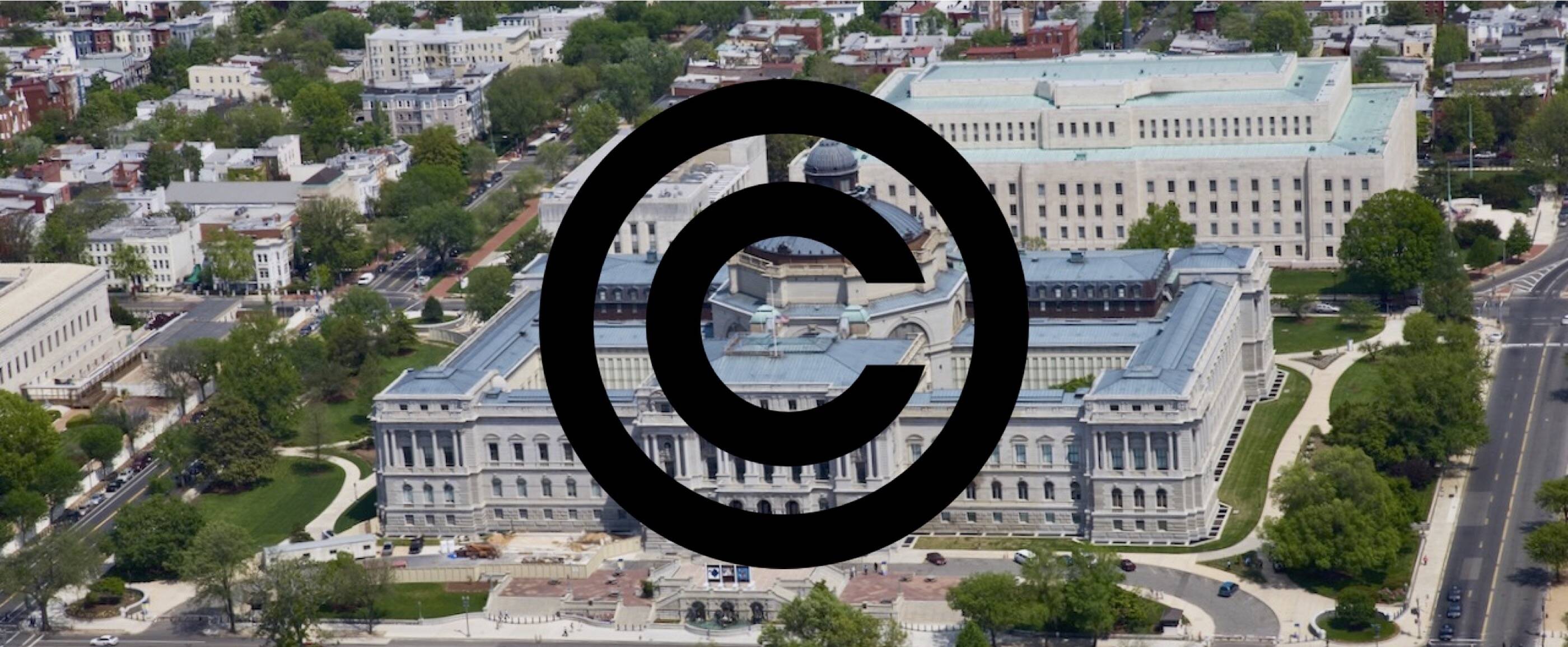 (Aerial photo of the Library of Congress by Carol Highsmith/Library of Congress. Photo illustration by Ron Charles/The Washington Post) | Yesterday, hundreds of authors — including bestsellers Neil Gaiman, Naomi Klein and Cory Doctorow — signed a public letter telling publishers to stop attacking libraries. If you don't know what's really going on, this must sound alarming, and it is, but not because publishers are attacking libraries. Here's the background: A San Francisco group called the Internet Archive routinely scans books and makes those files freely accessible to anyone in the world. It's a nifty trick, except for the part about it being illegal. Using a radical interpretation of copyright law, the group claims its practice is allowed under the "fair use" doctrine. Seeing the foundations of the book industry threatened, publishers rightly call that practice "stealing." The Internet Archive is — I predict — about to lose a federal case filed by Hachette, HarperCollins, John Wiley and Penguin Random House. Yesterday, Fight for the Future, a digital-rights advocacy group aligned with the Internet Archive, tried to rouse support with a publicity campaign that subtly blends inspiring declarations about libraries with misleading claims about publishers. A number of writers who should know better signed on. The letter criticizes commercial publishers for "undermining the traditional rights of libraries to own and preserve books, intimidating libraries with lawsuits, and smearing librarians." Those inflammatory claims are based on the fact that commercial publishers have effectively defended their right to sell e-books on their own terms, which is the way intellectual property is produced and traded. I agree that e-books for libraries are egregiously expensive and come with too many burdensome limits, but there's no evidence that publishers are out to undermine "the traditional rights of libraries to own and preserve books." And as for "smearing librarians," that's ludicrous. The Authors Guild and more than a dozen other writers organizations issued a response yesterday pointing out that it is "highly misleading" to equate the illegal actions of the Internet Archive with the "purchasing and lending practices of public libraries generally." The Authors Guild also claimed that it spoke to writers who signed the Fight for the Future letter but now feel "misled" by its organizers. At least one prominent author has already, apparently, withdrawn his support: Daniel Handler, creator of the popular Lemony Snicket novels, was highlighted in an embargoed press release and the first wire story about the letter, but his name does not appear among the signatures on the copy posted yesterday. Terrence Hart, general counsel for the Association of American Publishers, said in a statement, "That authors and publishers support libraries is not in dispute and most certainly not at issue in the infringement case against the Internet Archive, which is not a library. On the contrary, the Internet Archive operates an unlicensed digital copying and distribution business that copies millions of literary works without permission and gives them away for free. This activity is unprecedented and outside any reasonable interpretation of the copyright law." It feels particularly disingenuous for popular writers to attack the legal foundations of the industry that made them successful. Authors with the means to give away their books over the internet can do that without promoting a scheme that robs other authors of their livelihood. 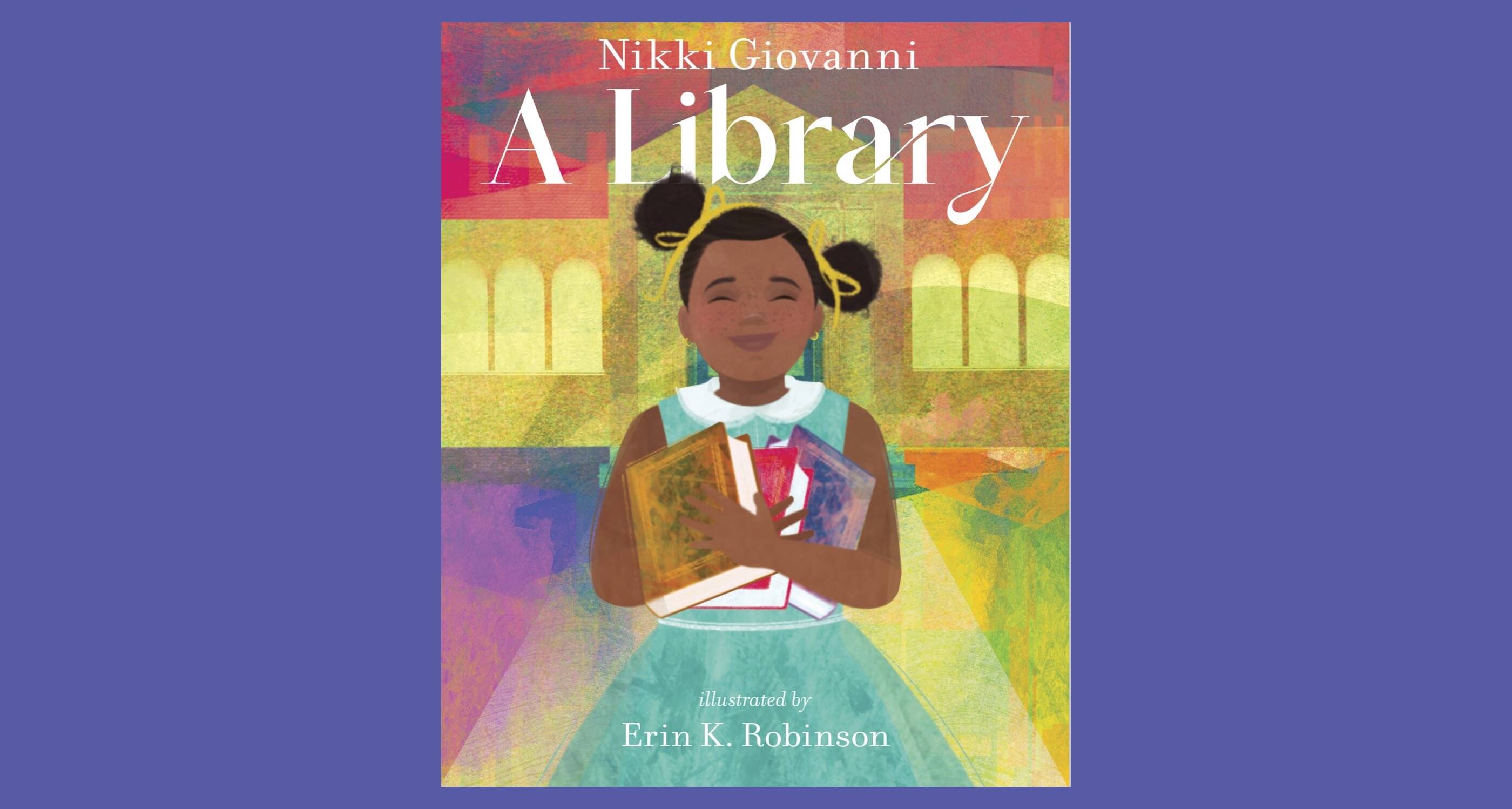 Versify | Libraries have become such battlegrounds in the United States that it's nice to be reminded that they're also havens for imagination and joy. This week, the poet Nikki Giovanni published a picture book called "A Library," which should become a part of every child's collection (ages 4-7). Gorgeously illustrated by Erin K. Robinson, the story recalls how much little Nikki treasured the public library near her grandmother's house in Knoxville, Tenn. A library is:
a place to be free
to be in space
to be a cook
to be a crook
to be in love
to be unhappy
to be quick and smart…. The simple text and Robinson's luminous pictures make a magical combination. In a brief afterword, Giovanni acknowledges that the literary oasis she loved was surrounded by a deeply conflicted society. "I grew up during the age of segregation," she writes. The branch near her grandmother's house was "the colored library." But the librarian, Mrs. Long, was willing to get any titles she wanted, even if it meant going up to the main library to track them down. "I was almost grown before I understood what she must have gone through to get me the books I was interested in." On Wed., Oct. 5 at 11 a.m. ET, you can hear Giovanni talk about this lovely book and her remarkable life as a writer and activist on Washington Post Live (free, but register here). Books to the screen (and stage) - A new AMC series based on Anne Rice's "Interview with the Vampire" rises from the ground on Sunday, Oct. 2. Of course, the TV show will be competing with the ghost of the 1994 movie starring Tom Cruise and Brad Pitt. (Back then, our reviewer said Neil Jordan's film "sucks at the neck a little too long.") But now, Lestat de Lioncourt is out of the crypt and the closet. Vampires are frozen in time, but TV standards evolve fast. Even before the show's undead heart starts beating, it's already been renewed for a second season. And the producers could keep this up for eternity: Rice wrote a dozen sequels before she died last year.
- Speaking of immortal novels, Nicholas Sparks's 1996 bestseller, "The Notebook," is now a musical at the Chicago Shakespeare Theater. (Someone just drove a stake into Harold Bloom's heart.) Adding musical numbers to "The Notebook" sounds like pouring marshmallow sauce on a lollipop, but I need to be careful what I say because my younger daughter has cried through the 2004 movie adaptation approximately 8 gazillion times. You can see clips of the play here. And yes, of course, it rains on the stage.
- "The Good House," based on Ann Leary's 2013 best-selling novel, opens this week in theaters (trailer). Sigourney Weaver and Kevin Kline bring lots of curb appeal to this quirky story about a Boston real estate agent in denial about her alcoholism, but our reviewer calls the rom-com "cloying" (meh).
 Penguin Press | Unveiling a big political book has always required careful choreography. But in these latter days of Trump exposés, marketing requires a burlesque fan dance with the news media and the MAGA industrial complex. Consider, "Confidence Man: The Making of Donald Trump and the Breaking of America," by New York Times reporter Maggie Haberman, forthcoming Oct. 4. After so much previously reported shocking information about the former president's behavior, a steady drumbeat of tantalizing revelations is necessary to rouse the interest of numbed readers. Behold: - Nov. 12, 2020 Penguin Press announces that Haberman's book "will be an instant classic, a definitive and fascinating account of Donald Trump, his life and his presidency."
- Dec. 10, 2020 On "Fresh Air," Terry Gross interviews Haberman, who is "working on a book about Trump."
- Feb. 10, 2022 In "an exclusive first look," Axios reveals that "Confidence Man" describes White House staff members finding documents clogging a toilet.
- March 9 The Daily Mail claims that "Confidence Man" quotes former press secretary Stephanie Grisham saying that Trump "ran a very loose shop ignoring staff breaches in protocols and often flouted the rules."
- June 3 In the New York Times, Haberman reveals that while doing research for "Confidence Man," she discovered that Mike Pence's chief of staff warned the Secret Service that Trump "was going to turn publicly against the vice president, and there could be a security risk to Mr. Pence."
- Aug. 8 Axios publishes photos from Haberman showing a toilet clogged with torn documents.
- Sept. 12 CNN posts an "exclusive" detail from "Confidence Man" revealing that Trump "repeatedly told aides in the days following his 2020 election loss that he would remain in the White House rather than let incoming President Joe Biden take over."
- Sept. 25 The Atlantic publishes an "exclusive" excerpt from "Confidence Man."
- Sept. 27 "In pages of 'Confidence Man' reviewed by Rolling Stone," we learn that the newly inaugurated President Trump mistook "racially diverse Democratic staffers" for waiters.
- Sept. 28 "According to an excerpt obtained by The Daily Beast," Haberman's upcoming book shows Trump behaving "as a boorish homophobe."
- Sept. 28 A copy of Haberman's book "obtained" by The Washington Post reveals that Trump "weighed bombing drug labs in Mexico."
- Sept. 29 "The Guardian obtained a copy" of "Confidence Man" that says "Trump implied his son-in-law and senior adviser, Jared Kushner, might be brutally attacked, even raped, should he ever go camping."
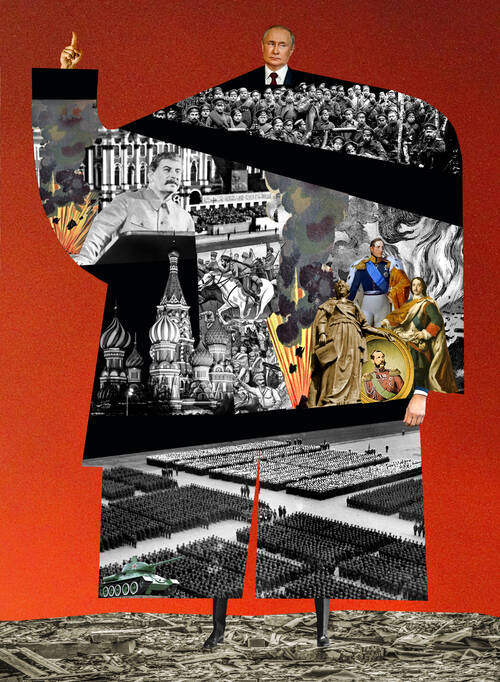
Now you can look forward to a crescendo of more leaks along with index-scraping news stories, embargo-breaking reviews and angry denials from Trump and his minions, all leading up to the book's official release on Tuesday. A week later – surprise! — we'll hear that "Confidence Man" has debuted on the nonfiction bestseller list. And that, too, will be news. 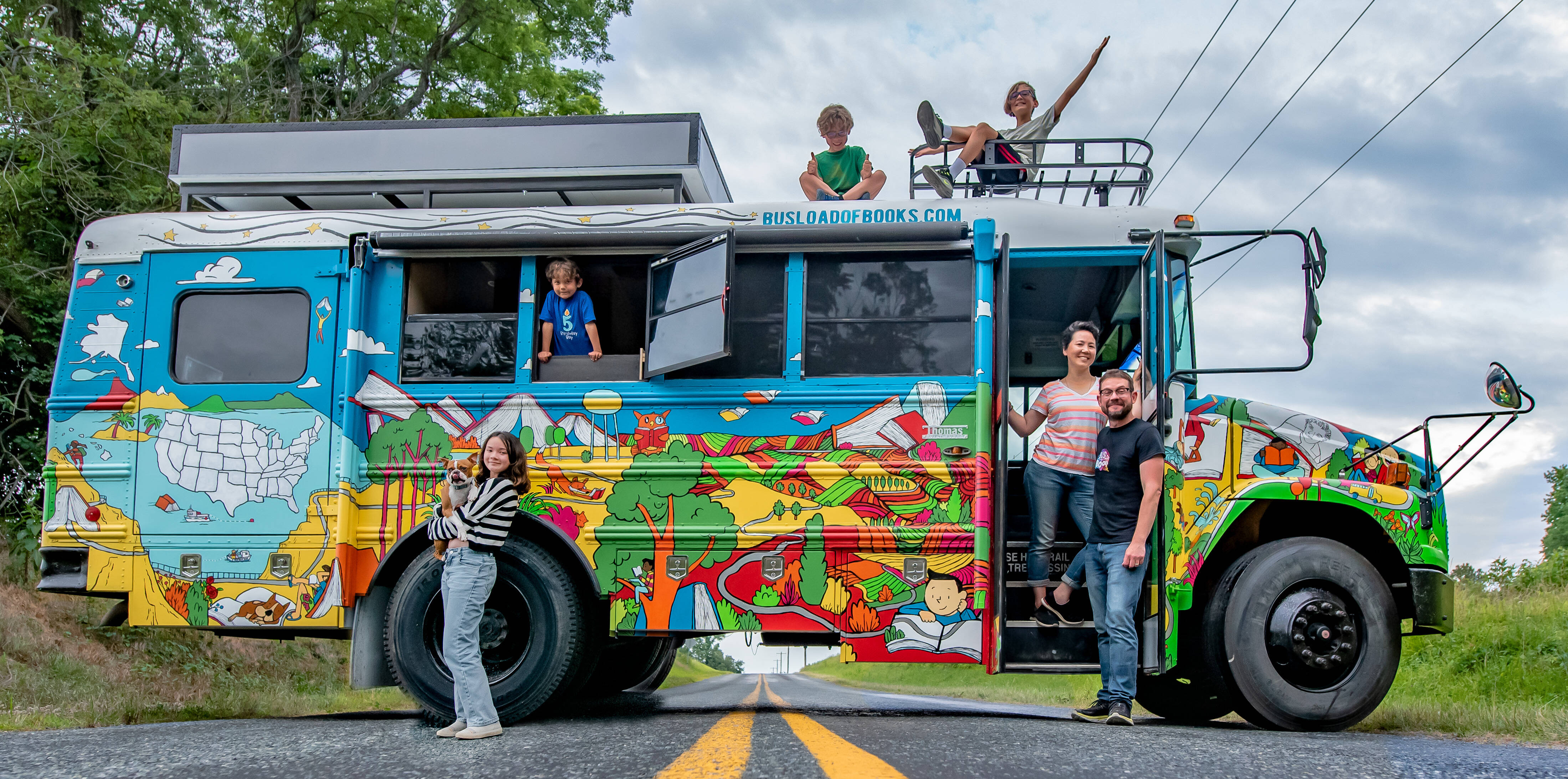 Robbi Behr, Matthew Swanson, their four children and their dog, Dumbles, on the Busload of Books tour. (Photo by Carolyn Fuss Thompson) | Illustrator Robbi Behr and her husband, author Matthew Swanson, have launched a literacy program for kids that's 97 percent inspiration and 3 percent bonkers. They converted an old school bus into a house on wheels, packed up their four kids and started driving around the country giving away 25,000 copies of their books. Creators of the Cookie Chronicles series, the Real McCoys trilogy and several picture books, Behr and Swanson are visiting Title 1 schools in all 50 states and Washington, D.C. They're partnering with the nonprofit First Book, which helped select the schools and is working with publishers to ship out mountains of donated books as the bus roams from state to state. I caught up with Behr and Swanson via Zoom yesterday morning when they were parked in a Pennsylvania campground near Hersheypark, which is appropriate because they seem like the sweetest people you'll ever meet (profile). Their converted bus has a compartment welded to the roof where the kids sleep. "Our youngest is too small to make the climb on his own," Behr says. "So every night I have to stand under the hatch so he can step on my head." "Our children just go with the flow," she adds. "We've done so many ridiculous things in their lives that they did not miss a beat. When we said we're getting on a bus for a year, they were like, 'I guess that's what we're doing.'" The bus has electricity but no bathroom. So far, they've used 97 public toilets. "And we didn't have to clean any of them," Swanson says. (Such simplicity isn't entirely new for the family. During summers, they're commercial salmon fishers in Alaska working out of "an off-grid tundra compound.") Aside from the zany backstory, their trip has a profoundly serious cause. Many of the schools they visit, even in areas that seem outwardly well-off, have no money for extra books. Behr and Swanson conduct two different assemblies for younger and older kids, and they make sure everybody gets a new hardback book. The responses have been wildly enthusiastic. Washington College, in Chestertown, Md., is using the tour as the basis for a study to determine the impact of author/illustrator appearances in schools. "That data could substantiate for the first time that there's a real impact to these visits," Swanson says. As you might imagine, their house-bus is a conversation starter wherever they go. Swanson recalls filling up the gas tank when a guy walked up and asked him what he was up to. "By the end of the conversation, he pulls a $50 bill out of his wallet, hands it to me, and says, 'What you're doing is great. Let me help a little bit." The Busload of Books Tour is supported by a GoFundMe campaign, which is now very close to its $150,000 goal (donate). Surely, this adventure will eventually be the subject of its own book, right? "I'm taking notes every day because I'm living in a blur," Swanson says. "There's no bandwidth for reflection. Later on, we'll figure out what it means. But now we're trying to get the children fed and get from place to place. The theme so far has been reciprocal generosity. We put out a request to the world, and the world responded with abundance." 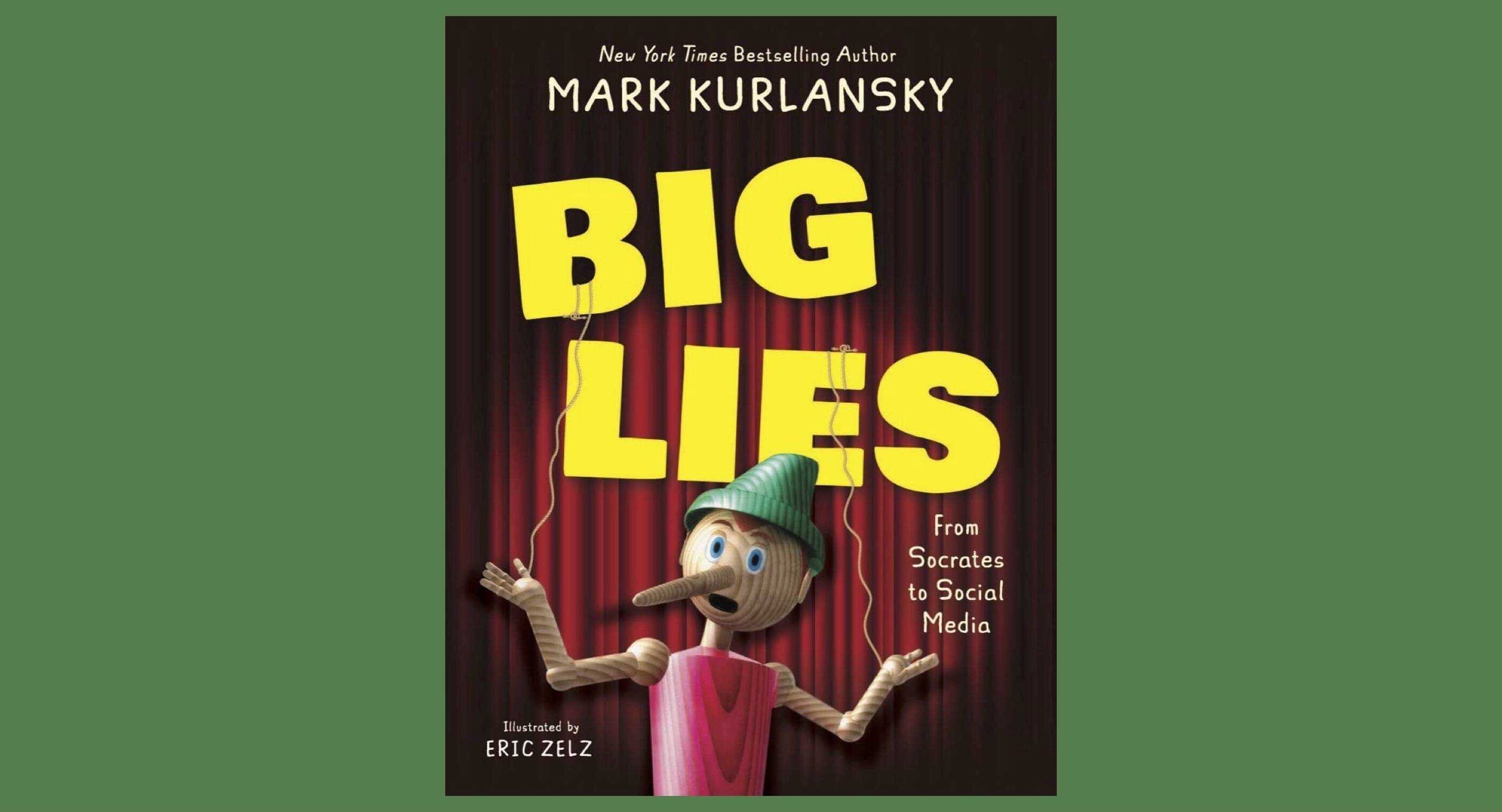 Tilbury House Publishers | The House select committee investigating the Jan. 6 attack on the Capit0l has provided an admirable demonstration of how to ferret out the truth. But the committee has also inadvertently exposed how little the truth can change anyone's mind. Deep-seated anxieties electrified by aggressive political ideologies have produced a thick mental fog in this country that shows no signs of clearing. I don't know what's happening to me, but for the second week in a row, the most urgent recommendation I have is a book written for young adults. Last week it was Amy Sarig King's novel "Attack of the Black Rectangles" about censorship in school. This week it's a work of cultural history by Mark Kurlansky called "Big Lies." You probably know Kurlansky from his best-selling adult books like "Cod," "Salt" and "The Basque History of the World." His new book is written for kids 13 and up — I would say all the up. Ranging from Socrates to social media, it's a continuously eye-opening analysis of the uses of propaganda, misinformation and deception. What's more, it's so engagingly designed that you can't stop reading; it's packed with photos, pull-quotes and quirky illustrations by Eric Zelz. "Big Lies" is high-octane education, but it's not written in the deadening, disembodied voice of a textbook. As Kurlansky takes us through classic acts of deception, conspiracy theories and deadly lies, his passion for truth – and research – animates every page. "The strength of science," he writes, "is this eternal, self-doubting allowance for the possibility of a mistake. It is this habit of doubt and constant testing that makes scientific thinking the greatest defense against lying." For young people, Kurlansky's swirling historical allusions — Machiavelli, Stalin, Orwell, Breitbart — may seem equally dazzling and baffling. And much of this history about the Salem witchcraft craze, the Dreyfus affair, the "fake" Moon landing, the Holocaust and more will be new and shocking. But even if you think you have a handle on these events, you'll be enlightened by Kurlansky's clear, forceful analysis of liars' tactics. Much of the book focuses on how technology, particularly social media, is used to confuse and deceive people. (AI can now create any image in seconds, bringing wonder and danger.) And Kurlansky has worked hard to pack the book with references to the very latest investigations and controversies involving climate change, covid, QAnon, the Capitol riot and, of course, our Very Stable Genius, Donald Trump. "The history of political lying reveals two reliable principles," Kurlansky writes. "The first is that the bigger the lie, the more followers it will attract…. The second is that the more often a lie is repeated, the greater the number of people who will believe it." A nation awash in misinformation, cloudy thinking and suspect news desperately needs to read "Big Lies." And Kurlansky and Zelz have made sure that people will want to. 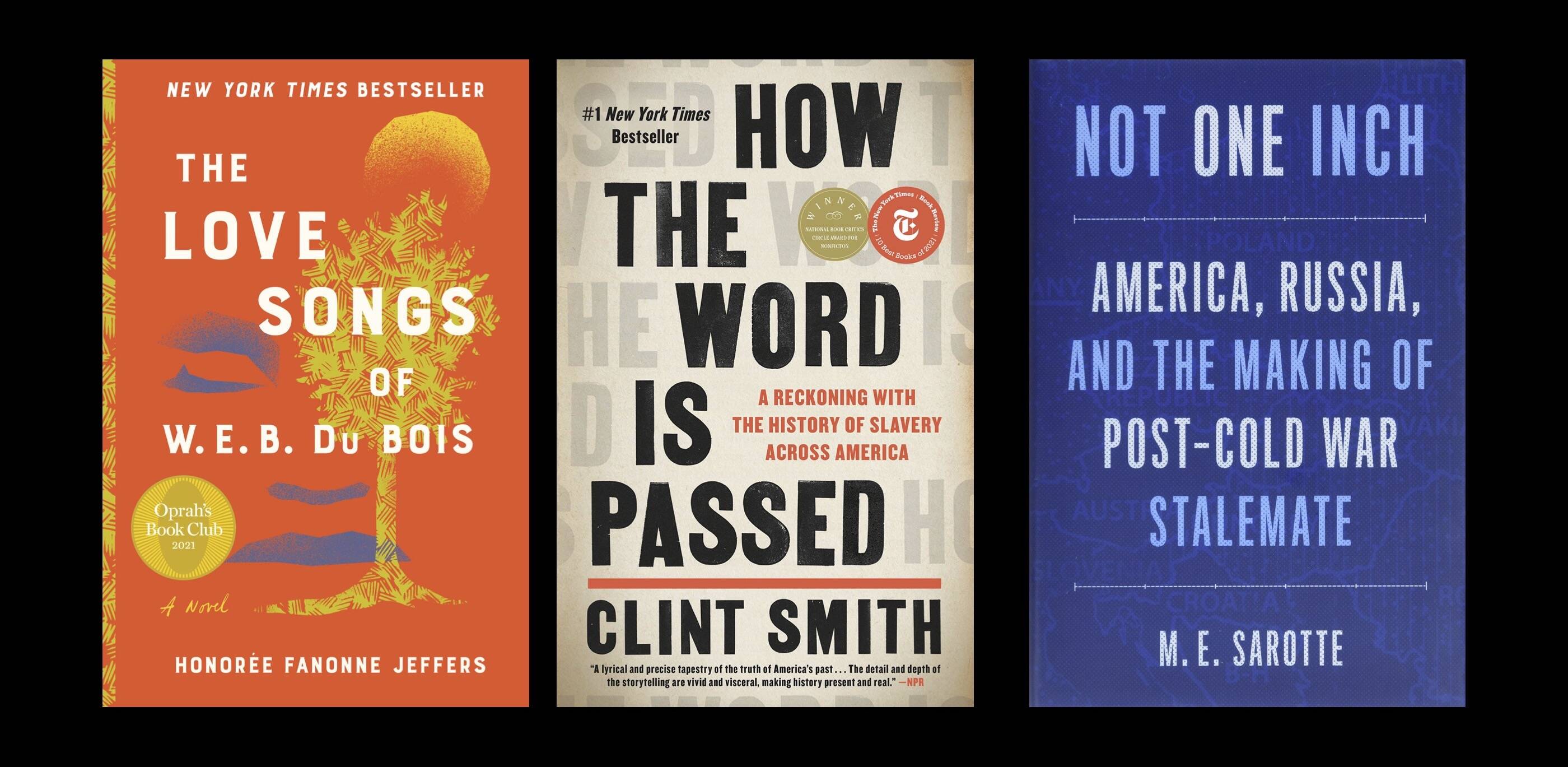 Harper; Little, Brown; Yale University Press | Literary honors and prizes this week: - I'm so thrilled that "The Love Songs of W.E.B. Du Bois," by Honorée Fanonne Jeffers, won the Dayton Literary Peace Prize for fiction. Jeffers's multigenerational epic about an African American family was my favorite novel of 2021 (rave). Clint Smith's "How the Word is Passed," which also addresses the lives of African Americans, won the Dayton Literary Peace Prize for nonfiction (review). These two $10,000 prizes honor books "that have led readers to a better understanding of other cultures, peoples, religions, and political points of view."
- "Not One Inch: America, Russia, and the Making of Post-Cold War Stalemate," by Mary E. Sarotte, won the Pushkin House Book Prize, which recognizes the best nonfiction writing on Russia (Q&A).
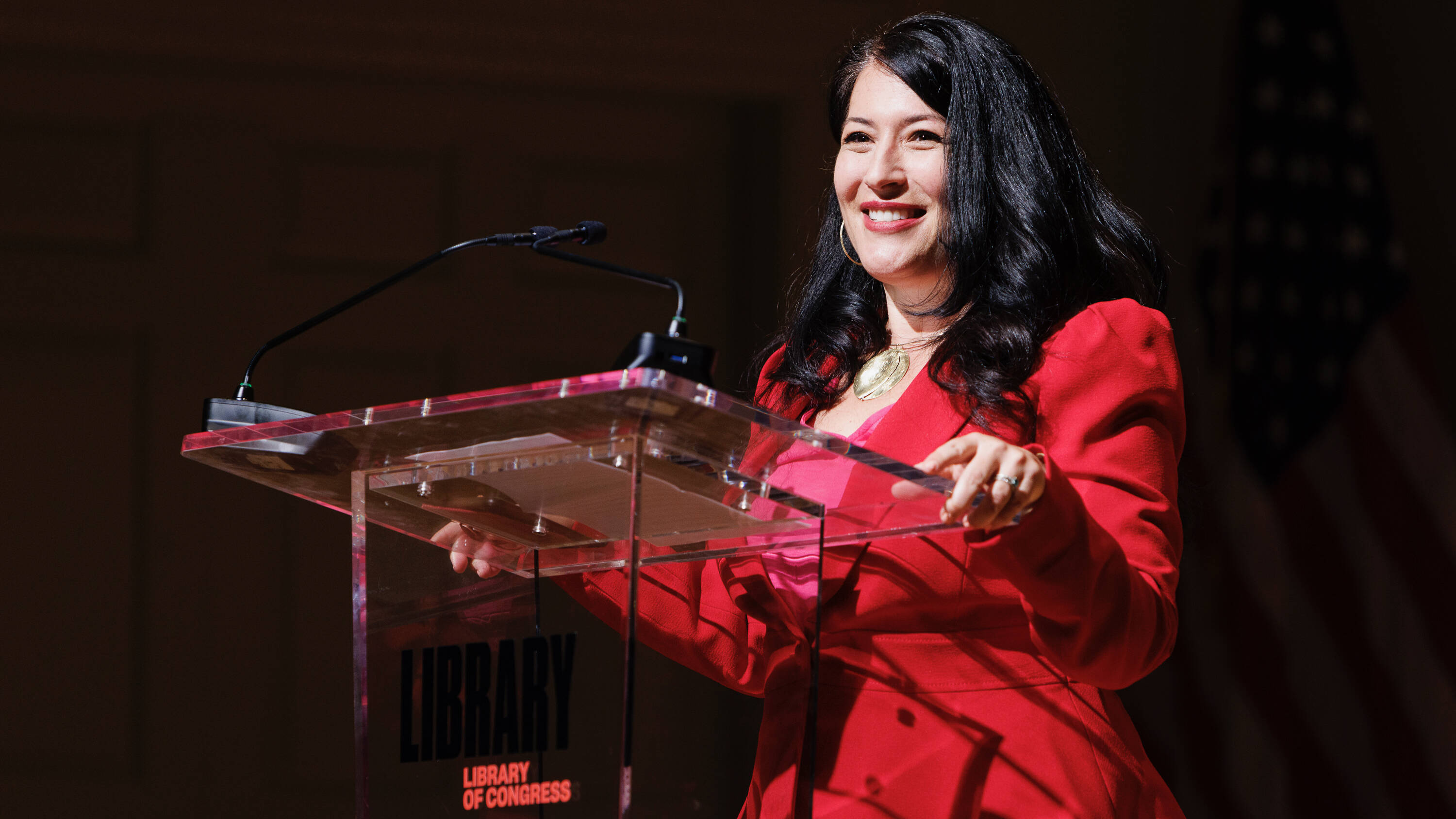 "This is never something you expect to happen to yourself," Ada Limón said in her first presentation as U.S. Poet Laureate at the Library of Congress on Sept. 29, 2022. (Photo by Shawn Miller/Library of Congress) | Last night before a standing-room-only crowd at the Library of Congress, Ada Limón took the stage as the 24th Poet Laureate of the United States. "Let us not be subdued," she said as she began her inaugural presentation, and there was nothing subdued about the audience's adoration. "Tonight is about everyone who risks making art in a world that often deems art unnecessary or, worse, frivolous." "I was lucky enough to be raised by people who supported my creative life," she said, noting, "My mom's paintings grace the cover of every book I've written, and my stepdad, Brady, has been making me a better writer since I was 10 years old." Following a tradition established by her mentor, former Poet Laureate Philip Levine, Limón read selected poems from five of her six collections, offering brief explanations and context along the way. I've know she's a captivating presenter of her own work since I interviewed her for the Life of a Poet series in 2019 (video). You can watch last night's presentation – elegantly produced by the Library – here. Near the end of the evening, Limón read a poem about her Mexican grandfather, who, as a boy, was a motherless foster child determined to do everything right. One day he was sent to get a box of matches. ...he put that box
of strike-anywheres in the pocket of his madras shirt
and ran home, he ran so fast to be on time, to be good,
and when he did so, the whole box ignited, so he was
a boy running down the canyon road with what
looked like a heart on fire. He'd laugh when he told
you this, a heart on fire, he'd say, so you'd remember. Anyone who hears Limón read feels that heat, sees that light. 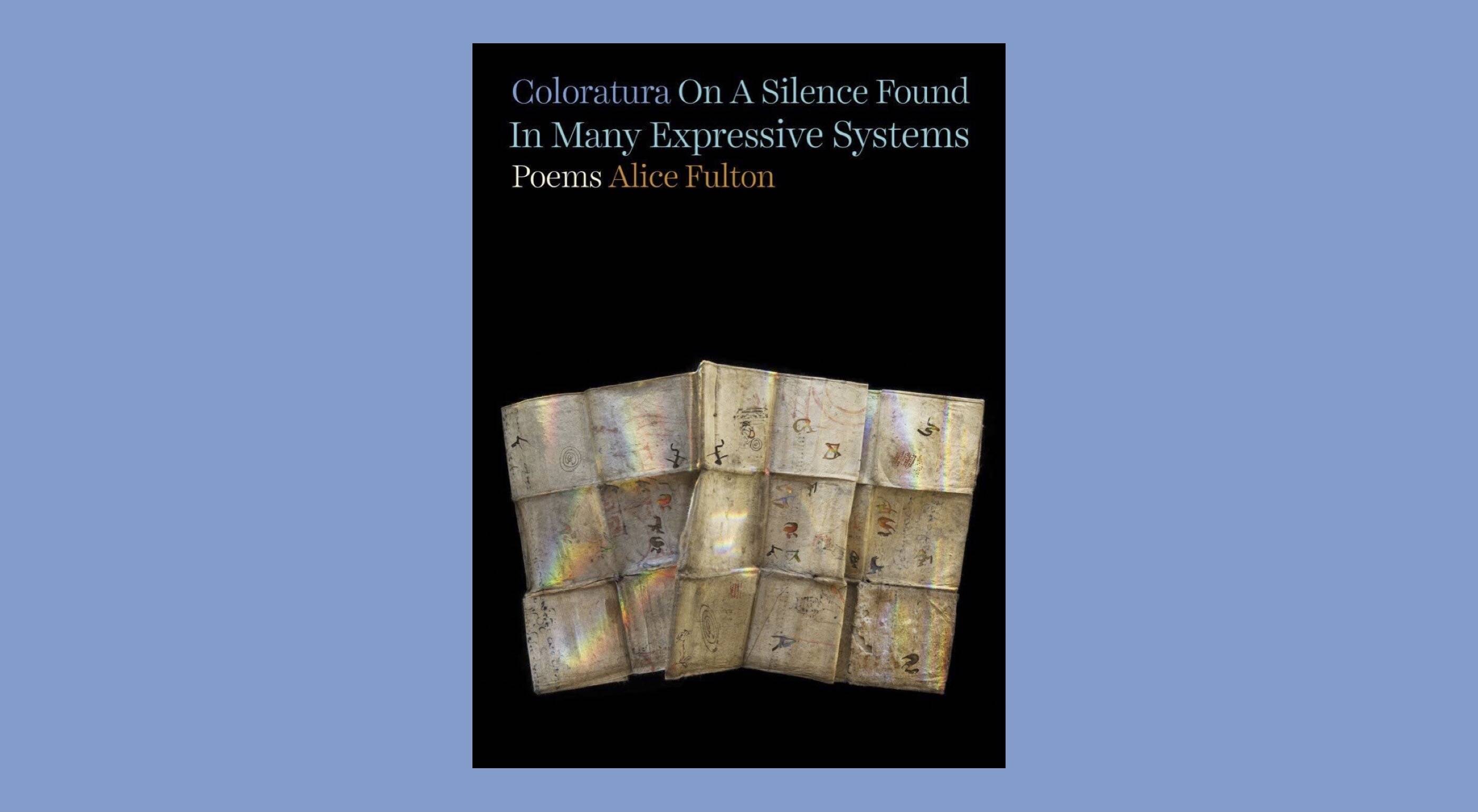 W. W. Norton | Alice Fulton's new collection is called "Coloratura on a Silence Found in Many Expressive Systems," but don't let that intimidate you. Fulton is one of the wisest and most insightful poets in the country. The profundity of her verse sometimes comes through long explorations, sometimes in single lines. "To witness constant miracle is a distraction," she writes. Let yourself be distracted by her. Once Or Ever Let Alone Again Enthronement Of snowflakes I can say
I admire their courteous way of falling,
the calm with which they espouse their claim
followed by a silent compounding.
Falling should be noisy.
Their quietism seems a violation
of the convivial.
Does each differentiate itself
from others through negotiation?
No. No crystal would insist
it is the one
all others should be modeled on.
Everyone knows it's possible
to gather an infinitude
and not find two alike.
But that is just a hypothesis
that's been hammered into fact. Of you I can say
the likelihood of anybody anything
like you falling into being
once or ever
let alone again is nil.
Yet you don't differentiate yourself
by boasting or insist
you are the one
all others need to be.
Nothing about you is compulsory.
There are few useful heavenly bodies
relative to where I am.
Though mortal,
you are a way to feel
the presence of a presence
belonging more to wish
than to existence existing. Excerpted from "Coloratura on a Silence Found in Many Expressive Systems," by Alice Fulton. Published by W.W. Norton & Company. Copyright © 2022 by Alice Fulton. All rights reserved. 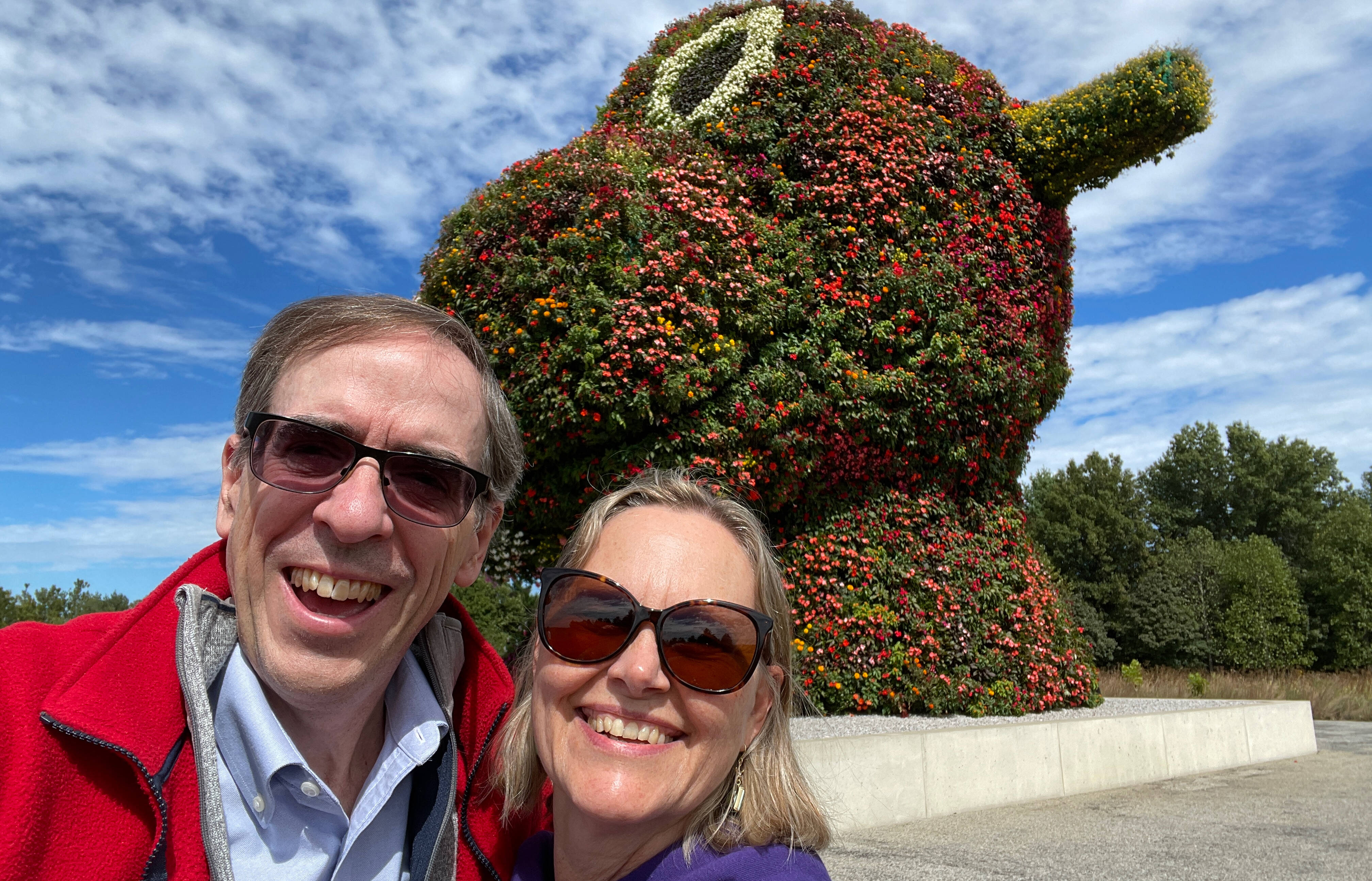 Ron and Dawn Charles in front of Jeff Koons's "Split-Rocker" at the Glenstone museum in Potomac, Md., on Sept. 24, 2022. (Ron Charles/The Washington Post) | Last Saturday, I was spiraling into a pity fest about having to spend the whole weekend reading a 900-page novel (Thank you, John Irving). But my wise wife insisted we get out of the house and visit Glenstone, which Washington Post art critic Sebastian Smee has described as "the most exciting new private museum in America" (details). I can see why. Spread across some 300 acres, Glenstone is a sculpture garden, a modern art gallery and a nature walk. Through much of our wandering, we felt like we were alone in the woods. Then we'd come upon some gigantic alien installation like Jeff Koons's "Split-Rocker" covered in flowers or four Serra cylinders housed in their own special mausoleum. It's amazing how restorative it can be to walk around a few million pounds of rusty steel. Meanwhile, send any questions or comments about the Book Club to ron.charles@washpost.com. You can read last week's issue here. Please tell friends who might enjoy this free newsletter that they can get it every week by clicking here. And remember: You can find all our books coverage, constantly updated, here.
Interested in advertising in our bookish newsletter? Contact Michael King at michael.king@washpost.com. |




 Email
Email



No comments:
Post a Comment