| The 5-Minute Fix will be off Monday for the Labor Day holiday. See you in your inbox Tuesday. Over the past week, there's been a ton of legal back-and-forth over what the FBI took from Mar-a-Lago and whether the bureau can have it. Through all this, we've learned quite a bit about the case. Last week the government released a heavily redacted version of its affidavit justifying its extraordinary search of Donald Trump's Florida residence. This week, the former president has been pushing for a third party to go through the documents for any that could possibly fall under executive privilege. Here are the biggest revelations from the investigation so far. Trump had more 300 documents of classified information at his clubhouse Trump took an astounding amount of classified material with him out of the White House to a clubhouse that could be accessed by a much broader swath of the public, including foreigners. Compare that with Hillary Clinton, whom the FBI investigated for using a private email server, finding she had 113 emails containing classified information in them — what then-FBI Director James Comey called "only a very small number" — with none nearly as secretive as what the government is alleging Trump had. On Friday, the government released a detailed inventory of what they found in 33 boxes from Mar-a-Lago. Many of the boxes had newspaper and magazine clippings mixed in with classified material, according to the government's search and tally: 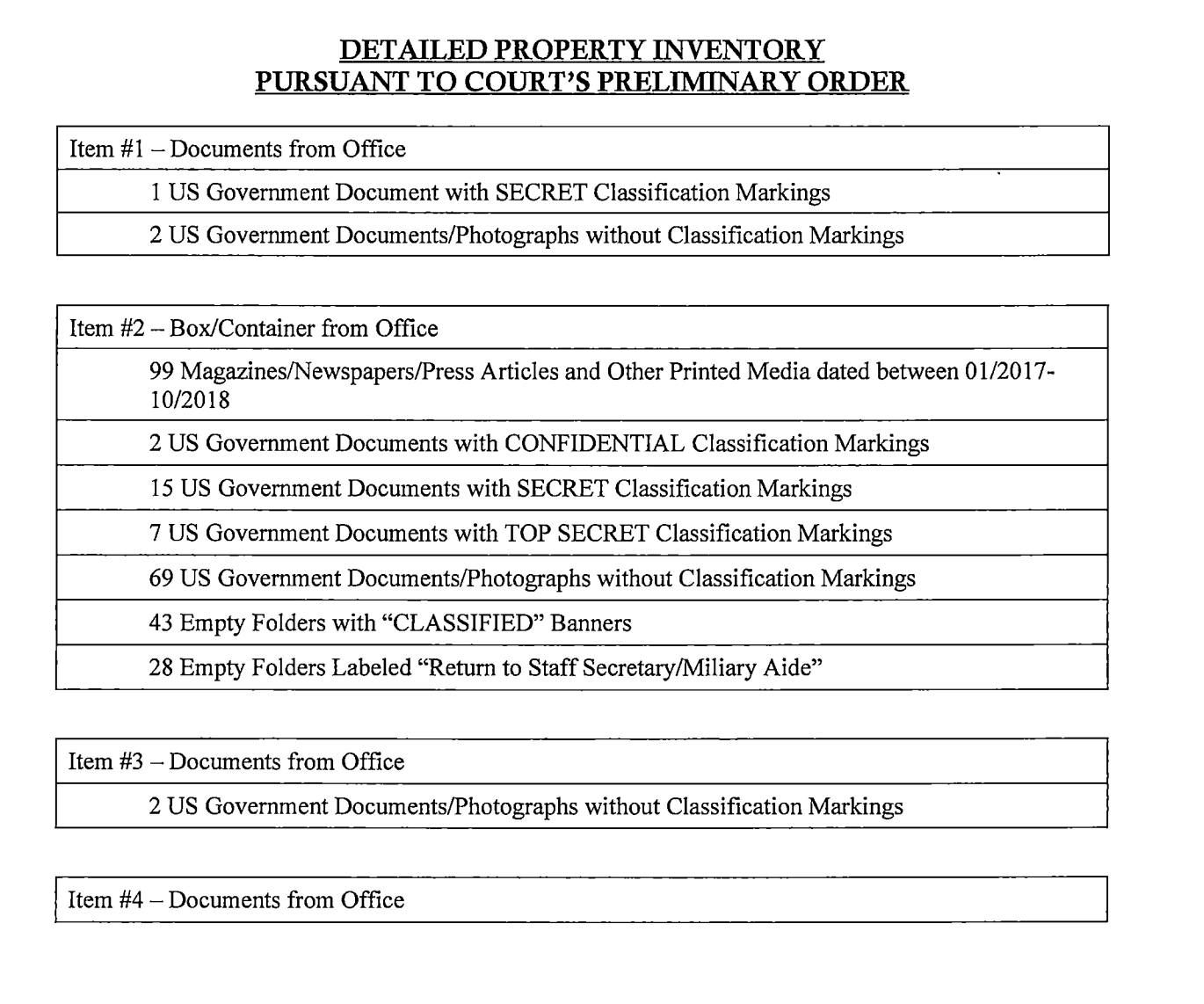 The government's official catalogue of what was found at Mar-a-Lago. (U.S. District Court, Southern District of Florida) (US District Court, Southern District of Florida) | The government says there is evidence its investigation has been obstructed Trump has said that he and his lawyers have been "cooperating fully" with the government on the return of these documents. The government has maintained in several court filings that this is not true. Consider the timeline: It took the National Archives six months of asking to get some documents back. The Justice Department went in with a subpoena this summer to try to get additional documents marked as classified that it suspected were still at Mar-a-Lago. But Trump's lawyers prohibited them from fully searching a storage room, the government alleged in a court filing this week. They also said there is evidence that some documents were removed from the storage room before the lawyers searched it. The FBI ended up having to get a warrant to search Mar-a-Lago in August to get the rest of the documents it said belonged to the government. That's more than 18 months of haggling, cajoling and eventually resorting to force to get government records back, including some that contained government secrets. 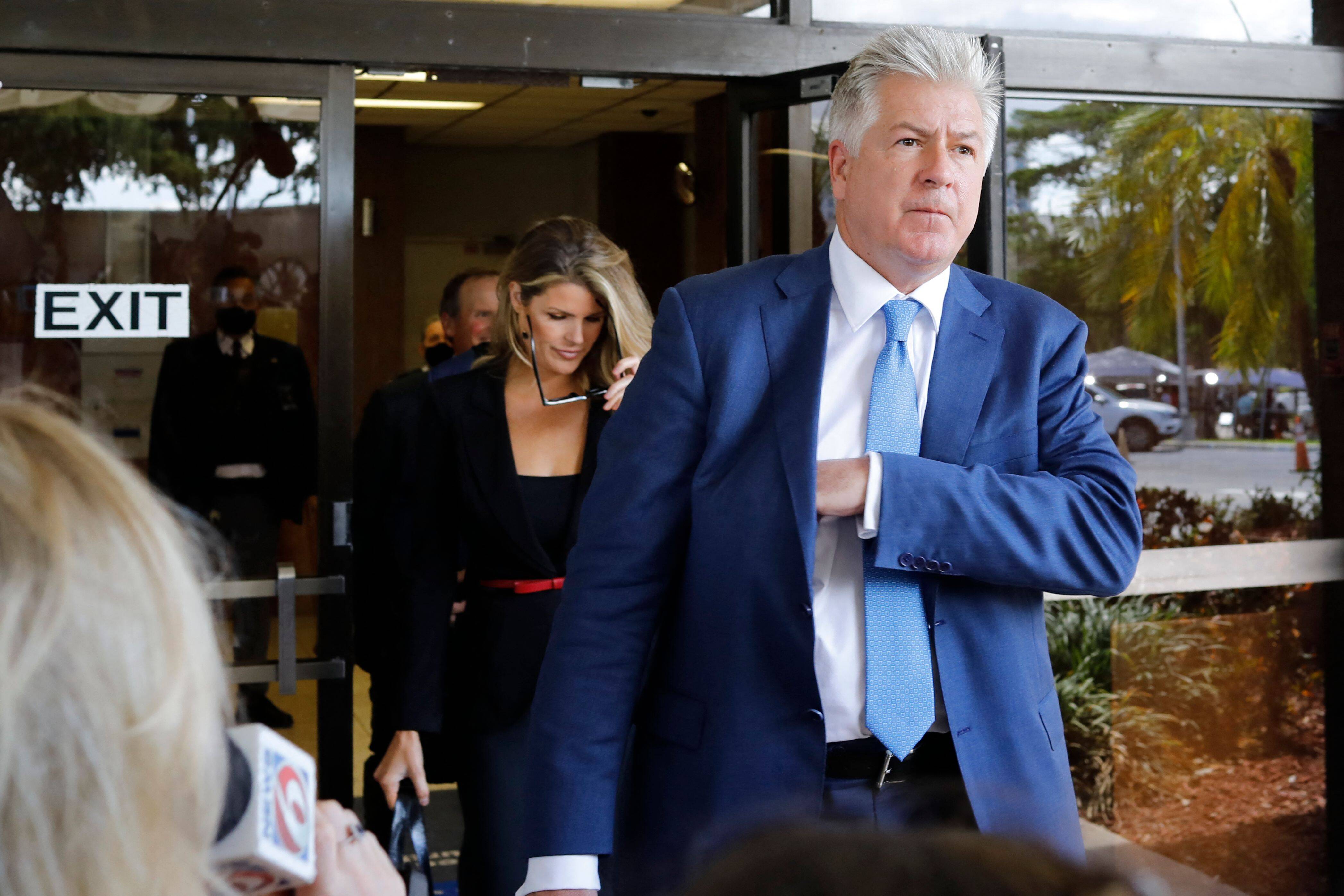 Trump lawyers Evan Corcoran and Lindsey Halligan in court on Thursday. (Marco Bello/AFP/Getty Images) | The FBI says there's probable cause to believe several laws were broken The search warrant and underlying affidavit mention three laws the government thinks have been potentially been violated. All relate to taking or hiding government documents or obstructing a government investigation. None of the laws cited require that information be classified — so simply just taking material out of the White House and refusing to give it back could be enough for prosecution. The government specifically cited a section of the Espionage Act that says a person in violation may have been in unauthorized possession of government secrets and had "reason to believe [this information] could be used to the injury of the United States or to the advantage of any foreign nation." Trump has yet to clearly explain why he took the documents with him His defense has shifted, and the government has punched major holes in what's left of it. Trump regularly claims on social media that as president, he declassified the documents. But prosecutors pointed out in a court filing this week that Trump's lawyers have never argued that in court or in conversation or correspondence with the Justice Department. And many of the documents they found, according to the photo investigators shared of one box, still had bright yellow or red cover sheets declaring them "Top Secret" or "Secret." 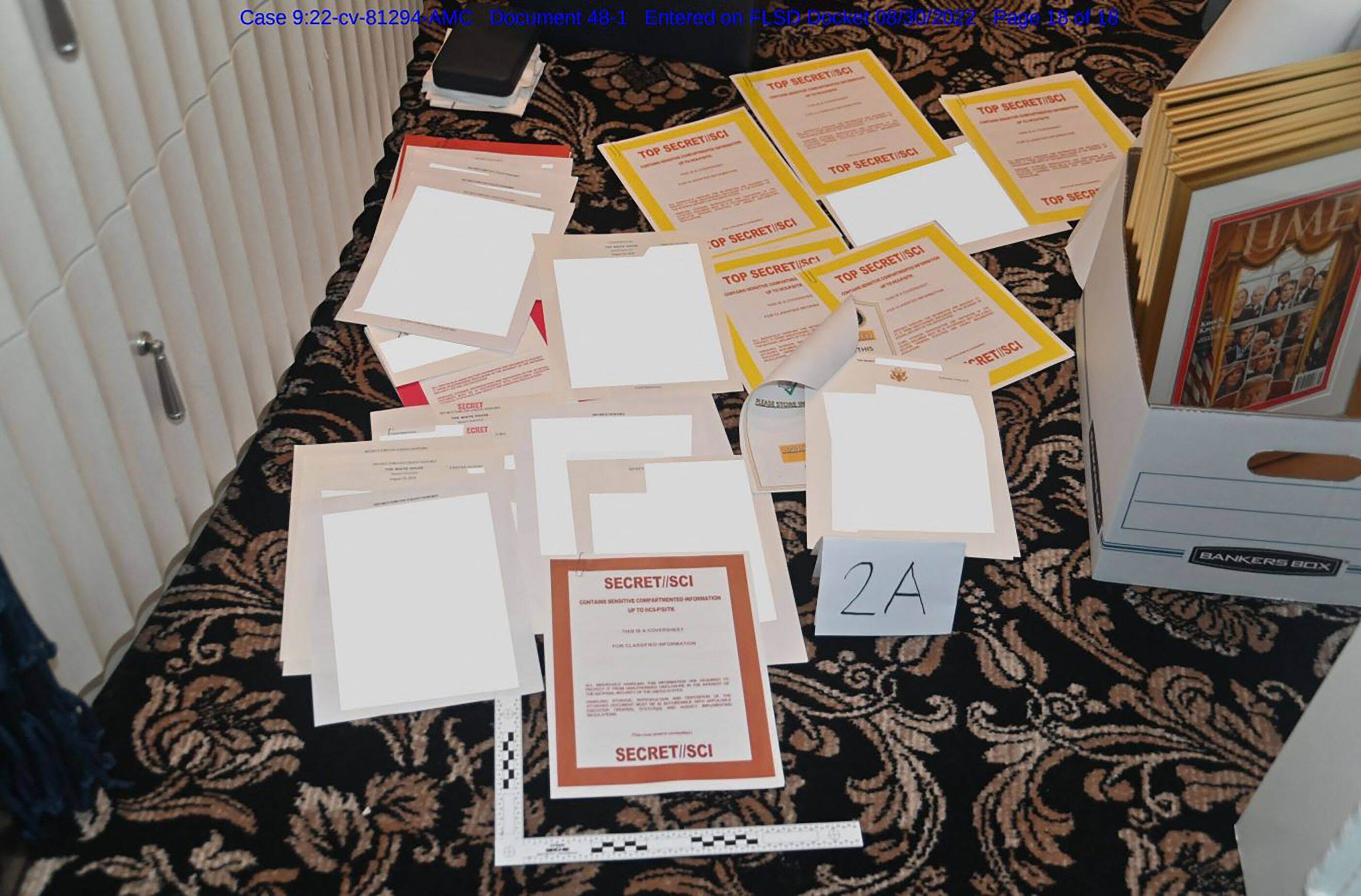 Some of what the government says it found at Mar-a-Lago. (Jose Romero/Justice Department/AFP/Getty Images) | We don't know whether Trump or his allies will get charged with anything The Justice Department faces a dilemma, report The Post's Perry Stein, Jacqueline Alemany, Josh Dawsey and Devlin Barrett: What does it take to charge someone who once served as the commander in chief? Legal experts say it's a very high bar — the evidence would have to be even more compelling than in a typical case, and the alleged crime might have to be even more serious. | 



 Email
Email


No comments:
Post a Comment