Help Monarchs on their Long Migration South 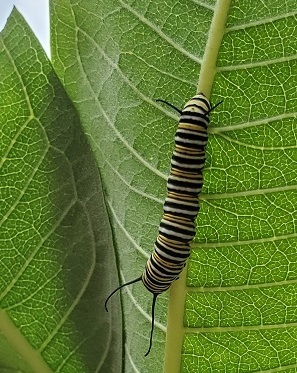 Monarch butterflies (Danaus plexippus) begin their annual fall migration in mid-August. These butterflies are the great-great-grandchildren of the monarchs that migrated to Mexico last fall. Monarch butterflies (Danaus plexippus) begin their annual fall migration in mid-August. These butterflies are the great-great-grandchildren of the monarchs that migrated to Mexico last fall.
You can help monarchs: - Provide food (nectar) and keep those areas protected:
- Turn a portion of your lawn into a wildflower meadow—plant milkweed or other native wildflowers.
- Delay mowing areas with milkweed until later in the fall.
- Avoid using herbicides—they kill all life-stages of monarchs (egg, caterpillar, pupa, and adult).
- Report sightings of adults online. View a map of the sightings so far this year.
Don't know when their migration peaks in your area? Check out this chart.
Chrysalis Stage
Have you seen a small green pod about an inch-long? This is a monarch caterpillar after it enters the pupa stage and is now in a chrysalis. If you see one, try not to disturb it. They will find a safe place, often under a milkweed leaf to enter this stage in their development, which lasts about 9-14 days. Sometimes they will pupate hanging under eaves, decks, other garden plants, or even on window screens! Photo of monarch caterpillar on milkweed by Sandy Van Vranken.
DEC and Partners Collaborate on Invasive Species Management 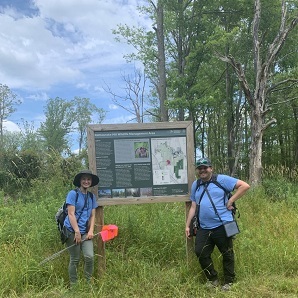 In late July, staff from the Western New York Partnership for Regional Invasive Species Management (WNY PRISM) surveyed and mapped the extent of invasive stiltgrass (Microstegium vimineum) on Rattlesnake Hill Wildlife Management Area (WMA) in Allegany County. This plant was discovered on the WMA in late 2021 and is one of just two known locations for this species in the county. DEC treated the site with herbicide once the survey was complete and hopes to eradicate this patch. Stiltgrass spreads prolifically and can create monocultures (areas with just one plant species) that reduce biodiversity and degrade wildlife habitat. Seeds from stiltgrass are easily transported on muddy tires and footwear, and always cleaning these items before entering natural areas is the best way to prevent its introduction. In late July, staff from the Western New York Partnership for Regional Invasive Species Management (WNY PRISM) surveyed and mapped the extent of invasive stiltgrass (Microstegium vimineum) on Rattlesnake Hill Wildlife Management Area (WMA) in Allegany County. This plant was discovered on the WMA in late 2021 and is one of just two known locations for this species in the county. DEC treated the site with herbicide once the survey was complete and hopes to eradicate this patch. Stiltgrass spreads prolifically and can create monocultures (areas with just one plant species) that reduce biodiversity and degrade wildlife habitat. Seeds from stiltgrass are easily transported on muddy tires and footwear, and always cleaning these items before entering natural areas is the best way to prevent its introduction.
Photo by Brittany Hernon with PRISM.
Migratory Game Bird Banding on Facebook Live In case you missed it, DEC Wildlife Biologist Josh Stiller and other wildlife staff were recently in Saratoga County banding wood ducks and mallards. They also recorded the age and gender of each duck before releasing them. Statewide, we band more than 8,000 migratory game birds every year in order to learn about their annual survival, harvest, migration routes, and much more. Check out the video on DEC's Facebook page!
DEC Releases Draft Access and Public Use Plans for Two Wildlife Management Areas 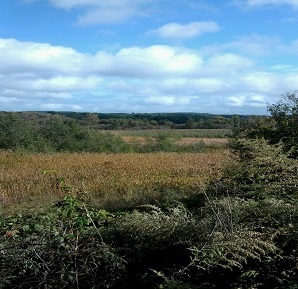 Draft Access and Public Use Plans for Plantation Island Wildlife Management Area (WMA) (PDF) and Cranberry Creek WMA (PDF) are complete and available for public comment. The draft Access and Public Use Plans (APUP) contain objectives for maintaining existing features—such as trail, parking areas, and kiosks—and wildlife-dependent recreation—including fishing, and wildlife observation. Draft Access and Public Use Plans for Plantation Island Wildlife Management Area (WMA) (PDF) and Cranberry Creek WMA (PDF) are complete and available for public comment. The draft Access and Public Use Plans (APUP) contain objectives for maintaining existing features—such as trail, parking areas, and kiosks—and wildlife-dependent recreation—including fishing, and wildlife observation.
Cranberry Creek WMA contains 13 acres of primarily forest in Jefferson County near the St. Lawrence River. The WMA also has a memorial grave site dedicated to the American soldiers that died during the War of 1812 Battle of Cranberry Creek. Plantation Island WMA is located in Herkimer County and contains 200 acres of island riparian habitat in the Mohawk Valley that is bounded to the north by the Mohawk River and to the south by the New York State Barge Canal. The island is co-owned by the DEC and the New York State Canal Corporation. The island itself, which was created by the construction of the 1913 Barge Canal, is a mixture of open marshes, wet meadows, scrub/shrub habitats, vernal pools, and floodplain forests. It provides habitats for a variety of plant and animal species in the area. Comments will be accepted until October 1, 2022, and can be sent to NYSDEC Bureau of Wildlife, Region 6, 317 Washington Street, 7th Floor, Watertown, NY, 13601 or by email with the subject line – "Cranberry Creek WMA draft APUP" for Cranberry Creek WMA and "Plantation Island WMA draft APUP" for Plantation Island WMA. Photo of Plantation Island WMA. | 


No comments:
Post a Comment