| Good morning, Early Birds. Today's the day. Beware the exit polls. Tips: earlytips@washpost.com. Thanks for waking up with us. In today's edition … What race calls to expect tonight … The latest on lawsuits … Paul Kane and Marianna Sotomayor on Nany Pelosi's legacy and her political future … but first … | | |  | The campaign | | Nine storylines we're watching tonight | 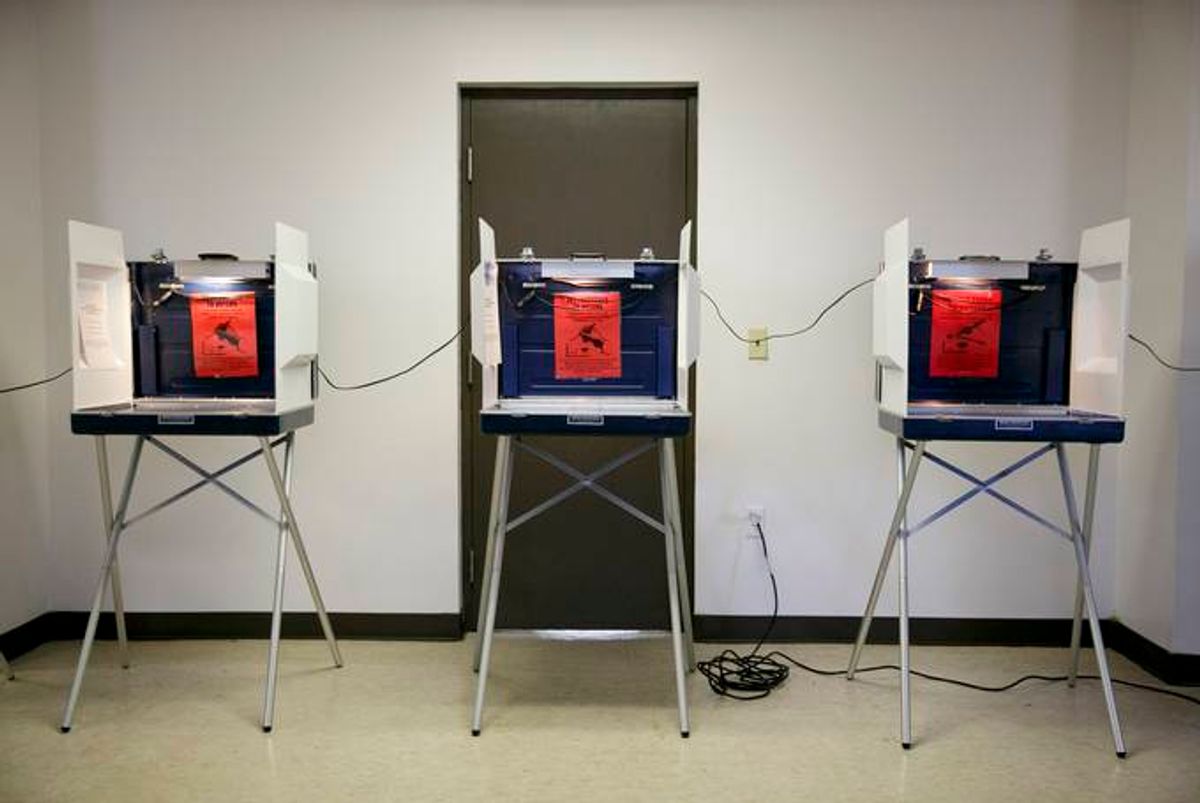 (Photo by Kristen Zeis/For The Washington Post) | | | It's Election Day (inhale, exhale). Republicans are expected to retake the House amid dissatisfaction with President Biden, and they could recapture the Senate, too. (The outcome might not be clear for weeks if neither Sen. Raphael G. Warnock (D-Ga.) nor his Republican opponent, Herschel Walker, break 50 percent, triggering a December runoff.) But the results will tell us much more than which party will control the House and which will control the Senate for the next two years. Here are nine other storylines we'll be watching tonight: | Can Democrats stop the bleeding with Hispanic voters? | | We're watching the Senate race and House races in Nevada, where Leigh Ann traveled last weekend to report on the tight race between Democratic Sen. Catherine Cortez Masto and her Republican rival, former Nevada attorney general Adam Laxalt. Other races to watch: Democratic Sen. Mark Kelly's race against Republican Blake Masters in Arizona and the House races in South Texas, where Trump did better than expected in 2020. (Keep an eye on the showdown between Democratic Rep. Vicente Gonzalez and Republican Rep. Mayra Flores in a newly redrawn swing district.) | Will Republicans who were present on Jan. 6 win House seats? | | There are three Republicans running for House seats who were near the Capitol on Jan. 6, 2021. Two of them could win tonight: Derrick Van Orden is favored in the race to replace retiring Rep. Ron Kind (D-Wis.) — read Theo's dispatch from Wisconsin — and J.R. Majewski is trying to unseat longtime Rep. Marcy Kaptur (D-Ohio). | Will any Republican incumbents go down? | | All eyes are on Democratic losses but it's common for a few House Republicans to lose their seats even in banner years for the GOP (and vice versa in strong years for Democrats). The Republicans in the most danger include Reps. David G. Valadao (R-Calif.) and Steve Chabot (R-Ohio), both of whom represent districts that became bluer during redistricting. | Can Republicans take out Rep. Sean Patrick Maloney (D-N.Y.)? | | Republicans have invested million of dollars in ads attacking Maloney, the Democratic Congressional Campaign Committee chairman, who's running for reelection in a district in the New York City suburbs that's mostly new to him following redistricting. Defeating Maloney in a seat that Biden carried by 10 points would be a symbolic victory for Republicans. | Will Republicans make inroads in New England? | | Reps. Jared Golden (D-Maine), Chris Pappas (D-N.H.) and Jahana Hayes (D-Conn.) are facing tight reelection races, and Republicans have rallied around Allan Fung, who's running as a relative moderate in the race for an open seat in a district Biden carried by nearly 14 points in Rhode Island. Sen. Maggie Hassan (D-N.H.), meanwhile, needs to win for Democrats to have a shot at holding the Senate. | Will abortion help Democrats limit their losses? | | Kansans defeated a proposed amendment to the state constitution in August that would've removed abortion protections, and Rep. Sharice Davids (D-Kan.) is relying on those voters to win reelection in a swing district, as Theo reported from Kansas. The same dynamic could help Democrats in Michigan, where an abortion rights measure is on the ballot. Michigan Gov. Gretchen Whitmer is up for reelection, Rep. Elissa Slotkin (D-Mich.) is facing a close race and Democrats are trying to pick up the district that includes Grand Rapids after Rep. Peter Meijer (R-Mich.) lost his primary to a Trump-backed candidate, John Gibbs. | How will the toss-up governors' races play out? | | Three Democratic governors — Kansas Gov. Laura Kelly, Wisconsin Gov. Tony Evers and Nevada Gov. Steve Sisolak — are especially vulnerable. We're also watching the governors' races in Oregon, where Christine Drazan could become the first Republican governor there since 1987, and Arizona, where Democratic Secretary of State Katie Hobbs is facing Trump ally Kari Lake. | How secretary of state candidates who've refused to accept the 2020 election results prevail? | | Mark Finchem, the Republican nominee for secretary of state in Arizona, and Jim Marchant, the Republican nominee for the same office in Nevada, are among the Republicans who've refused to accept the results of the 2020 election. If they win today, they would be in a position to oversee the 2024 election in two crucial swing states. (We spoke with their Democratic opponents last week about the risks to the election system if they're elected. ) "When my coalition of secretary of state candidates around the country get elected," Marchant said at a Trump rally last month, "we're going to fix the whole country and President Trump is going to be president again in 2024." | How will ranked-choice voting affect tight races? | | Golden, the Democrat facing a close race in Maine, beat Republican Rep. Bruce Poliquin in 2018 with the help of the state's new ranked-choice voting system. The system allowed voters who backed two independent candidates to rank Golden second or third, delivering him a narrow victory. This year, Alaska is using a similar system for the first time. It helped Democratic Rep. Mary Peltola win a special election in August. We're watching how ranked-choice voting will affect Peltola and Golden's races as well as the Alaska Senate race, in which Sen. Lisa Murkowski (R-Alaska) is facing a Trump-backed Republican rival, Kelly Tshibaka. (Read Leigh Ann's dispatch from Alaska if you missed it.) | What race calls to expect tonight |  Rep. Abigail Spanberger answers questions from reporters after a rally in Woodbridge, Va. on Sept. 24. (Robb Hill/The Washington Post) | | | As we reported last week, many states and races won't be called tonight for a variety of reasons, including late-counting mail-in ballots, historically slow counting, ranked-choice voting and a potential runoff in Georgia. Here are the battleground House races we'll be watching tonight that could give us a sense of how well each party is doing: | - Indiana's 1st District: Rep. Frank J. Mrvan (D) vs. Jennifer-Ruth Green (R). Poll closing time: 7 p.m. Eastern.
- New Hampshire's 1st District: Rep. Chris Pappas (D) vs. Karoline Leavitt (R). Poll closing time: 7 p.m. Eastern.
- Virginia's 2nd District: Rep. Elaine Luria (D) vs. Jen Kiggans (R). Poll closing time: 7 p.m. Eastern.
- Virginia's 7th District: Rep. Abigail Spanberger (D) vs. Yesli Vega (R). Poll closing time: 7 p.m. Eastern.
- North Carolina's 13th District: Wiley Nickel (D) vs. Bo Hines (R). Poll closing time: 7:30 p.m. Eastern.
- New Jersey's 7th District: Rep. Tom Malinowski (D) vs. Tom Kean Jr. (R). Poll closing time: 8 p.m. Eastern.
- Connecticut's 5th District: Rep. Jahana Hayes (D) vs. George Logan (R). Poll closing time: 8 p.m. Eastern.
| | And here are some of the states in which it could take days or weeks to learn the results, especially in close races: | - New York: We're watching the governor's race and half a dozen battleground House seats in this slow-counting state.
- Pennsylvania: The Senate race and three House seats are up for grabs; slow mail-in vote counting and lawsuits could delay the results.
- Maine: Ranked-choice voting could delay the results in Golden's race
- Wisconsin: Counting of mail-in ballots could be slow for the toss-up Senate and governor's races.
- Nevada: Three competitive House races, a toss-up Senate race, a toss-up governor's race and the secretary of state's race are all on the line — but counting mail-in votes could take days.
- Arizona: Like Nevada, there are competitive House, Senate, governors and secretary of state races — and like Nevada, counting mail-in votes could take days.
- Oregon: A heavily mail-in ballot state with a closely watched governor's race and three close House races.
- California: The state is one of the slowest vote-counters in the country and it could take days to call close House races there.
- Alaska: Due to the state's new ranked-choice voting system and because rural Alaskans often rely on mail-in voting, the results of the Senate race and the race for Alaska's lone House seat aren't expected until Nov. 23.
| | |  | From the courts | | Tis' the season for election litigation | 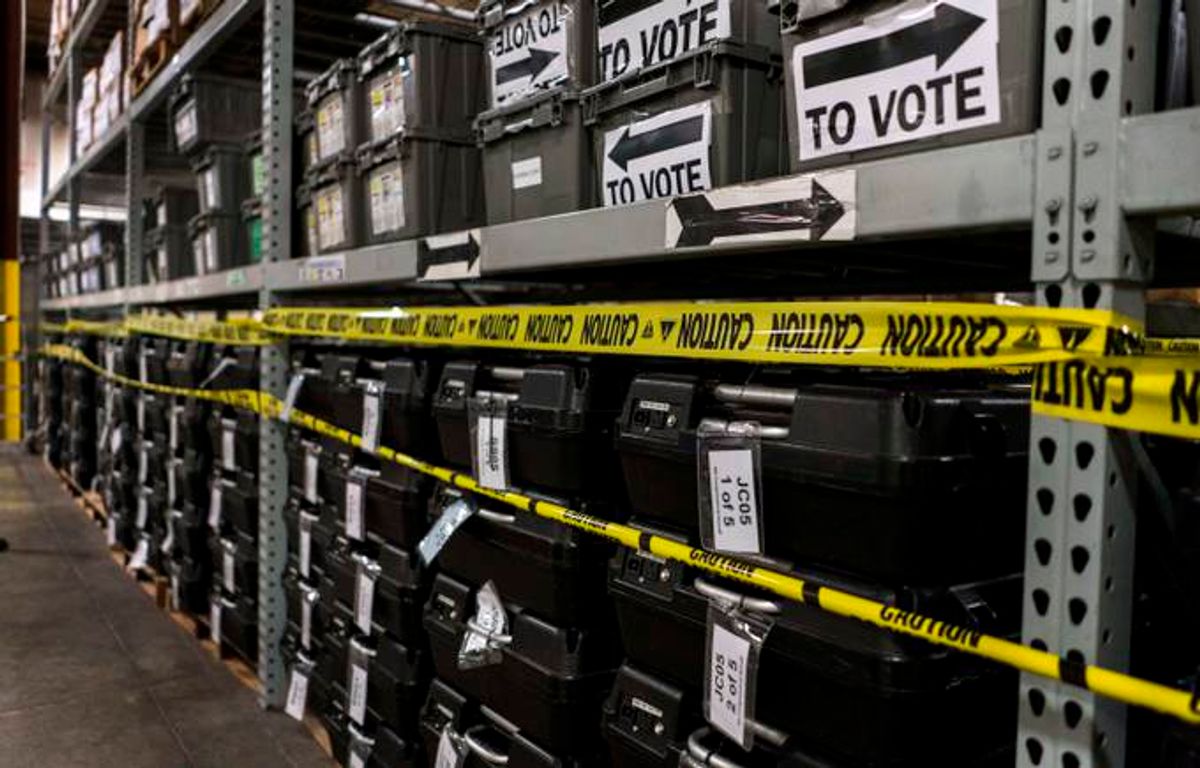 (Photo by Melina Mara/The Washington Post) | | | A legal blitz over mail-in ballots has erupted in several battleground states across the country. This year's high-stakes fight — like the one former president Donald Trump and his allies led in 2020 — could dictate who votes, how they vote and how their votes are counted. One hundred and twenty voting-related lawsuits have been filed as of Nov. 3, per CNN and Democracy Docket. More than half of those lawsuits sought to restrict access to the ballot and nearly 1 in 5 were brought by state GOP committees or the Republican National Committee. But Democrats have filed lawsuits of their own, aimed at making voting easier and more accessible. Here's a recounting of some of the many, many lawsuits: Pennsylvania | - On the right: The Republican National Committee successfully sued to disqualify thousands of undated ballots, our colleagues Amy Gardner and Emma Brown report. As a result, at least 7,000 ballots statewide (including 2,000 in Philadelphia) have been rejected, "enough to swing a close race."
- On the left: Lt. Gov. John Fetterman's Senate campaign joined the Democratic House and Senate campaign arms in suing "Pennsylvania elections officials Monday asking a federal judge to order that all mail ballots be counted regardless of what date, if any, voters wrote on the outside of the envelope," the Philadelphia Inquirer's Jonathan Lai and Jeremy Roebuck report. "Throwing out ballots over such a technicality, they argue, violates federal civil rights law."
| - On the right: "Kristina Karamo, the Republican nominee for secretary of state, sued the top election official in Detroit last month, seeking to toss absentee ballots not cast in person with an ID," Amy and Emma write. Although state Circuit Court Judge Timothy M. Kenny dismissed the lawsuit on Monday, "county clerks across Michigan have received emails from organized groups attempting to dispute the eligibility of voters who requested or cast absentee ballots, suggesting there could be more litigation to come."
| - On the left: The American Civil Liberties Union successfully sued the Cobb County elections department Sunday after 1,036 voters who requested ballots never received them, per the Atlanta Journal-Constitution's Taylor Croft. Cobb County Superior Court "Judge Kellie Hill will allow the county to accept absentee ballots that are postmarked by Election Day, even if they are received later."
| | |  | On the Hill | | With her political future unclear, Nancy Pelosi stares down another midterm |  Nancy Pelosi receives a kiss from her husband Paul Pelosi after a donation ceremony on March 7, 2018. (Michael S. Williamson/The Washington Post) | | | Her choice: "House Speaker Nancy Pelosi was already facing a pivotal midterm election Tuesday that could chart the future for both the Democratic Party and her political legacy," our colleagues Paul Kane and Marianna Sotomayor write. "But the brutal and politically motivated hammer attack on her husband, Paul, late last month has frozen the conversation in place as colleagues await word on her decision whether to stay in the House or retire from public service." | - "The California Democrat's presence has towered over the U.S. Capitol for nearly two decades since she broke the congressional glass ceiling and became the first female House speaker. Regarded by many experts as the most powerful speaker in more than 100 years, she presided over Democrats losing the majority in 2010, then defiantly remained at the helm of the caucus and led Democrats back to power in 2018."
- "Some veteran lawmakers and aides say the attack on her husband will embolden Pelosi, 82, to remain atop the caucus … Others wonder if the attack provides the personal pull for Pelosi to finally leave Congress and return home to help her husband of nearly 60 years through his 'long recovery,' as she has called it."
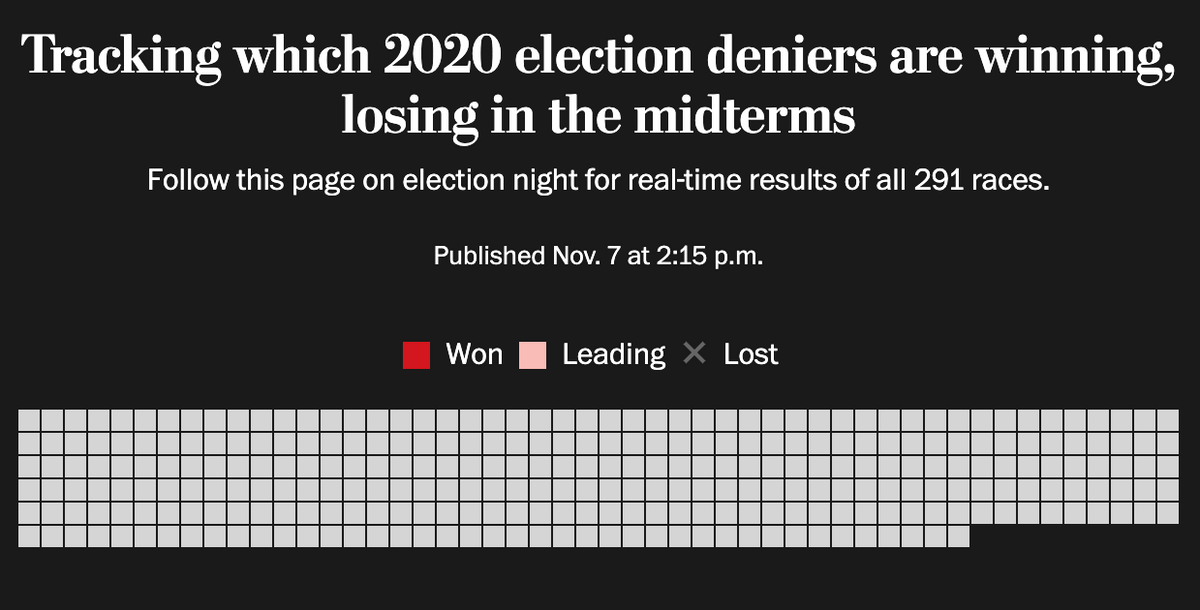
| | |  | The Data | | | The election deniers on the ballot, visualized: Nearly 300 Republican nominees who have denied or questioned the outcome of the 2020 presidential election are on the ballot today for House, Senate and key statewide offices, according to an analysis conducted by our colleagues Adrian Blanco and Amy Gardner last month. Adrian, Daniel Wolfe and Amy are tracking the outcomes of their contests. Click the image (and bookmark the page) for real-time results. Another Tracker: Where abortion access hangs in the balance. | | |  | The Media | | | |  | Viral | | | Palate cleanser |  | | | | | | AM/PM | | Looking for more analysis in the afternoon? | | | | Weekday newsletter, PM |  | | | | | | |




No comments:
Post a Comment