What's seditious conspiracy? The 5-Minute Fix author Amber Phillips is on parental leave, and Washington Post researcher Caroline Anders and reporter and editor Paige Winfield Cunningham are filling in. Send them a note any time on what you'd like to see in this newsletter. In a big win for the Justice Department, a federal jury convicted Oath Keepers founder Stewart Rhodes and one of his top deputies of seditious conspiracy Tuesday for their involvement in a months-long plot to prevent Joe Biden from being inaugurated. What that means: Seditious conspiracy, which is sometimes referred to as a lesser form of treason, is defined in part as an effort by two or more people to "conspire to overthrow, put down, or to destroy by force the Government of the United States, or to levy war against them." The charge is punishable by up to 20 years in prison. How it's proved: It's a rarely used charge, in part because it's so difficult to prove. (The last guilty verdict for a seditious-conspiracy charge was nearly 30 years ago.) To secure a conviction, prosecutors have to show that the accused harbored an intent to forcibly oppose the federal government. Jan. 6 context: Five Oath Keepers faced seditious conspiracy charges, but only Rhodes and lead Florida Oath Keeper Kelly Meggs were convicted. All five on trial were convicted of obstructing Congress as it met to confirm the results of the 2020 election. API's 10-Point Policy Plan provides a roadmap for a new era of American energy leadership. It recognizes our nation's abundant resources, supports energy investment, and keeps regulation from unnecessarily restricting energy growth. | |  | | | | These were the first seditious conspiracy charges leveled in connection to the attack on the U.S. Capitol, and Rhodes and his co-defendants were the first to be convicted of any conspiracy charge related to Jan. 6. Looking forward: "The verdict in Rhodes's case likely will be taken as a bellwether for two remaining Jan. 6 seditious conspiracy trials set for December against five other Oath Keepers and leaders of the Proud Boys," our colleagues report. Three things to know about the new House Democratic leadership House Democrats elected a slate of new leaders today, marking a generational shift for the party's leadership in the chamber. Rep. Hakeem Jeffries of New York will succeed Speaker Nancy Pelosi as the House Democratic leader, making him the first Black lawmaker to lead a party in Congress. Reps. Katherine Clark of Massachusetts and Pete Aguilar of California will serve as the No. 2 and No. 3 House Democrats. 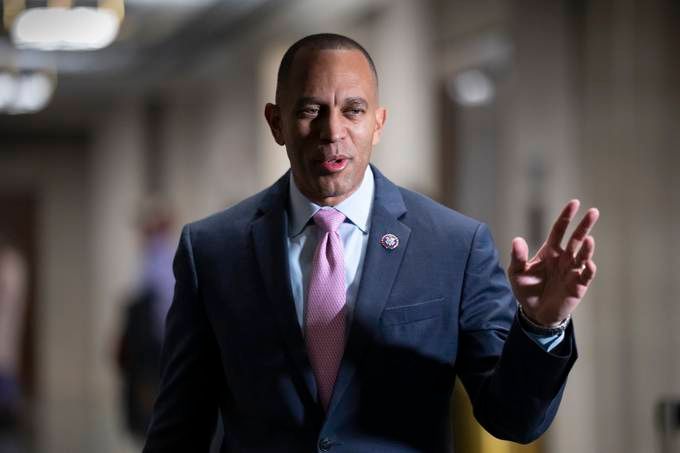 Newly-elected House minority leader Hakeem Jeffries (D-N.Y.). (AP Photo/J. Scott Applewhite) | Let's talk about what this means for House Democrats. 1. The new leaders will be guiding a party freshly in the minority. Republicans, with about half a dozen more seats than Democrats, will set the legislative agenda in the House starting next year. But there are other ways the minority party can wield power. Members can try to influence legislation by offering amendments, in committee or on the House floor. Even if the amendments have no chance of passing, they can help the minority party express where they differ with the majority on key issues. But the Democrats also ended up with more power than anticipated in the forthcoming Congress, losing fewer seats than many pundits had predicted. Because of their slim majority, Republicans will need some Democrats' help to get must-pass legislation through. That provides the Democrats an opportunity to tuck some of their priorities that might not otherwise pass into larger bills. 2. They're a new generation of leadership. Pelosi isn't the only House Democratic leader stepping down. So are House Majority Leader Steny Hoyer of Maryland and Majority Whip James Clyburn of South Carolina. All three are over 80 years old. Democrats have long been criticized for not cultivating younger leadership, and this exodus of older leaders will serve as a test of the party's ability to evolve. In his former role as the No. 5 House Democrat, Jeffries was the youngest member of House Democratic leadership. Clark, who will replace Hoyer, is 59, and Aguilar, who will replace Clyburn, is 43. 3. They're in charge of helping House Democrats win back seats in 2024. The main political goal of any House minority party is to gain the majority. This means finding and supporting candidates that could win in the next election as well as sharpening the party's messaging and policy goals. It's impossible to say at this point whether Democrats can take the House in two years; while they performed better than expected this election, midterm results usually don't predict general-election results. This new trio of leaders will also have the hefty task of trying to please all kinds of Democrats by ensuring that ideological factions within the caucus are represented in significant decisions. One line of tension is between liberal and moderate Democrats, who frequently clash over what the party's priorities should be. | 



 Email
Email


No comments:
Post a Comment