| Welcome to The Daily 202! Tell your friends to sign up here. Big day for English-language comedic literature. Samuel Langhorne Clemens, a.k.a. Mark Twain, was born on this day in 1835. And Oscar Wilde, one of the funniest writers of all time, died in 1900. | | |  | The big idea | | Biden drives railway deal over some labor rank-and-file allies | 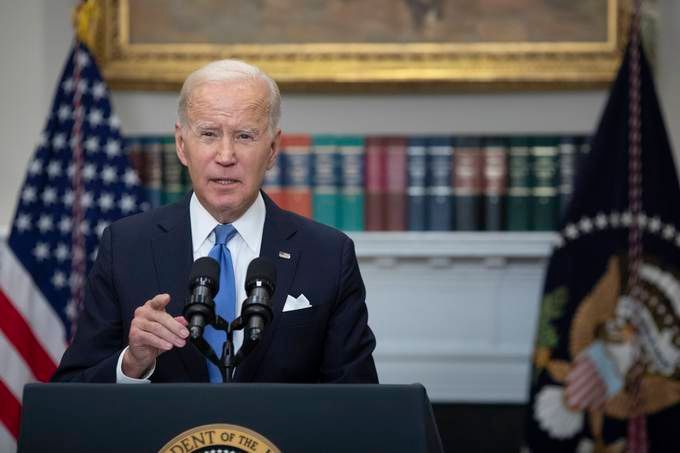 President Biden, seen here in a file photo, has touted his support for unions throughout his presidency. (Tom Brenner/The Washington Post) | | | President Biden credited organized labor with his 2020 victory — "it's not hyperbole, it's a fact!" In September 2021, from the East Room of the White House, he promised to be "the most pro-union President leading the most pro-union administration in American history." But now, some freight-railway unions have refused to line up behind a deal he helped midwife in September 2022 to avoid a punishing shutdown. So Biden is pushing Congress to pass legislation enacting the arrangement over their objections, which are tied to working conditions like a lack of any paid sick leave. If you see a potential political problem there for the president, you're not wrong. Unions are far weaker than they were decades ago, but they're crucial to Democratic hopes in places like Pennsylvania. But the political and economic downsides of a potential strike in December — one plausible way labor could clinch a better deal with the railroads, many of which posted record profits last year — would be much worse. As my colleagues Lauren Kaori Gurley, Tyler Pager and Tony Romm noted on Monday, when Biden pushed the issue to Congress: "A rail strike could threaten the nation's water supply, halt passenger rail travel and trigger major disruptions to the U.S. supply chain during the height of the holiday season, potentially worsening inflation. Already, some tech companies have begun rerouting cargo shipments from railroads to trucks in preparation for a potential shutdown, according to CNBC." | | | | | | | API's 10-Point Policy Plan provides a roadmap for a new era of American energy leadership. It recognizes our nation's abundant resources, supports energy investment, and keeps regulation from unnecessarily restricting energy growth. | | | |  | | | | | The deal "offered all members a 24 percent raise by 2024, annual bonuses of $1,000 and a cap on health-care premiums. It also granted conductors and engineers a single additional paid day off and allowed them to call out up to three times each year for routine doctors appointments without facing disciplinary action," they reported. In a written statement on Monday, Biden said as many as 765,000 workers could be out of work in just the first two weeks of a shutdown. "As a proud pro-labor President, I am reluctant to override the ratification procedures and the views of those who voted against the agreement," he said. "But in this case — where the economic impact of a shutdown would hurt millions of other working people and families — I believe Congress must use its powers to adopt this deal." On Tuesday, as he met with leaders of both parties and both chambers of Congress, Biden said: "It's not an easy call, but I think we have to do it. The economy is at risk." | | The dynamic feels like Biden's broken promise to make Saudi Arabia a "pariah," or his watered-down vow to make human rights "the center of our foreign policy." Passion gives way to what might charitably be called pragmatism. Sometimes, other national interests just win out. You could hear the same struggle — and same conclusion — from House Speaker Nancy Pelosi (D-Calif.). "It's not everything I would like to see," she said after the meeting. "I don't like going against the ability of unions to strike, but weighing the equities, we must avoid a strike." In addition to a vote on passing the deal, Pelosi scheduled an additional vote to add seven days of sick leave to the deal. She could very well muster a House majority to do so. And then the question becomes whether all Senate Democrats (and their independent allies) hang together on that change and manage to enlist 10 Republicans. | | Sen. Biden — the one from the last time Congress imposed a railway deal, 30 years ago — might not have approved of what he did Monday. As The Daily 202 reported the day of the tentative railway deal Biden helped get across the finish line, he was one of just six "no" voters on a bill banning strikes and lockouts and creating an arbitration system to settle the disputes of 1992. "A reasonable system in theory that has turned insidious in practice" is how he described the process, which then — as now — relies on a presidential emergency board. Railway executives know "in the end, the odds were stacked in their favor." | | The four unions – out of 12 – that voted "no" on ratifying the deal comprise more than half of unionized rail workers. My colleagues cited one of the largest rail unions, the Brotherhood of Maintenance of Way Employes Division, as saying pushing the problem to Congress "denied railroad workers both 'their right to strike' and the 'benefits they would likely obtain' if they were not denied that right." With razor-thin majorities in Congress, Democrats have limited margin to maneuver to overcome defections unless enough Republicans sign on. Which means one critical open question is: What will the unions do? | Exclusive: Hillary Clinton to honor four Ukrainian woman, including Zelenska |  Ukraine's first lady Olena Zelenska looks on, in London on Tuesday. (Jessica Taylor/UK Parliament) | | | On Monday, former Secretary of State Hillary Clinton will continue her career-long commitment to women's rights by honoring four Ukrainian women, including first lady Olena Zelenska and 2022 Nobel Peace Prize co-winner Oleksandra Matviichuk, at the annual Hillary Rodham Clinton Awards at Georgetown University. The awards, which Clinton has held since 2014, are given to people who've demonstrated "exceptional leadership in promoting women's rights and creating a more peaceful and secure world for all," according to an announcement obtained by The Post. They are among a cavalry of women involved in resisting the Russian war in Ukraine. There are 37,000 women in the Ukrainian army, making up 22 percent of service members, according to Zelenska, and women warriors have increasingly taken up combat positions after Russia launched its full-scale invasion on Feb. 24. Zelenska will be accepting Clinton's award remotely, but has made sporadic appearances in the spotlight, while living in hiding as a kill target of the Russians, to advance human rights. Her first appearance since the start of the war was a stealth meeting with first lady Jill Biden on Mother's Day in May, at a shelter for the displaced, in an active war zone, just over the border in Ukraine. She met with Biden again at the White House in July. Matviichuk, is a Kyiv-based human rights lawyer and chairwoman of the Center for Civil Liberties (CCL), was awarded the Nobel prize among a trio of human rights defenders that included an activist from Belarus and an organization in Russia. She's advocated for the expansion of the International Criminal Court and a revamping of the global justice system to adjudicate millions of unaddressed wartime crimes. Another honoree is Kateryna Levchenko, who serves as Ukraine's commissioner for gender equality – a role in which she coordinates and monitors gender policy throughout the government. She's also charged with overseeing implementation of a landmark 2020 U.N. Security Council resolution on increasing the role of women and girls in peace and security efforts, and protecting them from gender-based violence. The fourth is Natalia Karbowska, who is the director on strategic development of the Ukrainian Women's Fund (UWF), which issues grants to nongovernmental organizations that support Ukrainian women's rights and gender equality. This year, UWF switched focus to supporting women's wartime needs and has been issuing rapid-response grants to organizations that provide daily assistance to women and families fleeing the war, and distribute medicine, food, water, hygiene products, as well as provide mental and physical health services. | | |  | Politics-but-not | | | Click through to submit ideas for potential inclusion in our weekly roundup of stories you might not find in other political newsletters. Read more » | | | | | |  | What's happening now | | House Democrats elect Hakeem Jeffries as party leader | 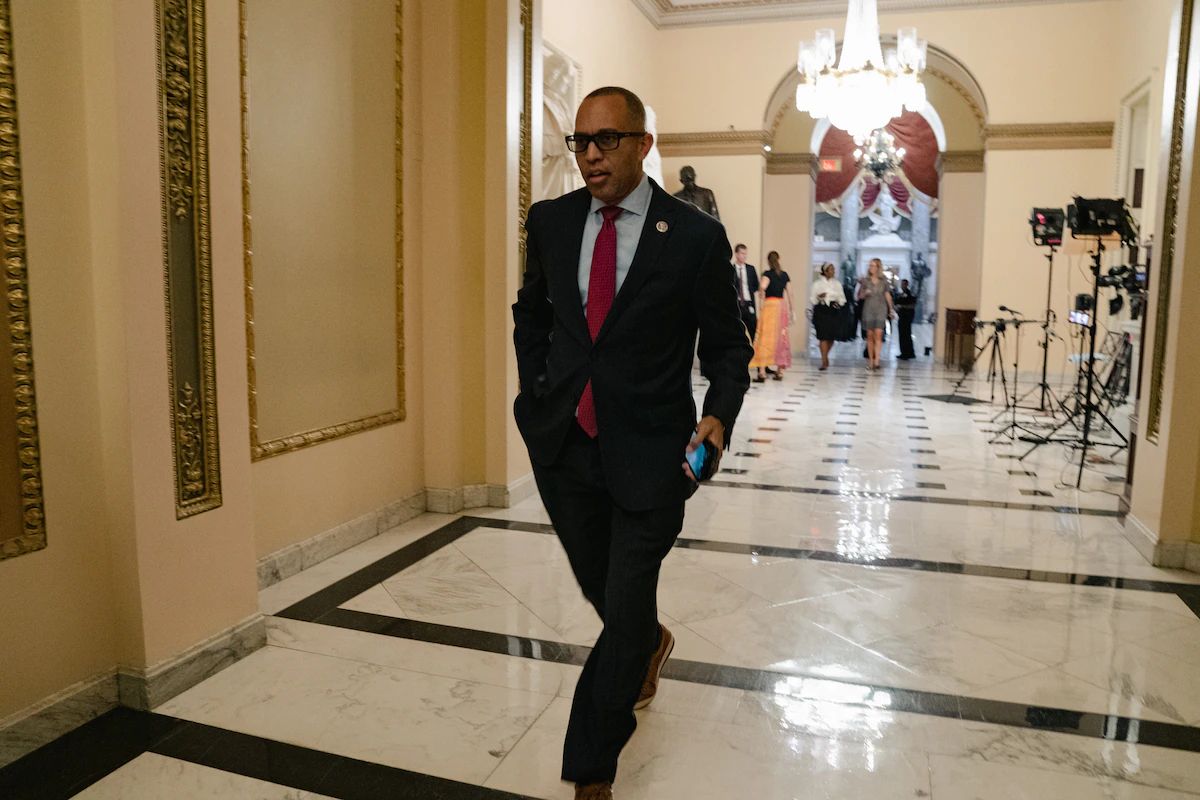 Rep. Hakeem Jeffries (D-N.Y.) walks into the House Chamber on Capitol Hill in Washington on Sept. 22. (Shuran Huang/The Washington Post) | | China warns of crackdown amid confused messaging on 'zero covid' future | | "Chinese authorities warned of a sweeping crackdown on 'zero covid' protesters and security forces conducted random spot-checks on the streets of major cities, amid widespread confusion over whether Beijing was making a serious attempt to relax its harshest coronavirus measures," Lyric Li reports. | | |  | Lunchtime reads from The Post | | These teens won the right to vote. Their county disenfranchised them. |  Ixchel Arista, pictured high-fiving classmates in October, fought with other teen activists to lower the voting age in Oakland, Calif. But Alameda County, which runs the city's election, never implemented the measures. (Melina Mara/The Washington Post) | | | "If all had gone as planned, thousands of high-schoolers in Oakland would have cast their ballots for the first time on Election Day. Many of them had worked since their freshman year to lower the voting age to 16 for school board races, arguing that no one had a higher stake in who led their district. And they won, convincing a supermajority of the electorate in 2020 to expand voting rights to younger teens," Moriah Balingit reports. "But Alameda County, which runs the city's elections, never implemented the measure. It also failed to deliver on a 2016 ballot initiative from Berkeley that did the same thing. So Tuesday passed like election days past: with 16- and 17-year-olds watching from the sidelines." | Opinion | Biden should respond boldly to a radical Netanyahu government | | "First, Israel should be told that, while the United States will continue to support its ally's legitimate security requirements, it will not provide offensive weapons or other assistance for malign Israeli actions in Jerusalem or the occupied territories. The United States specifically should warn against efforts to change the status of the West Bank and the Noble Sanctuary/Temple Mount, to 'legalize' settlement outposts, and to build infrastructure for settlers that is designed to foreclose the possibility of a two-state solution," Aaron David Miller and Daniel C. Kurtzer write. | China's swelling nuclear stockpile makes it a growing rival to U.S., Pentagon finds |  In this Sept. 3, 2015, file photo, Chinese military vehicles carrying DF-21D anti-ship ballistic missiles pass by Tiananmen Gate during a military parade to commemorate the 70th anniversary of the end of World War II, in Beijing. (Andy Wong/AP File) | | U.S. gun death rates hit highest levels in decades | | "The U.S. gun death rate last year hit its highest mark in nearly three decades, and the rate among women has been growing faster than that of men, according to study published Tuesday," the Associated Press's Mike Stobbe reports. "The increase among women — most dramatically, in Black women — is playing a tragic and under-recognized role in a tally that skews overwhelmingly male, the researchers said." | | |  | The Biden agenda | | Biden to commit to honor tribes with huge Nevada national monument |  The night sky looms over the Knob Hill area of the proposed Avi Kwa Ame National Monument in Boulder City, Nev. (Kyle Grillot) | | | "Two decades ago, Congress preserved the mountain — called Avi Kwa Ame (ah-VEE-kwah-may) in Mojave — and 33,000 acres around it as wilderness. Now the Biden administration is readying a proclamation that could put roughly 450,000 acres — spanning almost the entire triangle at the bottom of the Nevada map — off limits to development under the 1906 Antiquities Act," Dan Michalski reports. | Biden, in Michigan, sharpens 2024 pitch with focus on 2021-2022 | | |  | How senators voted on the Respect for Marriage Act, visualized | | 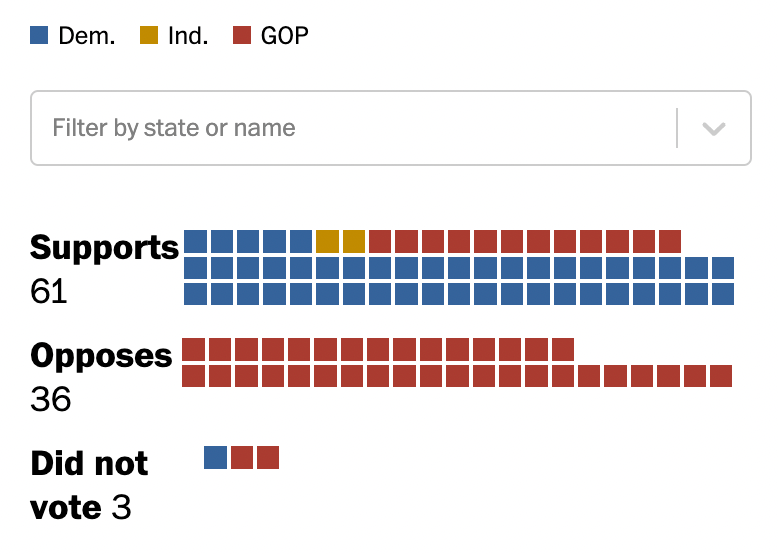 Click through to use the filtering feature | | | |  | Hot on the left | | Black turnout in midterms was one of the low points for Democrats | 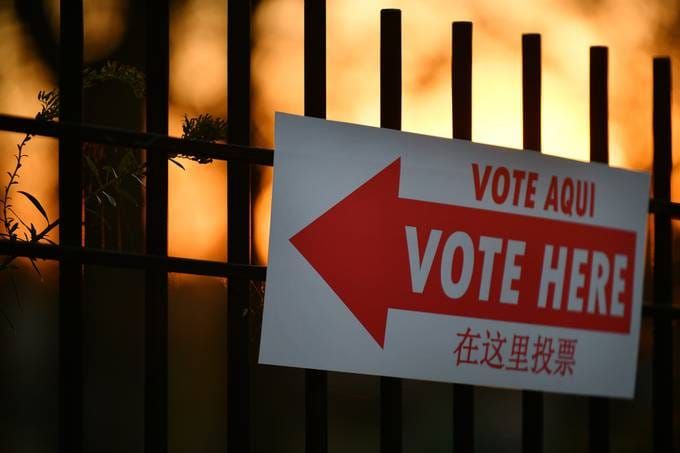 The sun rises behind an election sign which has been placed outside the voting center at Riggs Lasalle Recreation Center in Washington, D.C., on Nov. 8. (Astrid Riecken/The Washington Post) | | | "We won't get conclusive numbers on this for months, but the evidence so far raises the distinct possibility that the Black share of the electorate sank to its lowest level since 2006. It certainly did in states like Georgia and North Carolina, where authoritative data is already available," the New York Times's Nate Cohn writes. | | |  | Hot on the right | | Paul Ryan on the GOP's future: 'We lose with Trump' |  Former speaker of the House Paul D. Ryan. (Jay Westcott/The Washington Post) | | | Paul Ryan | "Well, I'm thankful we got the majority in the House, albeit much smaller than we should have or could have gotten. And we fell short of the Senate. I think the constant theme in this is: But for Trump, we would've had the Senate and a bigger House majority. It's just another fresh set of evidence that we lose with Trump." | | | | | | | |  | Today in Washington | | | At 11:05 a.m., Biden will head to the Interior Department for the Tribal Nations Summit. He will speak at 11:30 a.m. The Bidens, Vice President Harris and Second Gentleman Doug Emoff will attend the National Christmas Tree Lighting at 5:30 p.m. | | |  | In closing | | What's a state dinner, again? Macron is back for the first one post-covid. |  President Donald Trump shares a toast with French President Emmanuel Macron during a state dinner in 2018. (Jabin Botsford/The Washington Post) | | | "While the serious business of state takes place during the day, it's the glamorous dinner that gets all the attention: Everyone wears formal gowns or tuxedos; the White House pulls out the best food, china and crystal; and the guests are treated to some impressive entertainment," Roxanne Roberts explains. "An invitation to a state dinner is one of the most coveted in Washington and the guest list a snapshot of the administration's power and priorities." | | Thanks for reading. See you tomorrow. | | | | | |


No comments:
Post a Comment