| Good morning from Michigan. It's Election Day. Tell us what we need to know: rachel.roubein@washpost.com. Today's edition: The high-profile attorney general contests pitting abortion against crime. The Supreme Court is hearing oral arguments in a case that could impact Medicaid recipients' ability to sue in federal court. But first … | Today, Michigan will give abortion rights supporters a bellwether for future ballot measures | 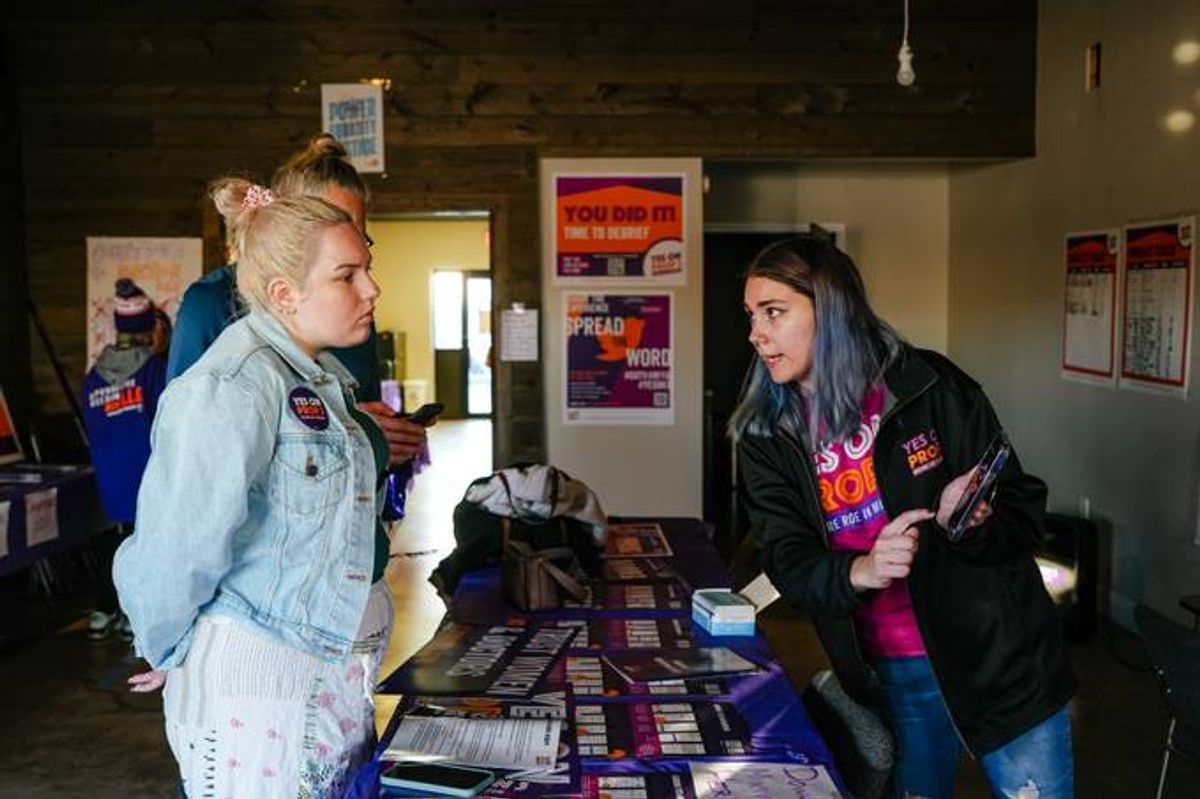 Alex Cascio, 27, an organizer with Reproductive Freedom for All in Michigan, teaches new volunteers how to use a mobile canvassing smartphone app. (Nick Hagen for The Washington Post) | | | ROYAL OAK, Mich. — Standing inside a campaign office here, Alex Cascio explained to a father-daughter pair of canvassers how the next few hours would go. They'd move from house to house, knocking on strangers' doors to seek their support for abortion rights. Cascio, an organizer, held up the Canvasser Guide for the Yes on Prop 3 campaign — the effort to enshrine abortion rights into the constitution of this swing state. She explained the talking points: This ballot measure is not extreme. It would give women the right to make their own private medical decisions. It would help prevent Michigan's 1931 near-total ban on abortion from going into effect. And then, a small group of canvassers took off, roaming the neighborhoods as the sun went down roughly 12 hours before polls open on Election Day. What happens today in Michigan could reverberate across the country. Abortion is on the ballot in five states, but Michigan is the only place where supporters gathered signatures to put a constitutional amendment to voters. That's a model abortion rights advocates in a handful of Republican-led states are eyeing for 2024 — and they're closely watching the outcome in Michigan as a bellwether for future initiatives. The results could also have implications for access to the procedure in other conservative states. Abortion providers say they've seen an influx of patients coming from out of state, with some women traveling as far away as Texas, Oklahoma and Tennessee. | | The effort to protect legal abortion in Michigan began before the Supreme Court struck down the constitutional right to an abortion. | | Roughly two years ago, the ACLU of Michigan, Planned Parenthood Advocates of Michigan and Michigan Voices started discussing a proactive way to counteract restrictions ready to spring into effect if the nation's highest court overturned Roe v. Wade. | - "We saw the writing on the wall when the Supreme Court took the Dobbs case in May of 2021," said Merissa Kovach, the legislative director for ACLU of Michigan. "They were signaling that at a minimum they were comfortable with entertaining the idea of overturning Roe."
| | Those initial conversations transformed into a pricey ballot measure campaign to guarantee the right to an abortion up until fetal viability, which is typically around 22 to 24 weeks. The ballot measure says the state may regulate abortions after the point of fetal viability, but must still allow abortions after that point if a health professional thinks it's necessary "to protect the life or physical or mental health of the pregnant individual." The state's pre-Roe ban on nearly all abortions is currently blocked, but the state's top court could reverse such a ruling. The result of the ballot measure — which a recent CNN poll showed voters favoring 54 to 45 percent — will also impact what restrictions on the procedure Republicans could pass in the future. The opposition counters that the ballot measure is too confusing and extreme. In particular, the group has focused on messaging that the initiative would eliminate parental consent for children seeking abortions and gender therapy. (Proponents deny this claim. The measure doesn't explicitly mention parental consent and experts believe the parental consent requirements would survive court challenges, as our colleague Dylan Wells recently noted.) "We're feeling optimistic," Christen Pollo, a spokesperson for Citizens to Support MI Women and Children, said in an interview last week. "Our message definitely seems to be resonating with voters." Yet, there's a stark disparity in how much money the two sides have raised. The abortion rights campaign has secured nearly three times as much cash as its opponent. It's raked in donations from major national progressive groups, funding the opposition has attacked as out-of-state dollars flooding Michigan. | - Reproductive Freedom for All, the organization supporting the ballot measure, collected over $44 million. Donors include the Sixteen Thirty Fund, Planned Parenthood Action Fund and NARAL Pro-Choice America, as well as local donors, according to recent campaign filings with the secretary of state's office.
- Citizens to Support MI Women and Children, the antiabortion group campaigning against Proposal 3, has raised nearly $17 million. Donors include the Michigan Catholic Conference, Right to Life of Michigan and Grand Rapids Right to Life.
| 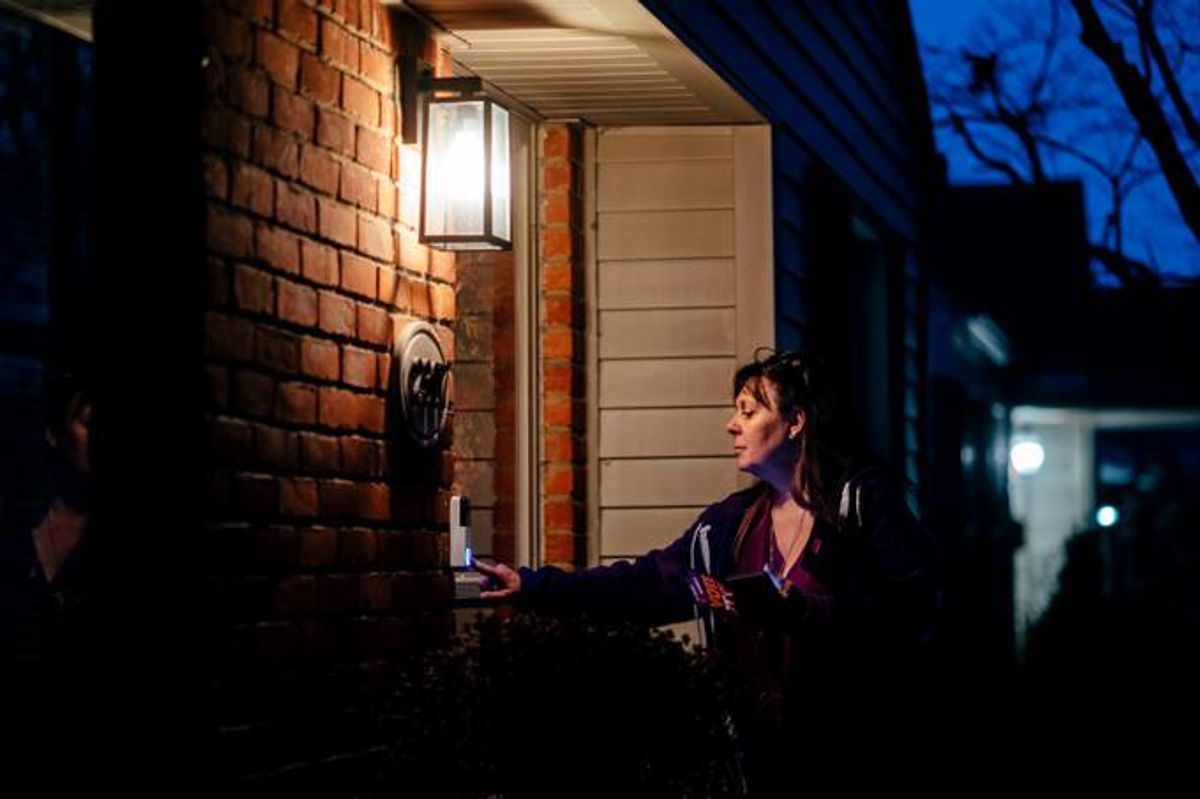 Lisa DeBlasi rings a door bell while canvassing for Reproductive Freedom For All, a group promoting abortion rights in Michigan. (Photo by Nick Hagen for The Washington Post) | | | The weekend's canvassing blitz continued into Monday afternoon, where a small gaggle of abortion rights supporters knocked on dozens of doors to ensure supporters or those leaning in support were voting in Royal Oak, Mich., a suburb of Detroit with a population of nearly 58,000. | | Many house calls went unanswered. A handful opened their doors and indicated their support. One man, who declined to talk with The Post, told the canvassers he was leaning yes. One home refused a Yes on Prop 3 doorhanger. Standing in his driveway, Robert Wallen, 35, an operations manager, said his ballot was downstairs. He plans to support the amendment, he said, because whether a woman has an abortion isn't his choice to make. Meagan McCallum, 31, a dietitian, already voted yes. She described signing the petition to get the measure on the ballot earlier this year, and how a network of friends had sent each other the details on how to do so. For Michael Mamassian, it was the lawn signs against the ballot measure that piqued his interest. The 35-year-old who works in IT says he doesn't identify with a particular political party. Once he began researching the ballot measure, he was firmly in support, saying abortion access shouldn't whipsaw back-and-forth depending on the politicians in office. | 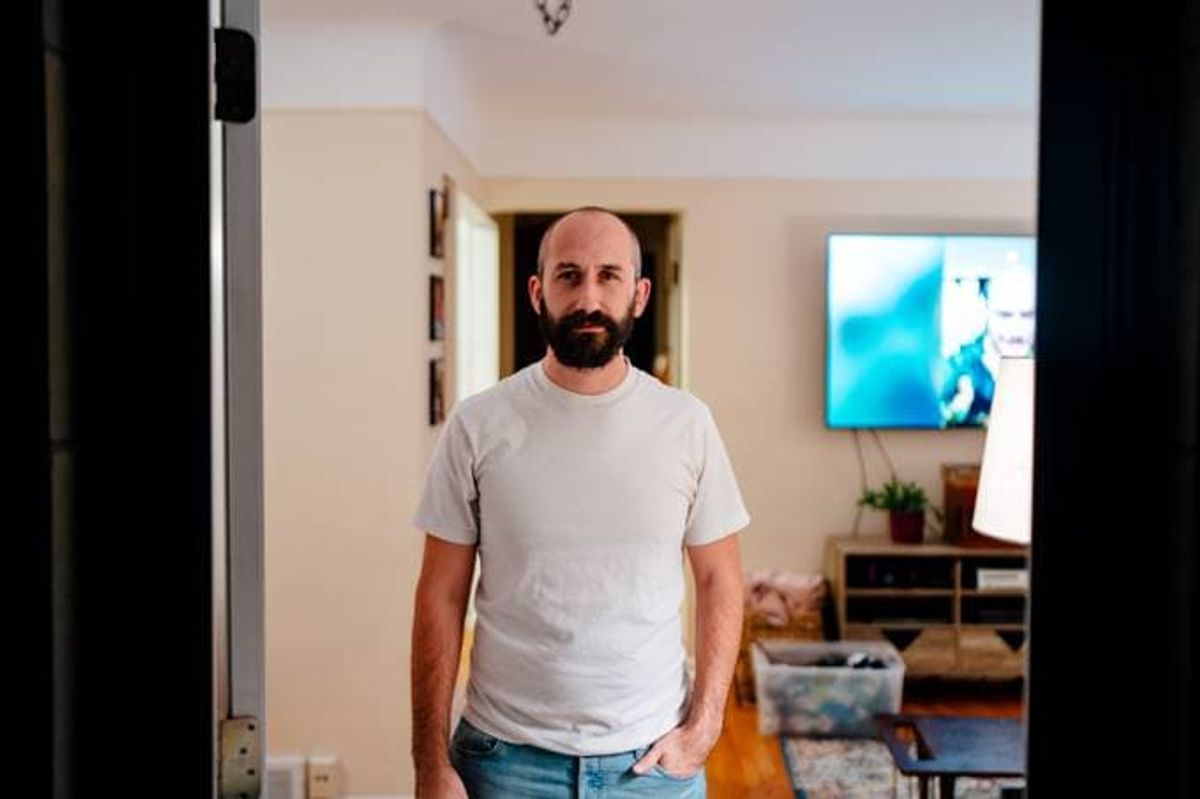 Michael Mamassian, 35, is a Royal Oak resident who is voting yes on Proposal 3 to preserve abortion rights in Michigan. He works in IT and considers himself politically independent. (Photo by Nick Hagen for The Washington Post) | | | |  | In the courts | | Supreme Court to hear nursing home case that could impact Medicaid rights | 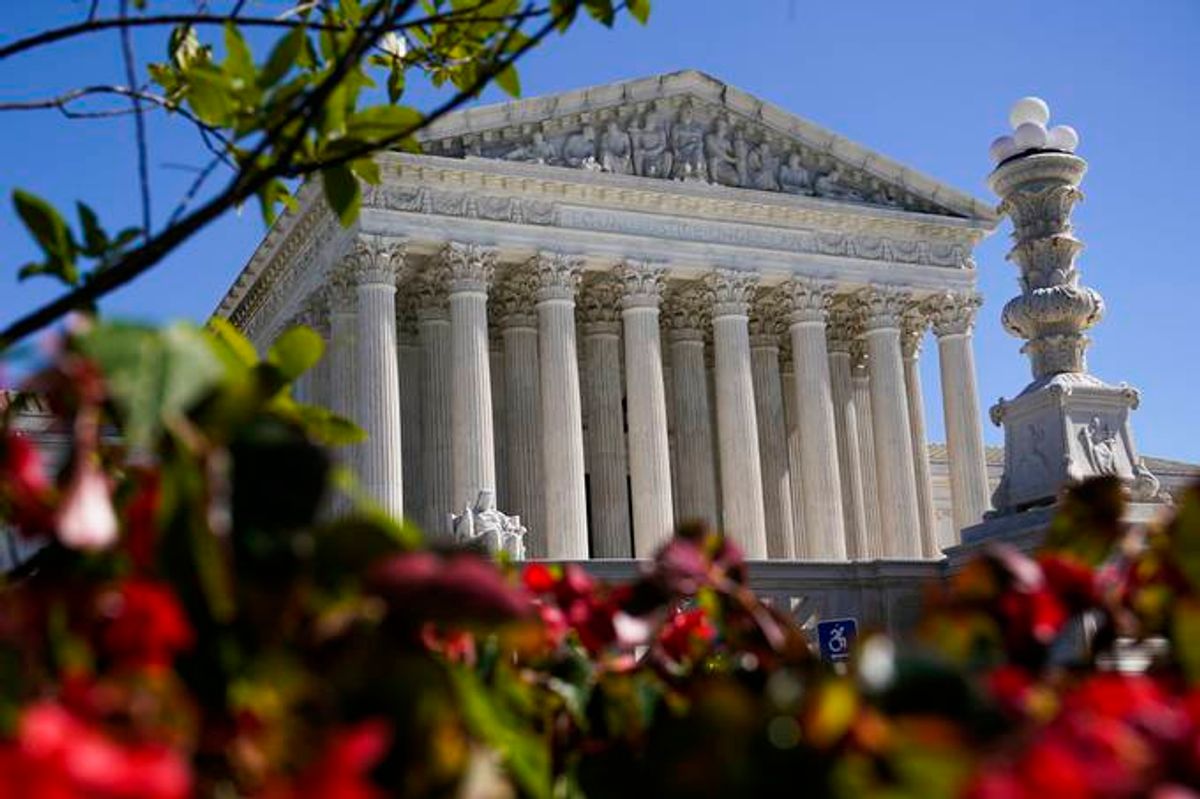 The case could strip Medicaid enrollees' power to hold states accountable when their civil rights are violated. (Mariam Zuhaib/AP) | | | On tap today: The Supreme Court will hear oral arguments in a case that could have national implications for millions of Americans enrolled in safety net programs like Medicaid, Farah Yousry of Side Effects Public Media reports, published in partnership with Kaiser Health News. The key question in the case: Should people who depend on federally funded initiatives be able to continue using a private enforcement mechanism granted under 1983 of the U.S. code to sue state-run facilities if their civil rights have been violated? Catch up quick: The case concerns Gorgi Talevski, a now-deceased dementia patient whose family alleges was abused while living at a nursing home operated by the Health and Hospital Corp. of Marion County, Ind. Because the adult-care home was publicly owned, the patient's family argued it could sue the corporation for allegedly violating Talevski's rights under the Federal Nursing Home Reform Act — but the corporation behind the nursing home disagreed, appealing several lower court rulings that sided with the Talevskis. The high court is expected to issue a ruling by the end of the term in June 2023. A ruling in favor of the defendants of Health and Hospital Corp. of Marion County v. Talevski could mean that Americans who rely on federal assistance programs would lose that right. Eliminating the private enforcement mechanism could shift Medicaid's oversight responsibilities primarily to the Department of Health and Human Services. But former officials say HHS lacks the logistical and practical capacity to monitor the rights of the program's nearly 83 million enrollees, leaving individuals without recourse should states neglect their care. | | The National Health Law Program: | 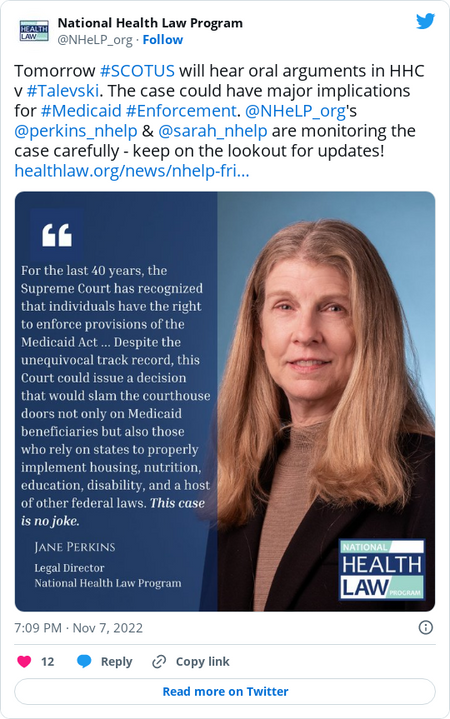 | | | | | |  | Midterms watch | | High-profile attorney general races pit abortion against crime |  In Minnesota, Republican challenger Jim Schultz, left, and Democratic Attorney General Keith Ellison are facing off in a race that has garnered widespread attention. (Glen Stubbe/Star Tribune/AP) | | | The race to be Minnesota's next attorney general is testing the political potency of abortion and crime among voters in what has become one of the most unpredictable competitions on the ballot, our colleague Holly Bailey reports. On the campaign trail, Democratic incumbent Keith Ellison's messaging has focused heavily on abortion rights. But his Republican challenger Jim Schultz has sought to center the contest on public safety in a region still reeling from the police killing of George Floyd more than two years ago. The contest's closing days have been dominated by both candidates attempting to paint their opponents' position on the hot-button issues as running counter to public opinion. Schultz has accused Ellison of trying to use abortion to distract from what he has described as the incumbent's "failure" to keep Minnesota families safe. Meanwhile, Ellison has zeroed in on Schulz's previous experience serving on the board of an antiabortion group to cast doubt on his challenger's promises to make the office "apolitical." Ellison has mocked his opponent's pledge that he wouldn't make abortion the focus of his time in office, likening it to the pledges made by conservative Supreme Court justices who later ruled to invalidate the constitutional right to abortion. "We've heard this before," Ellison said. "And now Roe is gone" The dueling themes have defined contentious attorney general races around the country this election cycle, with particularly competitive races in Minnesota, Michigan, Wisconsin, Arizona, Nevada, Georgia and Texas. The contests have drawn increasing public attention this year given the growing influence of the position in a post-Roe America. | | Minnesota Attorney General Keith Ellison (D): | 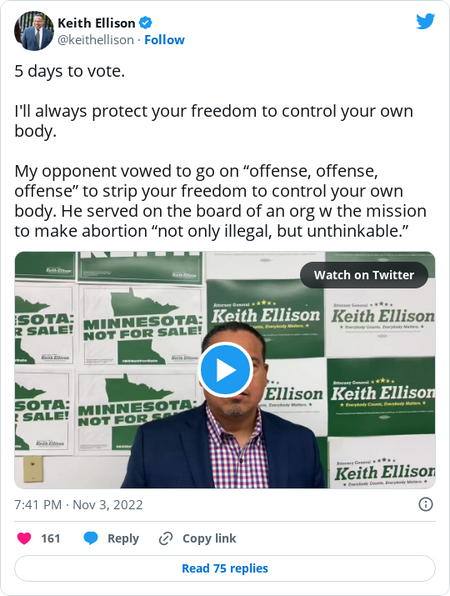 | | | | | Republican challenger Jim Schultz: |  | | | | | |  | In other health news | | - Robert Califf, commissioner of the Food and Drug Administration, tested positive for the coronavirus over the weekend while traveling on official agency business. He is experiencing mild symptoms, the agency announced yesterday.
- The Supreme Court declined to hear a dispute involving an Air Force veteran's bid to reinstate certain disability benefits denied by the Department of Veterans Affairs, which prompted a sharp dissent by conservative Justice Neil Gorsuch, Reuters reports.
- The VA will expedite disability benefits for veterans with certain types of cancer when it begins processing claims under the toxic exposure legislation signed into law this summer, VA Secretary Denis McDonough announced yesterday.
| | |  | Health reads | | | |  | Sugar rush | | | Thanks for reading! See y'all tomorrow. | |


No comments:
Post a Comment