| Good morning, and TGIF! This newsletter will be enjoying the congressional recess and we'll have a shortened schedule next week. See you back here Tuesday through Thursday. Was this forwarded to you? Sign up here. Today's edition: The annual financial outlook for the Medicare and Social Security programs could come as soon as today, The Health 202 has learned. Gun injuries rose amid the pandemic. But first … | A popular Obamacare provision is in legal jeopardy | 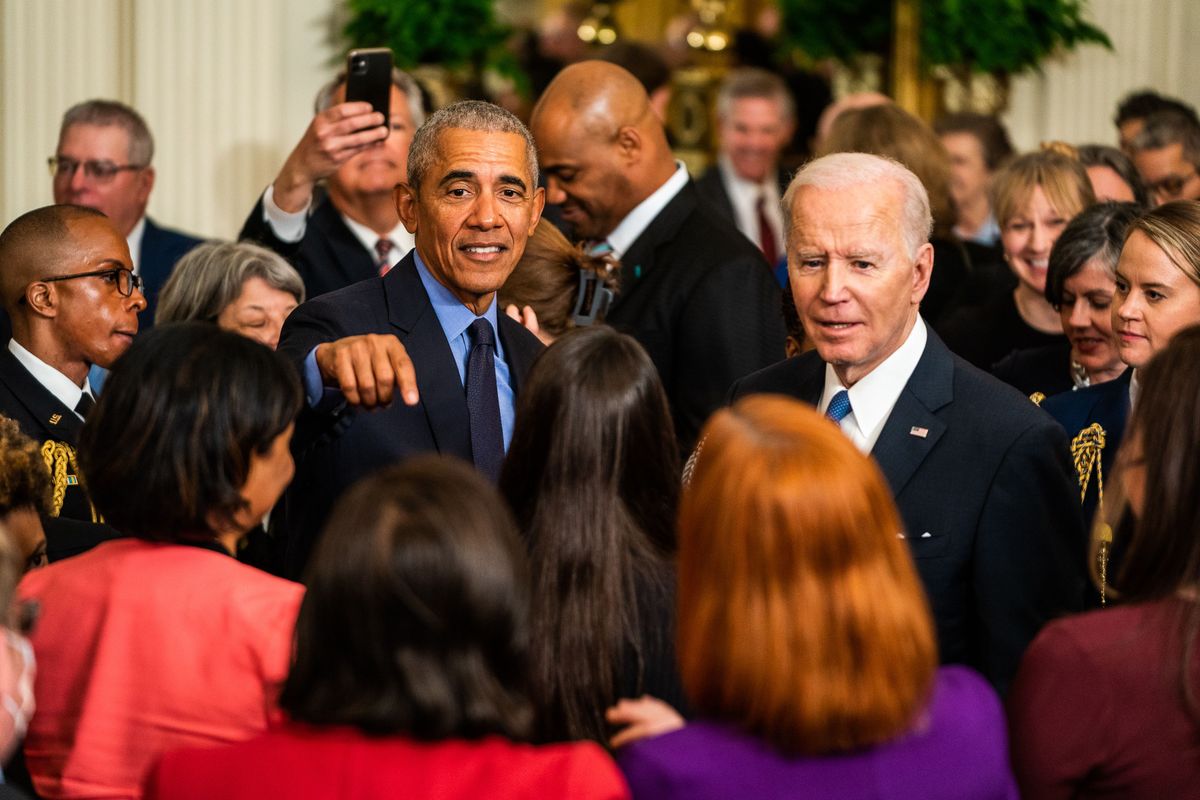 President Biden and former president Barack Obama greet visitors in the White House in April 2022 following remarks on the Affordable Care Act and lowering health-care costs for families. (Demetrius Freeman/The Washington Post) | | | Obamacare is no stranger to legal limbo — and uncertainty over a popular provision of the law is back. A Texas federal judge yesterday invalidated the law's mandate that insurers cover certain preventive services for free, such as some cancer screenings and medicines to avoid heart disease. The ruling puts the policy included in the 2010 health-care law in jeopardy and could impact what more than 150 million Americans pay out of pocket for these services. But the immediate implications are murky, as our colleague Amy Goldstein notes. Insurance companies don't typically revise their plan offerings in the middle of the year, and the main insurers lobby sought to assure the public that they "should have peace of mind there will be no immediate disruption in care of coverage." And the Biden administration is expected to appeal, though the White House and the federal health and Justice departments would only say yesterday that federal officials were reviewing the ruling. | - "You don't want to be revising your plans only for there to be a stay or reversal on appeal," said Andrew Twinamatsiko, an associate director of Georgetown's Health Policy and the Law Initiative at the O'Neill Institute. He added: "But what it creates is this wild, wild West of anything goes cause there's nothing obligating them" not to make changes.
| | Nicholas Bagley, a University of Michigan health law professor: | 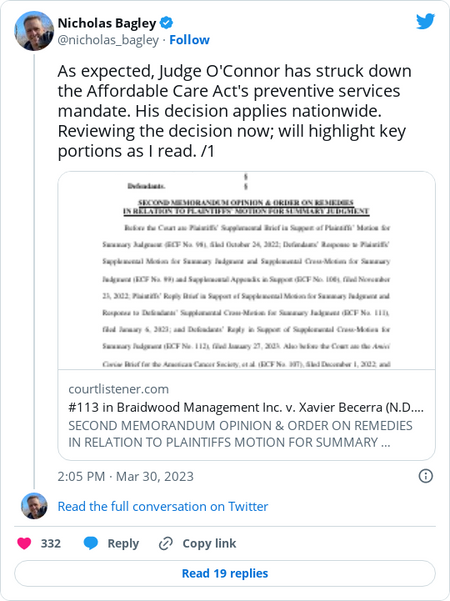 | | | | | The ruling was handed down by U.S. District Judge Reed O'Connor, who has a history of viewing Obamacare critically. In 2018, he ruled the entire Affordable Care Act was unconstitutional, and the case eventually wound its way to the Supreme Court, which upheld the law for the third time in a decade. | | | | | | | | America's hospitals and health systems meet the needs of communities in ways that go beyond curing injury or illness. Through mobile clinics, housing support, and food insecurity programs, hospitals advance health in America. Learn more. | | | | | | | | His latest ruling focuses on the U.S. Preventive Services Task Force, which is an independent group of experts and one of three entities that determines what kind of preventive services should be free. | - In his decision, O'Connor wrote that the task force's role is improper under a constitutional "appointments clause" since its recommendations don't get sign-off from presidential appointees.
- The ruling doesn't apply to all preventive care the task force has dictated should be available without cost-sharing. Instead, it pertains to those decisions that came after the ACA, or recommendations it has updated since then.
- Health-care experts are still sorting out the practical effect on various services. Cynthia Cox, of the Kaiser Family Foundation, said she believes commonly used services like well-woman visits and breast and colon cancer screenings wouldn't be touched.
| | Also of note: The ruling doesn't impact free coverage of contraception and vaccines. That's because those services were recommended not by USPSTF, but by the other panels, which are technically under the supervision of the Department of Health and Human Services. But separately, the judge ruled that free coverage of PrEP, a critical drug to prevent HIV, violates the plaintiffs' rights under a federal law guaranteeing religious freedom. | | First, everyone's waiting for an appeal and a potential stay preventing the ruling from going into effect. Some law professors suspect one of the plaintiffs, the employer Braidwood Management Inc., will try to convince whichever court handles the case next that O'Connor should have extended the ruling to preventive services that fall under the purview of other federal agencies. For now, it'll technically be up to insurers and employers to decide whether to continue free coverage of certain care. Health experts don't anticipate much will change in the short term. Though if the ruling isn't reversed, some predict insurers would likely still cover preventive services in the future, but they may require patients to pay part of the cost. Yet, there might be incentives for companies to continue with free preventive care. The health policy world has long debated whether prevention saves the nation's health system money, Amy notes, yet there is an array of evidence that shows it translates into healthier patients. "It's not necessarily the case that all insurers would even want to impose cost-sharing on some of these preventive services cause they might see it as beneficial," Cox, a vice president at KFF, said at a press briefing yesterday. | | |  | From our notebook | | | What we're watching: The annual financial outlook for the Medicare and Social Security programs could be released as soon as today, multiple sources with knowledge of the situation told The Health 202. An administration official, speaking on the condition of anonymity, said they expected it would come out today. The outlook for both programs slightly improved last year due to a stronger and faster economic recovery than predicted in 2021. But in their report, trustees for the massive entitlement programs expressed concern that both were facing long-term financing shortfalls. The future of both programs has been in the political spotlight this year, with President Biden having an ad-libbed exchange with Republicans in the midst of his State of the Union address after he accused the party of wanting to sunset both programs. The White House released a plan last month to bolster Medicare financing by at least 25 years. Both Biden and Republicans have said cuts to the program are off the table. Meanwhile, some experts are frustrated by the partisan politics and have argued that changes are needed to keep the programs afloat. | | |  | Coronavirus | | CDC: Gun injuries spiked during pandemic |  A government study yesterday highlights a surge in gunfire injuries during the coronavirus pandemic. (Bebeto Matthews/AP) | | | The number of people that visited U.S. emergency rooms with firearm injuries increased by nearly 40 percent in 2020 and 2021 compared with pre-pandemic levels, according to a study released yesterday by the Centers for Disease Control and Prevention. In 2022, gun injuries declined, but were still 20 percent higher than in 2019. Of all age groups, people under 15 had the largest proportional increase in emergency room visits for firearm injuries. The study's authors cite a range of pandemic-related challenges that may have contributed to the surge in gun injuries among children and adolescents, including disruptions to daily routine and schooling, more time spent inside at home where guns might be present and less parental supervision. | - Previous studies have shown that U.S. gun deaths also surged during the pandemic. The nation's firearm homicide and firearm suicide rate in 2021 were the highest on record since 1993 and 1990, respectively, per the CDC.
| | Zooming out: Gun violence was thrust into the national spotlight again this week as the country reels from its latest deadly shooting, in which three elementary students and three adults were killed at a private Christian school in Tennessee. | | The number of adults and teenage girls using prescription stimulants spiked during the first year of the pandemic, a new CDC study found, marking the latest evidence of a dramatic shift in the treatment of attention-deficit/hyperactivity disorder in recent years, our colleague Daniel Gilbert writes. The study's authors said the mental health impact of the pandemic may have exacerbated ADHD symptoms, while a federal effort to make it easier to get medical care online may have increased access to prescription stimulants. The sharp rise in prescriptions for Adderall, a stimulant approved to treat ADHD that's tightly regulated, has contributed to a national shortage of the drug. | | |  | State scan | | Constitutional referendum on abortion rights to go before Maryland voters | 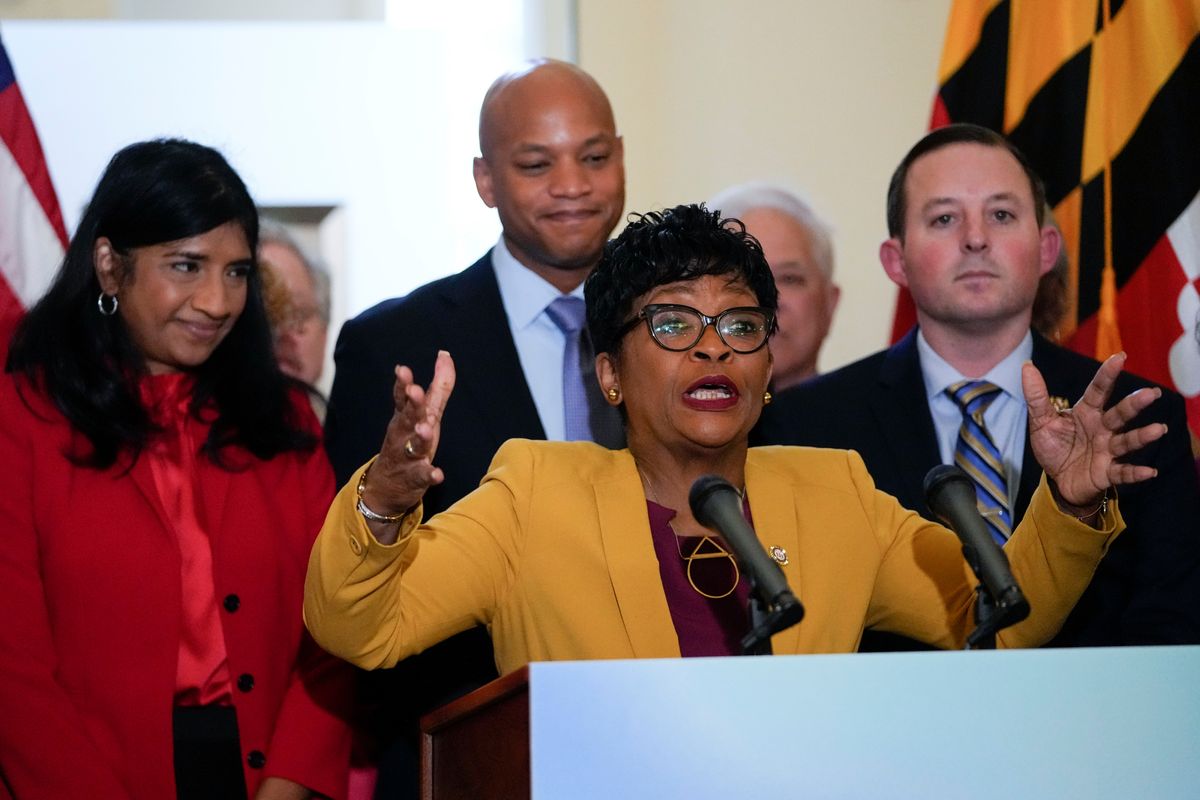 Maryland House Speaker Adrienne Jones (D-Baltimore) has been on a years-long quest to have voters enshrine abortion rights in the state constitution. (Julio Cortez/AP) | | | Maryland voters will decide whether to enshrine abortion rights in the state's constitution next year after the House of Delegates voted yesterday to put a constitutional amendment on the ballot, The Post's Erin Cox reports. The 2024 referendum — expected to pass because of broad public support for abortion rights in Maryland — is among a wave of protective measures being advanced this session by lawmakers in deep blue states in response to new restrictions on the procedure elsewhere. On our radar: Maryland Democrats behind the ballot initiative have also proposed legislation to shield patients and providers from criminal laws passed in antiabortion states, as well as to hide abortions in digital medical records. Both of those bills have cleared preliminary votes in both chambers of the state legislature and Gov. Wes Moore (D) promised to sign them, saying he wants to make Maryland "a safe haven for abortion." | | Michelle Siri, executive director of the Women's Law Center of Maryland: | 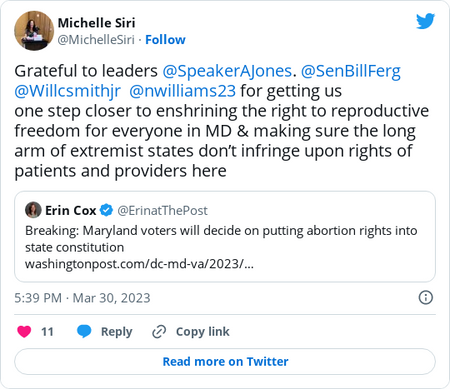 | | | | | |  | In other health news | | - An Idaho bill that would make it a felony to help a minor travel out of state to obtain an abortion without parental consent won final passage in the state legislature yesterday, sending it to the desk of Republican Gov. Brad Little, the Idaho Capital Sun's Kelcie Moseley-Morris reports.
- Maryland lawmakers voted to expand the number of gender-affirming services covered by the state's Medicaid program. The measure now heads to Moore, who has said he will sign it, Brian Witte reports for the Associated Press.
- The Centers for Medicare and Medicaid Services greenlit New Jersey's proposal to provide housing and nutrition benefits to Medicaid recipients, marking one of the first major actions the agency has taken since it began urging states to consider ways to expand the program to address enrollee's health-related social needs, Politico's Megan Messerly reports.
- Gisele Fetterman said a barrage of hateful right-wing attacks against her "exploded" after her husband, Sen. John Fetterman (D-Pa.), checked himself into Walter Reed National Military Medical Center last month to receive inpatient treatment for clinical depression, The Post's Amy B Wang writes.
| | |  | Quote of the week | | | Daniel Tsai, Medicaid director at CMS, on pandemic coverage protections ending tomorrow | "We go to sleep at night thinking about this and wake up in the morning thinking about this." | | | | | | | |  | Health reads | | | |  | Sugar rush | | | Thanks for reading! See y'all Monday. | | | | | | | |






No comments:
Post a Comment