| Until a deal is final, or there's a default, I'll update you on the latest about the debt ceiling. The latest: By the end of the day Wednesday, Congress could be halfway to averting a default. The first hurdle this week is the biggest: the Republican-controlled House of Representatives. There, a sizable faction of conservatives won't back the deal to raise the debt ceiling, because it doesn't cut federal spending as much as they want. And some liberals have blasted it because they think reducing any spending is too much, especially because the debt ceiling has nothing to do with future spending. The deal has inched its way through the House over the past two days. Next up would be a vote in the Democratic-controlled Senate, and then it needs to be at President Biden's desk by Monday to avert a default at the last moment. So there is no more time for disagreements. "Any needless delay, any last-minute brinkmanship at this point would be an unacceptable risk," warned Senate Majority Leader Chuck Schumer (D-N.Y.). By Monday, this could all be behind us for two years If this deal passes, it will underscore, as my colleague Toluse Olorunnipa writes, that "there were always more members of Congress who were willing to make a deal than to blow it up." Which raises the question of why Congress got so close to a catastrophic default in the first place. How Speaker Kevin McCarthy could lose his job 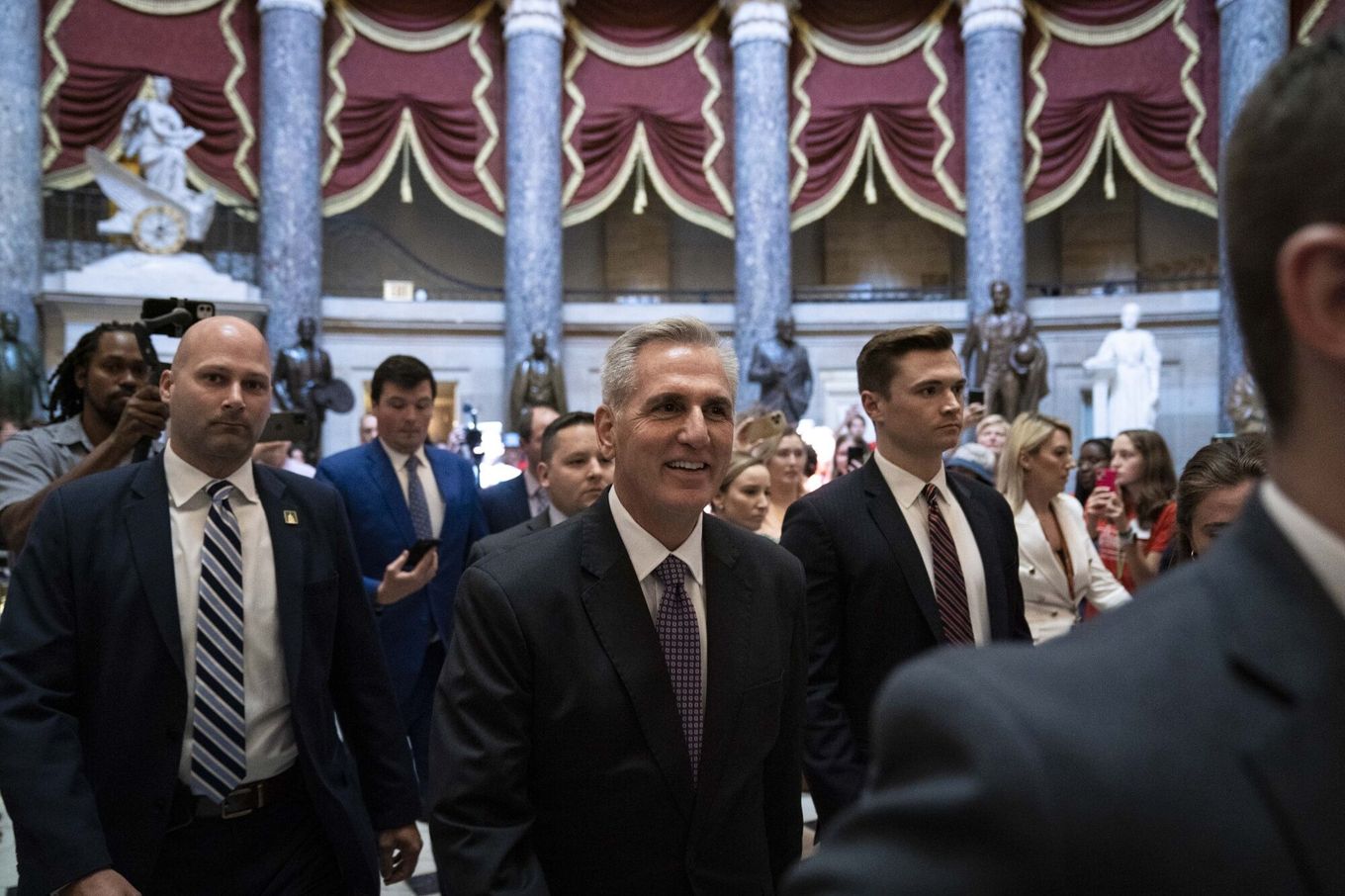 House Speaker Kevin McCarthy (R-Calif.). (Sarah Silbiger/Bloomberg News) | McCarthy (R-Calif.) has had his back against the wall this whole time after making deals earlier this year with conservatives that enabled any one member to force a vote to oust him. He agreed to that in January, as he spent days trying to get enough votes from his party to become speaker and made increasingly desperate concessions. That means McCarthy's standing as speaker is shakier than his recent predecessors. Previously, it took the majority of a party or the support of a party leader — rather than just any one member of Congress — to call for a vote to oust the speaker. Some conservative lawmakers who are unhappy that McCarthy struck a deal with Biden have threatened to force a vote to oust him. If it got to that point, it doesn't seem he would lose his job, though. About 20 Republicans opposed McCarthy for speaker in January, and lawmakers who want to oust McCarthy would need 218 votes. But McCarthy is operating under the constant threat of getting fired, underscoring why he's beholden to his right flank. And that's why this debt ceiling vote is so risky for him personally; he's had to forsake many of his GOP colleagues to avert a catastrophic financial collapse come next week. ("Doesn't bother me," McCarthy told reporters today, though, referring to the ouster threats.) Biden's toying with the idea of using the 14th Amendment to avert the next debt ceiling fight The theory goes like this: He would use the 14th Amendment to simply declare that the debt ceiling law Congress created a century ago is null and void. That's because the Constitution says that the validity of the public debt "shall not be questioned." Some liberals in Congress have urged Biden to use this to get around intransigent Republicans — now or two years from now — who won't vote to raise the debt ceiling when the government comes close to running out of money to pay its bills. But for this to work — and not freak out financial markets — Biden would need the courts to weigh in and side with him. It sounds easy on paper, but there are plenty of ways it could go wrong. If the courts declared Biden's move unconstitutional, it could send the global economy into a downward spiral by making the United States a risky place to invest in, legal experts say. "I think this is fantasyland," one expert told The Washington Post's Jeff Stein, referring to using the 14th Amendment to get around the next debt ceiling fight. | 


 Email
Email


No comments:
Post a Comment