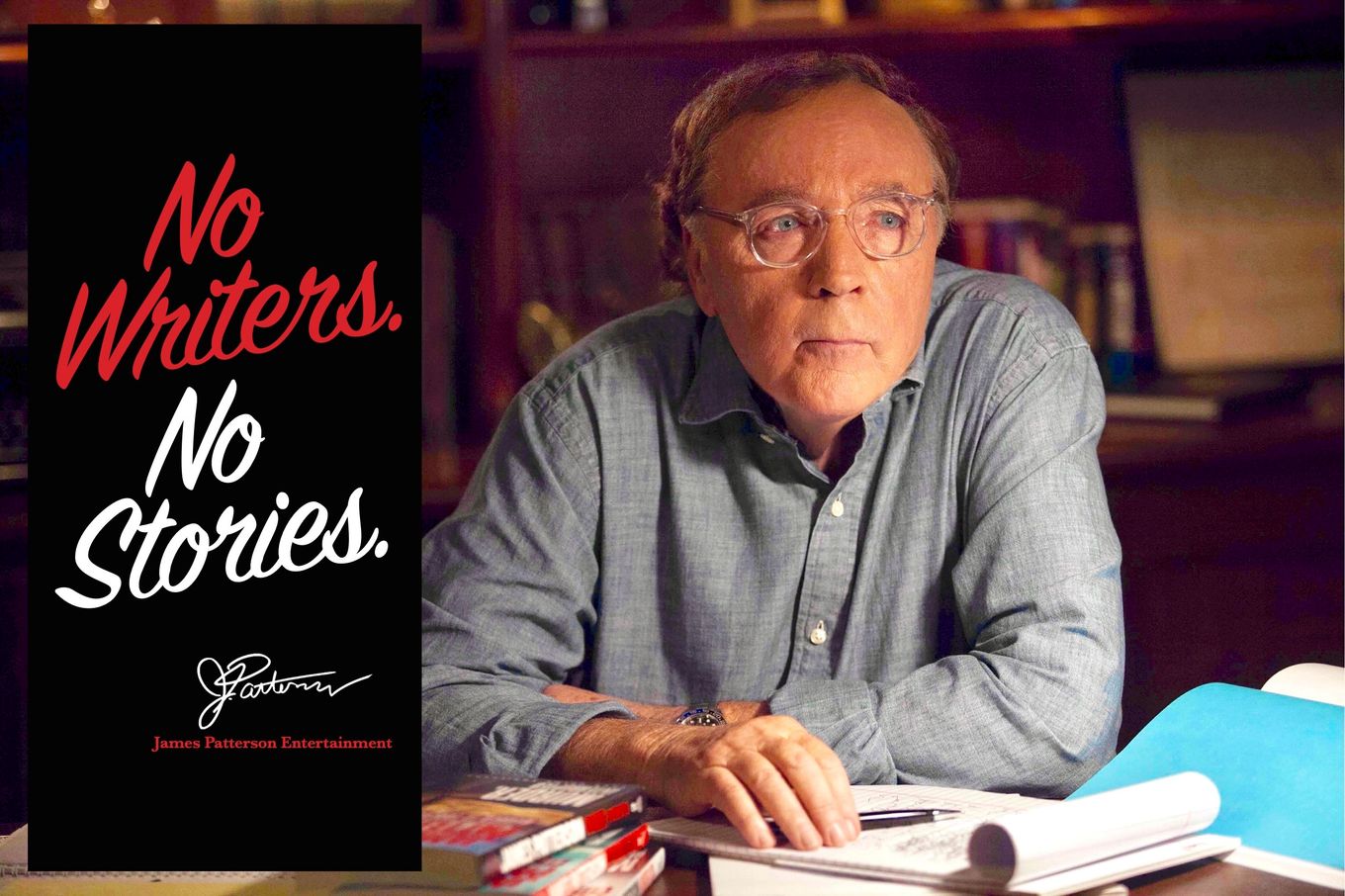
 James Patterson showed his support for striking writers with an ad in the Los Angeles Times on Wednesday. (Ad and author photo courtesy of James Patterson). | As the Writers Guild strike drags on for an eighth week, the union is getting some love from one of America's most popular novelists. On Wednesday, mega-seller James Patterson bought a full-page ad in the Los Angeles Times that said simply, "No writers. No stories." It's a stark reminder of what's really at stake in the contentious negotiations about wages, staffing, residuals and artificial intelligence. "The writers have been at the bottom of the heap in Hollywood. It's kind of a tradition out there," Patterson tells me. "It probably goes all the way back to the moguls when they would say, 'I want a movie about circuses — give me 10 writers.'" These days, Patterson works both sides of the aisle as a producer and a writer. He has "about a dozen" stories under option at the moment and several productions in the works. But the decision to support the Writers Guild was easy. "It's like with the troops: You send them letters." (Unity will determine if the writers strike succeeds.) Hollywood, he says, believes "that the directors, the producers and the actors are where it happens," but "stories are the basis of all this stuff. And if we can get people to understand that more, there'll be more respect." (Hollywood writers say they'll win.) Patterson expresses little sympathy for studios and streamers that lavish funds on production and marketing but not their writers. "Seriously, dudes," he says, "what are we spending this money on?" Books to screens - "Rock Hudson: All That Heaven Allowed" will be released June 28 on Max. Stephen Kijak's documentary about one of Hollywood's most celebrated stars is based on a biography published by Mark Griffin in 2018. This weekend, Griffin will talk about Hudson on CBS Sunday Morning.
- "The Perfect Find" debuts today on Netflix (trailer). Gabrielle Union and Keith Powers star in this rom-com based on a novel by Tia Williams about a fashion journalist in love with a much younger man — her boss's son. Williams's most recent novel, "Seven Days in June," was named one of The Washington Post's Top 10 Romance Novels of 2021 (full list).
 Photo illustration by Ron Charles/The Washington Post. Background photo iStock | Word watch: On Wednesday, Elon Musk took a break from promoting vaccine skepticism to troll transgender people: "The words 'cis' or 'cisgender' are considered slurs on this platform," the electric carmaker and noted linguist announced on Twitter. A few hours after Musk's pronouncement, the editors of Merriam-Webster tweeted, "'Cisgender' is currently our top lookup." The word was added to the dictionary in 2016 (story). A post on the Merriam-Webster website explains that "cisgender" "describes someone whose internal sense of gender corresponds with the sex the person was identified as having at birth. Most people can be described as cisgender, or cis." Contradicting the spaceman's claim that "cisgender" is a slur, the dictionary editors wrote, "Our current evidence shows that 'cisgender' and its variants are overwhelmingly used neutrally." I'll be curious to see if "cisgender" can be rendered poisonous in the same way that "woke" has been DeSantisized into a term of mockery. Soon after Musk bought Twitter last year, the Brookings Institution noted that it became "a major platform for proponents of hate speech." Last week, GLAAD called Twitter "the most dangerous" social media platform for LGBTQ+ people (story). 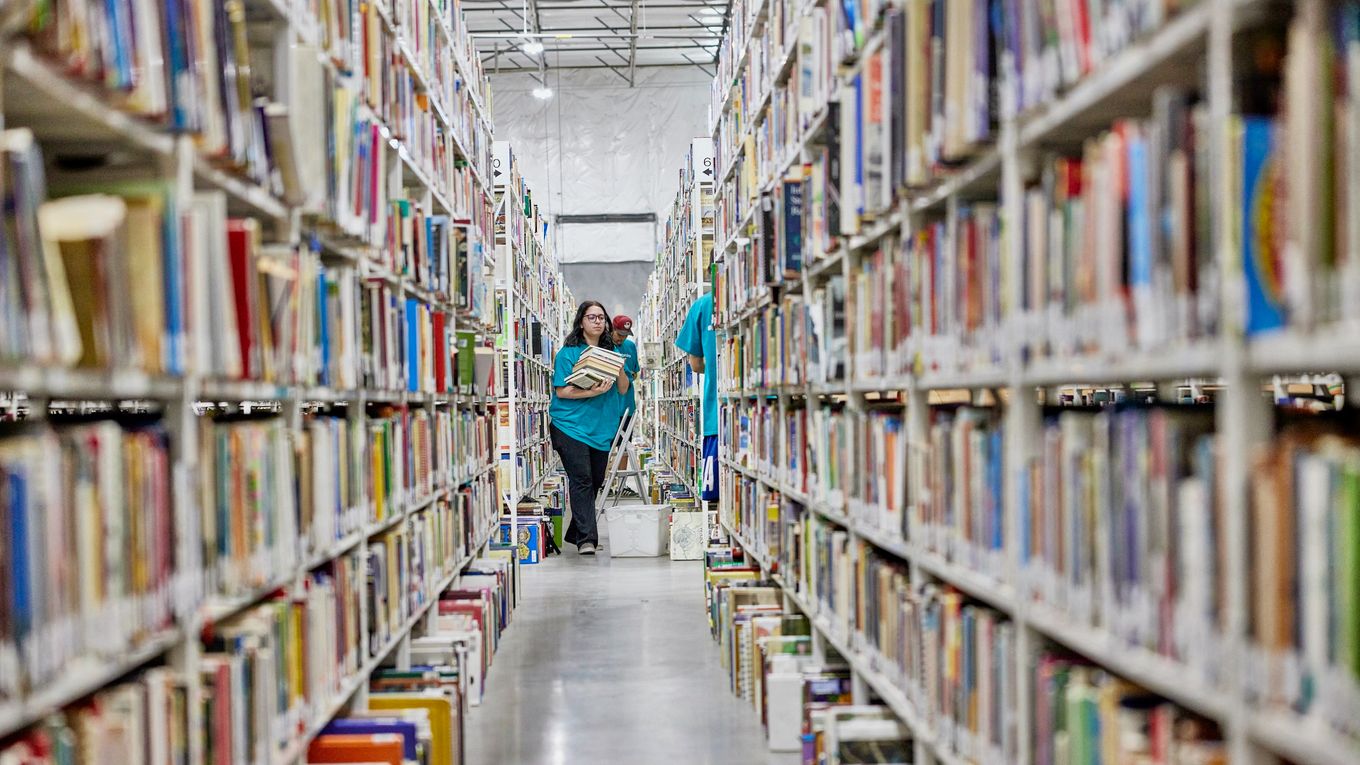 ThriftBooks employees work with about 2 million volumes at a processing center in Phoenix. (Courtesy of ThriftBooks) | Time's wingèd chariot isn't hurrying near just for us; it wants our books, too. Unless you're a collector of fine volumes, there's a good chance your personal library will someday be donated to Goodwill or dropped off at a library book drive. Behind the retail market for new titles lies a long, lumpy tail of used books that stretches from here to Gutenberg. It's a voluminous economy of printed matter swelling every year by the millions, struggling against chaos to match that one moldering book with that one interested reader. Enter ThriftBooks, a massive online used bookseller. This summer, ThriftBooks is celebrating its 20th anniversary. Over the past two decades, the company says it's sold more than 250 million books, donated more than 2 million and diverted another billion from landfills to recycling plants. "The devil is in the details," ThriftBooks CEO Ken Goldstein tells me. "If you're going to manage inventory at this volume, you have to know exactly what you want to take in inventory, what you don't want to take in inventory, how to price it, how long you're willing to let it sit on the shelf, and then what you're going to do with the unsold portions." ThriftBooks interrupts the mortality of a book just before it's consigned to an eternity of oblivion. The company's business model depends on buying extraordinarily large quantities by the pound at extremely low prices. A typical truckload might deliver 30,000 books. From there, the books have a chance at regaining their individuality and their salability. At five processing centers on the country, the volumes are sorted, identified, priced, shelved — or sent to recycling — at breakneck speed. It's a job that requires exacting data analytics and hundreds of human sorters and quality graders. Each processing center also employs three experts to spot rare books — three to five percent of the load. Those treasures usually sell for $50 to $100 and sometimes for thousands of dollars. For literature, the used book market is a fascinating confluence of permanence and impermanence. "We use an algorithm to determine scarcity," Goldstein says. "So the question is, how many days will we leave that book on the shelf before we use the shelf space to inventory another book? Every single book has its own time clock." (I can't get that harrowing sentence out of my mind.) To celebrate its 20th anniversary, ThirftBooks is offering a chance to see the operation up close: Six lucky buyers and their guests will receive a Teal Ticket for a trip to Phoenix, where they'll get a VIP tour of the facility containing more than 2 million books and the opportunity to take home as many as they can carry. You can't save them all, but you can try. 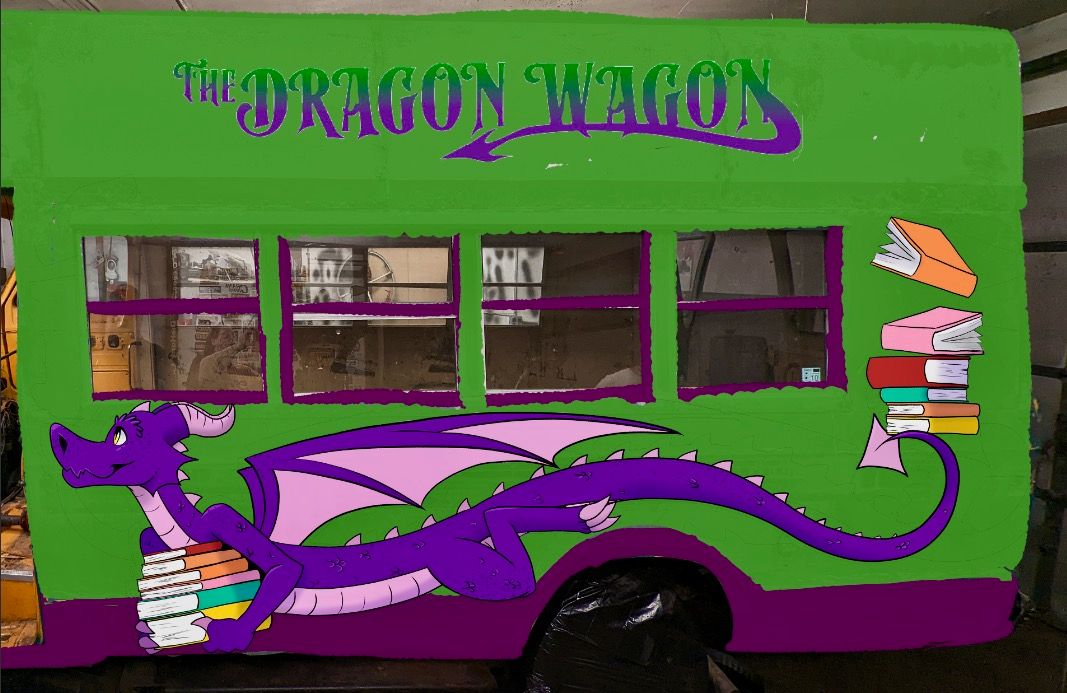 The driver's side of the Dragon Wagon mid-transformation. (Photo courtesy of Tracey West) | When Tracey West started her best-selling "Dragon Masters" series, she assumed it was a fantasy. But now an actual Dragon Wagon is about to head out spreading books wherever it flies. This delightful idea was hatched a few years ago after Tracey and her husband, Billy Hancock, moved to the western Catskills. A librarian there, lamenting that some local children had never been to a bookstore, said Tracey and Billy should open their own. But that didn't seem feasible for the couple: Tracey was busy with her writing, and Billy owns a sewing machine repair business. (In the winter, he's also a professional Santa Claus, which, I suspect, is a foreshadowing clue in this story.) As Tracey and Billy thought more about how to help local children, they started reconsidering the 1979 Dodge mini school bus they'd inherited from a friend. Why not convert it into a traveling children's bookmobile? They became provisional members of the American Booksellers Association and spent the winter learning how to run a mobile retail business. "Our goal," Tracey says, "is to take the bus when we can to different locations and events in the western Catskills. Every kid who visits the bus is going to get a free book." (Where will the Dragon Wagon be next?) Tracey and Billy also sell books from the Dragon Wagon. On Tuesday, they had a soft launch at the Cannon Free Library in Delhi, N.Y. They gave away or sold 88 books and encouraged kids to sign up for the Cannon Free Library's summer reading program. "It made us so happy to see readers excited to choose books for themselves, their siblings or their kids and grandkids," Tracey says. "We're exhausted and still processing that our dream is real." "Book choice is such an important thing for readers, and it's one of the reasons we started the bus." With an inventory of about 1,500 books, they offer everything from board books for babies to novels for teenagers (and stories about dragons, of course). There's a patriotic element to this work, too. "The concerning number of book bans around the country certainly lit a fire under us to get this going," Tracey says. When they hear about a book banning within driving distance, they plan to fire up the Dragon Wagon and head off to that community "to make sure our kids have access to the books that they need." (This is how an actual mom for liberty behaves!) When I ask if they're concerned the bookmobile might take over their lives, they both laugh. "It already has!" Tracey says. "But we do have a lot of friends helping out." Taking the Dragon Wagon on the road is just the beginning of their journey. Tracey and Billy hope they can offer a template that other literary entrepreneurs might follow. "You can do it, too," she says.  Copyright © 2023 American Library Association | You've probably read so much about efforts to ban books and harass librarians that it's hard to keep all the attacks on our liberty straight. I highly recommend a report just published by the nonprofit group EveryLibrary, which works to build voter support for libraries. "Unpacking 2023 Legislation of Concern for Libraries" outlines dozens of state-level efforts to crush "the professional autonomy of librarians and their ability to provide access to content without fear of arrest." The report clearly describes each of the censorial bills that have passed this year so you can understand the insidious schemes seeping across the country. "These bills create a social climate where librarians and educators are looked at as harming children," the editors write. "The effort to criminalize librarianship and education is happening alongside a movement to redefine what content in books, e-books, and other materials is considered obscene or harmful.… The concept of 'appropriateness' is often defined by the offended party rather than contemporary community standards." The EveryLibrary report makes grim but important reading. The growing list of anti-book laws it outlines suggests a nation being hectored into imbecility by a self-righteous clan of prigs determined to limit what your kids can read and think. The message is clear for librarians and politicians devoted to defending our way of life: "Plan ahead for 2024." The editors offer several pages of advice for effective advocacy. We'll need it. Despite strong opposition from a majority of Americans, book banners are still gaining strength with their message of fear and intolerance. Next week, the extremist group Moms for Liberty will hold a "Joyful Warriors" summit in Philadelphia. Among the scheduled speakers are celebrated book-banner Ron DeSantis and indicted paper-hoarder Donald Trump. Meanwhile, best wishes to the thousands of librarians gathering in Chicago for the annual American Library Association conference. Last night, National Book Award-winning author Ibram X. Kendi led a rally for the right to read. Speaking with me by phone beforehand, he said, "We're up against forces who are trying to take away our freedom from ignorance, our freedom from censorship, our freedom from the suppression of speech." "Oftentimes, over the course of history, it's been everyday people who have been thrust into freedom fights," he said. "They recognized that they were standing at the door of history and decided to step up." Kendi sees librarians in that position now, "at the center of one of the most important freedom fights of our time." (The Anti-Racist Revelations of Ibram X. Kendi.) Seven of Kendi's books have been banned in different parts of the country. "On the one hand, I understand that the very books that are being banned are the books that are actually effective in allowing the American people to see racial equality, to appreciate difference, to recognize the newer forms of racism," he said. "On the other hand, I write books for people to read, and so knowing that my books and others' are being taken out of people's hands has been incredibly disheartening and disappointing." Indeed, it's sobering to note that this Sunday marks the 70th anniversary of the Freedom to Read statement adopted by the American Library Association and the Association of American Publishers. Its opening lines sound like they were written this morning: "The freedom to read is essential to our democracy. It is continuously under attack."  Courtesy of Concord Free Press | There's commercial publishing, and there's nonprofit publishing, and then there's whatever you want to call Concord Free Press. Co-founded by Stona and Ann Fitch, their company publishes new, high-quality books by writers like Gregory Maguire, Jenny Slate and Madison Smartt Bell, and then just gives them away. It's like a business model conceived by Satan to torment Ayn Rand in hell. But Stona and his wife had a vision inspired by generosity: Writers donate their work. Volunteer staff members edit and design the books. And then readers who request copies are asked only to make a donation to a charity of their choice or someone they know who needs help. When Concord Free Press started in 2008, I thought it was a sweet idea that would be gone within the year. Since then they've published 42 titles that are distributed through about 80 independent bookstores across the country. "We have a very generous cohort of writers, designers, proofreaders, editors, recovering punks and publishing expats," Stona says. Joyce Carol Oates and Francine Prose are among the famous writers on the advisory board. What's most amazing, the books have generated more than $5 million in charitable donations. "It's been really inspiring," Stona tells me. The press's success demonstrates the empathy at the heart of reading. "If you can believe in a character made out of words, you can believe that people around you are in need of help sometimes." But Stona admits that younger writers and people in different stages in their careers are often not in a position to donate a manuscript. So this year, Concord Free Press has started a commercial imprint called Arrow Editions. Proceeds from book sales are split 50/50, with half going to the author and half going to support the charitable work of Concord Free Press. The first book, "Death Watch," by Stona Fitch himself, is a thriller with an absurd and fantastical twist. The new money-generating imprint is just the latest in the deliberate evolution of the Fitches's radical experiment in literary philanthropy. "We're too small to fail," Stona says. Their publishing house is above a bakery. "We're not in the Flatiron Building; we're in the flatbread building." There's something almost mischievous about his cause. Someone once offered to buy Concord Free Press for "seven figures," Stona says. But he turned down the offer. "One of the most subversive things you can do in our consumer culture is create something beautiful and not let people buy it."  Virago (UK); Knopf (US); Picador (UK); Grove Press (US) | The earliest recorded kiss goes back at least 4,500 years (really). And apparently, Americans are still shy about it. This week, I reviewed a delightful Irish novel by Caroline O'Donoghue called "The Rachel Incident" (review). The U.K. cover sports a young woman engaged in an intense kiss, but the U.S. cover shows a woman alone, her face turned away from us. Honestly, I wouldn't have noticed, except that it's the same wet blanket thrown over Douglas Stuart's "Young Mungo" (review). The U.K. cover shows a couple of young men mashing their mouths together, while the U.S. cover shows a teenager alone, partially submerged in water. So much for young love … Am I onto something, or am I just suffering from the feature writer's fallacy of constructing a trend from two random examples? If you notice other prudish contrasts between the covers of American and international editions, let me know. 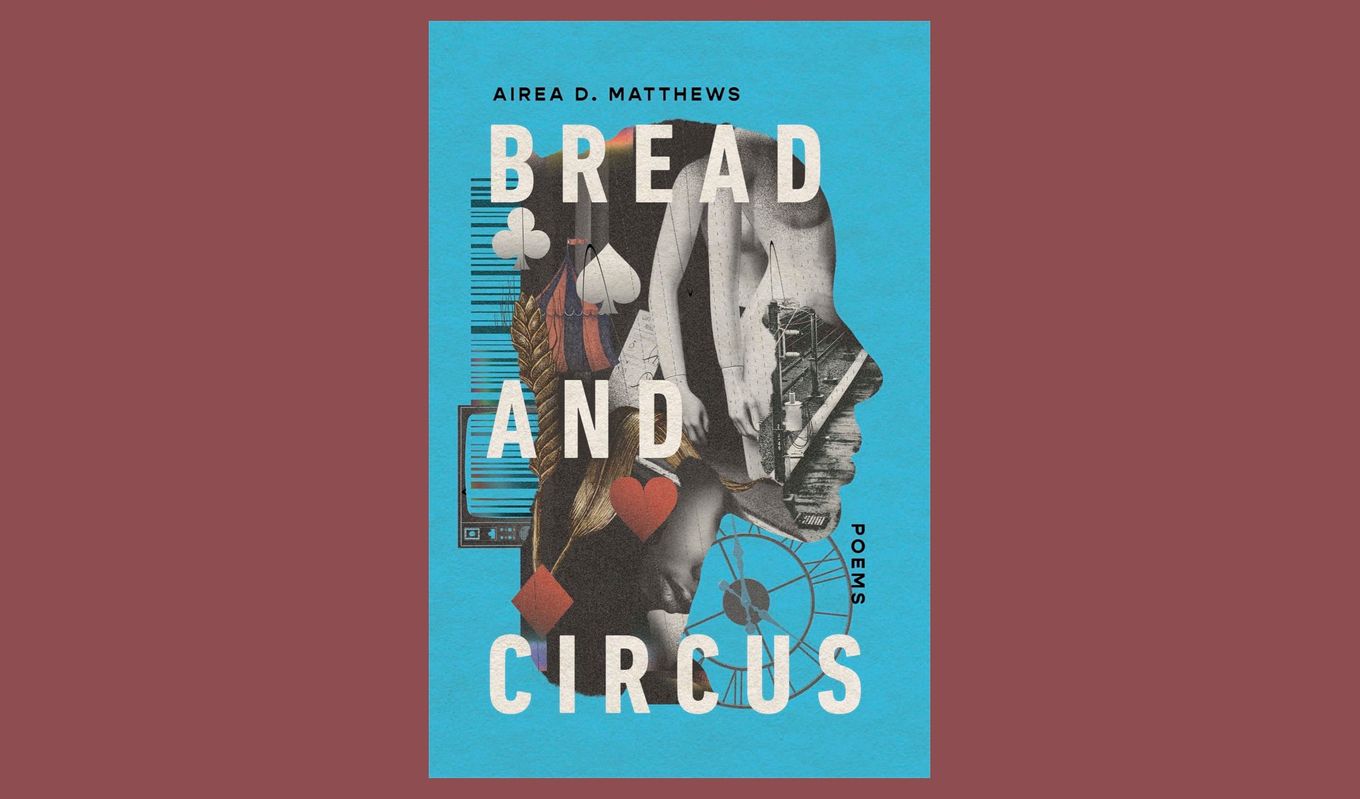 Scribner | Airea D. Matthews, who teaches at Bryn Mawr College and serves as the poet laureate of Philadelphia, has just published her second collection, "Bread and Circus." The individual poems about an African American family are incredibly moving, but in the context of this brilliantly designed book, her verse attains even greater power. Running throughout the collection appear conflicting selections about value and values from Adam Smith, the 18th c. founder of modern capitalism, and Guy DeBord, a 20th-century French Marxist. That framework may make the book sound intimidating — and, frankly, it is — but dig in: It's visually arresting, emotionally engaging and reveals more insights every time I read it. Eviction
— for Wislawa As if I created this
pyramid of obey and exist.
Between the breathturn stares
of others, also exiled, and those
who called me all but my name,
I nearly forgot that I could,
unlike Lot's wife, glance back
for the answers — some threads
of truth where memory faltered.
In sooth, that snake was not a reptile.
The fruit of good and evil
was a flower of wasps, not an apple.
I was less inbred rib — more accurately,
unbred. Love was often anguished and
paradise looked like anybody's
overgrown garden. I didn't
beg Adam's pardon and never
asked why me, O Lord? No
proverbs would suffice when
genesis is what is and was what
was. I looked, instead, to the present
as the past cracked underfoot,
lowered into riverbeds. The waters
rose below and leagues above flaming
vines enveloped the stairs to heaven
glister by glister. Due east, fly ash
blanketed each morning glory
I named in light, pocked
the night phlox perfumed distant
moons ago. I vowed from the eye
of that reckoning, fates among
Eves would not be the same: If one sister is silenced into salt
without body that remembers,
then I will batter my cymbals
bearing witness for us both
with what body still remains. From "Bread and Circus: Poems," by Airea D. Matthews (Scribner, 2023). Previously published in the Georgia Review. Used with permission of Scribner. All rights reserved. 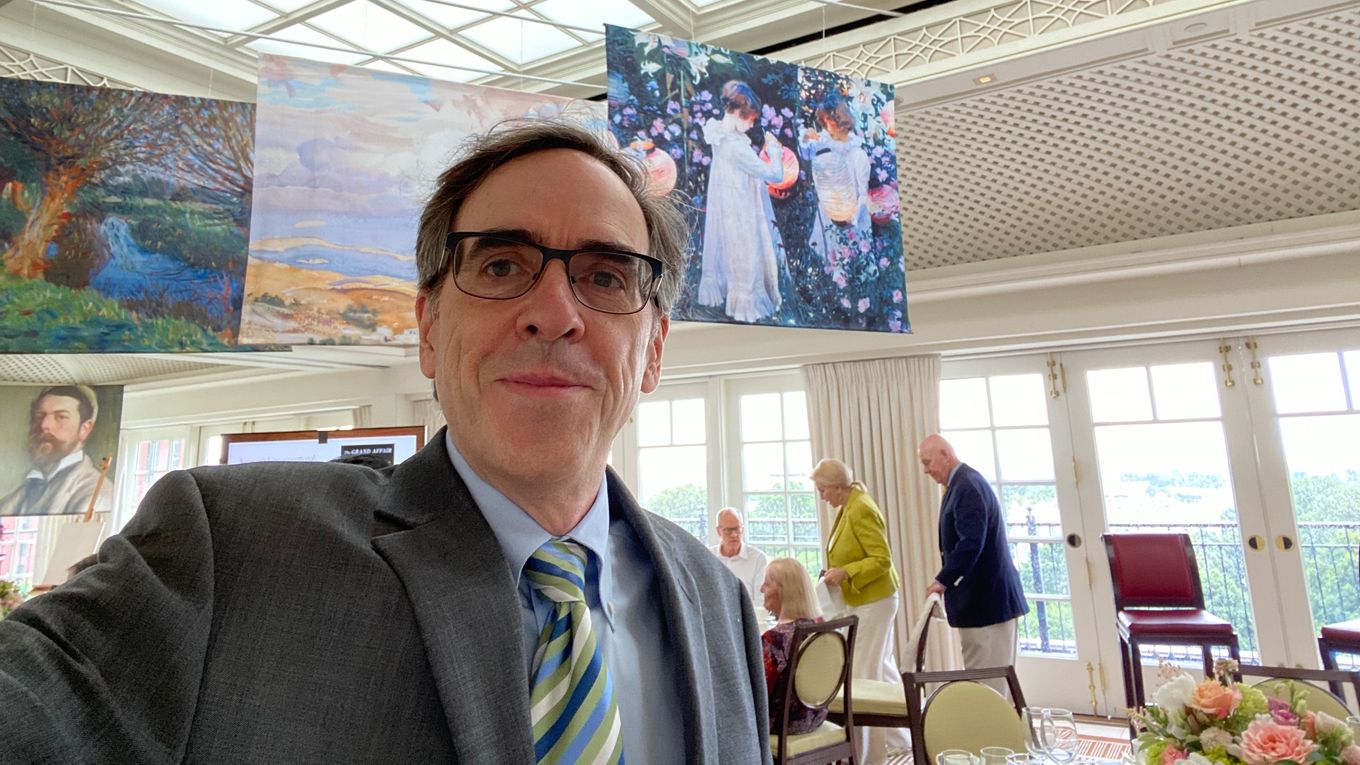 Ron Charles takes a selfie at the Hay-Adams Author Series luncheon in Washington on June 16, 2023. (Ron Charles/The Washington Post) | As soon as last Friday's newsletter went out, I headed into Washington for lunch at the Hay-Adams. The hotel's Author Series is the most glamorous book club imaginable — an homage to the salons once hosted by Henry Adams and his wife, Clover. Guests enjoy lunch on the top floor with an expansive view of the White House. I decided to wear my gray suit because it's the only suit I have. The dining room was decorated in honor of the literary guest of honor, Paul Fisher, author of "The Grand Affair: John Singer Sargent in His World." At lunch, I was seated next to Fisher, which gave me a chance to inform him about Henry Adams and his friendship with Henry James. Then, just before dessert, Fisher went to the front of the room to give a short presentation, and I learned that he's also the author of "House of Wits: An Intimate Portrait of the James Family." I'm sure he appreciated my undergraduate insights. If you're in the Washington area, or you're coming in for the National Book Festival on Aug. 12, keep an eye out for the next Author Series luncheon at the Hay-Adams on Aug. 11. The speaker will be announced soon (details). Send any questions to ron.charles@washpost.com. I'm happy to pontificate on all subjects, even to renowned experts. You can read last week's issue of the newsletter here. Tell friends who might enjoy this free newsletter that they can get it every week by clicking here. And remember, you can find all our books coverage, updated every day, here.
Interested in advertising in our bookish newsletter? Contact Michael King at michael.king@washpost.com. | 


 Email
Email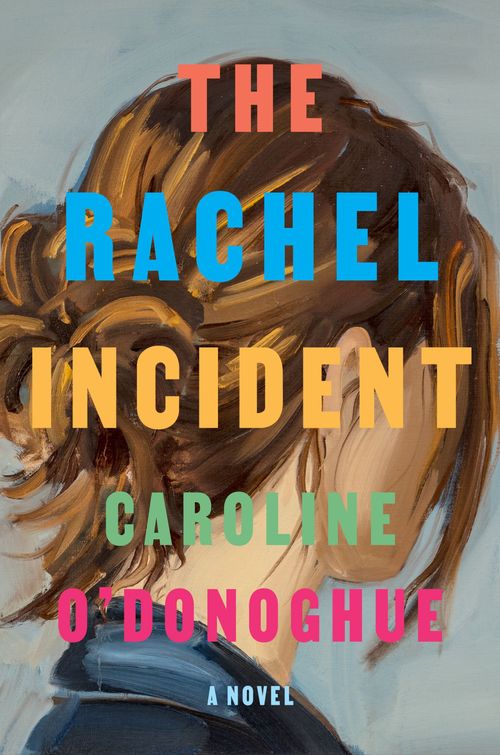



No comments:
Post a Comment