| The 5-Minute Fix will be on vacation starting Friday. We'll be back in your inbox Tuesday, July 11. The Supreme Court said Thursday that affirmative action policies at the University of North Carolina and Harvard are unconstitutional. That probably means that virtually no U.S. college or university can continue to weigh race and its desire for a diverse student body as reasons to admit someone, reports The Washington Post's Robert Barnes. This is one of the court's most profound decisions since it ended federal abortion protections. Here's what it means — and the arguments for and against affirmative action. What is affirmative action?: It's using race as one factor to admit students with the intent of giving minorities a boost and promoting campus diversity. What happens now?: Everyone is still figuring out exactly what this ruling means. But in broad strokes, the Supreme Court overturned decades of its previous rulings in favor of affirmative action, and universities now have to throw out those policies. 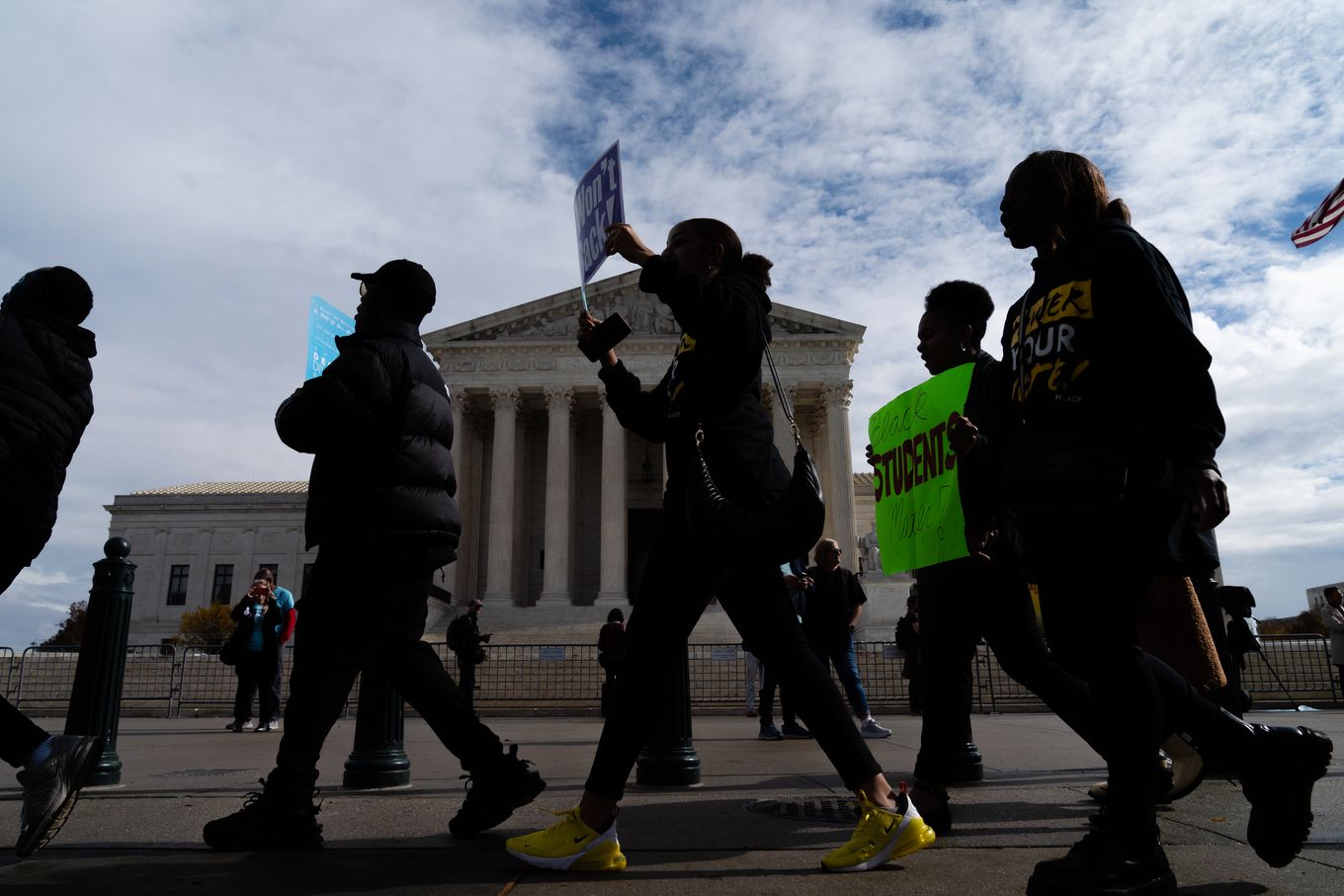 Demonstrators outside the Supreme Court in October. (Eric Lee for The Washington Post) | The arguments against affirmative action: That it is really discrimination in sheep's clothing. "The student must be treated based on his or her experiences as an individual — not on the basis of race," Chief Justice John G. Roberts Jr. wrote. Justice Clarence Thomas, a Black man who has long been opposed to affirmative action, wrote that he was hoping to achieve a "colorblind" Constitution in banning the practice. He's argued that people saw his success only through the lens of affirmative action policies rather than believing he earned it. The arguments for affirmative action: That it's naive to think the United States has a colorblind society. "With let-them-eat-cake obliviousness, today, the majority pulls the ripcord and announces 'colorblindness for all' by legal fiat," Justice Ketanji Brown Jackson wrote. "But deeming race irrelevant in law does not make it so in life." She added: "If the colleges of this country are required to ignore a thing that matters, it will not just go away. It will take longer for racism to leave us." We have some data on that. When California voters banned race-based admissions in the 1990s, Black and Hispanic student representation at the University of California at Berkeley almost immediately dropped by around 50 percent. "Ignoring race will not equalize a society that is racially unequal," Justice Sonia Sotomayor wrote. She read her dissent from the bench to underscore how much she disagreed with the decision. She's talked about growing up in the Bronx as a Latina in poverty and surmised she wouldn't be on the Supreme Court if it weren't for affirmative action giving her a boost into elite colleges. "What was true in the 1860s, and again in 1954, is true today: Equality requires acknowledgment of inequality." A few reader questions Q: Re: Donald Trump's indictment on 37 counts. Does he have to be found guilty on all 37 or can the jury find him guilty on some and not others? I keep seeing reference to one juror being able to cause a hung jury, leading to a mistrial and I don't understand what that means. A: The jury will deliberate on each charge and can find the defendant guilty of some and not guilty of others. But the decision for each individual charge must be unanimous. A hung jury and a mistrial happen if the jury can't unanimously agree on whether Trump is guilty or not guilty for each charge. Q: What has Kamala Harris been up to lately? A: In her first year as vice president, Harris's portfolio was mainly focused on immigration and voting rights — two policy areas where the Biden administration has made little to no clear progress. But with the reelection, Harris has taken a more front-facing role. Earlier this year she represented the United States at an international conference in Germany, excoriating Russia for "crimes against humanity." She spoke at the funeral of Tyre Nichols, a Black man who died in January after being chased and beaten by Memphis police following a traffic stop. She embarked on a week-long official visit to Africa. And she's become the face of the Biden administration's abortion rights push, which is arguably the Democrats' strongest issue heading into 2024. "We fight for reproductive rights and legislation that restores the protections of Roe v. Wade," she said at a rally in D.C. last week. "And here's the thing. The majority of Americans are with us. They agree." | 


 Email
Email


No comments:
Post a Comment