| Happy official first day of summer (the absolute best season) ☀️ Send news and tips for the longest day of the year to rachel.roubein@washpost.com. Not a subscriber? Sign up here. Today's edition: Half of OBGYNS in states with bans say they've had patients who were unable to obtain an abortion despite seeking one, a new survey finds. A federal judge strikes down Arkansas's first-in-the-nation ban on gender transition care for minors. But first … | Democratic-led states are passing shield laws, solidifying abortion rights post-Roe | 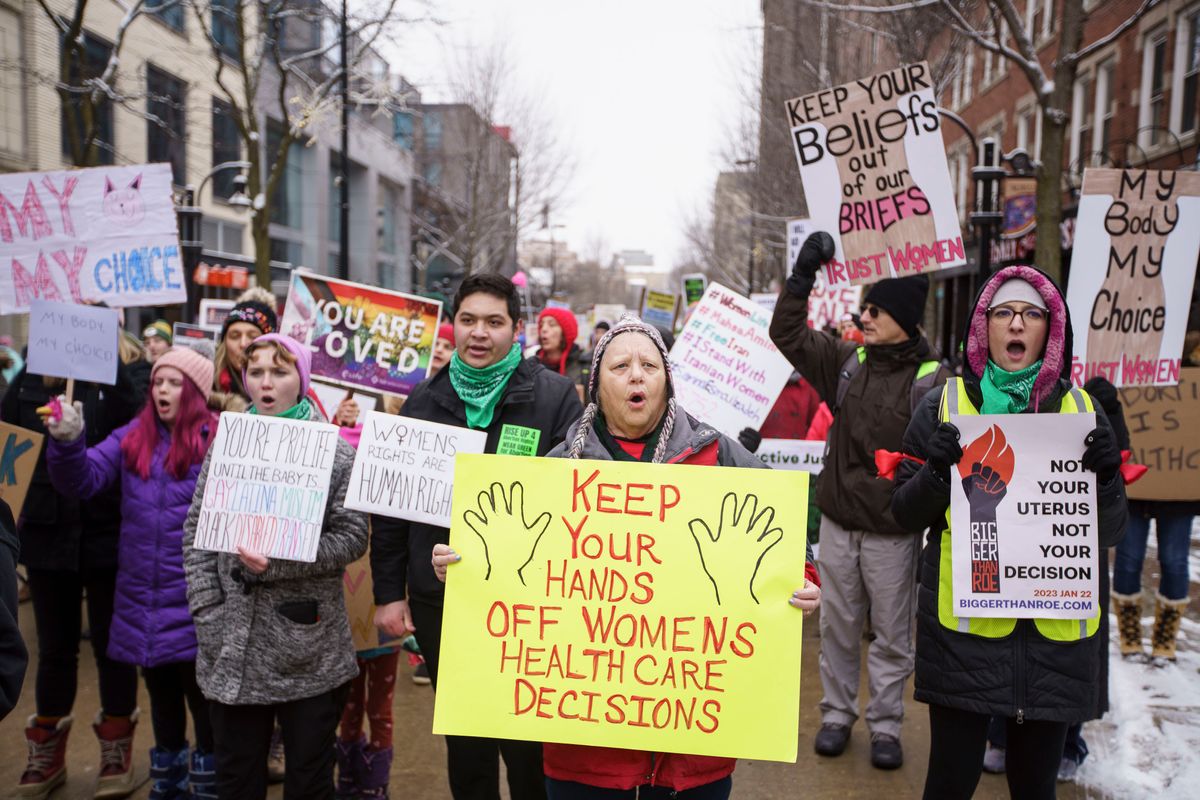 Abortion rights activists at the Bigger Than Roe National Mobilization March in Madison, Wis. (Sara Stathas for The Washington Post) | | | Democratic-led states rushed to shore up abortion protections in the first legislative season of the post-Roe era. Lawmakers in blue states passed an array of bills, from solidifying abortion rights to expanding access to medication abortion to shielding providers who practice in states where abortion is legal. The goal? Democrats are seeking to ensure abortion remains legal in their states, while continuing to serve as a destination for women who live in conservative areas with strict abortion bans. Their efforts this year built on legislation passed in 2022 in anticipation of the Supreme Court overturning Roe v. Wade — and some abortion rights advocates say it's just the beginning. | - "This is truly the next iteration of innovation and creativity at the state level, as well as at the local level," said Andrea Miller, the president of the National Institute for Reproductive Health.
| | We've written a lot about how abortion bans fared during state legislative sessions this year. This morning, we're turning to trends in states seeking to counteract such restrictions. | Trend #1: Some states sought to shore up abortion rights. | | There were several prominent examples of this effort popular among liberal states and abortion rights groups. | | In Minnesota: In a surprising upset during November's midterm elections, Democrats took full control of the state government for the first time since 2014. They rushed to enact a law codifying the right to an abortion into state law. (The procedure was already protected under a 1995 state Supreme Court decision, but supporters said they wanted to take the decision out of the hands of "individual judges.") In Michigan: Democrats also won control of both the state House and Senate for the first time in nearly four decades. In April, Gov. Gretchen Whitmer (D) signed legislation to repeal a 1931 near-total abortion ban, which came after voters in the state approved a constitutional amendment to enshrine the right to an abortion into the state constitution. In Maryland: The General Assembly gave the greenlight to let voters decide whether to enshrine abortion rights into the state constitution next year. In New York: For the second time, state lawmakers passed an amendment to enshrine abortion rights into the state constitution. That means the measure will also now head to voters next year. | | More from Whitmer: | 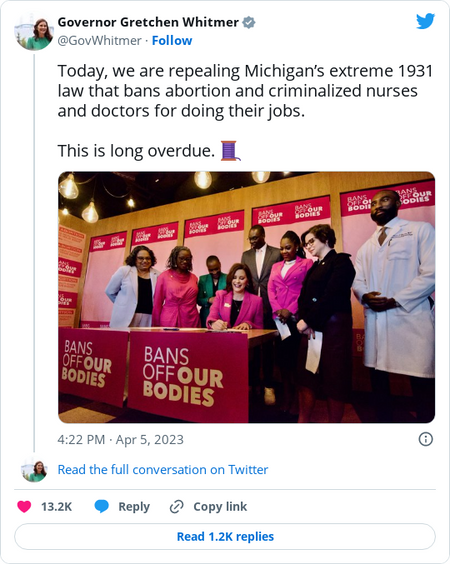 | | | | Trend #2: Democrats look to shield providers. | | While the specifics in states may differ, this policy is generally aimed at protecting medical professionals and others who practice in states where abortion is legal from punishment in states with bans. Advocates for such laws acknowledge there don't appear to be cases of charges filed against providers in such instances. But they say the new measures send a message and act as a guard against lawsuits. In New York: The legislature gave approval yesterday to legislation granting legal protection for doctors in the state to prescribe and send abortion pills to patients in states with bans. Gov. Kathy Hochul (D) has indicated her support for the idea of a new shield law, per the New York Times. The state certainly isn't the only one to enact new shield laws. In Vermont, Republican Gov. Phil Scott signed a shield law that explicitly protects access to mifepristone, even if the federal government withdraws approval of the commonly used abortion pill. | | David S. Cohen, a professor at Drexel University's law school: | 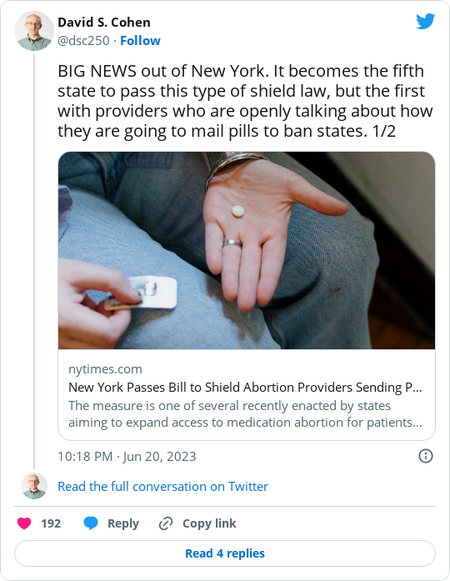 | | | | Trend #3: States are testing out a smattering of new bills. | | States tend to follow each other's lead, so it's worth watching closely what could emerge as a trend during the next legislative cycle. Some bills that caught our eye: | - In New York, Hochul signed a bill aimed at ensuring all public colleges and universities offer medication abortion.
- In Washington state, a new law will ensure the Department of Corrections can sell, deliver, distribute and dispense abortion pills.
- And Rhode Island has become the latest state with a measure letting state funds cover abortion in the Medicaid program and for those on state employee insurance plans.
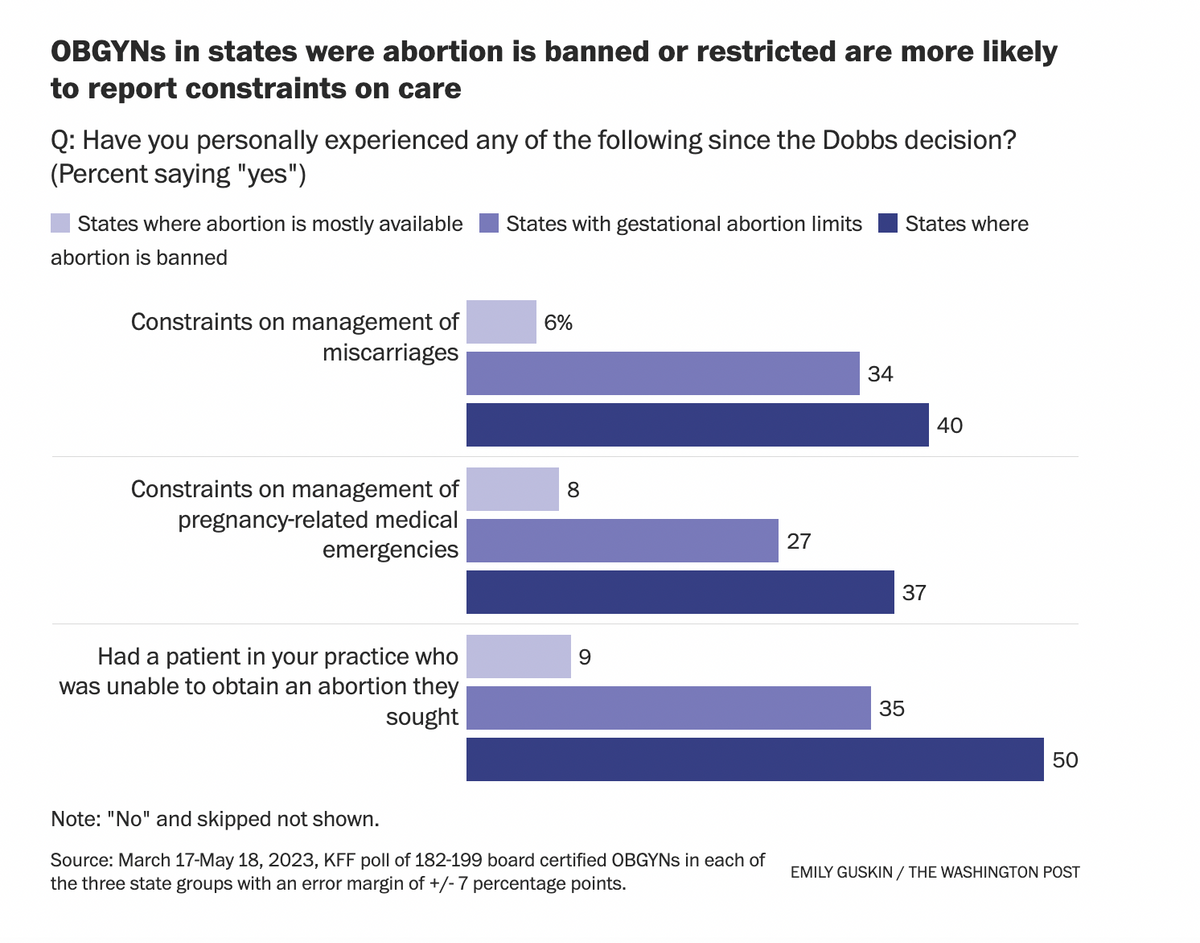
| | Meanwhile … State and local governments are putting more money toward expanding access to abortion. Since the Supreme Court's decision, at least 15 municipal governments and six states have put nearly $208 million toward funding abortion, reproductive health services, patient navigation programs and other services, according to the National Institute for Reproductive Health. | | Rhode Island Gov. Dan McKee (D): | 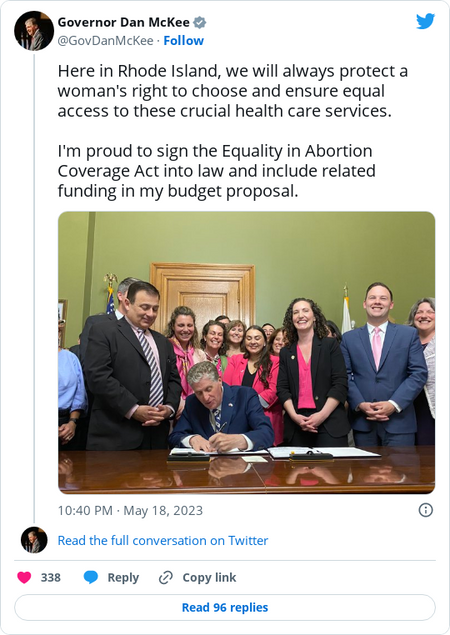 | | | | | |  | Chart check | | New this a.m.: How OBGYNs say new abortion restrictions are affecting maternal care | 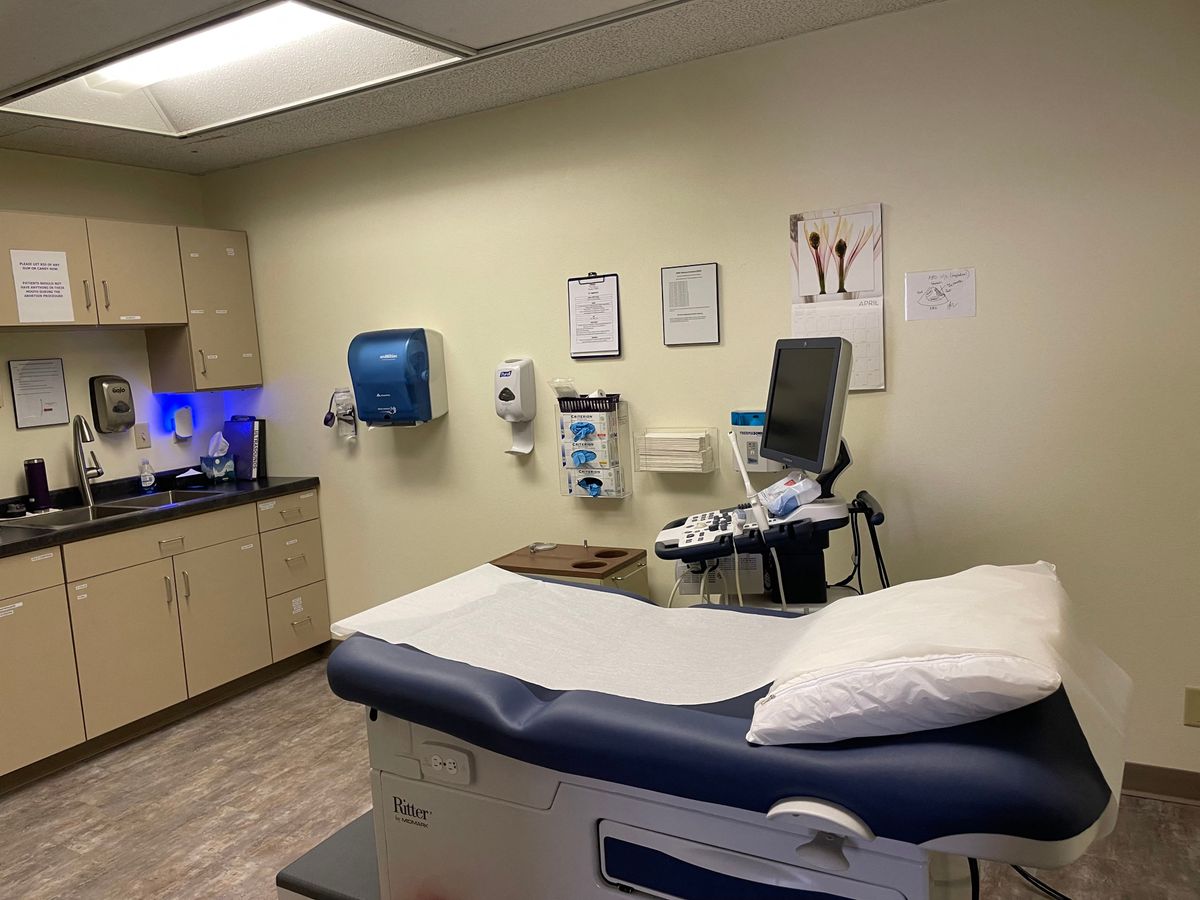 The poll indicates restrictions on abortion enacted over the last year have had a negative effect on maternal health care. (Inès Bel Aiba/AFP/Getty Images) | | | In the year since the Supreme Court overturned Roe v. Wade, half of OBGYNs working in states with abortion bans say they have had patients who were unable to terminate their pregnancies despite seeking to do so, according to a new survey out this morning from KFF. By the numbers: Across the country, 68 percent of OBGYNs said the effects of the Dobbs ruling have made managing pregnancy-related medical emergencies worse, while 64 percent said they believe the ruling has exacerbated pregnancy-related mortality, according to the poll. Zooming out: The findings represent the first nationally representative survey of OBGYNs since the ruling and provide one of the clearest views yet of how the decision has affected reproductive and sexual health care in the United States, The Post's Kim Bellware writes. | | |  | Transition care | | Federal judge in Ark. blocks first ban on gender transition care | 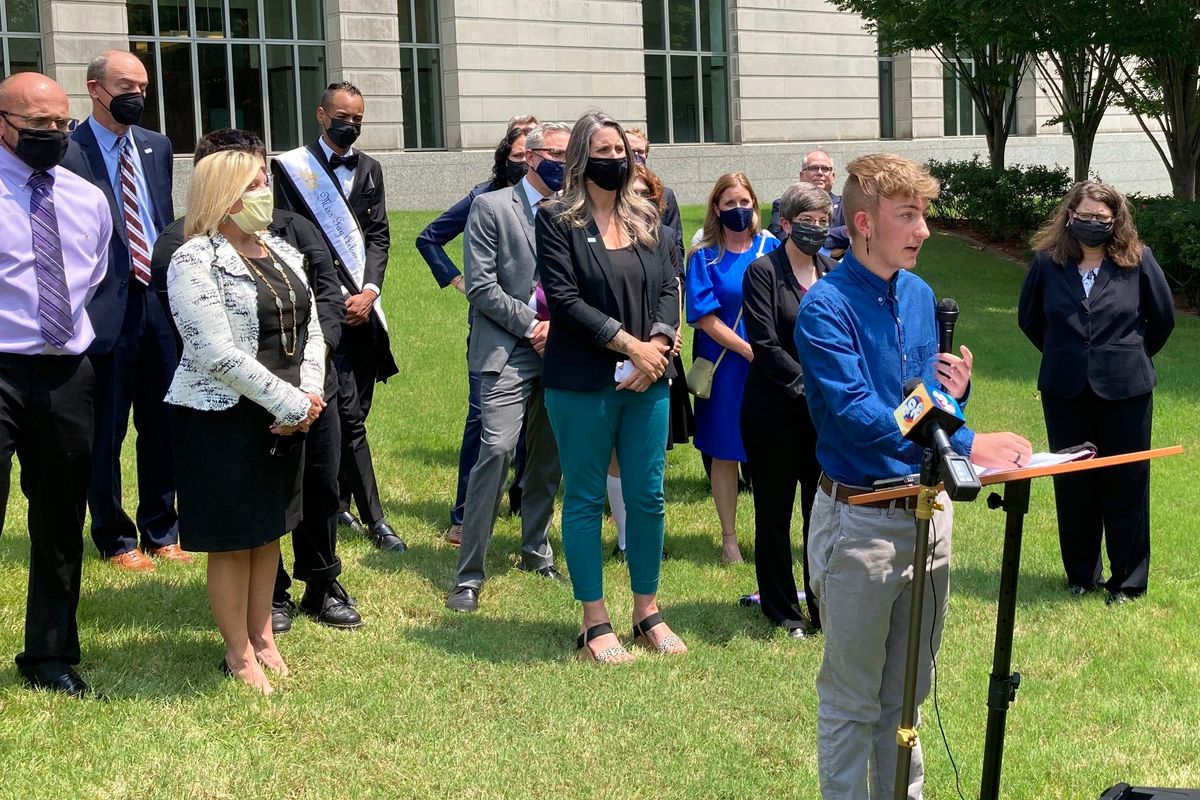 Transgender teen Dylan Brandt is one of several plaintiffs who challenged the state's ban. (Andrew DeMillo/AP) | | | A federal judge struck down a 2021 Arkansas law prohibiting gender-affirming care for youth as unconstitutional yesterday, finding that the first-in-the-nation ban violated the rights of doctors and discriminated against transgender people, our colleague Anne Branigin reports. U.S. District Judge James Moody of the Eastern District of Arkansas issued a permanent injunction forbidding the enforcement of the ban, which he had previously temporarily blocked from taking effect. The state plans to appeal the decision, Arkansas Attorney General Tim Griffin (R) said in a statement yesterday. The bigger picture: Moody's closely watched ruling marks the first time a federal court has decided the legality of such restrictions, which have been adopted by at least 20 additional states in recent years, according to data compiled by the ACLU. | | Arkansas Gov. Sarah Huckabee Sanders (R): | 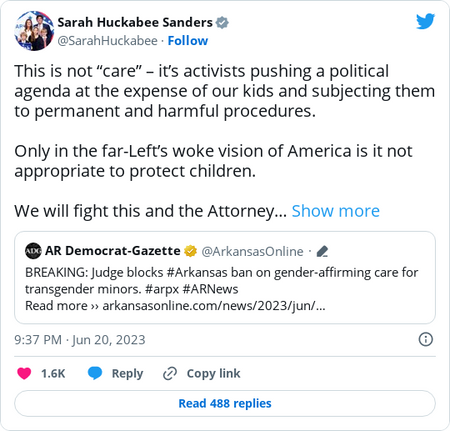 | | | | | The ACLU of Arkansas: | 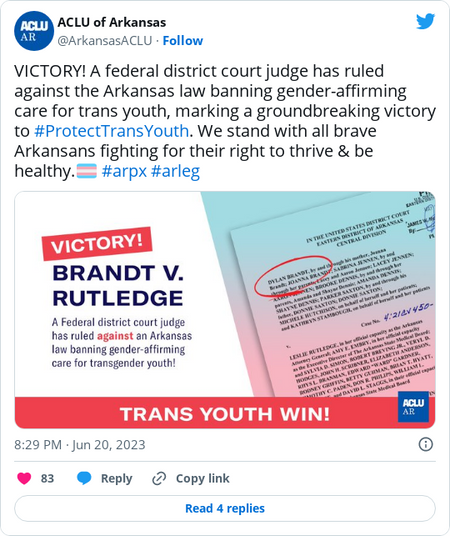 | | | | | The U.K.'s publicly funded National Health Service for England announced this month that it would limit the use of most puberty blockers for youth to clinical trials, saying more evidence is needed about their potential benefits and harms, the Wall Street Journal's Jathon Sapsford and Stephanie Armour reported over the weekend. It's an argument that has cropped up among Republicans in Congress, with GOP lawmakers seizing on European doubts last week to support their push for increased caution and restrictions. On the other side, Democrats contend Republicans are attempting to score political points. The U.S. medical community largely hasn't wavered in its support for clinical interventions. Last week, delegates from the American Medical Association endorsed a resolution reiterating support for access to gender-affirming care, saying that GOP claims "do not reflect the research landscape." | | |  | State scan | | Inside how Gov. DeSantis used secretive panel to flip Florida Supreme Court | 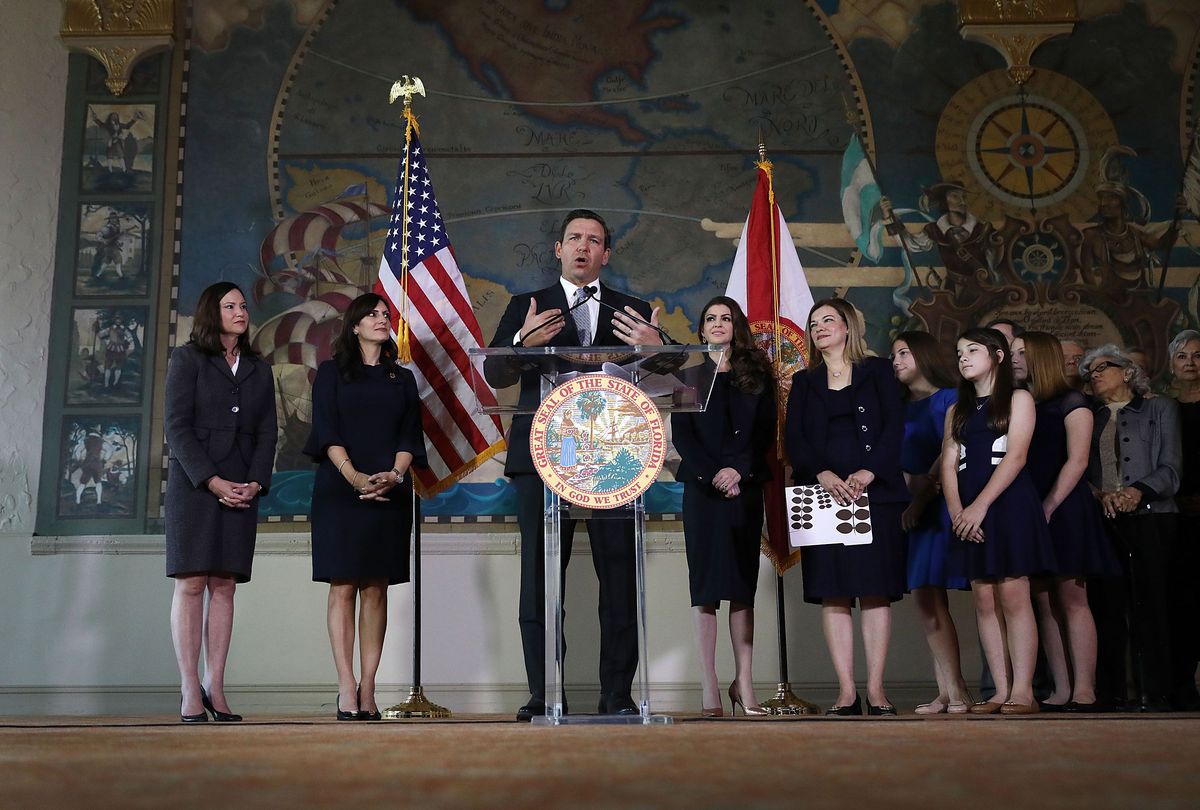 Florida Gov. Ron DeSantis (R) announces Barbara Lagoa's appointment. (Joe Raedle/Getty Images) | | | Our colleagues Beth Reinhard and Josh Dawsey published a deep dive yesterday on how Florida Gov. Ron DeSantis (R) seized on the unusual retirement of three liberal justices on the state Supreme Court at once to quickly reshape the panel into a conservative stronghold. The details: After DeSantis narrowly won election in 2018, he enlisted the help of a secretive panel led by Leonard Leo — the key architect of the U.S. Supreme Court's conservative majority — to quietly vet judicial nominees to fill the vacancies. The group grilled finalists on whether their principals matched those of the Federalist Society, an organization for conservative and libertarian attorneys that's led by Leo, people familiar with the process told The Post. DeSantis would go on to appoint three new justices in his first two weeks in office, flipping the court from what he described as a 4-3 liberal majority to a 6-1 conservative advantage. Why it matters: The governor's efforts have yielded one of the most conservative state Supreme Courts in the country, and it is set to weigh the constitutionality of Florida's 15-week abortion ban in the coming months. A six-week ban that DeSantis approved this year also hangs in the balance, Beth and Josh write. | | Our colleague Caroline Kitchener, who covers abortion for The Post: |  | | | | In other news from the states … | | In Kansas: State officials have agreed to not yet enforce a new law requiring clinics to inform patients of the disputed notion that a medication abortion can be interrupted using an unproven drug regimen until a judge weighs in on a formal request to block it, the Topeka Capital-Journal's Andrew Bahl reports. In Missouri: A judge rejected Republican Attorney General Andrew Bailey's bid to stop a constitutional amendment to restore abortion rights, ordering him to approve Republican Auditor Scott Fitzpatrick's cost estimate of the proposal within 24 hours of the ruling, Kurt Erickson reports for the St. Louis Post-Dispatch. | | |  | In other health news | | - The Senate voted 51-43 yesterday to confirm Julie Rikelman to the U.S. Court of Appeals for the 1st Circuit, overcoming opposition from some Republicans and antiabortion advocates over her work as an abortion rights attorney.
- The Supreme Court threw out a lower-court ruling yesterday stopping South Carolina from cutting off public funding to Planned Parenthood, remanding the case to the U.S. Court of Appeals for the 4th Circuit for further consideration.
- On the move: Anne Esposito, PhRMA's senior vice president for federal advocacy, will leave the lobbying group later this summer after over three years at the organization, Stat's Rachel Cohrs reports.
- The U.S. Preventive Services Task Force finalized its recommendation yesterday urging primary care providers for the first time to screen all adults younger than 65 for anxiety disorders, The Post's Lindsey Bever reports.
| | |  | Health reads | | | |  | Sugar rush | | | Thanks for reading! See y'all tomorrow. | |




No comments:
Post a Comment