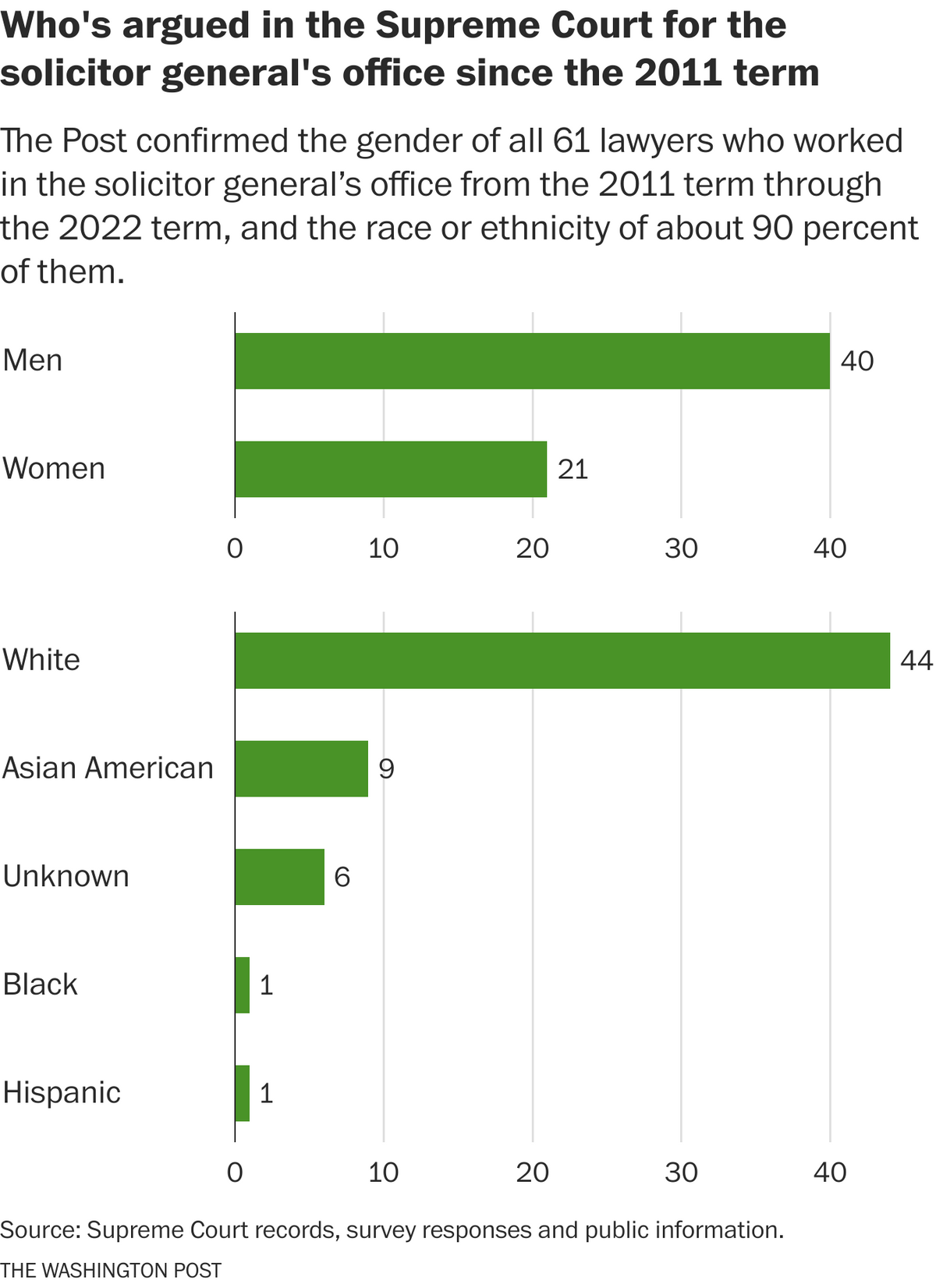
| |  | | Presented by Air Line Pilots Association, Int'l | | | Good morning, Early Birds. Who saw "Barbie"? Who saw "Oppenheimer"? Who saw both? Who saw neither? Tips: earlytips@washpost.com. Was this forwarded to you? Sign up here. Thanks for waking up with us. In today's edition … What we're watching: House takes up a funding bill and Senate considers NDAA amendments … She was a GOP congresswoman. Her son is a transgender activist. … States are losing federal water funds to earmarks … but first … | | |  | From the courts | | Why the solicitor general's office isn't more diverse | 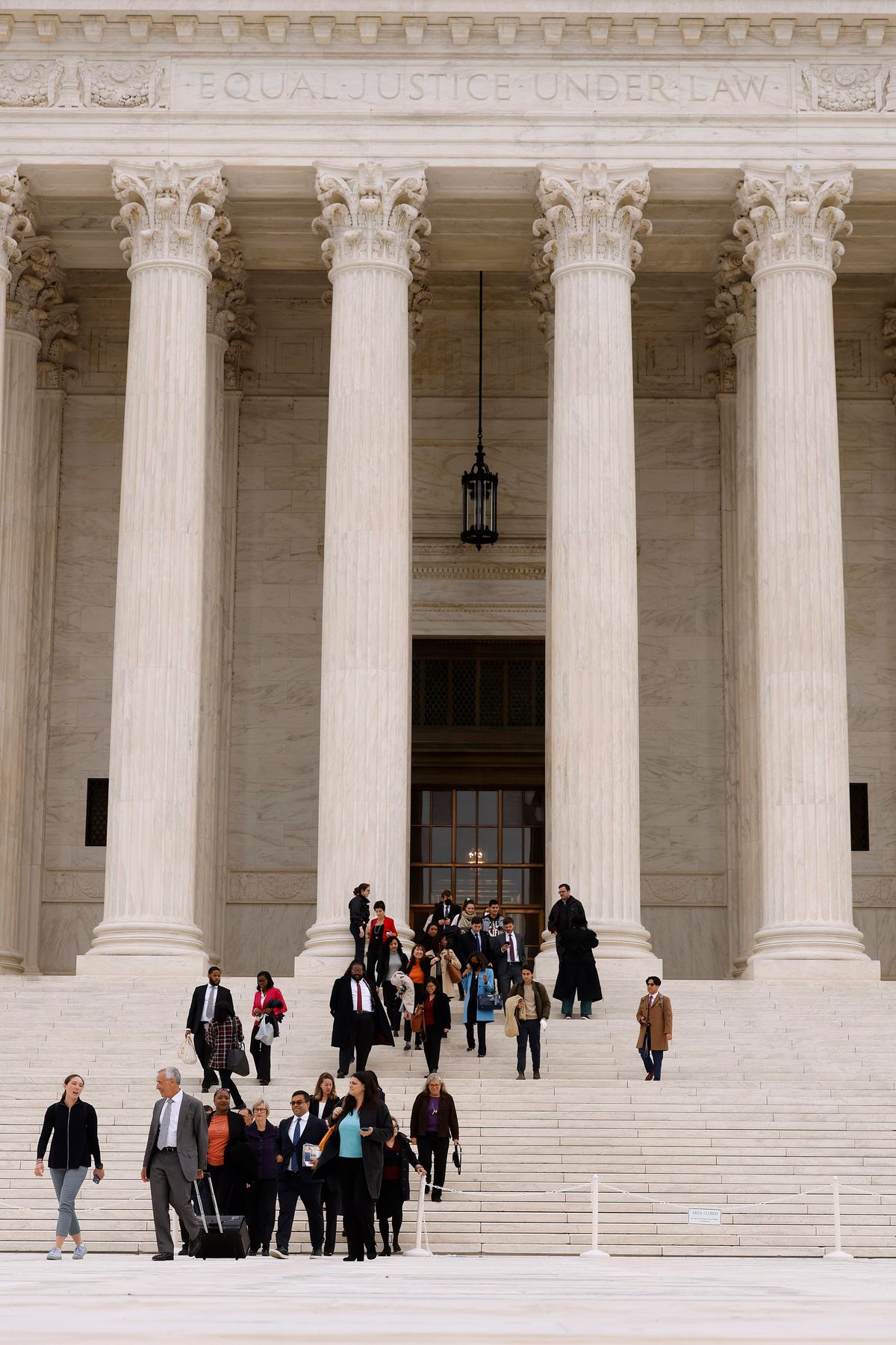 The U.S. Supreme Court in Washington. (Chip Somodevilla/Getty Images) | | | When Solicitor General Elizabeth B. Prelogar defended college affirmative action programs before the Supreme Court in October, she cited the lack of diversity in a group of people the justices know well: the lawyers who argue before them. Just two of 27 lawyers who appeared before the court over the next two weeks would be women, Prelogar told the justices — a statistic she said could lead women to wonder whether they have a shot at arguing before the high court. Prelogar cited only the dearth of women and not of Black and Hispanic lawyers arguing before the court, but her message in a case dealing with race-conscious admissions programs was clear. "When there is that kind of gross disparity in representation, it can matter and it's common sense," she told the justices. Her argument didn't sway the court's conservative majority, which ruled last month that the affirmative action programs of Harvard University and the University of North Carolina were unconstitutional. | | | | | | | Passenger safety is at stake. Don't compromise safety by raising the mandatory pilot retirement age and weakening strong pilot training rules in the FAA reauthorization bill. Learn more. | | | | | | | | It did, however, garner the attention of the court's three liberal justices, who cited Prelogar's remarks in a dissent, warning that "inequality in the pipeline to this institution, too, will deepen." A similar lack of diversity to the one Prelogar pointed out in her argument has persisted for years in the solicitor general's office, which is part of the Justice Department and represents the federal government before the Supreme Court, Tobi and Theo report. | - Over the past dozen terms, nearly three-quarters of Supreme Court arguments made by lawyers in the office have been delivered by men, according to our analysis.
- More than 80 percent have been made by White lawyers, according to the analysis of the office's attorneys whose race could be confirmed. No Hispanic lawyer has argued a case for the office since 2016. No Black lawyer has done so since 2012.
- The relative lack of diversity among lawyers in the office reflects the broader group of lawyers who argue before the court — including lawyers at private firms, state solicitors general and others — which is disproportionately White and male, as Theo and Tobi reported in October.
| | Prelogar declined an interview request for this story, and the Justice Department declined to comment on the record. But Prelogar told us in a statement last year that "there is more work to be done to ensure that we reflect the American people as we represent them before the Court" and that she was committed "to seeking out, hiring, and retaining outstanding attorneys who fully represent our Nation's diversity." | | The solicitor general's office doesn't track the race of its lawyers, so we asked each of the 61 lawyers who have argued cases on behalf of the office over the past 12 Supreme Court terms to share their race or ethnicity and gender identity. Fifty-two responded and confirmed their gender; 51 confirmed their race. We confirmed the race of four more and the gender of all the remaining lawyers using Supreme Court argument transcripts and public statements. | | Prelogar, who is only the second woman to win Senate confirmation as solicitor general, has taken steps since her confirmation in 2021 to make the office more diverse. She's made five hires, including Luke McCloud, a Black man who next term is set to make his first Supreme Court argument since joining the office. | | But the years-long absence of Black and Hispanic lawyers from the office demonstrates the glacial pace of change even in an office whose leader says she is committed to diversity and who works for a president who has promised "to build an administration that looks like America." Among the challenges are federal hiring rules that prohibit taking race or gender into account, as well as a low turnover rate among lawyers in the office, the vast majority of whom are civil servants, not political appointees. Critics argue that the office's preference for hiring former Supreme Court clerks — who historically have been disproportionately White — has made it harder to achieve diversity. | | Neal Katyal, who served as acting solicitor general during the Obama administration, said the office needs racial and ethnic diversity — along with diversity of political views, religion and sexual orientation — to make the best arguments before the court. "You are arguing your case to nine justices who come from a variety of different perspectives," said Katyal, who is Indian American. "And to have a workforce that is attuned to those differences in ideology, approach, outlook and background makes for much better advocacy strategy." Advocates for a more diverse Supreme Court bar also argue the solicitor general's office has a special responsibility to reflect the country it serves. "The solicitor general is often referred to as the 10th justice. The lawyers in the office represent us, the United States," said Juvaria Khan, the founder of the Appellate Project, which seeks to help more lawyers of color do appellate work. "Because they represent the people, they should prioritize developing an office that reflects all our people and the diversity of the country." | | Lawyers and academics who follow the court closely said that diversifying the solicitor general's office could have an outsize effect on the diversity of the broader group of lawyers who argue before the court, in part, because lawyers in the office appear so often. Lawyers who argue before the Supreme Court are disproportionately White and male. | | The simplest way to diversify the Supreme Court bar "is to diversify the SG's office," said Noah Feldman, a Harvard Law School professor and former Supreme Court clerk. Some conservatives have expressed skepticism that increasing racial and gender diversity would lead to better arguments. "It's possible that having people of multiple races in the room when you're writing your briefs and preparing for the argument could make the briefs better and the arguments better," said Brian Fitzpatrick, a former clerk to Justice Antonin Scalia and a professor at Vanderbilt Law School. "I'm certainly open to that. But I just don't think we should engage in racial discrimination based on speculation." | | |  | What we're watching | | | The House comes in on Tuesday this week. Lawmakers will take up their first funding bill, the Military Construction Veterans Affairs and Related Agencies Appropriations bill. It is a top appropriations priority for Republicans to show they are fully funding veterans programs, including health care, after Democrats hammered them for not explicitly protecting veterans programs in their partisan debt limit bill. The House has pledged to pass all 12 funding bills before the end of the fiscal year on Sept. 30. But that doesn't mean the government will be funded after the House acts. The House has to reconcile the bills with the Senate — a near impossibility ahead of the new fiscal year — which is why talk of a short-term stopgap bill is already being discussed and why fears of a government shutdown continue to mount. Wednesday: Homeland Security Secretary Alejandro Mayorkas will testify before the House Judiciary Committee. While this is just an oversight hearing, at least half of the Republicans on the committee want to impeach him. This will not be fun for Mayorkas. A House Oversight subcommittee will hold a hearing on UFOs, now known as unidentified anomalous phenomena, or UAPs. | | The Senate also comes in on Tuesday and will continue its work on the annual defense policy bill. This is the week senators will vote on controversial amendments, including potentially the Defense Department's abortion travel policy. Senate Majority Leader Charles E. Schumer (D-N.Y.) indicated he would allow a vote on Sen. Joni Ernst's (R-Iowa) amendment to prohibit the Defense Department from paying for travel for service members or their dependents seeking an abortion. However, it was not on the list of amendments sent to Senate offices last week for an initial whip count, according to a senior Senate aide. Sen. Tommy Tuberville (R-Ala.), who is holding up military nominees and promotions, has not indicated whether a vote on such an amendment would be enough to satisfy his demands that either Congress codify the policy or the Pentagon end it. Wednesday: The Senate will have its third briefing on artificial intelligence. Schumer has prioritized crafting legislation on AI. He introduced a framework earlier this summer, and he added AI guardrails and reporting on the Pentagon's use of AI to the defense bill being debated on the floor. | | The Iowa Republican Party holds its annual Lincoln Day Dinner. Nine presidential candidates have confirmed their attendance, including former president Donald Trump, Florida Gov. Ron DeSantis, former vice president Mike Pence, former U.N. ambassador Nikki Haley and Sen. Tim Scott (S.C.). | | President Biden will announce on Tuesday the establishment of a national monument dedicated to Emmett Till, whose 1955 murder helped spark the civil rights movement, our colleague DeNeen L. Brown reported on Sunday. Biden will also speak about mental health. On Thursday, Biden will speak about climate change after being briefed on the extreme heat afflicting much of the country. He will also meet with Italian Prime Minister Giorgia Meloni at the White House to discuss China and Ukraine, among other subjects. And on Friday, Biden will make his first trip to Maine since taking office, where he will speak about his favorite theme: Bidenomics. White House homeland security adviser Elizabeth Sherwood-Randall, meanwhile, is headed to Mexico City today for meetings with Mexican and Canadian officials to discuss immigration and the opioid epidemic. She's leading a delegation that includes Rich Verma, the deputy secretary of state for management and resources; Deputy Attorney General Lisa Monaco; Kristie Canegallo, the acting deputy secretary of homeland security; and Kemp Chester, a senior adviser to the White House Office of National Drug Control Policy. | | |  | On the Hill | | She was a GOP congresswoman. Her son is a transgender activist. | 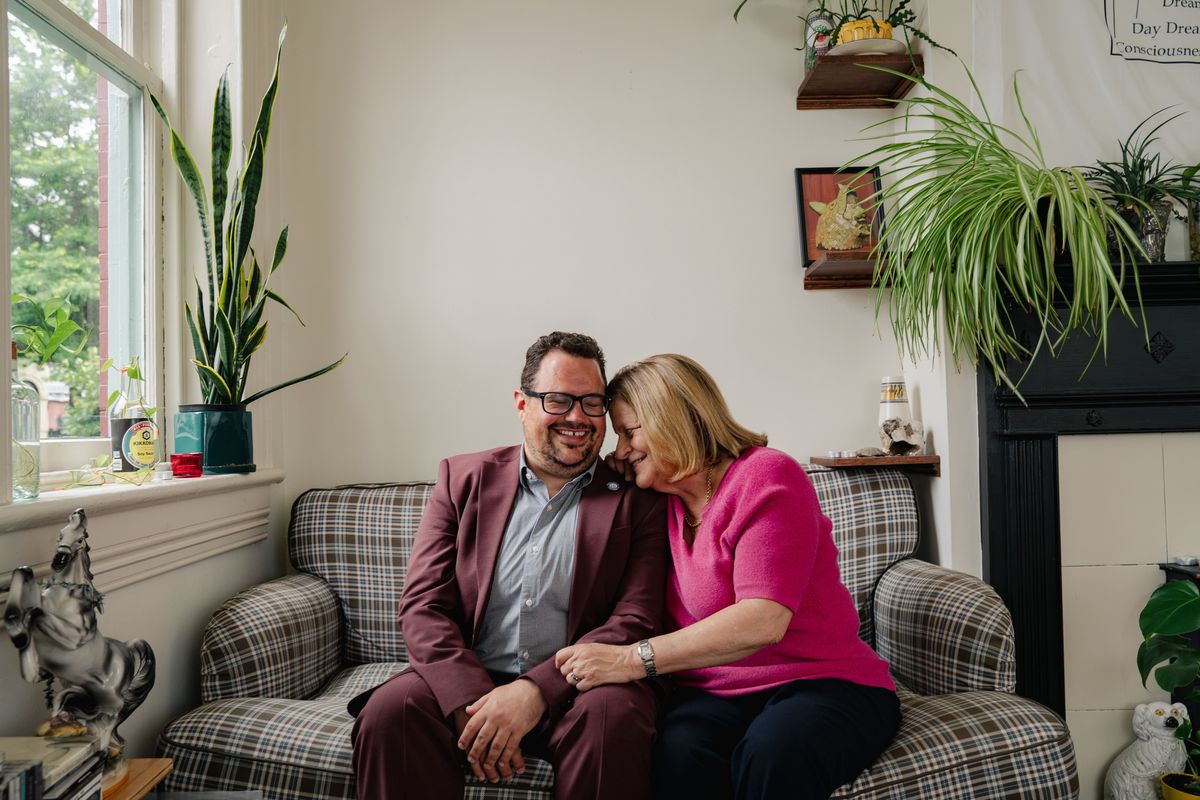 Former congresswoman Ileana Ros-Lehtinen (R-Fla.) and son Rodrigo Heng-Lehtinen. (Shuran Huang/The Washington Post) | | | Read our colleague Jesús Rodríguez's profile of former Republican congresswoman Ileana Ros-Lehtinen (Fla.) and her 37-year-old son, Rodrigo Heng-Lehtinen, who is transgender. Ros-Lehtinen, who became the first Republican to support the Respect for Marriage Act, which would allow same-sex couples to wed, told Jesús that she's been trying to encourage her Republican colleagues in closed-door conversations to embrace transgender people the way she and her husband have "embraced their son's identity." | - "One on one, they're more compassionate, understanding, and they get the family dynamics," Ros-Lehtinen says of her Republican colleagues. "But then when you get this herd mentality, it's very difficult to cut through all the fog."
| States are losing federal water funds to earmarks | 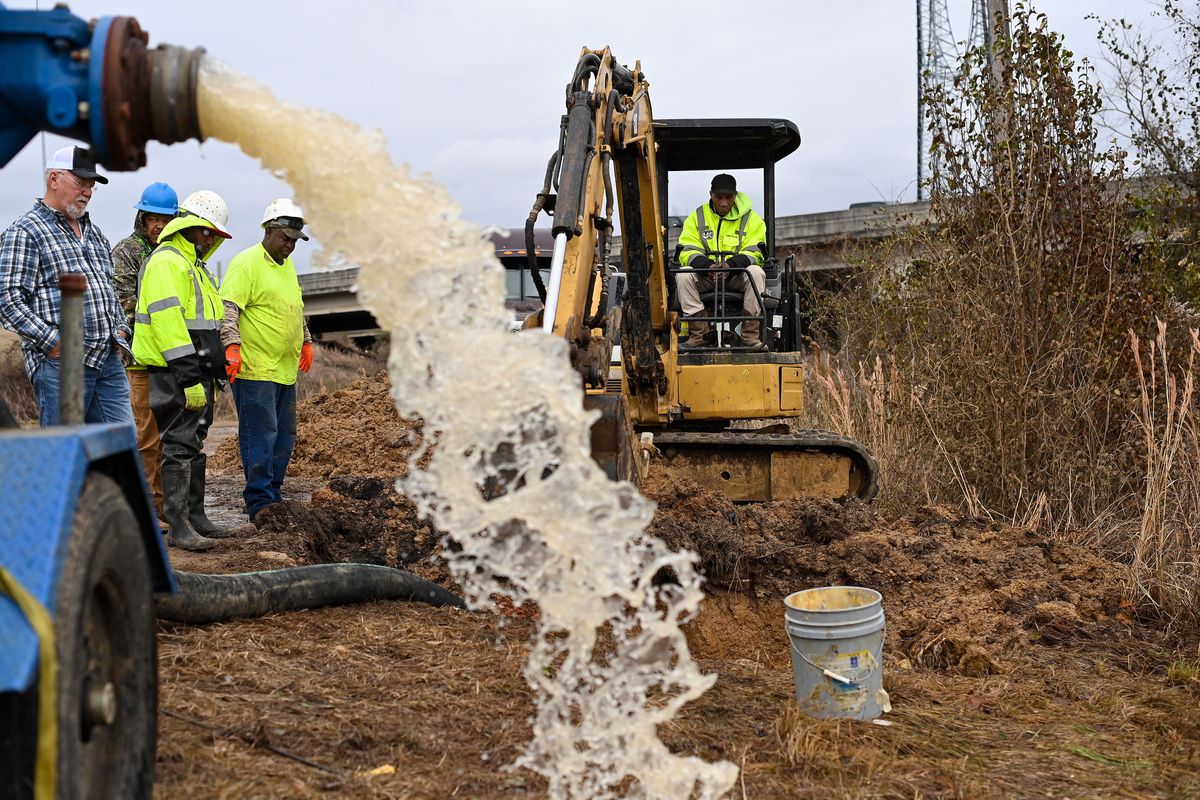 Water is redirected from a water main break in Jackson, Miss., last December. (Joshua Lott/The Washington Post) | | | Skimming off the top: "Members of Congress have redirected roughly $2.3 billion dollars in federal water funds toward political pet projects over the past two years, cutting at times into the money that could have been made available for poorer, needier communities," our colleague Tony Romm reports. "As a result, 38 states and territories have been shortchanged about $660 million in federal water aid." | - "The problem is expected to worsen in the coming fiscal year, as House Republicans eye a $1.7 billion cut to the overall funding that Washington sends states for their water needs."
- "That could complicate a new national push to replace lead pipes, repair wastewater facilities and improve other aging infrastructure — an urgent task at a moment when the United States is grappling with extreme heat and other consequences of a fast-warming planet."
| | |  | The Media | | | |  | Viral | | | | AM/PM | | Looking for more analysis in the afternoon? | | | | Weekday newsletter, PM |  | | A lunchtime newsletter featuring political analysis and a global perspective on the stories driving the day. | | | | | | | | | | |







No comments:
Post a Comment