| Happy Thursday! A big shout out to Caroline Kitchener for her excellent reporting in the top of today's newsletter. And one note: I'll be heading out on summer vacay for a few days, and you'll have a great rotating cast of Post reporters bringing you this newsletter. See you next week! In the meantime, send all your news and tips to mckenzie.beard@washpost.com. Today's edition: A hearing continues today on a lawsuit seeking clarity over exceptions to Texas's strict abortion ban. Sen. Bernie Sanders (I-Vt.) introduces a competing bill to fund community health centers as a critical deadline nears. But first … | Aid Access launches new way to send abortion pills into states with bans |  Packets of mifepristone, a commonly used abortion pill. (Paul Ratje/The Washington Post) | | | There's a new, more efficient pipeline sending abortion pills into states with bans. Europe-based Aid Access, one of the largest abortion pill suppliers, revamped its protocols in mid-June. The result? Doctors in certain Democratic-led states with "shield" laws can now mail and prescribe pills directly to patients in antiabortion states. The new process could ignite a complex interstate battle over abortion, where U.S. doctors in blue states are empowered to legally circumvent abortion laws in red states. The move could also undermine abortion bans at a time when antiabortion groups and doctors are seeking to revoke the approval of key medication used in over half of all abortions in the country. Our colleague Caroline Kitchener dove deep into the new effort — and here's what she found. | | Previously, Aid Access only allowed Europe-based doctors to prescribe abortion pills to women in states where abortion is restricted. Those pills were shipped from India, and often took weeks to get to patients, which could push abortions well into the second trimester. (The Food and Drug Administration has approved mifepristone through 10 weeks gestation, though some studies have shown it can be used safely and effectively later in pregnancy.) | | | | | | | | With 90% of the U.S. population living within 10 miles of a Walmart store or pharmacy, Walmart is providing access to services and medications that help millions of Americans live a little better. | | | | | | | | But new laws enacted over the past year are helping to streamline the process. Democratic-led states have moved to protect medical professionals and others who practice in states where abortion is legal from potential punishment in states with bans. New York, Massachusetts, Washington, Vermont and Colorado explicitly protect abortion providers who mail pills to restricted states from inside their borders, Caroline writes. The new landscape: In less than a month, seven U.S.-based providers affiliated with Aid Access have mailed 3,500 doses of abortion pills to people residing in states with bans. All together, the small group could help facilitate at least 42,000 abortions in antiabortion states in a year. (Those numbers could grow, of course, if more providers join in.) | - As one expert told Caroline, the shield laws are "a huge breakthrough for people who need abortions in banned states," said David Cohen, a Drexel University law professor who focuses on abortion legislation. "Providers are protected in many ways as long as they remain in the state with the shield law."
| Could doctors face legal risks? | | That's a key question. And it could ultimately be resolved by the courts. Some lawyers say the doctors — who are preparing and packaging the pills sent to restricted states themselves — could face repercussions, even if they don't travel to states that prosecute abortion providers. Some wonder whether states with abortion bans would try to extradite medical providers from states with shield laws, though that could prove difficult. Jonathan Mitchell, the former solicitor general of Texas and architect of the state's roughly six-week ban, said it seems too early to predict what will happen, but that "there absolutely is a world in which they could get in trouble for it." (In many states with bans, those found guilty of distributing abortion pills could be sentenced up to at least several years in prison.) But some involved in the effort say they're not worried. "Everything I'm doing is completely legal," a doctor in New York's Hudson Valley, who spoke on the condition of anonymity to protect her safety, told Caroline. "Texas might say I'm breaking their laws, but I don't live in Texas." Read the full story here. | | |  | Reproductive wars | | Testimony begins in hearing seeking clarity on Texas's abortion exceptions | 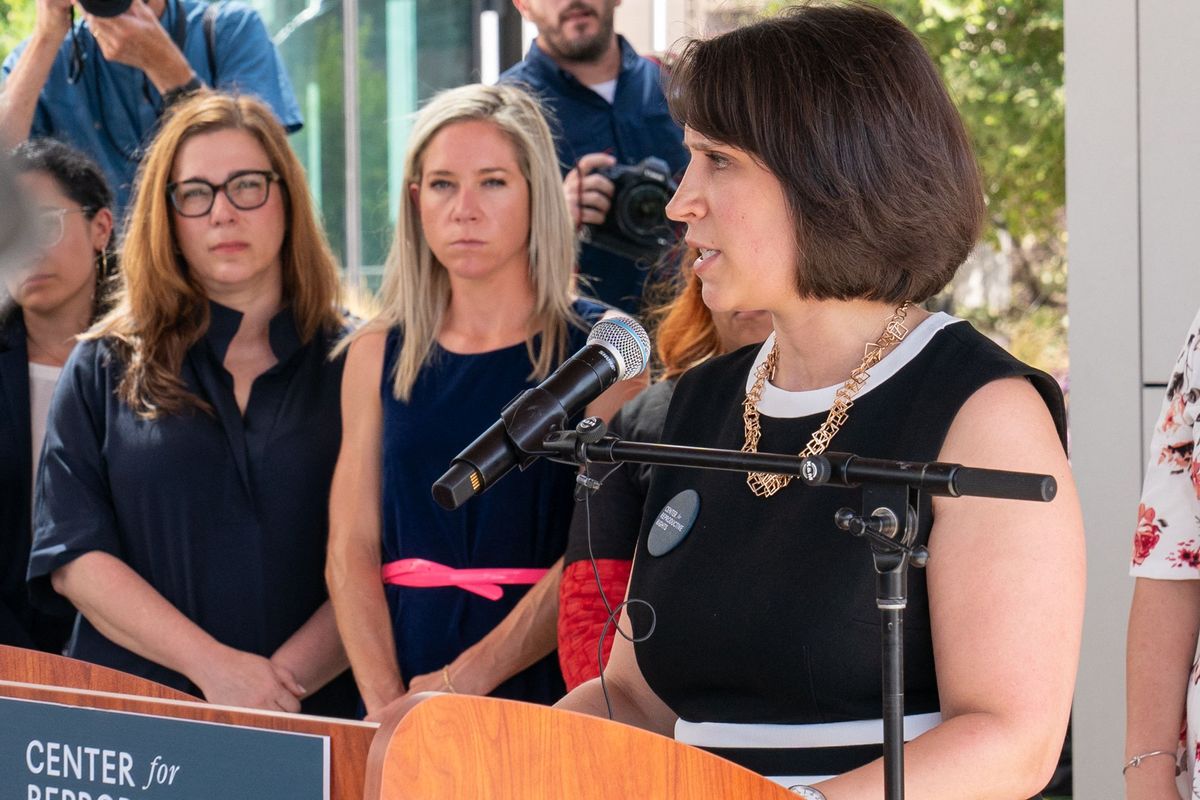 Center for Reproductive Rights attorney Molly Duane speaks during a news conference outside the Travis County Courthouse. (Suzanne Cordeiro/AFP/Getty Images) | | | Three women gave accounts yesterday of being denied abortions or given delayed medical care due to confusion over the exceptions in Texas's strict abortion laws. The testimony in a Texas courtroom was often emotional. At one point, one woman was reading a letter from her doctor describing how her baby had been diagnosed with a condition incompatible with life. She became sick on the stand, and the judge quickly recessed. The case, which was filed by the Center for Reproductive Rights, is believed to be the first lawsuit from women denied abortions since the nation's highest court overturned Roe v. Wade last summer. The hearing began yesterday, as three women and a doctor took the witness stand for the plaintiffs, and will continue today. The legal challenge isn't seeking to overturn the state's abortion ban, but rather to clarify when an abortion is allowed in the case of a medical emergency. The plaintiffs are also seeking a temporary injunction blocking the state's ban in instances where a patient experiences a pregnancy complication. During the hearing, Molly Duane — an attorney with the Center for Reproductive Rights — argued that the exceptions in the state's abortion ban are either "conflicting or lack definitions," and that doctors fear the high penalties they'd face if they're found to violate the law. On the other side, Amy Pletscher, who represented the Republican attorney general's office, called the legal challenge an "ideological crusade." "Plaintiffs simply do not like Texas's restrictions on abortion," she said. | | Shefali Luthra, reporter at the 19th: | 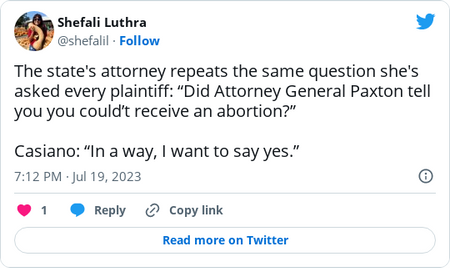 | | | | | |  | On the Hill | | Sanders introduces bill to fund community health centers |  Sen. Bernie Sanders (I-Vt.) released legislation to revamp the primary care system. (Demetrius Freeman/The Washington Post) | | | Senate HELP Committee Chair Bernie Sanders (I-Vt.) unveiled a bill yesterday that aims to overhaul the country's primary health-care system — a move that indicates there isn't a bipartisan compromise in the Senate over funding for health centers that provide care to the country's most vulnerable. | | The details: The legislation would invest $20 billion per year over a five-year period to expand community health centers and expand the health workforce. The panel is slated to mark up the legislation next Wednesday. Sanders's proposal comes days after the panel's top Republican, Sen. Bill Cassidy (La.), introduced a bill to reauthorize the fund comprising roughly 70 percent of federal dollars for health centers, which is set to expire Sept. 30. That legislation mirrors the funding plan the House Energy and Commerce Committee advanced with unanimous support in late May. The view from Cassidy: "This is partisan legislation that cannot pass the Senate," he said in a statement. "There is already reauthorization legislation that unanimously passed out of the House E&C committee, has been introduced in the Senate and is endorsed by community health centers. That is the bill we should mark up next week." | Meanwhile, in the House … | | The House Energy and Commerce Committee advanced two Republican-drafted bills aimed at reauthorizing an emergency preparedness law. The votes were 28-23 and 27-22. In a political maneuver ahead of the hearing, the panel's Democrats introduced their own version of the emergency preparedness bill that included a slate of measures they had been pushing to address the country's drug shortages. One more thing: The panel also voted unanimously to advance a bipartisan bill that would reauthorize an array of addiction treatment and recovery programs first enacted as part of the Support Act, which Congress passed in 2018. | | Frank Pallone Jr. (N.J.), the panel's top Democrat: | 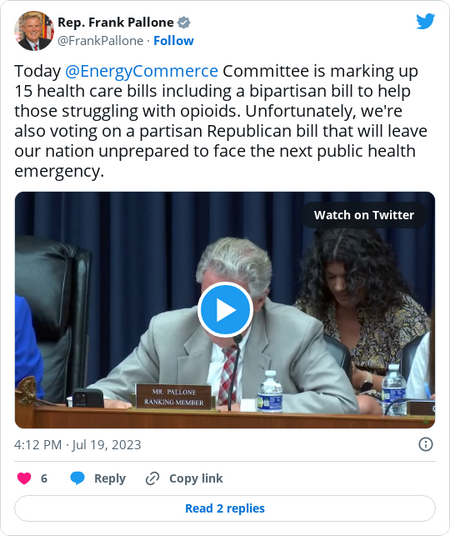 | | | | | Rep. Jeff Duncan (R-S.C.), a member of the committee: | 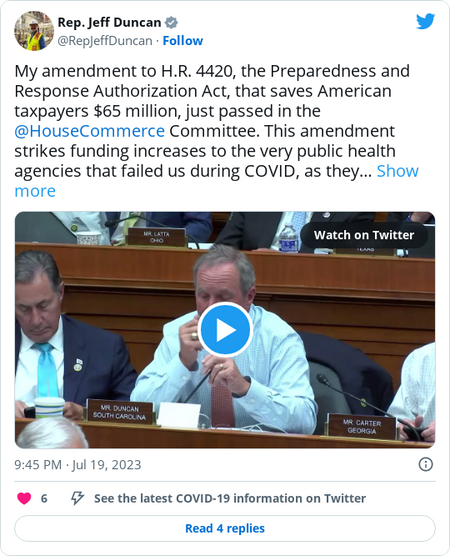 | | | | | Senate Majority Leader Chuck Schumer (D-N.Y.) will allow a vote to repeal the Pentagon's abortion policy, in an effort to sway Republican Sen. Tommy Tuberville (Ala.) to lift his hold on scores of military promotions, Politico's Burgess Everett reports. | - If he "wants to have an affirmative vote, we would not object to it," Schumer said yesterday. "Tuberville said he wanted a vote, we'll see what happens."
| | What we're watching: Schumer's offer could come as an amendment vote on the must-pass National Defense Authorization Act or as a stand-alone vote, although both would likely fail in the Democratic-controlled chamber. Privately, some Republicans have expressed worries that such an outcome wouldn't be enough to satisfy Tuberville. | | |  | Coronavirus | | Health officials: Funding cuts to Chinese lab separate from congressional probes |  The Wuhan Institute of Virology. (Thomas Peter/Reuters) | | | The federal health department suspended funding this week to the Wuhan Institute of Virology, the Chinese lab at the center of investigations about the coronavirus's origins. Current and former health officials told our colleague Dan Diamond that the decision was independent from congressional investigations into the virus's origin, and that it doesn't indicate confirmation of theories that the virus leaked from the facility. Instead, the order was "necessary to mitigate any potential public health risk," after the research institute failed to turn over key documents about its work on coronaviruses, according to a Department of Health and Human Services memo. Read the full story here. | | Rep. Brad Wenstrup (R-Ohio), who chairs the House panel investigating the coronavirus response: | 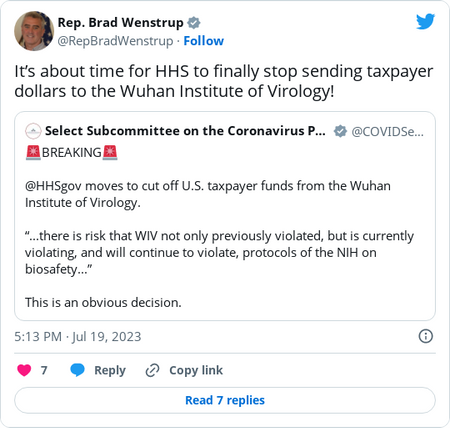 | | | | | |  | Daybook | | | On tap today: Our colleague Sabrina Malhi will host a live Q&A with Peter Hotez, a prominent scientist and pediatrician, on misinformation surrounding vaccines. The event will take place at 1 p.m. Submit your questions here. | | |  | Health reads | | | By Joshua Goodman and Jim Mustian | The Associated Press ● Read more » | | | | | |  | Sugar rush | | | Thanks for reading! See y'all tomorrow. | |






No comments:
Post a Comment