Mises Wire |
- Homicides Are Way Up in 2020, and Covid Lockdowns Are a Likely Cause
- If Deficits Don't Matter, Why Bother with Taxes?
- Can Las Vegas Recover from Covid?
- Central Planning by Business Is Not the Same as Central Planning by Government
- GDP Hides the Damage from the Covid-19 Lockdowns
- Opposition Builds to the F-35 Program's Runaway Costs
- Lockdowns Are More Economically Devastating Than Voluntary Social Distancing
| Homicides Are Way Up in 2020, and Covid Lockdowns Are a Likely Cause Posted: 30 Mar 2021 05:00 AM PDT If we're going to ask ourselves what might have caused such an unusually large rise in homicide, we ought to look for very unusual events. Covid lockdowns certainly fit the bill. Original Article: "Homicides Are Way Up in 2020, and Covid Lockdowns Are a Likely Cause" This Audio Mises Wire is generously sponsored by Christopher Condon. Narrated by Michael Stack.
 |
| If Deficits Don't Matter, Why Bother with Taxes? Posted: 30 Mar 2021 05:00 AM PDT If deficits don't matter, why bother with taxes? The regime has the answer: taxes are important for punishing people we don't like, rewarding our friends, and for maintaining control over the public. Original Article: "If Deficits Don't Matter, Why Bother with Taxes?" This Audio Mises Wire is generously sponsored by Christopher Condon. Narrated by Michael Stack.
 |
| Can Las Vegas Recover from Covid? Posted: 30 Mar 2021 04:00 AM PDT The Clark County Commissioners voted recently to rename McCarran Airport to Harry Reid International Airport. The vote was unanimous among those who rule the Las Vegas Strip. The public doesn't understand why Las Vegas International Airport wouldn't do if McCarran's past is so perturbing. Not everyone is so wild about Harry. There was a time when 40 million plus visitors passed through McCarran, during the boom years. But January 2021 saw visitor traffic fall 64 percent from a year ago. This sort of traffic has The Motley Fool wondering, "Are There Too Many Casinos in Las Vegas?" After all, convention traffic is nil, and "[a] concrete industry convention this summer is seen as the first real test of whether Las Vegas can come back soon," writes Rich Dumprey. These days the convention center is housing covid vaccinations. The creator of the Las Vegas convention industry, Sheldon Adelson (SGA), just passed away, and had lined up a sale of all Las Vegas Sands properties before his death. LVS is all about Macau, Singapore and … Texas? That's right, Sands money flooded into Austin in hopes of moving the legalized gaming needle, and convention business, in LVS's direction.  What did SGA see that the rest of the town didn't and doesn't? As the Fool explains, "There are around 30 casinos on the Las Vegas Strip, about two dozen more nearby (such as on Fremont Street), and dozens more elsewhere. Yet with so many gambling halls available and so few people to fill them, casino operators could delay their recovery by continuing to operate them all. Perhaps the new normal for Vegas should be fewer casinos." As for convection space, in a piece for mises.org, I wrote, "Las Vegas convention attendance first topped 6 million in the boom year of 2005. Since then, the number of yearly convention visitors has bounced between just short of 4.5 million in 2009 and again in 2010 … " In 2019, 6.6 million conventoineers hit town, while in 2020 let's just say very few arrived. Meanwhile, the Las Vegas Convention Authority has added "1.4 million square feet to its facility, including six hundred thousand square feet of new leasable exhibit space," supposedly because, as LVCVA chief Steve Hill said in 2019, "It's pretty remarkable what's going on in Las Vegas right now, but it's in response to demand." Elon Musk finished an underground people mover at the LVCVA site and has been signed on to dig more tunnels. So, SGA saw thousands of rooms to compete with and the government (LVCVA) continuing to compete with subsidized rates for conventions. You see, hotels pay the LVCVA fees to bring business to Las Vegas and with those fees are able to offer lower convention space rates. Texas doesn't sound so crazy after all. As for Harry's airport, one wonders when folks will want to fill the friendly skies again. The New York Times's Farhad Manjoo writes, "Face-to-face interactions were said to justify the $1.4 trillion spent globally on business travel in 2019. In 2020, business travel was slashed in half, our faces were stuck in screens, and yet many of the companies used to spending boatloads on travel are doing just fine." Manjoo gives plenty of space to the carbon footprint of the average business traveler, but, more importantly, he interviewed Darren Marble, an entrepreneur based in Los Angeles, who learned face-to-face is not all it's cracked up to be. "Rapport is overrated," Marble told Manjoo. And while I may think having a carbon-neutral footprint is overrated, younger folks put it much higher on their preference scales. The Global Business Travel Association predicts business travel will return to 2019 levels by 2025. For Las Vegas and Reid International, 2025 won't be soon enough.  This posting includes an audio/video/photo media file: Download Now |
| Central Planning by Business Is Not the Same as Central Planning by Government Posted: 29 Mar 2021 09:00 AM PDT Electing better planners won't make socialism work. Central planning fails because planning without the feedback mechanisms of the market is an impossible task. Original Article: "Central Planning by Business Is Not the Same as Central Planning by Government" This Audio Mises Wire is generously sponsored by Christopher Condon. Narrated by Michael Stack.
 |
| GDP Hides the Damage from the Covid-19 Lockdowns Posted: 29 Mar 2021 09:00 AM PDT Do not believe government pronouncements that the economy is rebounding from very minimal damage caused by unprecedented covid-19-inspired closures of businesses. Government will use its favorite statistic of the health of the economy to justify its actions—gross domestic product (GDP). GDP is supposed to represent the total of spending on final goods and services in the economy. It is a Keynesian term that elevates a concept called "aggregate demand" as most important. Not production and especially not savings. In fact Keynesians fear savings most of all. Now, you and I know that we can become wealthier only by saving some of our income and investing it wisely for the future. But Keynesians invented a concept called "the paradox of thrift," whereby they claim that the economy enters a death spiral from reductions in spending caused by an increase in savings. Individually, savers may be better off, they say, but collectively the economy suffers. For example, the new auto that we savers do not buy, rather keeping our old one in good repair for a few more years, denies the automakers and all who work for them the money they need to continue production. Layoffs and plant closings ensue. The reduction in aggregate demand ripples outward, bankrupting more and more support businesses and their employees. This is the simplistic Keynesian view of savings. But what happens to the money that we do not spend on as many new cars? Is it thrown down a rathole? No, of course not. It is invested in longer-term production processes that will yield even more wealth than if we had continued our former practice of buying new cars more often. Austrians call this phenomenon a change in the "structure of production." We may produce few automobiles now, but later we'll have access to products and services that would not have existed without our previous investment. We see this in our personal financial profiles. Our savings accounts increase at a compounding rate, allowing us to live a more comfortable existence later in life. This is the truth that used to be drilled into all of us before governments' in-house economists propagandized that by being frugal we were denying our fellow citizens what was rightfully theirs: i.e., our money and our future. It's nonsense. But, you may ask, where does GDP enter the picture? Remember, aggregate demand is measured by spending on final goods and services, which becomes GDP. There are two critical problems with GDP. One, it does not capture a lot of spending on longer-term and intermediate-term production, but rather mostly retail sales. (For a quick explanation of how the government calculates GDP, listen to the twelve-minute narration of Mark Brandly's Mises Wire article "Calculating GDP Correctly." In his summary of key points, Brandly states that intermediate goods and services are not generally included in GDP unless added to inventories.) Headlines that retail sales are up are supposed to generate confidence that all is well with the economy. But is it? If you and I spent all our savings and even borrowed more, we would soon find ourselves in the poorhouse. But Keynesians would say that our individual financial difficulties were good for the economy. Anybody buying that? I certainly hope not! GDP Captures Price Inflation and Calls It Economic GrowthBut the biggest problem with GDP is the most obvious one—that GDP measures price increases, not increases in the production of real goods or services. For example, in the past month or so the price of a gallon of regular gasoline in my home state of Pennsylvania has gone up from just under $2.50 to around $3.00. That's a 20 percent increase in price. Since gasoline consumption changes little in the short run, selling the same volume of gasoline at a higher price causes GDP to go up. But our standard of living just went down! Our increased dollar spending on the same amount of gasoline had to come from somewhere. We had to cut back somewhere else, either some other consumption item or, most likely, a reduction in savings. Whereas government says that the increase in GDP means that we are better off, actually we are worse off. Increases in the Monetary Base and M2 Are Harbingers of Future Price InflationThe best measure of long-term price inflation is not necessarily measuring retail prices in the short run but measuring the increase in the money supply over time. If the money supply increases, eventually this increase will work its way into the price structure. It can do nothing else. The two statistics that best measure the money supply are the "monetary base" and "M2." The monetary base consists of all cash, wherever held, plus bank reserves held at the Federal Reserve Bank which may be converted into cash on demand by the banks. It is called the monetary base, because banks can create money out of thin air by pyramiding loans on top of their reserves at roughly a ten-to-one ratio. Just after the 2007/08 subprime-lending debacle the monetary base was $0.910 trillion. The Fed juiced the monetary base to bail out the banks, so that in January 2020, just prior to the covid-19 lockdowns, it stood at $3.443 trillion. That's a 278 percent increase. After the covid-19 lockdowns the Fed juiced the monetary base again. Today it stands at $5.248 trillion, a further increase of 52 percent over the already inflated January 2020 level. And we haven't seen the effect of the recently passed $1.9 trillion stimulus bill! Since this government helicopter money will be funded completely by money printing by the Fed—a process called "monetizing the debt"—the full amount will go directly into the monetary base as the checks are either cashed or deposited to the recipients' bank accounts. M2 is the broadest measure of the money supply that can be accessed by the public on demand. It comprises cash in the hands of the public (but not cash in bank vaults) plus money in checking and savings accounts. M2 has exhibited similar meteoric increases. M2 stood at $7.215 trillion in 2008, then was juiced to $15.419 trillion by January of last year. It now stands at $19.384 trillion. That's a 169 percent increase, and tracks well with inflation in asset prices like stocks and housing. The $1.9 trillion third stimulus program will add dollar for dollar to M2 initially. If the banks pyramid more lending on top of this increase in their reserves, M2 will continue to grow beyond the $1.9 trillion. This is exactly what the government wants, because it will goose GDP. The lesson is this—don't be fooled by government statistics, especially GDP, that the economy is recovering nicely from the covid-19 lockdowns. The covid-19 lockdowns have caused immense damage to the economy. Government money printing may goose GDP, but It will do nothing to compensate for the deadweight loss that millions have suffered.  This posting includes an audio/video/photo media file: Download Now |
| Opposition Builds to the F-35 Program's Runaway Costs Posted: 29 Mar 2021 05:00 AM PDT The reliability and service life of the F-35 were greatly exaggerated in earlier reports. Now the aircraft is looking like an even bigger boondoggle than before. Original Article: "Opposition Builds to the F-35 Program's Runaway Costs" This Audio Mises Wire is generously sponsored by Christopher Condon. Narrated by Michael Stack.
 |
| Lockdowns Are More Economically Devastating Than Voluntary Social Distancing Posted: 29 Mar 2021 04:00 AM PDT Once again, several European countries have extended and tightened lockdowns, despite the continent having been under recurrent strict confinement measures since the beginning of the pandemic. The population watched in disbelief how new restrictions were added to the already heavily curtailed access to restaurants, bars, cultural gatherings, sport events and international travel. The authorities are repeating the same narrative to justify the new measures—a spike in covid-19 cases threatens to overcrowd hospitals, while the media blames the fiasco on the spread of new virus strains or slow vaccination campaigns. In reality, this is yet more proof that lockdowns are not the solution to the covid-19 crisis. Ryan McMaken makes a strong case that restrictive lockdown measures further reduced economic activity beyond the effect of normal voluntary social distancing without producing any additional health benefits during the pandemic. This invites the obvious question why, after more than one year of pandemic, mandatory lockdowns are still perceived as a "silver bullet" when voluntary self-protection against the virus would work better. In principle, individuals using their own judgment are likely to adjust more efficiently their business and social behavior to the perceived health risk, thus reducing the burden of social distancing. This question becomes almost rhetorical if we think about the inherent drive of governments and politicians to control the conduct of businesses and citizens. They could not miss the opportunity of the covid-19 crisis. And in order to support them, mainstream analysts spare no efforts to come up with unexpected theories and arguments. In chapter 2 of its latest World Economic Outlook the International Monetary Fund argues that "lockdowns and voluntary social distancing played a near comparable role in driving the economic recession" and warns "against lifting lockdowns prematurely in hope of jump-starting economic activity." In other words, it was not mandatory lockdowns that drove many economies to the ground during the pandemic, but the fear of contracting the virus, which led many people to reduce social contact. Moreover, the IMF concludes that "lifting lockdowns is unlikely to rapidly bring economic activity back to potential if health risks remain" and "medium-term gains may offset the short-term costs of lockdowns, possibly even leading to positive overall effects on the economy." So, what the IMF claims is that lockdowns bear little or no economic cost because in their absence the epidemic would have wreaked havoc through the economy anyway. Before showing that the IMF's analysis flies in the face of reality, one cannot help noting that their overall claim is counterintuitive. If the IMF's models are correct and lockdowns and voluntary social distancing have played a similar role in reducing mobility and economic activity during the pandemic, why would the former be necessary at all? Even if lockdowns are allegedly not causing additional economic pain, they certainly have a psychological cost, which reduces people's welfare. Moreover, there is a nonnegligible legal compliance cost both for the police and the taxpayer. The IMF's claim is based on a quantitative analysis of the impact of lockdowns and voluntary social distancing on mobility. According to it, applying a full lockdown that includes stay-at-home requirements, business and school closures, and travel restrictions reduces mobility significantly, by about 25 percent within a week. Afterwards, mobility would resume gradually as the "lockdown tightening shock dissipates." But people are also likely to reduce exposure to one another on a voluntary basis when the number of cases increases. In this case, the IMF estimates that a doubling of daily cases reduces mobility by about 2 percent within two to three weeks, after which the effect starts to dissipate (graphs 1 and 2). The IMF further concludes that during the first three months of the pandemic, both lockdowns and voluntary social distancing had a large and roughly similar impact on mobility, with a smaller contribution from voluntary social distancing in low-income countries and a larger one in advanced economies. Graphs 1 and 2  Source: International Monetary Fund, World Economic Outlook: A Long and Difficult Ascent (Washington, DC: International Monetary Fund, October 2020).One should always take modelling results with a grain of salt, but in this case it is difficult to see how a drop in mobility of about 25 percent within a week could be roughly equal to a decline of about 2 percent within two to three weeks, given historic trends in the number of daily cases. For example, US statistics show that, between April and October 2020, the number of daily new covid-19 cases doubled only once at the beginning of the summer (graph 3). Subsequently, the number of cases increased about five times from November 2020 to January 2021, which is clearly not enough to put lockdowns and voluntary social distancing on the same footing in terms of impact on mobility. In particular because the increase in the number of daily cases went almost hand in hand with the rise in the number of daily tests from April 2020 until January 2021. More testing automatically yields a higher number of cases but not necessarily a larger spread of the disease if diagnosing a case does not require clinical symptoms. In addition, false positive tests are also commonplace, which makes us wonder how this kind of increase in "cases" would change the social distancing behavior of people. Finally, the IMF analysis shows that the lockdowns' negative impact on mobility dissipates much faster than that of voluntary social distancing. It means that over time people will do their best to get around rules they don't believe in, further weakening the case for mandatory lockdowns. Graph 3  Source: US Centers for Disease Control and Prevention (CDC).A cursory look at developments in several major economies shows that government lockdowns are the main driver of the fall in mobility and economic growth during the pandemic. According to the Oxford COVID-19 Government Response Tracker (OxCGRT), France, Germany, Italy, Spain, the UK, and the US suffered from stricter lockdowns than Japan, Switzerland, Korea and Sweden. This seems consistent with anecdotal evidence and independent reports. At the same time, according to the population mobility trends provided by Apple the same group of economies with more severe lockdowns recorded lower population mobility, on average, both in terms of walking and driving (graphs 4 and 5). Graph 4  Source: OXFORD COVID-19 Government Response Tracker (OxCGRT) and Apple Mobility Trends (Average, January 2020–February 2021, own calculations). Graph 5  Source: OXFORD COVID-19 Government Response Tracker (OxCGRT) and Apple Mobility Trends (Average, January 2020–February 2021, own calculations).As these indicators are just aggregate proxies which cannot capture reality in full, there are also less clear-cut cases requiring further clarifications. Korea appears to display low population mobility despite fairly light lockdown measures, which seems puzzling. A second mobility indicator provided by Google shows that in reality Koreans managed to carry on their usual activities with least disturbances compared to the prepandemic situation. Korea performed much better than its peers by almost all mobility metrics, including visiting workplaces, time spent at home, use of public transport, shopping and visiting places of recreation (graphs 6–11). It only trailed the peer group in terms of visits to parks and outdoor spaces, which may indicate that by preserving almost normal movement patterns, trips to local parks and gardens were less needed. Korea has benefitted from extensive early testing to detect and isolate potential cases and a well-prepared health sector. The US and Germany also exhibited relatively high mobility according to the Apple index, but unlike Korea, they appear as having had strict lockdowns. In the case of the US, the lockdown stringency seems to have affected working arrangements and time spent at home, rather than travel for shopping and recreation. Together with a lower volatility of mobility and lockdown strictness than in Europe, the US's data points to a better continuity of business and social life. On the other hand, Germany enjoyed higher mobility at the beginning of the pandemic, which worsened considerably once it entered a strict and lengthy lockdown in November 2020. Overall, despite intrinsic limitations, these indicators clearly show that lockdown stringency correlates well with population mobility, either when comparing different countries or different points in time within the same country. Graphs 6–11 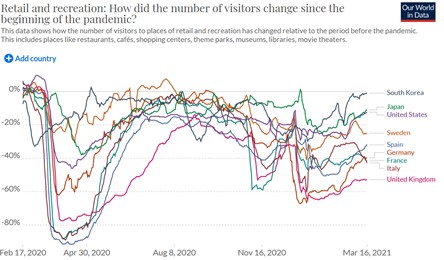 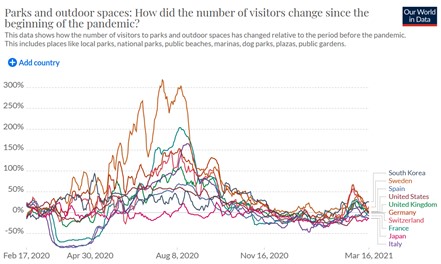   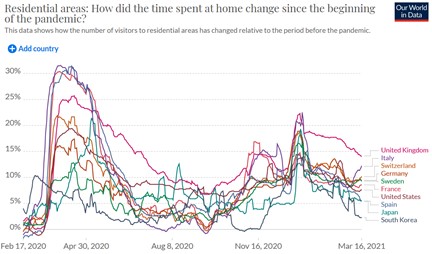 Source: Google COVID-19 Community Mobility Trends. Our World in Data.As strict lockdowns tend to reduce population mobility and business activity more, they also have a more negative impact on economic growth. Organisation for Economic Co-operation and Development data shows that real GDP fell dramatically, by close to 10 percent or above, in France, Italy, Spain, and the UK in 2020. The output growth differential between 2019 and 2020 has been more than double in these countries compared with peers that had higher population mobility (graph 12). At the same time, Korea, Sweden, and Switzerland were the best economic performers during the pandemic while having some of the lightest lockdowns. Graph 12  Source: OECD.Stat.ConclusionThe IMF's claim that mandatory lockdowns and voluntary social distancing played a similar role in driving the economic recession during the pandemic seems mostly unfounded. Available data shows that severe lockdowns reduced population mobility and hampered economic growth more than milder ones. As several studies question also the alleged benefits of lockdowns in suppressing the pandemic, they should be lifted instead of extended or tightened. The main reason to maintain them seems to be the failure of socialized medicine to deal with peaks in the number of covid-19 cases. Yet, it is almost inconceivable that after more than one year since the start of the epidemic some of the world's richest countries cannot ensure sufficient hospital ICU beds and are lagging far behind in terms of vaccinations. In that case, the logical response would be not to expand government intervention further, but to unwind the initial one, i.e., deregulate and privatize healthcare.  This posting includes an audio/video/photo media file: Download Now |

| You are subscribed to email updates from Mises Wire. To stop receiving these emails, you may unsubscribe now. | Email delivery powered by Google |
| Google, 1600 Amphitheatre Parkway, Mountain View, CA 94043, United States | |




No comments:
Post a Comment