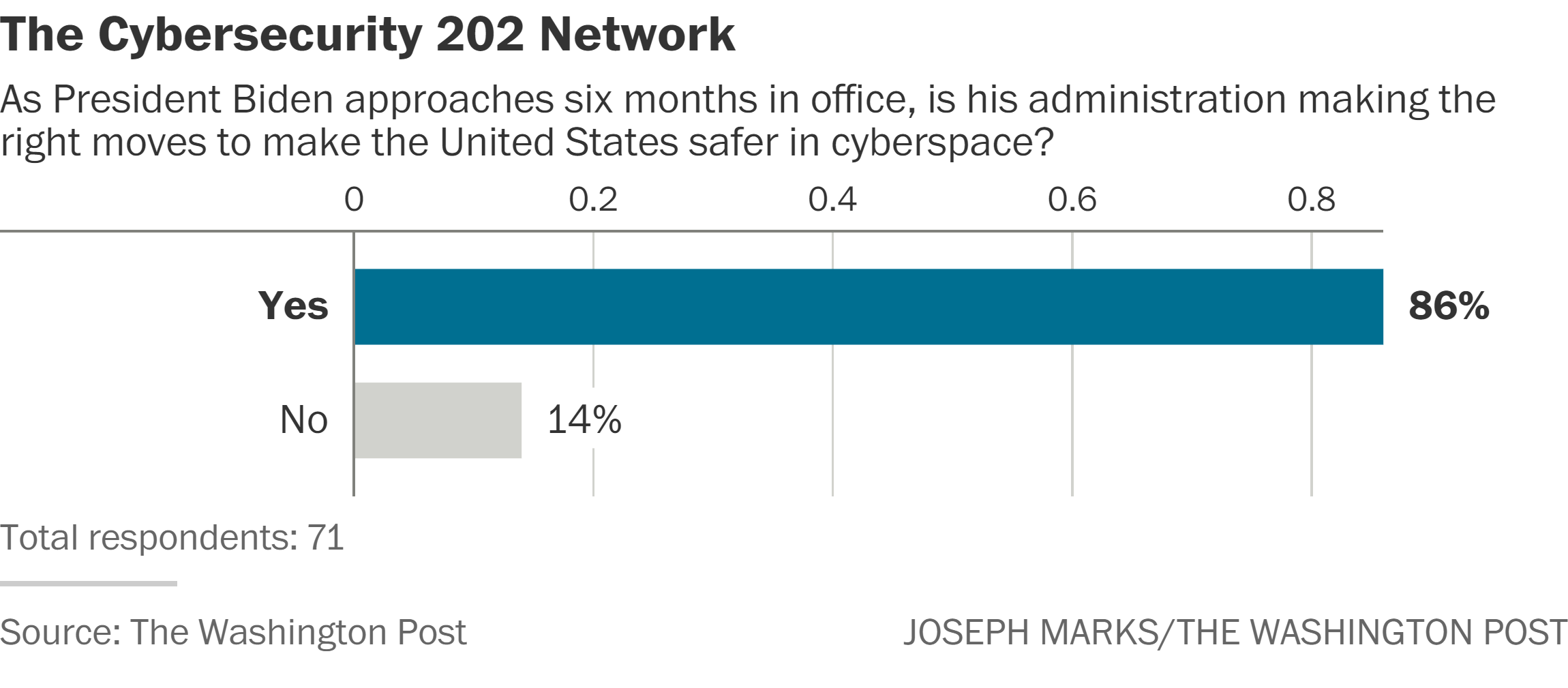
| At his six-month mark in office, President Biden is making the right moves to ensure the United States is safer in cyberspace, according to an overwhelming majority of cybersecurity experts we polled. Biden's term has been marked by a string of cyber cataclysms starting with cleaning up the SolarWinds Russian espionage campaign, which was discovered soon before he took office and affected hundreds of major businesses and several federal agencies. More recently, the nation has been struck by significant ransomware attacks that have threatened U.S. gas and meat supplies and wreaked havoc on small businesses. Biden has effectively managed the day-to-day crises while dealing with longer-range concerns such as getting top cyber officials in place and facing off with Russian President Vladimir Putin over hacking, according to 86 percent of The Cybersecurity 202 Network. "It's hard to imagine an administration moving more aggressively [without being irresponsible] or putting more priority on cybersecurity issues," said Chris Finan, a top White House cyber official during the Obama administration. "[There's] much more to be done, but the administration is off to a strong start in the face of escalating malicious cyber activity," said Suzanne Spaulding, who led Department of Homeland Security cyber operations for President Barack Obama. The network is a panel of more than 100 cybersecurity experts who participate in our ongoing informal survey. (See the full list of experts here). 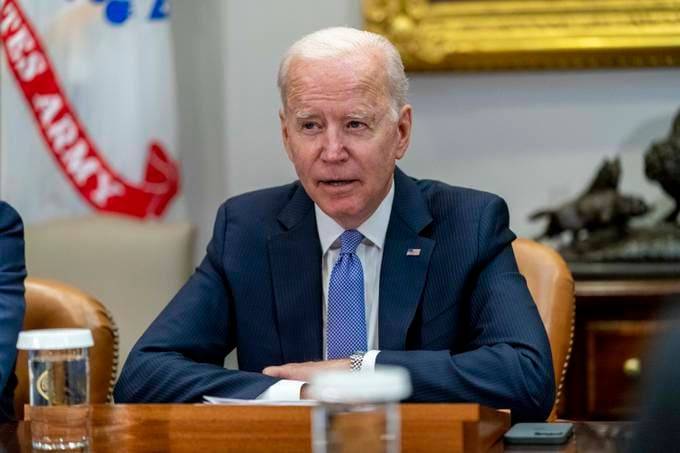 President Biden is getting high marks from experts on his handling of cyber issues. (Andrew Harnik/AP) | Experts praised Biden for taking an aggressive stand against Russian hacking. He pressed Putin on Russia-based ransomware attacks during a summit in Geneva last month and pledged to impose serious consequences if Putin doesn't crack down on the groups. Biden's tough stance with Putin is a "particularly welcome change," said Chris Painter, who was the State Department's top cyber diplomat under Obama. He acknowledged, however, that "holding Russia accountable will be a real test for this administration." "[Biden] has made clear to Russia's president that some cyber actions cross a red line," said Sam Visner, director of the National Cybersecurity Federally Funded Research and Development Center, managed by Mitre. Experts contrasted Biden's tough stance with former president Donald Trump, who was wary of challenging Putin. "Could the administration be doing better than it is now? Yes," said Herb Lin, a senior research scholar at Stanford University's Center for International Security and Cooperation. "But it is doing much better than the previous administration was doing, especially with respect to Russia, where [Trump] was affirmatively downplaying and ignoring the Russian cyber threat." Former National Security Agency general counsel Glenn Gerstell also compared Biden favorably to Trump. "Following an administration that demoted the role of cyber advisers in the White House and mostly ignored pleas from the private sector for more assistance, the Biden administration has made a series of exceptional, cyber-savvy appointments throughout the executive branch," he said. The survey was concluded before the White House publicly accused China's government of hacking into Microsoft email servers and fostering close ties with criminal hackers. 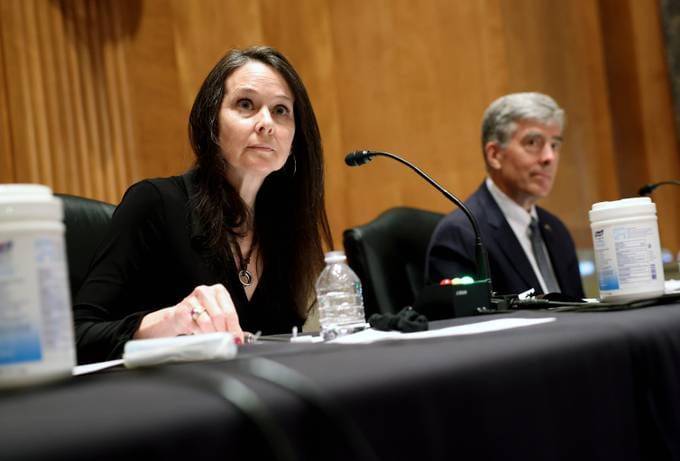 Jen Easterly, director of the Cybersecurity and Infrastructure Security Agency, and national cyber director Chris Inglis at their confirmation hearing. (Kevin Dietsch/Getty Images) | Experts gave Biden strong marks on hiring. His cyber team includes Chris Inglis, a former top NSA official who was recently confirmed as the nation's first national cyber director, and Jen Easterly, another NSA veteran who is leading the Cybersecurity and Infrastructure Security Agency. "President Biden has recruited very talented people to serve in senior administration positions," said Michael Daniel, who led White House cyber operations under Obama. Daniel is now president of the Cyber Threat Alliance industry group. Inglis's position differs from Daniel's because he will manage a far larger office and the post requires Senate confirmation. "Staffing the key, most senior cybersecurity positions [with] qualified and respected leaders is certainly a step in the right direction," said Deborah Plunkett, another former NSA official who runs Plunkett Associates, a cybersecurity consulting firm. The hiring process has not been totally smooth, however. Easterly's Senate confirmation was held up for weeks because Sen. Rick Scott (R-Fla.) placed a hold on top DHS nominees until Vice President Harris visited the U.S.-Mexico border. "President Biden has been seriously hampered by the slow pace at which his top cybersecurity political appointees have been confirmed," Betsy Cooper, director of the Tech Policy Hub at the Aspen Institute, said, adding that "devastating ransomware attacks are continuing apace, with or without political appointees in place." Even as they praised Biden, many experts warned there's a lot more to be done – especially where Russia's concerned. "If Putin continues to turn a blind eye to these criminals, President Biden should use every tool at his disposal to put a stop to these devastating hacks," said Rep. Jim Langevin (D-R.I.), co-founder of the Congressional Cybersecurity Caucus, who has urged a far stronger set of sanctions against Russian businesses that support hacking. "President Biden cannot slow down. He must put every nation-state and cyber-criminal group on notice that those responsible for cyberattacks will be held accountable through all levers of national power," said Marcus Fowler, director of strategic threat at the Darktrace cybersecurity firm and a former CIA official. Cyber could also be better integrated into the administration's other priorities, such as by prioritizing cyber training in jobs and infrastructure efforts, said Megan Stifel, an Obama-era White House official who now works at the Global Cyber Alliance. There were 14 percent of our experts who said Biden wasn't making the right cyber moves. Many of them said he simply hadn't done enough on getting tough with Russia and prioritizing U.S. cyber defense. "The administration's current failure to actually get tough — in a public, substantive way — with the cyber attackers responsible for recent attacks on American and allied infrastructure and to extract costs from the nation-states that support them is limiting our nation's ability to deter further acts," said Jamil Jaffer, vice president for strategy and business development at IronNet Cybersecurity. Jaffer urged punching back harder against those attacks and doing so publicly. "To the extent we do actually respond, we must stop doing it behind closed doors," he said. "Widespread impactful attacks continue to happen to companies around the globe," said Tony Cole, chief technology officer at Attivo Networks. "The United States government and its allies need to hit back against Russia with stiff sanctions to get Putin to sit up and notice." | Share The Cybersecurity 202 |  |  |  | | | 


 Email
Email 







No comments:
Post a Comment