| We might have gotten lucky with the coronavirus pandemic. So says Tom Frieden, the former director for the Centers for Disease Control and Prevention. Frieden now serves as chief executive of Resolve to Save Lives, a global health initiative that recently released a report on some of the world's near misses with potentially devastating epidemics. He told The Health 202 that the world needs to be on its guard for the next pandemic, which could be even worse than the one caused by SARS-CoV-2. Pandemics can be prevented, Frieden argues, but it's going to take serious investment. Frieden has called for a health defense fund that would not be subject to budget ceilings (the Bipartisan Policy Center has also called for isolated, guaranteed infectious-disease funding). Frieden talked about that proposal and more with The Health 202. [This interview has been lightly edited for clarity and length.] H202: The coronavirus pandemic seems like a singular, once-in-a-lifetime event, but the world has had near misses before. Tell me why we should be worried about those. The world identifies about one new pathogen every year. Covid is certainly the most disruptive pandemic in a century. Of course, HIV still has the dubious distinction of having killed more people than covid has so far, so [covid is] not even the deadliest pandemic of our lifetime. There could be a future pandemic that's even more contagious, even deadlier, that's harder to make a vaccine against. One type of scenario that would be very concerning: What would happen if some of the vector-based diseases became deadlier? I think about, for example, tick-borne disease. In the U.S., there are three or four hundred thousand cases of Lyme disease every year. Now, around the world, there are ticks that carry Ebola-like illnesses … What would happen if the ticks in the U.S. were to get infected with an Ebola-like illness, so instead of worrying about Lyme disease you had to worry about something that could cause you to bleed to death? 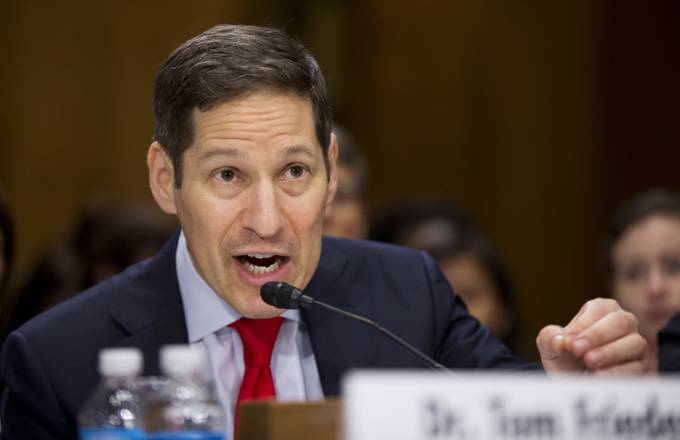 Former CDC director Tom Frieden testifies on Capitol Hill in Washington. (Manuel Balce Ceneta/AP) | H202: So what do we need to do to prevent another pandemic? Fundamentally, microbes outnumber us, and we need to outsmart them. The only way we can do that is by working together and breaking the cycle of panic and neglect. We see this with every emergency. There's panic. Money is spent on public health, and then it goes out of the headlines and the money dries up. That's exactly what happened with Ebola. The main thing we need to do is break the cycle of panic and neglect. And the way to do that, I believe, has to do with the budget. The Bipartisan Policy Center has recently released a report on this, which updates a proposal we made a little over a year ago with bipartisan support that would have allowed for Congress to have a way of funding preparedness that doesn't rob Peter to pay Paul. Because currently what happens is if Congress wants to increase funding for preparedness, they have to cut funding for something like Alzheimer's research or Early Head Start. That's the terrible dilemma. There's a real analogy to after 9/11. After 9/11, a lot of money was spent on strengthening defense systems In the U.S. and globally, and Congress realized that money was going to dry up and there was a real risk the investments would be lost, so they created what was called the Overseas Contingency Operations fund. H202: Are there other reforms to make the CDC and other agencies nimbler, besides increasing budget? Absolutely. One is: We need to understand what went wrong with the lab tests. During my time at CDC, we had H1N1, and we had a lab test within two weeks. We had a million copies of it going out within days. For years after, countries went to thank me for the CDC test. So the stumble of CDC's lab in February [with the release of flawed coronavirus tests] was costly, both in lives and credibility. We need a full and open understanding of what went wrong and an approach to make sure nothing like that can go wrong again. Second is, I think CDC needs to up its game in terms of being well-aligned with state and local health departments, and the way to do that is for them to embed thousands of staff in state and local health departments, who then rotate back into CDC so there's more common vision about what's needed and what works in public health. I also think CDC needs to be more insulated from politics. [But] it's not about CDC only. CDC can only do what Congress funds it to do, and it can only succeed when state, city and local public health are competent. You had a lack of credibility, and then you had a sidelining of public health. I think you have to ask: Was this a failure of public health, or was it a failure to empower public health to succeed? 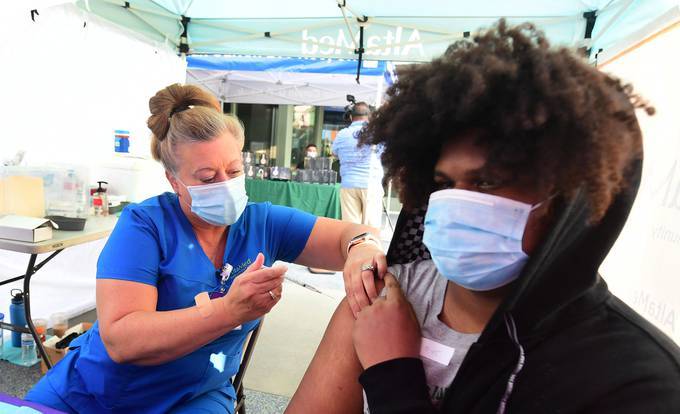 The Pfizer vaccine is administered in Los Angeles, California. (Photo by FREDERIC J. BROWN/AFP via Getty Images) | H202: We've talked about how to prevent a future pandemic. But this pandemic is not over. Here's a stunning fact: More people have died of covid-19 since the vaccine was developed than before the vaccine was developed. H202: What should the Biden administration be doing now? Right now, it needs to be forcing Moderna to do technological transfer so that we can ramp up manufacturing of mRNA vaccines to manufacturing hubs around the world. The math on this is very clear. We are billions of doses short. Billions. So yes, we should share more [doses] now, but even if we share more, it's not going to meet anything like the need. That's even if we don't recommend boosters in the U.S. We've been saying this for a long time. The U.S. taxpayers funded the Moderna technology. Moderna has $12 billion in the bank. They are trying to keep a monopoly on technology that the U.S. taxpayers paid for. H202: How should the debate over the origin of the pandemic inform our thinking about pandemic prevention? In the big picture, we don't know now and we may never know whether the pandemic emerged naturally as SARS-1 in 2003 is believed to and likely did, or from a laboratory accident, as we know has happened in other situations. For example, the last case of smallpox in the world was because of a laboratory error in the United Kingdom. We know that the anthrax attacks in the U.S. likely came out of a laboratory. There's pretty good evidence that an influenza pandemic in the late 1970s emerged from laboratory error either in the Soviet Union or elsewhere. Because of that, I think my belief is we really need to do much better in two ways. We need to do better at assessing laboratory safety and improving it, and second, we need to do better at reducing the risk of spillover events. | 


 Email
Email 





No comments:
Post a Comment