| Did a friend forward this to you? Sign up here. Red beans and rice for Monday night For most of my life, in my mind, New Orleans was a caricature of drunken partying and bead throwing, loud brass bands and ostentatious parades. Then, about 12 years ago, I met my friend Bobby, who is enthusiastic about a lot of things, but often seems most enthusiastic about New Orleans. He isn't from the city, but visits annually for Jazz Fest with a group of pals. Then, he spends the rest of the year talking about the music and, of course, the food. Before my first trip to the Crescent City, for Jazz Fest in 2009, Bobby gave me two pieces of advice: Get a muffaletta sandwich at Central Grocery, and eat red beans and rice on Mondays. Though I'd never been to New Orleans before, from the minute I stepped outside the airport, it felt like home. I lost no time following Bobby's advice, but it wasn't until I read Sara Roahen's "Gumbo Tales: Finding My Place at the New Orleans Table," that I understood how deeply the city cares about its red beans and rice. "Food unites with complete sincerity," Roahen writes in her chapter on the dish. "It harbors no ulterior motives; its power is irreversible. Red beans and rice is my best example." When Roahen moved to New Orleans, she was mystified by the myth of red beans and rice. There's local lore about why neighborhood restaurants only serve this dish on Mondays, and there's a religious-like affection for the ritual. After befriending a local whose red beans and rice have earned him a devoted following, Roahen sees the light. "Rendered pork fat, weeping garlic, collapsing beans. This is the smell of a Monday in New Orleans, the all-day reminder of what you want to be eating ... the smells are braided into your hair, woven among the fibers of your clothing, clinging to your skin. … And then there's the rice, without which the dish wouldn't be complete and Mondays wouldn't smell quite right." The dish is almost as simple as it sounds: Saucy beans, fattened with pork sausage or a ham hock, are infused with the flavors of the holy trinity of Cajun/Creole cooking — onions, bell peppers and celery. There can also be garlic and some cayenne, plus maybe herbs such as bay leaves or thyme. The beans are then served over or under rice — the ratio is up to each diner — and usually topped with scallion greens and parsley. Traditionally, a meal of red beans and rice takes all day to make, because you're supposed to start with dried beans. This version, from New Orleans' native David Guas, chef-owner of Bayou Bakery Coffee Bar and Eatery in Arlington, Va., is done in under an hour, thanks to one major shortcut: using canned beans instead of dried.  | Today's recipe | 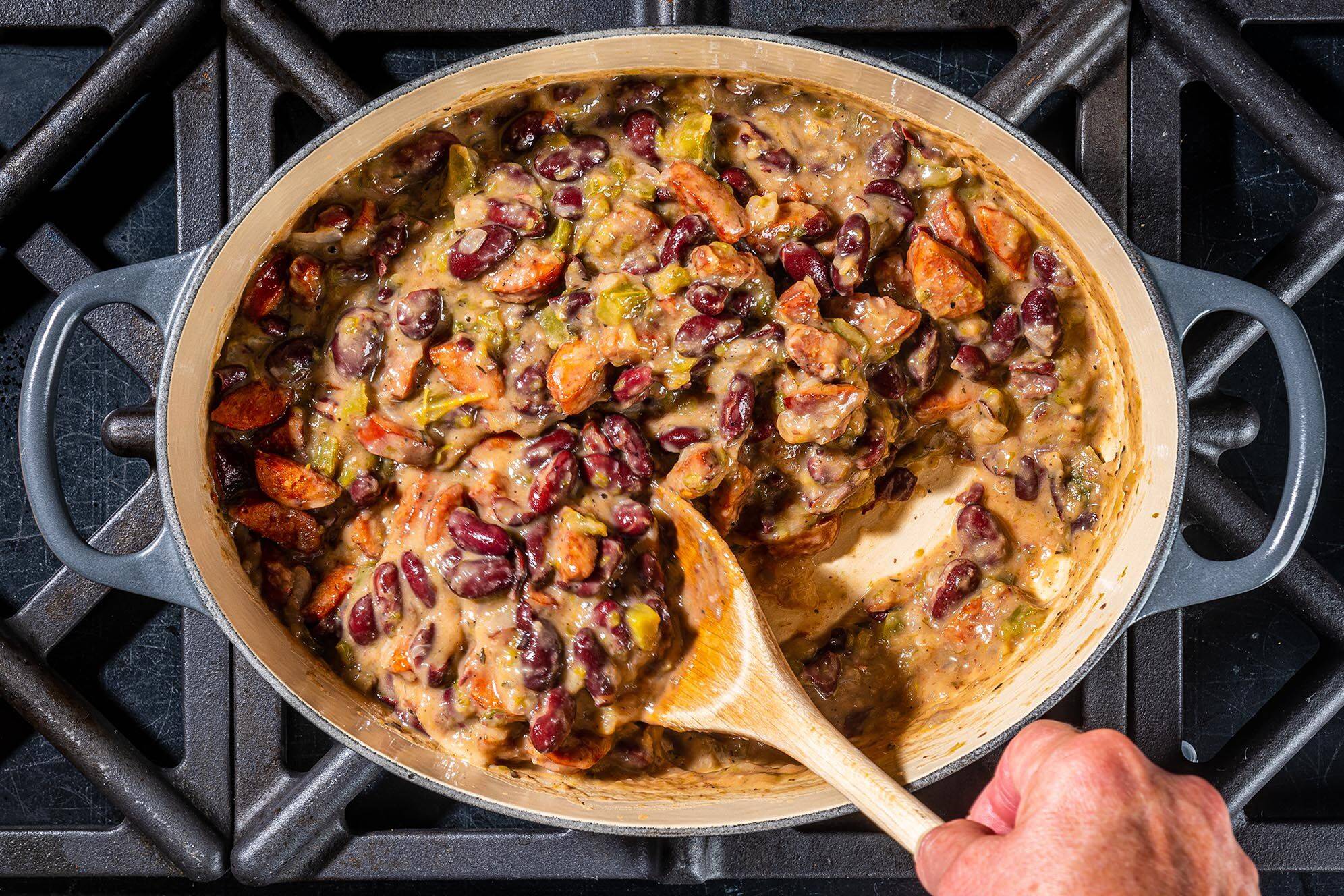 Photos by Rey Lopez for The Washington Post; food styling by Marie Ostrosky for The Washington Post | Red Beans and Rice - In "Gumbo Tales," Roahen writes about what she perceives as a strong preference among cooks for New Orleans' Camelia brand red beans. But she's ultimately proven wrong: Any red beans, from pintos to kidneys, work just fine in this dish.
- To make it vegan, omit the sausage and use vegetable broth instead of chicken.
- If you can't have onions or garlic, use an infused oil, or celery and fennel.
- If you want to use dried beans, cook 1 cup of dried kidney or pinto beans — which will yield the same amount as two 15-ounce cans of beans — before starting this recipe.
Want to save this recipe? View it here and click the bookmark icon below the serving size at the top of the page to add it to your Reading List. For easy printing and scaling, view this recipe in our Recipe Finder. Servings: 2 to 4
Active time: 15 mins
Total time: 45 mins Ingredients - 8 ounces smoked, cooked pork sausage, halved lengthwise and sliced across into 1/4-inch half-moons
- 1 tablespoon canola or vegetable oil
- 1 medium green bell pepper, deseeded and diced
- 1 medium sweet onion (about 8 ounces), diced
- 6 or 7 scallions, chopped (about 1/2 cup)
- 2 cloves garlic, minced or finely grated
- Two (15-ounce) cans no-salt-added kidney beans, drained and rinsed
- 3 cups low-sodium chicken broth
- Leaves from 3 full stems fresh thyme (may substitute 1 teaspoon dried thyme leaves)
- 3 bay leaves
- 1/2 teaspoon freshly ground black pepper
- 1/4 teaspoon ground cayenne pepper
- Leaves from 2 or 3 stems fresh parsley, coarsely chopped, plus more for optional garnish
- 1/2 teaspoon table or fine sea salt, plus more to taste
- Cooked long-grain rice, for serving
- Hot sauce, for serving
Steps1. In a large soup pot or Dutch oven over medium heat, heat the oil until shimmering. Add the sausage and cook, stirring a few times, until some of its fat renders and the sausage browns, 6 to 8 minutes. Using a slotted spoon, transfer the sausage to a plate. 2. Add the bell pepper, onion, scallions and garlic to the pot and stir to coat in the fat. Increase the heat to medium-high and cook, stirring, until just softened, about 2 minutes. Add the beans, broth, thyme, bay leaves and the black and cayenne peppers. Reduce the heat to medium, cover and cook for 25 minutes. 3. Uncover and discard the bay leaves. Using the back of a wooden spoon, mash about a cup's worth of the beans against the side of the pot; this will thicken the mix a bit. 4. Return the reserved sausage to the pot, as soon as it's heated through, turn off the heat and stir in the parsley. Taste, and season with the salt, as desired. Serve hot, with white rice and garnished with additional parsley; pass the hot sauce at the table. From David Guas, chef-owner of Bayou Bakery Coffee Bar and Eatery in Arlington, Va. Tested by Bonnie S. Benwick and Olga Massov. Nutrition information per serving (based on 4): Calories: 320; Total Fat: 18 g; Saturated Fat: 5 g; Cholesterol: 30 mg; Sodium: 530 mg; Carbohydrates: 26 g; Dietary Fiber: 7 g; Sugars: 2 g; Protein: 16 g.  | Dessert | 🎧 "Double Trouble" by Otis Rush.
💬 "To create one's own world takes courage." — Georgia O'Keeffe
📖 Inside one bakery as it prepares for Dia de los Muertos.
👀 These portraits.
🗣 If you liked this newsletter, please forward it to a friend! |



 Email
Email 


No comments:
Post a Comment