| Our lead story this week isn't one piece — it's 12. Whitney Joiner, articles editor for The Washington Post Magazine, and her team just published a remarkable issue. None of the stories were reported by Post journalists, which was exactly the point. In early 2021, during a weekly story meeting, our team began to toss around an idea for a big, ambitious project: a special issue showcasing what's lost when community and regional journalism dries up. We'd read the stories about the closing of local news outlets and the gutting of once-storied newsrooms. We'd read the research findings — that the loss of local journalism leads to a drop in civic engagement and an increase in political polarization within communities. At the time of our meeting, we'd just lived through an election — and an attack on the U.S. Capitol — that starkly highlighted the country's divides. Political polarization was fresh on our minds. I wondered if there was a different way to cover the local news crisis. What if we created a Magazine issue that aimed not to report on the problem, but to show what's lost? To share the stories that might have gone untold or underreported, and to spotlight the local journalists who know those areas best? My colleague Alexa McMahon and I spent the rest of the year conceptualizing and editing what became The Lost Local News issue. We spoke with experts, professors and nonprofit newsrooms doing fantastic work in this space. (We especially relied on the work of Penny Muse Abernathy, a visiting professor at Northwestern who has gathered the most extensive data on American news deserts; she served as an adviser to our issue, and we used her data for our news desert map.) We circulated a detailed call-out for story ideas from local journalists around the country. From the more than 200 pitches we received, we chose the 16 features, photo essays and stand-alone illustrations that make up The Lost Local News issue. Every story originates in a news desert and was written and photographed by journalists who lived in or near where the pieces take place. We paid all of the contributors as freelance journalists and you can read any story for free if you register for a washingtonpost.com account. While accountability and investigative pieces are vital to a community's well-being, so are the quirky human-interest stories and local controversies, and we wanted to reflect that in a diverse editorial mix: a deep dive into a New Mexico judge's radical approach to addressing addiction; a photo-driven feature on an Alaskan Indigenous school threatened by erosion; a Facebook post that led to a school board saga in Colorado. I've lived in towns with strong local journalism: my old home of Marfa, Tex., (pop. 1,831) has an award-winning weekly, The Big Bend Sentinel, and an award-winning NPR affiliate, Marfa Public Radio. During the pandemic I've been in Taos, N.M., (pop. 6,474) where the weekly Taos News has repeatedly been named the U.S.'s "Best Weekly Newspaper" by the National Newspaper Association. I've seen how these local news outlets knit together their communities, providing a sense of connection and a shared sense of cultural identity. That's what comes through in each of the pieces in our special issue. In every story there's a strong sense of place, of the struggles and triumphs and personalities that make that community unique, whether it's a grizzly bear murder mystery in Idaho or a controversy over dusty roads in Utah. Those losses might not be as obvious when we talk about the local news crisis. But they speak to how a community news outlet can be a vital part of the soul of a place — how it can offer some sense of unity.  (From left: Natalie Behring; Chris Caldwell; Rebecca Kiger for The Post) Since 2005, about 2,200 local newspapers across America have closed. Here are some of the stories in danger of being lost — as told by local journalists. From the Magazine ● By Washington Post Staff ● Read more » |    | | | | Grizzlies are protected under federal law. So when three were killed in an Idaho community, it didn't seem like a coincidence. From the Magazine ● By Natalie Schachar ● Read more » | | | | | Kirk Shipley, the rowing coach at Walt Whitman High in Bethesda, Md., held onto his job through two investigations into his behavior. Then he was arrested. Exclusive ● By Lizzie Johnson ● Read more » | | | | According to an analysis of almost 100,000 bird interactions, big birds like crows are the kings and queens of the feeder, but scrappy mockingbirds and woodpeckers punch above their weight. Doves do not. Analysis ● By Andrew Van Dam and Alyssa Fowers ● Read more » | | | | | Chief Justice John G. Roberts Jr. holds the reins but is no longer firmly in control of his horses. Some of his most conservative justices are champing at the bit. The Opinions Essay ● By Ruth Marcus ● Read more » | | | | Mississippi Attorney General Lynn Fitch believes abortion bans empower women. She's taking that argument to the Supreme Court. The Lily ● By Caroline Kitchener ● Read more » | | | | |  (The Washington Post) Amazon's use of Alexa as a wake word for its voice assistant turned the name into a command, impacting daily interactions for people with the name, myself included. Perspective ● By Alexa Juliana Ard ● Read more » | | | | | | Preparing for a long haul with the virus may help ease the anxiety of covid's ebbs and surges. By Alex Baumhardt, Jack Douglas, Kayla Ruble and Lenny Bernstein ● Read more » | | | | | | For another holiday season, many Americans are trying to find ways to safely celebrate. While there's no one-size-fits-all solution, a group of epidemiologists, infectious disease experts and physicians from across the country offer some advice. By Deborah Lynn Blumberg ● Read more » | | | | | 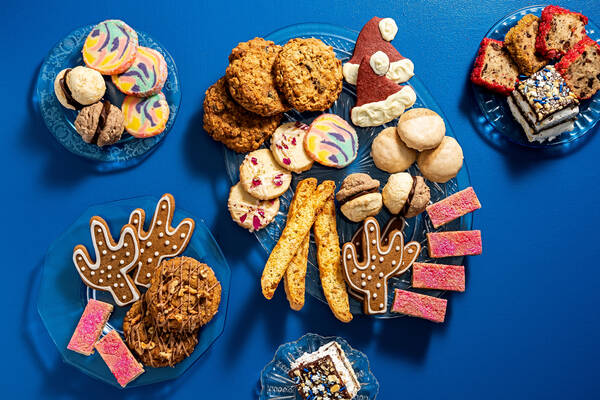 (Scott Suchman for The Washington Post) This year's holiday cookie recipes feature sparkles, sprinkles, fruit, spice and everything nice. By Becky Krystal ● Read more » | | | | | |





 Email
Email 



No comments:
Post a Comment