| Good morning. There's so much news this week that it's almost like we're seeing 2020 again. Below: The Supreme Court appears inclined to uphold Mississippi's 15-week abortion ban, and President Trump tested positive for coronavirus days before debating Biden. But first: | The administration has released a winter-and-omicron-focused pandemic plan | 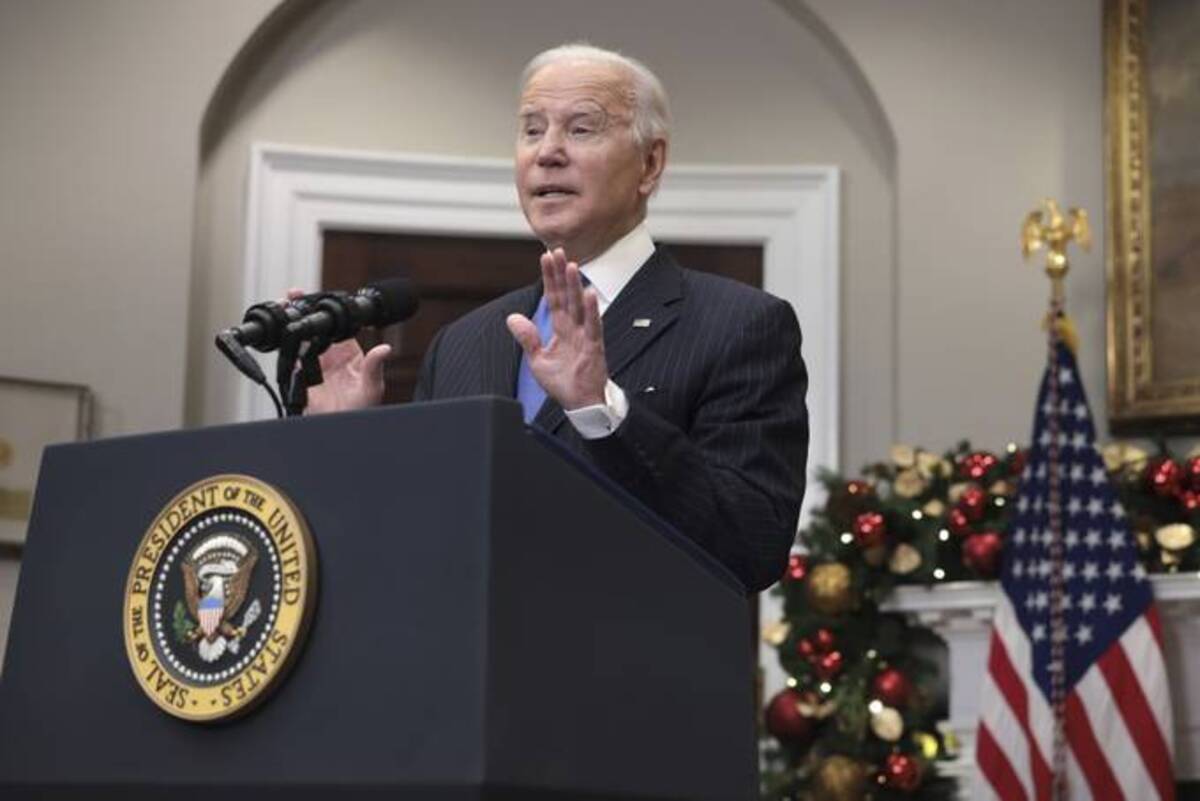 Biden speaks about the omicron variant on Monday. (Anna Moneymaker/San Francisco Chronicle via AP) | | | The Biden administration unveiled a nine-pronged plan to fight the coronavirus this winter as it grapples with the threat of a new variant. The strategy released early this morning includes requiring private insurers to reimburse Americans for buying rapid at-home coronavirus tests, tightening testing requirements for travelers arriving in the U.S. and launching campaigns to encourage Americans to get their booster shots. The new strategy comes less than 24 hours after the United States detected its first case of the variant in a San Francisco resident who recently returned from South Africa. Researchers are racing to answer a slew of unknown questions over omicron's transmissibility, severity and whether it evades existing vaccines. Ending the pandemic is key to Biden's political fortunes. He came into office pledging to get the coronavirus under control. On July Fourth, Biden said the country was "closer than ever" to declaring independence from the virus — only to see a surge of cases from the infectious delta variant weeks later. | - On tap today: Biden will formally unveil the plan in a speech at the National Institutes of Health — part of a broader effort to reassure Americans his administration can rein in the virus regardless of the new variant, our colleagues Dan Diamond, Lena H. Sun and Tyler Pager report.
| | The winter plan builds on a requirement that insurers cover coronavirus tests in doctors' offices, pharmacies and clinics. The Biden administration will soon mandate insurers reimburse Americans with private coverage for purchasing at-home tests, as public health experts have called for greater access to this critical public health tool. | | The timeline: The administration is directing three federal departments to issue the guidance by Jan. 15. But it doesn't apply to those who get their health coverage through public programs, like Medicare or Medicaid, or the uninsured. Instead, the administration is doubling the number of at-home tests it's sending to places like health centers and rural clinics to 50 million, a senior administration official emphasized on a call with reporters. | Beefing up travel protocols | | By early next week, the United States will require all international travelers to test within one day of departure, regardless of vaccination status. Previously, vaccinated passengers had to show a negative test within three days of travel. Biden is also extending a requirement for travelers to wear masks on airplanes, trains and public transportation until March 18. (The requirement was set to expire in January.) Per our colleagues, some health experts have called for a greater emphasis on domestic travel, such as Celine Gounder, an epidemiologist and infectious-diseases specialist who advised the Biden administration's transition team on its coronavirus response. | | In recent days, federal health officials have ratcheted up their calls for all Americans to get their booster shots, believing the extra shot adds an extra layer of protection against omicron. The strategy released this morning is consistent with that messaging. | - The Department of Health and Human Services is slated to launch a new public education campaign to encourage adults — particularly seniors — to get booster shots.
- The administration is also targeting outreach to Medicare beneficiaries and pharmacies will conduct outreach campaigns.
- New family vaccinations clinics will administer shots to kids, as well as boosters to adults.
| | |  | In the courts | | | A potentially seismic shift: In nearly two hours of oral arguments yesterday, the Supreme Court signaled a willingness to uphold a Mississippi law banning most abortions after 15 weeks. Such a move could begin to curtail abortions across the country, particularly in Republican-leaning states. | - But what about Roe v. Wade? The 1973 landmark decision declared a woman's constitutional right to terminate her pregnancy up until the point of viability, roughly estimated as between 22 and 24 weeks.
- It's unclear if the justices will overrule Roe entirely or just stop at 15 weeks. Yet, none of the six conservative justices expressed support for maintaining its rule that states can't ban abortion before the point of fetal viability, our colleague Robert Barnes writes.
- Liberal justices say don't do it. They argued such a dismantling would damage the reputation of the high court, with Justice Sonia Sotomayor asking, "If people believe that it's all political, how will we survive? How will the court survive?
| | John McCormack, National Review | 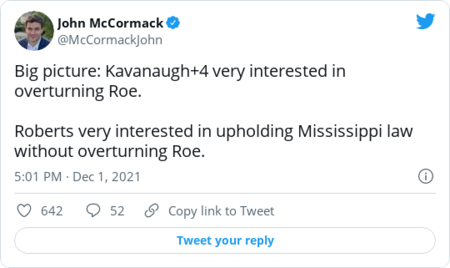 | | | | | All eyes were on Chief Justice John Roberts. He's partial to more incremental steps, instead of a dramatic rewriting of precedent, and seemed inclined to allow Mississippi's law to go into effect. The 15-week limit wasn't a "dramatic departure" from viability, Roberts said. | - "Viability, it seems to me, doesn't have anything to do with choice. But, if it really is an issue about choice, why is 15 weeks not enough time?" he asked.
| | The viability framework was a central question in the case. And the justices and lawyers clashed over it throughout the hearing, Ariana Eunjung Cha and your host report. | - Justice Samuel Alito summed up the argument for dismantling the viability framework, saying the fetus "has an interest in having a life" and asking "that doesn't change, does it, from the point before viability to the point after viability?"
- The other side contends viability provides a cutoff to the contentious issue of when to allow abortions — and one that has been legal precedent for nearly five decades.
- "I don't think there's any line that could be more principled than viability," U.S. Solicitor General Elizabeth Prelogar, representing the Biden administration, said in response to a question about an alternative marker from Justice Neil Gorsuch.
| | Mary Ziegler, abortion law expert at Florida State University | 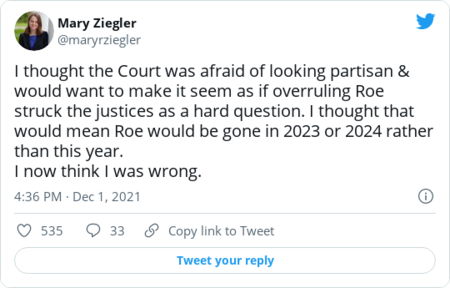 | | | | | What happens next? The Supreme Court's decision isn't expected until next summer. But on Capitol Hill, Democrats are already vowing to fight. | - Senate Majority Leader Chuck Schumer pledged to bring a bill aimed at guaranteeing abortion access, known as the Women's Health Protection Act, to a vote on the Senate floor.
- The legislation passed the House without any GOP support back in September. It faces an uphill battle in the Senate, where 10 Republicans would need to join all Democrats to pass the legislation. At least one Republican senator, Susan Collins (R-Maine), supports codifying Roe, but favors a more limited measure, per NBC's Sahil Kapur.
- Democrats also immediately signaled they'd make abortion rights a central issue in next year's midterm elections. Meanwhile, Republicans want to keep the focus on issues facing Biden, like inflation, The Post's Sean Sullivan and Seung Min Kim report.
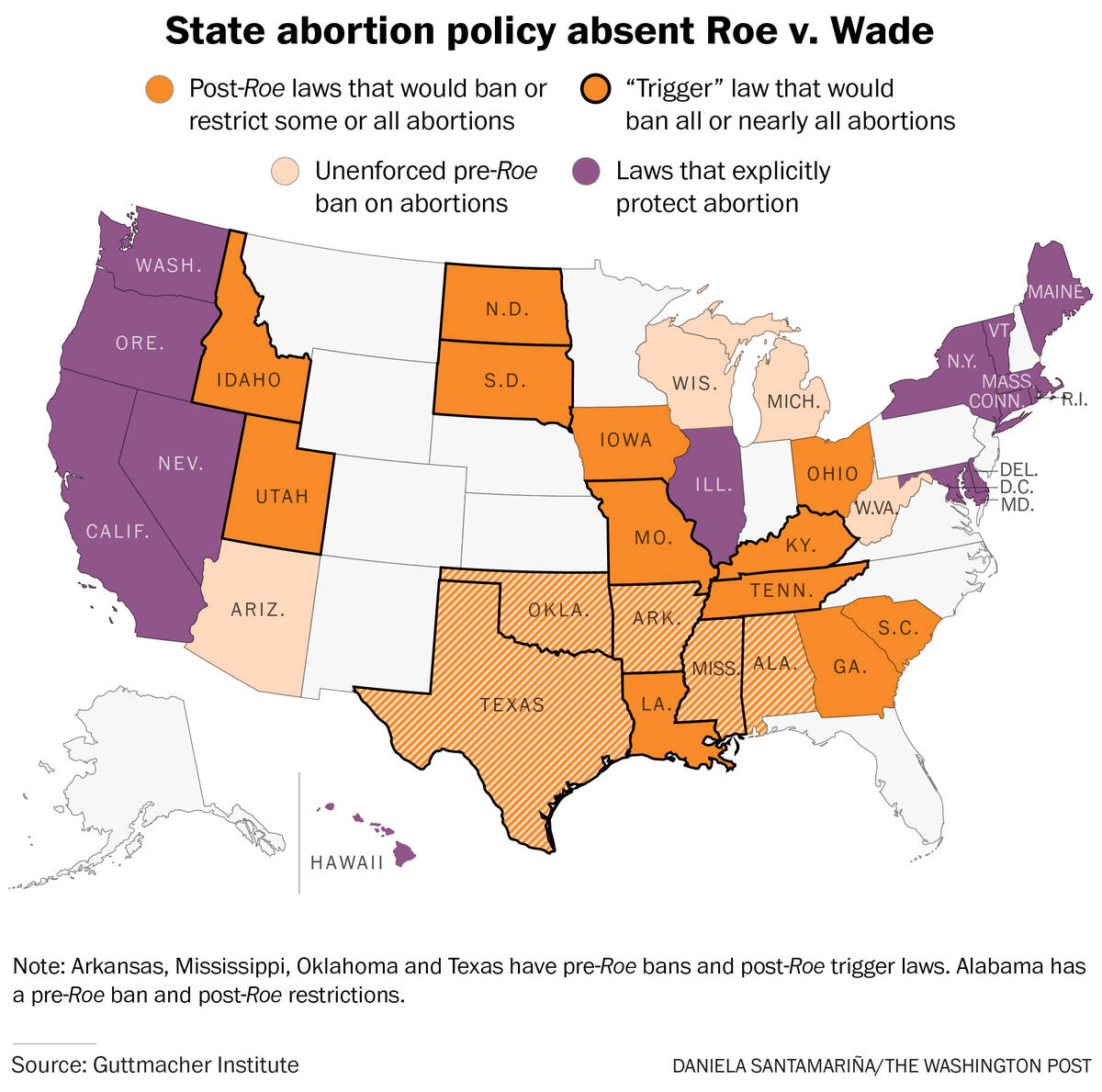
| | |  | Chart check | | What happens if Roe is overturned | | If Roe v. Wade is overturned, 21 states would ban or severely restrict abortion access, according to data from the Guttmacher Institute, an organization that supports abortion rights. Nine states have pre-Roe bans that could become enforceable again in a post-Roe America, while 12 have passed so-called "trigger laws" — bans that would go into effect if the precedent is overturned, The Post's Daniela Santamariña reports. | | |  | Coronavirus | | | President Donald Trump tested positive for the coronavirus days before his first debate with Biden Trump's positive test for the virus was just three days before the Sept. 29, 2020, presidential debate and six days before he was hospitalized for covid-19 at Walter Reed National Military Medical Center, according to an account by former White House chief of staff Mark Meadows in a new book obtained by The Guardian. Two others familiar with the president's test confirmed the account to The Post. After the first test came up positive, the White House appeared to rerun the same sample with one of Abbott's Binax rapid antigen tests, which produced a negative result. In a statement yesterday, Trump denied Meadows's account, calling it "Fake News." | Most vaccinated adults plan to get a booster | | A new poll from the Kaiser Family Foundation finds that nearly a quarter of vaccinated Americans have already received a booster shot, up sharply from October when only 10 percent of Americans had received a booster dose. | - More than half of vaccinated Americans say they have not yet gotten a booster shot but will "definitely" or "probably" do so. Only 1 in 5 say that they probably or definitely will not get a booster dose.
- The survey also looked at Americans' experience with vaccine mandates, finding that over a third of workers (36 percent) at large firms are already required to get the shot. An additional 17 percent of Americans at workplaces with more than 100 employees want their employer to impose a mandate, while 41 percent of workers oppose it.
| | |  | From our reporters' notebooks | | Gavi chair talks about lessons learned | | José Manuel Barroso, chair of the global vaccine alliance, said that "many problems" have hindered the initial ambitious goals behind Covax, the Gavi-backed global alliance intended to provide equitable distribution of coronavirus vaccines. | - "There has been bad behavior from some of the players in the system," Barroso said in a "Washington Post Live" interview yesterday with our colleague Dan Diamond, citing export restrictions on some vaccine supplies, excessive stockpiling of doses by wealthy nations and lack of manufacturing transparency among the factors that have slowed global distribution of shots.
| | Covax has shipped 586 million vaccine doses so far, Barroso said — well off the alliance's original target of delivering 2 billion doses by the end of 2021, and leading to frustrations among international officials that Covax over-promised and under-delivered. Pressed to grade Covax's performance, Barroso — a university professor — said he would give the global vaccine alliance "14 to 15" out of a total score of 20. | - "Looking retrospectively, probably yes, it was too ambitious, or probably a little bit naive, because we were thinking that everybody will play multilateral," he admitted.
| | |  | In other news | | | Shutdown watch: The U.S. government is on the brink of a potential shutdown as a group of Republican lawmakers have threatened to hold up a funding bill over the Biden administration's vaccine and testing mandates, The Post's Tony Romm, Mike DeBonis and Seung Min Kim report. The emerging conservative campaign has divided GOP lawmakers and enraged congressional Democrats, as it threatens to unravel days of delicate bipartisan talks. The current federal spending agreement is set to expire Friday at midnight. Hacked: Planned Parenthood Los Angeles says a hacker gained access to the personal information of about 400,000 patients in October. The breach is confined to that affiliate, and there's no indication at this point that the information was "used for fraudulent purposes," our Cybersecurity 202 pals Aaron Schaffer and Joseph Marks — along with Hannah Knowles — scooped yesterday. | | |  | More health reads | | By Carl Zimmer and Jonathan Corum | The New York Times ● Read more » | | | | | |  | Sugar rush | | | Thanks for reading! See y'all tomorrow. | |






No comments:
Post a Comment