| Welcome to The Technology 202! Happy Social Media Day to all those who observe. Send tips to: cristiano.lima@washpost.com. Below: President Biden is working on a letter to the FTC about post-Roe privacy protections, and the trackers on Planned Parenthood's website are raising concerns. | Sen. Cantwell's elusive endorsement puzzles privacy talks | 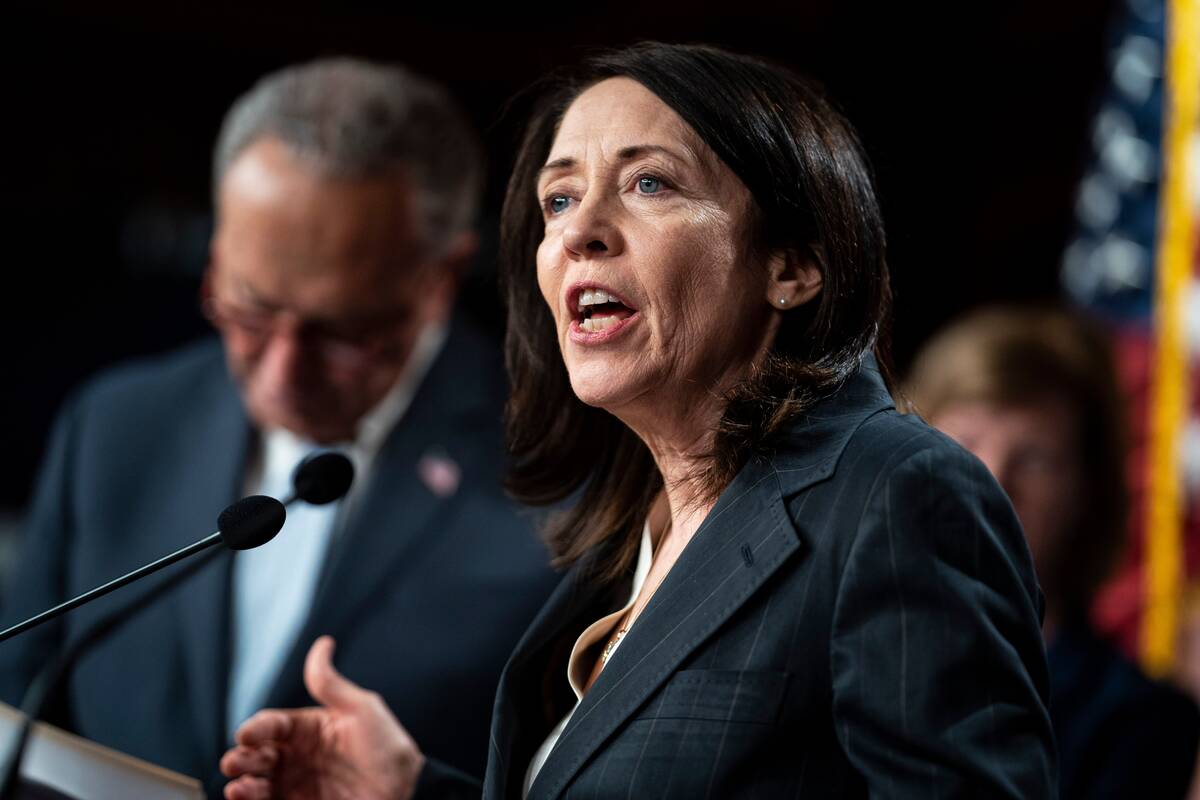 Sen. Maria Cantwell (D-Wash.) chairs the powerful Senate Commerce Committee. (Jabin Botsford/The Washington Post) | | | Early this year, Sens. Richard Blumenthal (D-Conn.) and Marsha Blackburn (R-Tenn.) struck a deal on a bipartisan data privacy bill aimed at breaking the years-long impasse on passing a federal law — earning the blessing of a top Republican. But the proposal was rebuffed at the time by Senate Commerce Chairwoman Maria Cantwell (D-Wash.), who declined to take it up, according to four people familiar with the negotiations, who spoke on the condition of anonymity to discuss the private talks. The response stymied what was otherwise seen as one of the most viable privacy proposals in years, the people said. Now, Cantwell has grown critical of another major privacy effort negotiated by a trio of top lawmakers, threatening its chances of passage. Meanwhile, her own attempts to advance a long-sought privacy bill are facing external push back. Civil society groups, including privacy and civil rights advocates, have expressed strong reservations to lawmakers about key provisions in a recently circulated version of Cantwell's proposal, the Consumer Online Privacy Rights Act, according to multiple people. Chief among them: a clause that would restrict consumers' ability to bring class-action lawsuits against companies that allegedly have caused "substantial harm." The wrinkle is seen as a potential "poison pill" measure that could hurt the bill's prospects of garnering bipartisan support, two of the people said. The provision was absent from a draft of the proposal that leaked after circulating in late May, but was included in a separate, expanded version circulated more recently, according to two copies reviewed by The Technology 202. Its addition could further muddle the increasingly contentious debate around data privacy, which has been bogged down for years amid partisan disagreements. | | | | | | | | Meta is helping build the metaverse aviation so mechanics will be able to practice servicing different jet engines – preparing them for any complex job.
The result: A more skilled workforce.
| | | |  | | | | | "They have not engaged Cantwell's team on those concerns, and we'd be happy to have that discussion," Tricia Enright, a spokesperson for Cantwell, said of the criticisms. As chair of Senate Commerce, the committee with primary jurisdiction over data privacy, Cantwell plays a major role in determining the fate of any proposal. Cantwell controls what bills get marked up by the committee — a hurdle that proposals typically must clear before being considered by the full Senate. To date, her panel has yet to take up any major privacy bill, including her own bill and the bicameral bill led by Sen. Roger Wicker (Miss.) and Reps. Frank Pallone Jr. (D-N.J.) and Cathy McMorris Rodgers (R-Wash.), the top Republican on her panel and the chair and ranking member on the counterpart House Energy & Commerce Committee, respectively. Wicker had also been supportive of Blumenthal and Blackburn's framework, three of the people said, but the bill has yet to be formally introduced. Spokespeople for Wicker did not return a request for comment. Spokespeople for Blumenthal and Blackburn declined to comment. Cantwell has cited concerns that her colleagues' proposals lack teeth when it comes to their enforcement mechanisms. In a blunt rebuke, Cantwell said the bill from Wicker, Pallone and McMorris Rodgers has "major enforcement holes" and that she was not close to backing it. Cantwell has criticized a provision in the bill delaying when consumers can file their own lawsuits. The remarks drew blowback from activists including Evan Greer, director of the progressive advocacy group Fight for the Future: | | Last week, a House subcommittee unanimously advanced that bill, the American Data Privacy and Protection Act, marking the most significant development in efforts to pass a law to date. | | Cantwell's office declined to speak to discussions between her and other lawmakers. But a committee aide to the senator, who was not authorized to speak on the record, said that they had concerns that the proposal from Blumenthal and Blackburn, reviewed by The Technology 202, lacked adequate protections against companies pushing consumers into forced arbitration — limiting the number of claims that make their way to court. The aide pushed back on criticisms of the class action language in Cantwell's bill, which they called a narrow carve out that would not affect most of its protections. The concerns from civil society groups, however, highlight that some advocates see weaknesses in Cantwell's approach to privacy enforcement, too. Lawmakers on Cantwell's panel are also pushing to advance legislation that would boost protections for children online, headlined by a separate bill from Blumenthal and Blackburn, the Kids Online Safety Act. But the bill has languished since its introduction in February. Cantwell had told Blumenthal that the committee would mark up the proposal, according to four of the people, but the panel has yet to take it up. Cantwell has publicly talked about wanting to hold a markup next month after the July Fourth recess, but it's unclear what will be on the agenda. | | |  | Our top tabs | | Biden plans to send FTC letter calling for post-Roe privacy protection |  It comes amid concerns that law enforcement agencies could seek data from reproductive apps (Demetrius Freeman/The Washington Post) | | | Biden will ask the Federal Trade Commission to protect privacy in the wake of the Supreme Court's overturning of Roe v. Wade, Axios's Sophia Cai reports. It comes amid growing fears that law enforcement agencies could seek data on people seeking abortions. "In a letter to be sent as early as this week, Biden will say the FTC should not tolerate unfair or deceptive practices related to reporting, surveillance, sharing or sale of personal information — including sensitive health-related information — in any state," Cai writes. "It's part of a broader request to the FTC asking the agency to use tools at its disposal to ensure women's privacy is protected when they seek information or disclose personal data related to reproductive health care." | Planned Parenthood's marketing trackers raise privacy concerns after Supreme Court decision |  Planned Parenthood says it uses trackers for marketing purposes (Jae C. Hong/AP) | | | Planned Parenthood's online scheduling tool gives it the ability to share patients' location — and, sometimes, the type of abortion they selected — with major tech companies, my colleague Tatum Hunter reports. That could raise privacy concerns as around 20 states ban or prepare to ban abortion in the wake of the Supreme Court ruling overturning Roe v. Wade. The state bans passed so far would allow abortion providers — not patients themselves — to be prosecuted. Third-party tracking is ubiquitous online, and many organizations including nonprofits like Planned Parenthood have long collected such data, according to The Markup. Yet in this new era of state abortion bans, law enforcement agencies could turn to digital data to gather evidence of crimes. Tech companies still haven't said what they'll do in such a situation and employees are getting frustrated, my colleagues report. The Planned Parenthood scheduler can share information with Google, Facebook, TikTok and tracking tool Hotjar, according to an investigation by Lockdown Privacy, which makes an app that blocks online tracking. Planned Parenthood uses trackers for marketing, spokeswoman Lauren Kokum said. She didn't respond when asked if Planned Parenthood plans to remove the trackers given new state abortion bans, or why the trackers are even running on the scheduling page. | Consumer groups call on FTC to investigate Google "dark pattern" |  European consumer groups also notified regulators and warned the company (Krisztian Bocsi/Bloomberg News) | | | Ten groups are calling on the Federal Trade Commission to investigate the process for creating a Google account to "ensure that U.S. consumer privacy rights are protected," according to a letter that the groups sent to the commission. The groups contend that when users create Google accounts and try to opt-in to the company's privacy settings, they must go through a "five-step process with at least ten clicks that requires the user to wade through a series of unclear, misleading, and incomplete information." This, according to the groups, is a "violation of Google's obligation to refrain from unfair practices" and "should be investigated" by the FTC. European consumer groups, meanwhile, said that Google could be violating European privacy law, Bloomberg's Stephanie Bodoni reports. The groups say Google is ignoring European privacy regulations and that people have to deal with "unclear, incomplete, and misleading" information when they try to enable privacy options when they sign up for Google accounts, according to consumer group BEUC. Groups in three European countries told authorities about Google's practices, while groups in five countries sent warning letters, a potential first step before suing, BEUC said. Google spokesperson Peter Schottenfels said in a statement that they give account creators different options "to help people make choices on their terms." The options it gives "are clearly labeled and designed to be simple to understand," Schottenfels said. | | |  | Inside the industry | | | |  | Workforce report | | | |  | Agency scanner | | | |  | Trending | | | |  | Daybook | | - CSIS hosts an event on antitrust legislation today at 10 a.m.
| | |  | Before you log off | | | That's all for today — thank you so much for joining us! Make sure to tell others to subscribe to The Technology 202 here. Get in touch with tips, feedback or greetings on Twitter or email. | |





No comments:
Post a Comment