| TGIF, readers. Now that Congress has recessed for the summer, we're following suit (sort of) with a three-days-a-week publishing schedule in August. We'll see you back here on Tuesday. Not a subscriber? Sign up here. Below: The Senate has passed a Pentagon policy bill, teeing up a partisan clash with House over abortion access. The Biden administration announces a precision cancer surgery initiative. But first: | A look at how the Medicaid unwinding is going |  Kristin and Ryan Forner lost Medicaid in April and are trying to get back on. (Andrea Morales for The Washington Post) | | | The notice arrived in an envelope stamped "important information," telling Kristin Fortner she needed to prove that she and her husband still deserved Medicaid. She filled out the form within a week of receiving it this past winter and mailed it back. So she was perplexed by a phone call almost three months later from the Arkansas Department of Human Services alerting her that she had neglected to renew the couple's Medicaid and, unless she sent the paperwork, their health insurance would end. Fortner quickly resubmitted the same form, this time in person. Except Arkansas already had cut them off. She is among nearly 4 million Americans who have been lopped off Medicaid since the end of a pandemic-era promise that people with the safety-net health coverage could keep it, requiring every state to begin a herculean undertaking of sorting out who still belonged on the rolls. The 3.8 million is an undercount, reflecting only people who have lost coverage so far in 37 states that have voluntarily made public their data from this sorting process, known as the Medicaid unwinding. Most of those people have been dropped from Medicaid for reasons unrelated to whether they actually are eligible for the coverage. Three-fourths have been removed because of bureaucratic factors, according to the compilation by KFF, a health-policy organization. Such "procedural" cutoffs — prompted by renewal notices not arriving at the right addresses, beneficiaries not understanding the notices, or an assortment of state agencies' mistakes and logjams — were a peril against which federal health officials had cautioned for many months as they coached states in advance on how best to carry out the unwinding. Fortner's experience attests to the bureaucratic maze ensnaring some people — and the damage being done to their well-being. The Arkansas Medicaid agency, one of the nation's first to launch the unwinding, has repeatedly insisted that Fortner needs to provide different documents. Her husband, Ryan, has stopped making physical therapy appointments for a herniated disk. Fortner felt like she was going through withdrawal when she skipped Suboxone, a medication that helps her stay off opioids, for two weeks, and now, after paying for a partial order with a drug discount card, stretches the supply by cutting the pills in half. Beneficiaries typically must renew Medicaid every year, but that stopped in 2020 when the coronavirus arrived. With no one leaving the program, the number of Americans on Medicaid swelled to 85 million by this April, when the unwinding began in phases with five states starting to terminate people. By July, every state except one had started removing some people from the program. Oregon will begin removing people in the fall. The government wants states to spread the undertaking over a year, although a few have chosen to do it faster — none more rapidly than Arkansas. | | Health and Human Services Secretary Xavier Becerra has made clear his displeasure with the high rates at which low-income people are being severed from Medicaid without knowing whether they still qualify. | | | | | | | | Prescriptions are too expensive and managing your care can be complicated. We're finding ways to make it better ever step along the way. Learn how we're working to "Optumize" pharmacy care. | | | |  | | | | - "[I]t is critically important to ensure that individuals do not lose coverage due solely to administrative processes," Becerra admonished in a June letter to the nation's governors in which he urged states to improve their renewal methods.
| | Some health-policy advocates and Democrats on Capitol Hill contend that HHS is partly to blame, saying federal health officials should exert a heavier hand with states that have been performing poorly. "They have to be more assertive," said Rep. Frank Pallone Jr. (N.J.), the ranking Democrat on the House Energy and Commerce Committee, which oversees Medicaid. Pallone said in an interview that the Centers for Medicare and Medicaid Services (CMS) should explore whether some Republican-led states are deliberately winnowing their Medicaid rolls so they will have fewer low-income people to insure. Last year, Congress gave CMS the power to order states to draft plans to correct the problem and pause removing beneficiaries for procedural reasons — and to fine states that persist in mishandling cases. During the unwinding's first few months, CMS refused to disclose how many states were violating federal guidelines and how often federal officials were intervening. In recent days, the agency has pivoted, portraying itself as stepping in when it discovers that a state is performing badly. According to Daniel Tsai, CMS's Medicaid director, the agency has ordered a half-dozen states he did not identify to pause the removal of people for paperwork reasons and to reinstate some whose coverage had been denied — up to tens of thousands of people, depending on the state. The agency is conferring with about a dozen other states regarding potential violations. Tsai said some states are failing to follow a federal requirement that they rely on when possible on electronic data — such as wage records from food stamps or other benefits programs — to check people's eligibility automatically and avoid the burden of renewal notices. "Make no mistake, where we have found problems or violations of federal requirements, we are taking action to ensure that states correct the issue immediately," CMS Administrator Chiquita Brooks-LaSure said during a recent news briefing. CMS has been collecting states' unwinding data monthly but does not plan to release its first state-by-state snapshot until the end of July, saying federal officials have needed time to check the accuracy of that data. Along with how many people were cut off during the first months and why, the snapshots are expected to show how many of those declared ineligible because they earn too much to qualify for Medicaid have been referred to Affordable Care Act insurance marketplaces — the path the Biden administration hopes will help people move onto subsidized private health plans. Many health-care advocates say CMS should have been providing this unwinding picture sooner. | | Still, the data compiled by KFF and separate tracking of 20 states by Georgetown University's Center for Children and Families show considerable variation in how many people have been cut off — and the rate at which people lose coverage for paperwork reasons. Michigan and Pennsylvania are doing comparatively well, with most beneficiaries who have come up for renewal remaining on Medicaid. The KFF and Georgetown tallies show that, in both states, 3 in 5 cases removed from the rolls were dropped because of ineligibility. Florida has severed the second-most people — after Texas — at slightly more than 300,000, two-thirds for procedural reasons. You can read the rest of Amy's report here. | | |  | On the Hill | | Senate passes Pentagon policy bill, teeing up partisan clash with House | 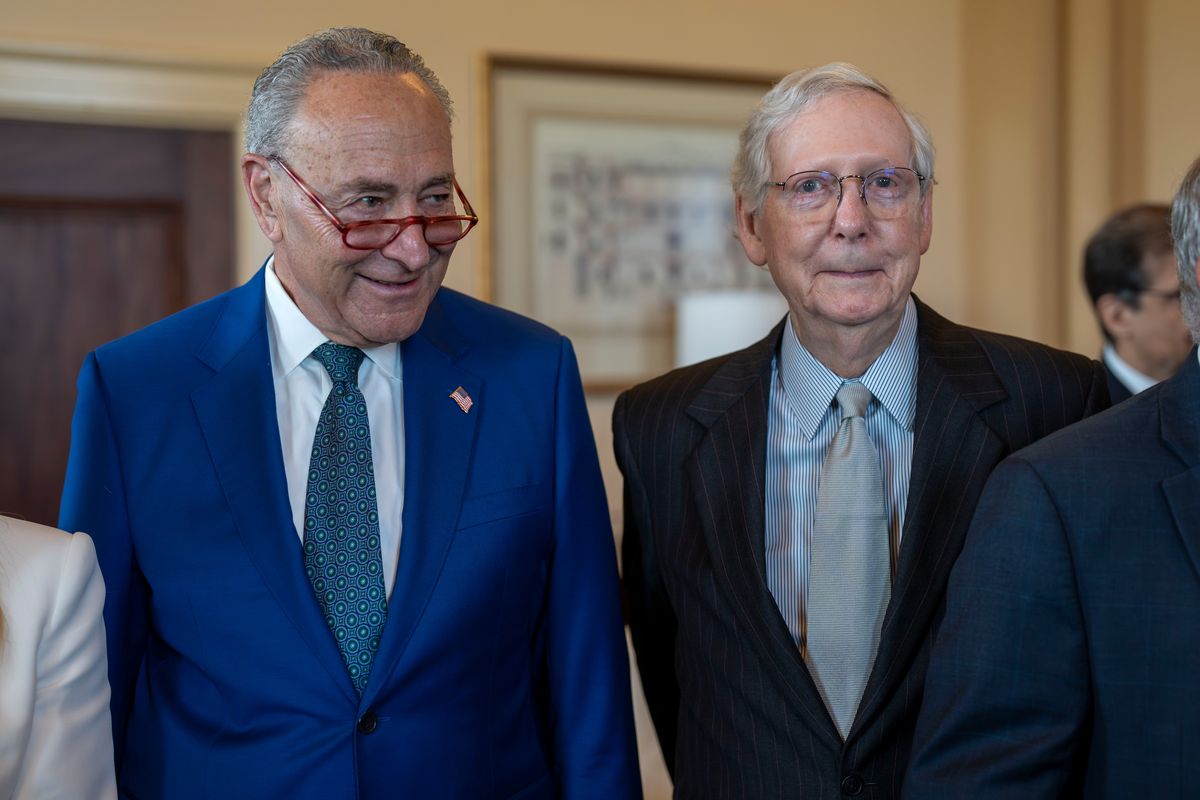 Senate Majority Leader Chuck Schumer (D-N.Y.), left, and Senate Minority Leader Mitch McConnell (R-Ky.). (J. Scott Applewhite/AP) | | | The Senate approved a largely bipartisan defense policy bill by a vote of 86-11 last night, teeing up what is expected to be a bitter negotiation with the House where hard-right Republicans muscled through a vastly different version of the $886 billion package, our colleague Abigail Hauslohner reports. In the weeks to come, the chambers must reconcile their sharpest differences — deciding, for example, whether the final bill will include a Republican-backed amendment that would roll back Pentagon policies on abortion access and gender-affirming care — or risk failing to pass a National Defense Authorization Act for the first time in more than six decades. | | The upper chamber gave final legislative approval yesterday to a bill that would enable the federal health department to overhaul the nation's organ transplant system, The Post's Lenny Bernstein reports The bipartisan legislation provides health officials with the authority to break monopoly control of the way kidneys, livers, lungs and other organs are delivered to sick patients. It now heads to the desk of President Biden, who is expected to sign it. | On the other side of the Capitol … | | The House narrowly passed its first fiscal 2024 appropriations bill along party lines yesterday, setting up a high-stakes clash with the Democratic-controlled Senate when Congress returns this fall. The legislation, which would fund veterans benefits and military construction projects, passed the chamber by a 219-211 vote. Democrats slammed the spending bill, saying it was chock-full of partisan policy riders targeting abortion, transgender care, and diversity, equity and inclusion. After the package passed, Majority Leader Steve Scalise (R-La.) announced that Friday votes would be canceled and that the chamber would start its August recess early, despite an unresolved feud within the GOP over abortion provisions attached to the food and agriculture spending bill, Juliegrace Brufke and Andrew Solender report for Axios. | | Rep. Rick Allen (R-Ga.): | 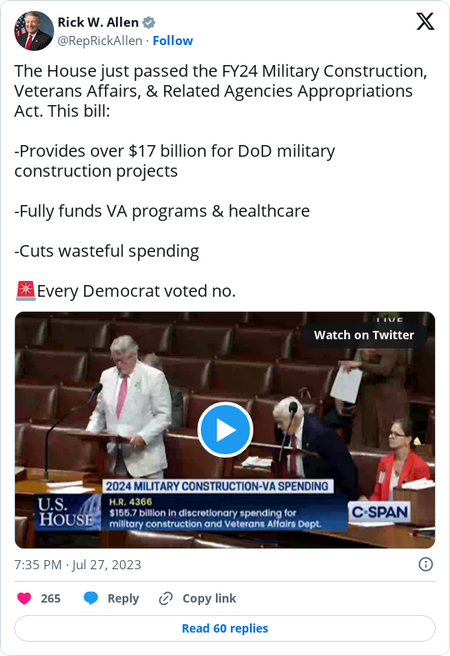 | | | | | Rep. Rosa DeLauro (Conn.), ranking Democrat of the House Appropriations Committee: |  | | | | | |  | White House prescriptions | | Biden administration announces precision cancer surgery initiative | 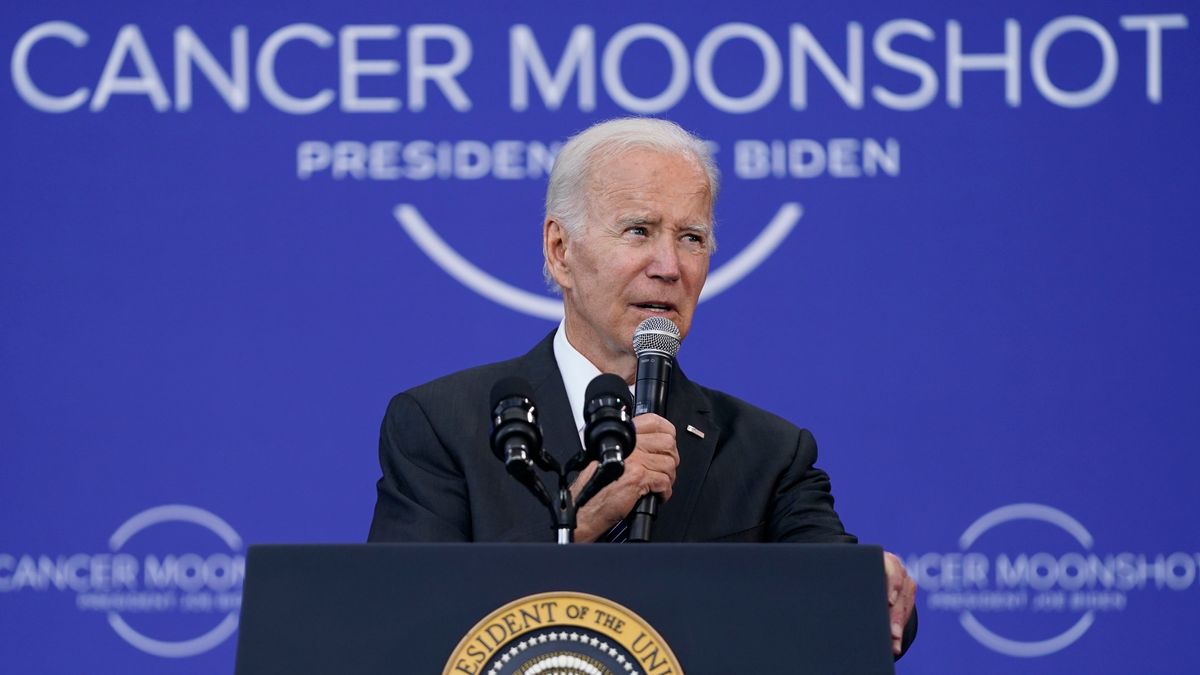 President Biden announced the new research agency's first cancer-focused initiative yesterday. (Evan Vucci/AP) | | | The Biden administration launched a new cancer-research initiative yesterday aimed at developing better surgical interventions to treat the disease. The administration's Advanced Research Projects Agency for Health (ARPA-H) will oversee the program, which will solicit proposals for new devices and technology that could help surgeons more easily distinguish between cancerous cells and healthy tissue, the White House said in a statement. | - The initiative seeks to improve patient outcomes by reducing repeat surgeries, difficult recoveries and cancer recurrence while also lowering health-care costs. Multiple awards are expected.
| | The bigger picture: ARPA-H, along with the administration's cancer moonshot initiative, is a key component of President Biden's "unity agenda," which was announced during his 2022 State of the Union address to bring the Congress together to combat cancer, improve veterans' care and make mental health treatment more accessible, Zeke Miller reports for the Associated Press. | | Health and Human Services Secretary Xavier Becerra: | 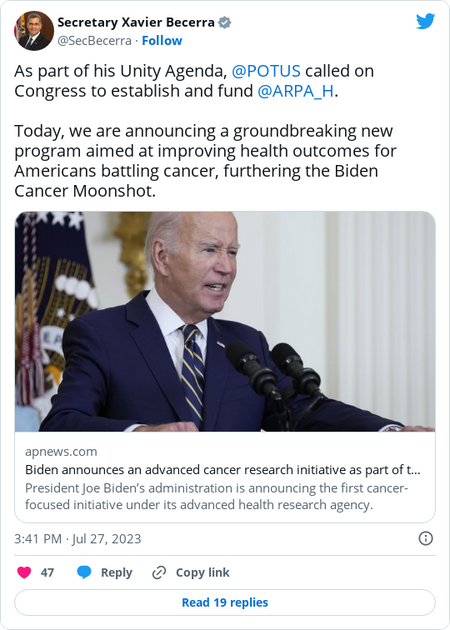 | | | | | |  | In other health news | | - Leaders of the Senate HELP Committee and the House Energy and Commerce Committee are seeking information from stakeholders on the Food and Drug Administration's regulation of hemp-derived cannabidiol products.
- Inpatient rehabilitation facilities and inpatient psychiatric facilities will see their Medicare payment rates increase by 3.4 percent and 2.3 percent respectively in fiscal 2024 under a pair of rules finalized yesterday by the Centers for Medicare and Medicaid Services.
- New data from federal health officials estimate that as many as 450,000 Americans could be living with a potentially life-threatening red meat allergy that has been linked to tick bites, but many doctors aren't aware of the condition or how to diagnose it, our colleague Lena H. Sun reports.
- A factory that fills the self-injection pens for the new weight-loss drug Wegovy has repeatedly breached U.S. sterile-safety rules and staff have failed to perform required quality checks, Maggie Fick reports for Reuters.
| | |  | Quote of the week | | | Wendy Parmet, director of Northeastern University's Center for Health Policy and Law, on state medical boards failing to hold doctors accountable for spreading covid misinformation. | "We allow the profession to police themselves. And when they fail to do that, even in the most egregious cases, what they are abetting is the erosion of trust and respect for doctors." | | | | | | | | |  | Health reads | | | By Fenit Nirappil, Paul Kane, Mariana Alfaro and Amy B Wang | The Washington Post ● Read more » | | | | | By Isabelle Taft | Mississippi Today and ProPublica ● Read more » | | | | | |  | Sugar rush | | | Thanks for reading! See y'all tomorrow. | |








No comments:
Post a Comment